
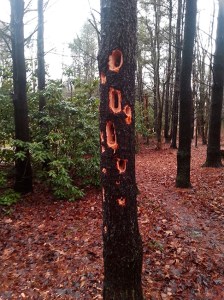
 I posted a picture on social media a few days ago of a tree that had been recently visited by one of the several large pileated woodpeckers that reside in the woods around my home and studio. Earlier that day I had been coming through the woods to the studio in the early morning, As I passed this tree I stopped because it looked like the tree was casting a shadow in the moonlight which wasn’t unusual except for the fact that there was no moon out. The light around the base of the tree turned out to be a large piles of woodchips created by the woodpecker.
A lot of people were surprised by the apparent damage done but for us it’s nothing new or unusual. We’ve lived in these woods for going on twenty years and the sound of the woodpecker’s distinct cackle and hard pecking rings through the forest regularly. We often see the very large birds at work and in flight with their strange up and down motion– each upstroke of their wings lifts them while each downstroke sees them seemingly pulled down by their sheer weight.
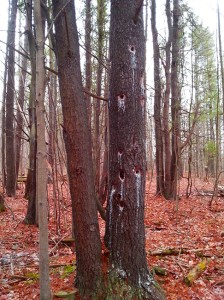 In the first few years we lived here they seemed very evasive and we seldom caught sight of them but as we settled in and they grew accustomed to us, the sightings increased. I think they see us now as part of the forest and we definitely see them as an integral part of the woods. And while they appear to inflict damage on some of the trees of the forest, we know that the trees they work on are already being damaged and destroyed from the inside by boring insects, most often carpenter ants.
One way or another, these softwoods are in natural peril. We view the woodpecker’s work as being simply collateral damage. Although there are times when we wish their work wasn’t quite so close to our home or my studio.
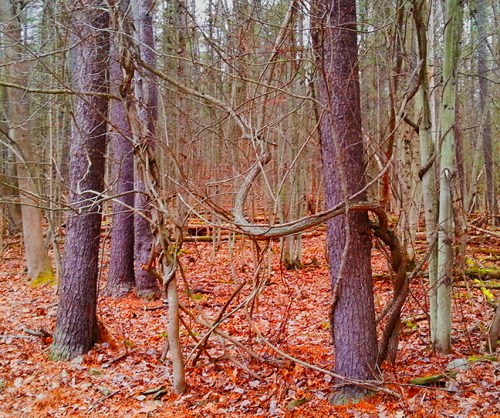
These twisted trees and vines just outside the studio are not the target of our woodpeckers, I just found them interesting and wanted to share them.
 Redtree Times
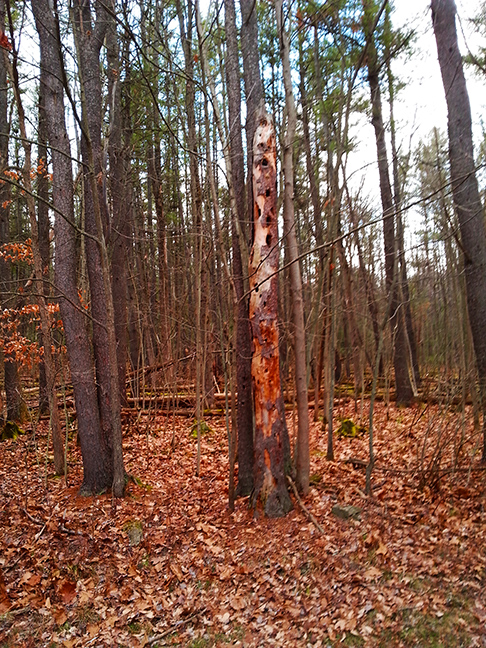
Love the vines. I just mentioned to someone a couple of days ago that the nature centers (and others) around here are allowing the trunks of some dead and dying trees to stand, just for the woodpeckers. Actually, a thirty-foot trunk that’s been worked by the birds can be a nice bit of natural sculpture.
We have quite a few of those natural “sculptures” around our woods.
On Wed, Jan 13, 2016 at 8:29 AM, Redtree Times wrote:
>
As always, a a fascinating post ! 🙂
Thank you, Jackie.
On Wed, Jan 13, 2016 at 9:14 AM, Redtree Times wrote:
>
I love your observations and recollections. Another wonderful talent, but I’m guessing most artists are incredible observers. I know that whenever I sketch, I see so much more..
Thanks, Vivian!
On Wed, Jan 13, 2016 at 6:30 PM, Redtree Times wrote:
>
i also have Pileated woodpeckers in the woods behind my home at Keuka Lake. I can remember the first time I saw one, some years ago. It flew across route 54, and I was staggered by the sight. They are big and dramatic looking. But what I love even more than their drumming on trees is their call, which sounds like a bird in the tropics rather than one in the woods of upstate New York!
By the way, the Pileated wood[pecker was once on the endangered species list and is no more. Much of their habitat was lost with the cutting of American forests, but with the return of our Eastern forests since the mid-1900’s, their population has been growing steadily..So if we have dead trees on our properties, we should leave them be (unless they are dangerous in some way) to provide food and shelter for these magnificent birds.