It’s interesting how an artist sometimes severely views a piece of their own work. Even more interesting when that same piece of work that fell under their critical eye becomes extremely popular. In the case of the great Norwegian composer Edvard Grieg, that piece became arguably his signature piece of music.
This came to my attention last night when there was a question on the current Jeopardy Greatest of All Time Tournament (big fan- been watching Jeopardy since the 1960’s when Art Fleming was the host on the daytime version) that made me laugh out loud. It had to do with Grieg’s work that he was composing as music for Henrik Ibsen‘s epic verse drama based on a Norwegian fairy tale, Peer Gynt. His work for the play was meant to be just incidental music but turned into 26 pieces for the long five act drama, much more than he had anticipated when initially agreeing to work with Ibsen. It was obviously a very trying collaboration and Grieg was not impressed with some of his work.
He wrote the following to a colleague about one of the pieces, part of which was also the question ( or answer, as the format requires) on last night’s Jeopardy:
“And I have done something for the hall of the troll king in Dovre which literally I can’t bear to hear, it reeks so of cow-turds, ultra Norwegianism, and to-one’s self-enoughness! But I am hoping that the irony will be able to make itself felt.”
The answer (or question) was : What is In the Hall of the Mountain King.
That he thought that this piece which is now so associated with his name reeked of cow turds just made me laugh. Maybe it was just the idea that he used that term. Okay, maybe that’s a little sophomoric but, hey, he said it first!
You most likely know the piece in question here. It is surprisingly short and has been performed and used in many ways over the years. It always makes an impression. I am sure it was used in a Warner Brothers or Disney cartoon at some point and I liked a version from the early 70’s from the Electric Light Orchestra.
Here’s a performance of the In the Hall of the Mountain King section from the ballet Peer Gynt from the Zurich Ballet in 2008. Great visuals to go with the music.
I was going back through some old things on this site and came across this piece of music that I shared here several years ago. Listening to it took my mind far way from the subject I had intended to write about this morning.
So far, in fact, that I can’t even recall that original thought stream. It must not have been too important.
So, forget what I was going to say and, if you’re so inclined, give a listen to that piece of music. It’s called Miss Sarah off the album Blues Twilightfrom jazz trumpeter Richard Boulger.
Maybe it will distract you from something you intended on doing, as well.
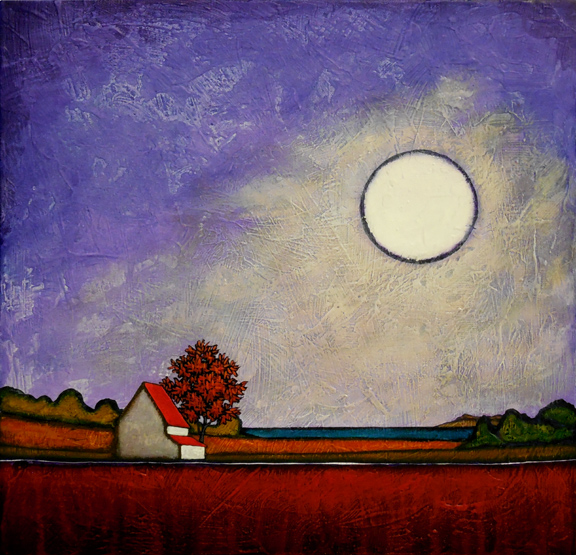
PS: The painting at the top is a fave of mine, Pause in the Moonlight, which is at the West End Gallery.
–Bob Thiele and George David Weiss, What a Wonderful World
**************************
On a morning when it would be so easy to focus on the many wrongs of this world, I think I want to just listen quietly to a song and ponder the small things that make living in this world worth all the trouble. The song is What a Wonderful World, originally performed, of course, by the legendary Louis Armstrong.
It was written in 1967 by Bob Thiele and George Weiss in response to the tensions, anger and division that the VietnamWar and race riots were spawning here. The songwriters chose Armstrong to perform the song because of what they believed was his ability to bring people of different races and backgrounds together.
The song as performed by Armstrong, as you most likely know, became a classic. But it wasn’t an instant hit. While it was the best selling song of 1968 in the UK, it went pretty much unnoticed here at the time. In fact, its original pressing as a single sold only around 1000 copies here. But it is the kind of song that doesn’t just fold up its tent and leave town. It had staying power and over the coming decades gained great popularity. Twenty years later, in 1988, it’s use in the Robin Williams film, Good Morning, Vietnam pushed it into our collective consciousness, here and around the globe.
A lot of other artists have recorded it but the Louis Armstrong version is the gold standard, the crème de la crème. It seems almost sacrilege to play any other version but I am playing a lovely version by Mark Knopfler and Chris Botti. Hope you’ll take a few moments to give a listen and focus on some small things that make your world a decent place.
For me, right now it’s looking out my window at the snow coating the tree branches backlit brilliantly by a cool sun. As I’m looking, a doe slowly crosses under the taller trees and disappears into the dark green of the pines below.
For the moment, it’s my own peaceable kingdom.
The whimsical artwork in this video and at the top of the page is from artist Zurab Martiashvili, an artist born in Tbilisi, Georgia in 1982 and now working in Ukraine. Wonderful work. Wonderful world.
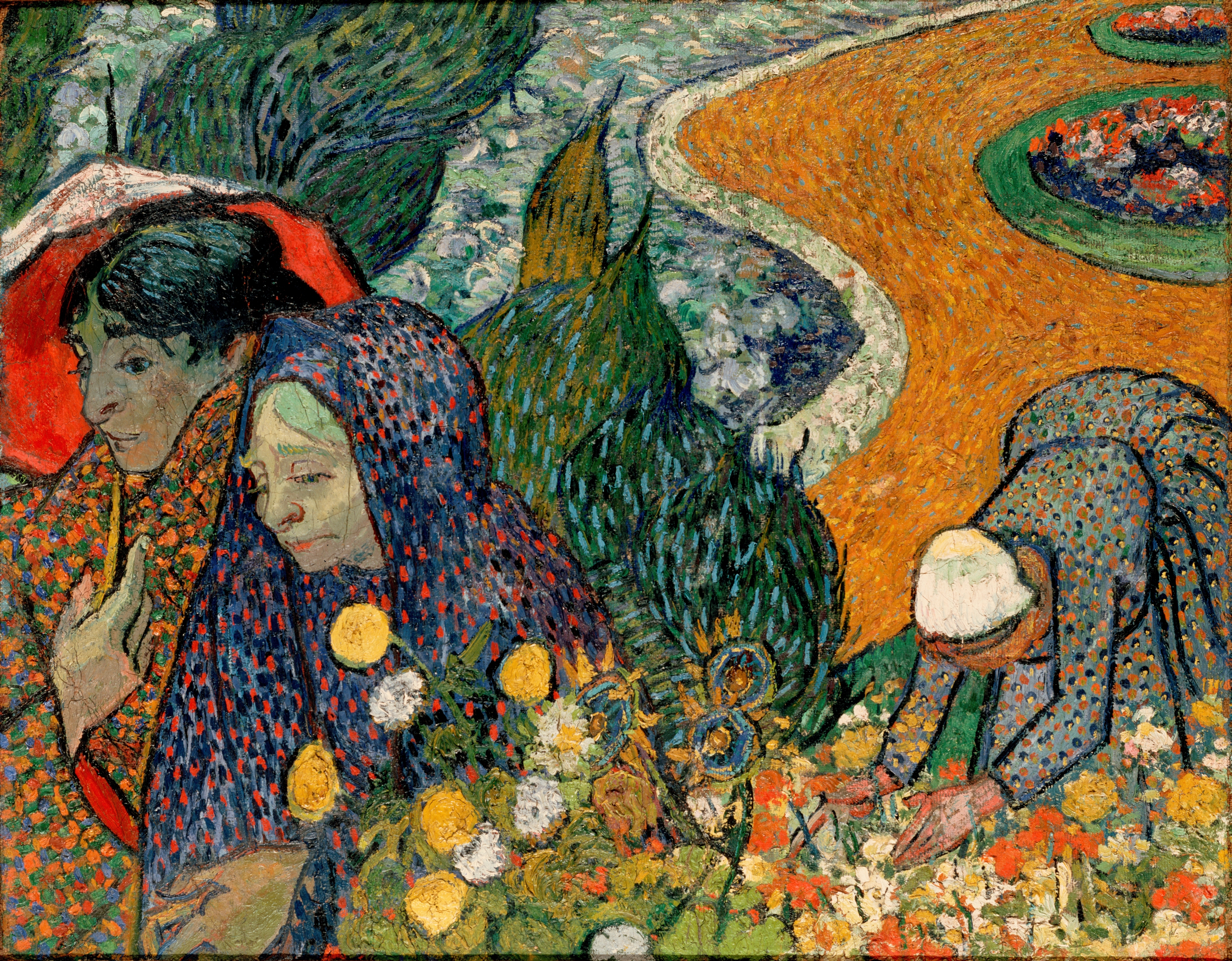
Vincent Van Gogh- Memory of the Garden at Etten 1888
*******************
My aim in life is to make pictures and drawings, as many and as well as I can; then, at the end of my life… looking back with love and tender regret, and thinking, ‘Oh, the pictures I might have made!’ But this does not exclude making what is possible…
–Vincent Van Gogh
*******************
Love this painting from Vincent Van Gogh with its wonderful color and the abstraction of the forms that comes from eliminating the horizon line. It was a piece that came to mind when I ran across this passage from Van Gogh. The words reminded me of something else, a thought that has been on my mind in recent times.
I was asked at my Gallery Talk at the Principle Gallery this past September if I ever had thoughts of retiring from my painting career. I think I made a bit of a joke about it, saying that I would no doubt die working away at a painting.
And that’s most likely true. I couldn’t imagine ever saying I am done as a painter.
It goes back to Van Gogh’s words above. I still see my artistic future brighter than my past, still envision important projects and better works to come. I still see my best work as being in the future, not dwelling in the distant past.
I can’t imagine that feeling ever changing. I can see myself on the day of my death, if I am capable of taking a moment to reflect on that day, will have that same regret that Van Gogh expressed: Oh, the pictures I might have made!
That being said, I must get to work. I am not retired yet and there are pictures to be made. The future is calling.
I thought I would rerun the blog entry below that first ran in January of 2015. It might be the only piece of advice I truly feel comfortable in giving to aspiring artists in any discipline. Plus, it can be applied to everyone in their lives even if they aren’t engaged in creative endeavors because, at its base, it’s not just about making things, as much as it might seem at first glance. It’s about an attitude of being proactive in altering the world around us in what we see as being a positive manner. It’s about seeing something that doesn’t fully satisfy you and taking action to change that.
Moreover, at its root, it is about determining the person we want to be and moving consciously towards that goal.
Take a look and decide for yourself:
I spent quite a bit of time this morning looking at the image of the painting above, Listening to the Muse. It’s part of my show at the Kada Gallery [That show opened in December of 2014] which is in it’s last weekend there. This painting really captivates me on a personal level and reminds me of a thought that once drove me forward as a younger painter. It’s a thought that I often pass along as a bit of advice to aspiring artists:
Paint the paintings you want to see.
Sounds too simple to be of any help, doesn’t it? But that simplicity is the beauty and strength of it.
For me, I wasn’t seeing the paintings out there that satisfied an inner desire I had to see certain deep colors that were being used in a manner that was both abstract and representative. If I had seen something that fulfilled these desires, I most likely would not have went ahead as a painter. I wouldn’t have felt the need to keep pushing.
It was this simple thought that marked the change in my evolution as a painter. Before it, I was still trying to paint the paintings that I was seeing in the outer world, attempting to emulate those pieces and styles that already existed as created by other artists. But it was unsatisfying, still echoing the work of others, forever judged in comparison to these others.
But after the realization that I should simply paint what I wanted to see, my work changed and I went from a bondage to that which existed to the freedom of what could be found in creating something new. For me, that meant finding certain colors such as the deep reds and oranges tinged with dark edges that mark this piece. It meant trying to simplify the forms of world I was portraying so that the colors and shapes collectively took on the same meditative quality that I was seeing in each of them.
In my case this seems to be the advice I needed. But I think it’s advice that works for nearly anything you might attempt.
Paint the paintings you want to see.
Write the book you want to read. [Toni Morrison said this very thing at one point]
Play the music you want to hear. Make the film you want to see. Cook the food you want to eat. Make the clothes you want to wear.
The world has moved to a position of extreme danger, far more perilous than its normal state which is often pretty damn dangerous. The inmates have taken over the asylum.
As you can see, I want to rant and rage this morning.
But I won’t. I will try to find something peaceful, something soothing.
Maybe something from Vivaldi? And since I am looking out the window of the studio and there is a light coating of snow on the ground and the sky is a cold and dull gray, how about the Winter section of his concerto, The Four Seasons?
This works for me.
Here’s a performance from renowned violinist Cynthia Miller Freivogel and the Baroque music group, Voices of Music.
Try to find some peace in this piece and have a great day.
I have posted This description of one of the process for one of my paintings, followed by a short video showing its evolution from start to finish, a couple of times over the past nines years. I thought it might be a good time to revisit it as there are many new readers who may not be familiar with how my work comes together. I paint in two distinctly different processes, one being a reductive process where I put paint on the surface then remove much of it and this process that is additive, with layer after layer of paint building up. Here’s what I wrote in January of 2011:
I worked on a new piece the last couple of days, a large canvas that is 24″ by 48″. I had already gessoed the canvas with a distinct texture and applied a layer of black paint. I had vague ideas of where I thought the painting might go from a composition standpoint but knew that this was only a starting point in my mind. Like most of my paintings, the finished product is often drastically different than what I imagined at the beginning. As I paint, each bit of paint dictates the next move and if I don’t try to force in something that goes against these subtle directions given to me by the paint the piece usually has an organic feel, a natural rhythm in the way the different elements go together. A cohesion of sorts.
Knowing I wanted to use a cityscape in this piece, I started in the bottom left, slowly building the city with geometric forms and rooflines in a red oxide paint that I use to block in my composition. I prefer using the red oxide because it gives a warmth under the layers paint to come that shows through in small bits that are almost undetectable at a quick glance.
At this point I still am unsure where the painting is going. I have thoughts of filling the canvas completely with the cityscape with the smallest view of the sky through the buildings but am not married to this idea. The paint isn’t telling me enough yet to know. But it has told me that I want a path of some sort- a street or canal- through the composition. I make room for one near the center before starting on the right side with the buildings there. I go back and forth between the right and left sides as I build the city, constantly stepping back to give it a good look from a distance to assess its progress and direction.
At a point where the city is nearing the halfway point on filling the canvas, I decide I want this piece to be less about the cityscape and more about how it opens to the open sky beyond it. I extend the road that started at the bottom and twist it upward, terminating it at a bend in what will be now a field beyond the city edge. The sky, though still empty, is pushing me ahead, out of the city. The piece has become about a sense of escape, taking the street from the cityscape and heading upward on it towards the open fields and sky. Painting faster now, another field with a bit of the road appearing is finished beyond the first lower field. I have created a cradle in the landscape for the sky to which I now turn my brush.
There’s a certain symmetry at work here and I decide I want the central focus of a sun in this composition. I roughly block in a round form, letting it break beyond the upper edge of the canvas. I pay little attention to the size of this sun except in its relationship to the composition below it. My suns and moons are often out of proportion to reality but it doesn’t matter to me so long as it translates properly in the context of the painting. If it works well, it isn’t even noticed.
I finish blocking in the sky with the red oxide, radiating the strokes away from the sun, and step back. [The video below basically begins at this point in the process] The piece has began to come alive for me and I can start to see where it is going. The color is starting to fill in in my mind and I can see a final version there. This is usually a very exciting time in the process for me, especially if a piece has a certain vitality. I sense it here and am propelled forward now, quickly attacking the sky with many, many brushstrokes of multiple colors. working from dark to light.
There are layers of a violet color in different shades that are almost completely obscured by subsequent layers. I could probably leave out these violet layers but the tiny shards that do barely show add a great depth to the flavor of the painting for me and to leave them out would weaken the piece in a way.
I have painted several hours on the sky now and still have a ways to go before it reaches where I see it in my mind. There are no shortcuts now. Just the process of getting to that final visualized point. But it’s dinnertime and my day is now done. I pick up and step back to give it one final look before I head out into the darkness. This is where the painting is at this point, where I will start soon after I post this:
In the blog post with the final version I then wrote:
Above is the tentatively finished version of the painting I started earlier this week, a 24″ by 48″ canvas that I am considering calling Escape Route. I showed the first few steps of the painting process on this blog two days ago, ending with the sky being near finished and the composition blocked in. I’m not going to go into all the steps and decisions that went into completing this piece. Instead, I put together a short film that shows the painting evolving to the finished product.
I will say that the final version is much different in many ways than I first envisioned with the first strokes of red oxide that went on the canvas. Each subsequent bit of color, each line that appeared, altered the vision in my head just a bit, evolving the piece constantly until the very end of the process. Even the last part, where I inserted the treeline that appears on the farthest ridge, was not seen in my mind until just before the decision to proceed with them was made. I decided to go with this treeline to create a final barrier for the road to break past on its way upward toward the sky. A final moment of escape.
This painting has given me a great sense of satisfaction after finishing it. I spent much of the late afternoon yesterday just looking at it and taking it in. I don’t know if it will translate as well on the computer screen but this piece has substantial size at 24″ by 48″ which gives great weight to the blocks of color from the buildings and the light from the sky. There is a sense of completeness here that I could only struggle to explain, but as I said, brings me great satisfaction. I feel as though the evolved painting has exceeded what I imagined when I first started this piece. While I can’t fully explain that, it is all I can hope for from my work.
I will spend some more time over the next several weeks looking at this painting, determining if anything should be tweaked or altered. A highlight added here, a line made crisper there. But as it stands, it feels as thought it has taken on its own life and I will probably leave it alone as it is.
And here’s the video, only about a minute long, that shows how the piece came about.
I found that if I planned a picture beforehand, it never surprised me, and surprises are my pleasure in painting.
–Yves Tanguy
*******************
Thought we’d start the new year with a quick look at the Surrealist painter, Yves Tanguy. I can’t say I know a lot about Tanguy, who was born in Paris in 1900, raised in Brittany and died in Connecticut in 1955. He first was attracted to painting in 1922 after seeing a Giorgio De Chirico painting in the window of a Paris art dealer as he was riding a passing bus. He jumped off the bus and went back to study the painting. That was the experience that set off his career.
But with the little info I could quickly glean, I found that we shared a few similarities. One was coming to painting with little training. I consider myself basically self taught and, while he had did some sketching before his brush with De Chirico’s work, Tanguy basically set out on his career as a painter with no formal training. His self taught style developed quickly and was recognizable and celebrated within several years.
He also practiced automatism in his work, which is just a more formal word for having no real plan as you start a painting. I actually didn’t know there was a word for this though I’ve been practicing it for decades now. Much like he said in the quote at the top, I also take great pleasure in the surprises that come from working this way. There’s a form of revelation in working this way that I can’t get when beginning a piece with a predetermined outcome.
Tanguy also described the effects of his automatism this way: The painting develops before my eyes, unfolding its surprises as it progresses. It is this which gives me the sense of complete liberty, and for this reason I am incapable of forming a plan or making a sketch beforehand.
I understand this completely.
He also said: I believe there is little to gain by exchanging opinions with other artists concerning either the ideology of art or technical methods.
I hate to admit it but I kind of agree with this. Don’t get me wrong, I very much enjoy talking with other artists, hearing about their experiences and their breakthroughs. But I don’t really like to talk about my own process or my ideology with other artists. Oddly enough, I am more likely to do this with a group such as at a gallery talk. There, I feel like I am simply describing what I do and not giving advice or direction, which I dislike giving to other artists.
I think art comes from having an idea of what one wants and needs to get from their art as well as their individual knowledge of their strengths and weaknesses as applied to technique and materials. I can’t tell someone what they need from their own art or how it should make them feel. Nor can I tell them how they will better understand what they know about the paints or tools they use. I can give little ideas but they must gain their own insights through their own experiences.
I’ve often said there is no right or wrong in art and this hesitancy to exchange opinions is just an extension of that. What might be right for me or Yves Tanguy might not be right for another artist.
Okay, I know there is a that can be debated here but I am tired of even talking about this right now. Let’s just look at few Yves Tanguy paintings, okay?
Yves Tanguy- The Sun In Its Jewel Case – 1937
Yves Tanguy- There, Motion Has Not Yet Ceased – 1945
All is quiet on New Year’s Day A world in white gets underway I want to be with you Be with you, night and day Nothing changes on New Year’s Day On New Year’s Day
—U2, New Year’s Day
****************
Found myself beginning the new year this morning walking to the studio through the woods in the dark before 6 AM.
Like the song says: Nothing changes on New Year’s Day.
I always think of this song on New Year’s morning because there is always a preternatural quiet on these mornings.
Today was no different.
It’s an absolute stillness free of all noise. Even the deer whose eyes glow green in the light of my headlamp as I scan the forest, make no sound. They are motionless and when they finally move there is no snort of alarm, no crunch of leaves, no breaking of branches.
Just a stealthy movement of shadows against an empty void of blackness. It makes me stop for a moment just to listen, trying to absorb as much of that quietude as I can with the hope that I can recall this glorious absence of sound when I need it at some point later.
It makes me think of the old Elvis song If Every Day Was Like Christmas with its lyrics that ask: why can’t every day be like Christmas? I think a more appropriate question would be why can’t every day be like New Year’s Day?
The pressure of the holidays is past. No concerns about gift giving. It’s a fresh start, with the old and worn last year fading into the grainy grayness of the past and the new year stepping in, all shiny bright and full of potential. Even the most pessimistic and jaded of us most likely feels at least small glimmers of hope on this day.
And why not? It’s a clean slate, a tabula rasa, on which anything can written. It is a time, a moment, that assures us that there are no limits on what we can do in the coming year and the coming decade.
Of course, the pragmatic part of me knows that it is just as the song says: Nothing changes on New Year’s Day.
But this morning, at least for a while, I will try to hang on to the belief that there is change coming in this shiny new year. For the better, I hope.
Here’s the song New Year’s Day from U2 from way back in 1983. Time flies so enjoy this quiet morning.




 Redtree Times