Feeds:
Posts
Comments

Archive for February, 2022

Genesis Eternal/ Klee

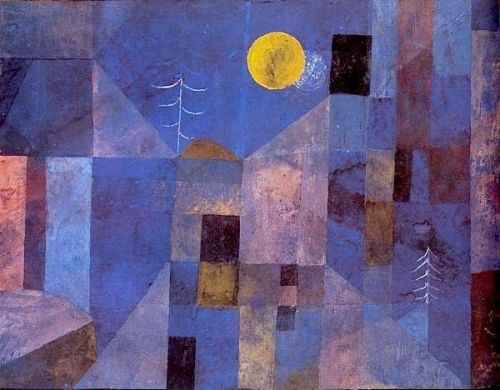
Ad Marginem C 1930 Painting by Paul Klee; Ad Marginem C 1930 Art Print for salePaul Klee On Modern Art 1924


The excerpt above is from On Modern Art, the 1924 treatise from the great Swiss artist Paul Klee, someone who I have featured here a number of times over the years. Yesterday, I wrote about how it often feels like everything has been done before. With Klee, I often wonder if he was one of the exceptions to that rule.

His work always felt like it was a jumping off point, an origin, rather than an extension of something that had come before. It was work that didn’t owe anything to the past and set the able for the future.

I know for me, he was a big influence if only in his attitude and the distinctness of his work.  I always think of his work in terms of the color– sometimes muted yet intense and always having a melodic harmony to it.

It always feels like music to me.

I like his idea that the world is in the process of creation, a constant and ongoing Genesis, and that it is not a final form. It allows for visionary work, for imagining other present worlds that extend beyond our perception because, as he writes, In its present shape it is not the only possible world.

And to me, that is an exciting proposition, one that gives my little created world viability.


This was a reworking of a post from back in 2015. It’s the post I needed this morning.


Paul Klee Fish-Magic 1925

klee_southern-gardens

Southern Gardens- Paul Klee
blossoms-in-the-night-paul-kleePaul Klee MoonshinePaul Klee

Read Full Post »

Vemödalen

150419106-compilation-of-alarm-clocks-with-different-time-settings-from-one-hour-to-twelve-concept


vemödalen

n. the frustration of photographing something amazing when thousands of identical photos already exist—the same sunset, the same waterfall, the same curve of a hip, the same closeup of an eye—which can turn a unique subject into something hollow and pulpy and cheap, like a mass-produced piece of furniture you happen to have assembled yourself

–The Dictionary of Obscure Sorrows


The artist forever wants to be original. Unique and different from the pack of other artists with that same impulse.

And this desire applies to their own work, wanting each piece to be absolutely distinct and unrepeatable, totally different from their other pieces of created art.

But despite all best efforts, for most artists there is a dreadful feeling that is often near at hand.

The fear that everything has already and always been done.

It’s can be a crippling feeling for an artist.

Why go on when everything has been done, when there is nothing new under the sun?

Standing in front of the easel holding a blank canvas, that question and many more often arise.

Will this piece be something new, something never seen before? Or will it be a reworking of a theme and a pattern that has been repeated numerous times through the decades and centuries before this moment? Or a repetition of a similar work or pattern of my own?

Why go on?

That’s a good question. And an existential one for an artist.

The answer, at least in the way that I see it, is that it doesn’t matter whether it has been done once, twice or a thousand times before, either by myself or artists of distant past generations.

The simple act of creating is what counts. This moment with this thought, with this effort and concentration, with this interpretation of how it feels to be in this moment, is what counts.

Attempting to reach out from this moment and connect with another mind and soul in whatever manner and form is possible within our limited abilities– that is all that counts.

Everything has been done. But it doesn’t matter because it wasn’t done in this place nor point in time.

The opportunity comes in this distinct moment.

Knowing that takes away the fear, allows the artist to continue. And to do so with the hope that today is unlike any day before, that something new and never seen before will come to life.

And if that doesn’t happen, that’s okay because the artist fought through the fear and made the attempt.

There is always a new opportunity to contribute to the continuum of creation tomorrow.


Read Full Post »

Harris’ Distillate, Again

Lawren Harris Ice House Coldwell Lake Superior

Lawren Harris- Ice House, Coldwell, Lake Superior 1923


Art is the distillate of life, the winnowed result of the experience of a people, the record of the joyous adventure of the creative spirit in us toward a higher world; a world in which all ideas, thoughts, and forms are pure and beautiful and completely clear, the world Plato held to be perfect and eternal. All works that have in them an element of joy are records of this adventure.

Lawren Harris


I love this quote from the great Canadian painter Lawren Harris. I know that whenever I am working and am excited with the joy of what is unfolding before me, I feel closer and more connected to some sort of power that is beyond my knowledge.

It’s as though I feel tapped in to that winnowed result of the experience of a people as Harris puts it.

Connected to a universal oneness.

That is a great feeling, exhilarating and calming at the same time. It is ultimately the feeling that brings one to art, both as a viewer and a creator.

Unfortunately, in the course of creating, it is sometimes a feeling that is forgotten, put aside for ends other than this element of joy.

It’s easy to do, believe me.

But rediscovering that joy is like coming across it for the first time. Because even though you know you have experienced it before, it feels all new and shiny, full of promise.

Effervescent– that is the word that comes to mind when I think of these moments of joy.

So, let me stop right here. I am close to my own joy and don’t want to delay it for another minute.

Effervescence and joy will not wait around too long, you know, and I don’t want to miss it.


Trying to find some of that effervescence this morning so I am replaying this post from several years back.

Read Full Post »

Questions & Answers

GC Myers- In The Revealing small

In the Revealing


“Why do you pray?” he asked me, after a moment.

Why did I pray? A strange question. Why did I live? Why did I breathe?

“I don’t know why,” I said, even more disturbed and ill at ease. “I don’t know why.”

After that day I saw him often. He explained to me with great insistence that every question possessed a power that did not lie in the answer. “Man raises himself toward God by the questions he asks Him,” he was fond of repeating. “That is the true dialogue. Man questions God and God answers. But we don’t understand His answers. We can’t understand them. Because they come from the depths of the soul, and they stay there until death. You will find the true answers, Eliezer, only within yourself!”

“And why do you pray, Moshe?” I asked him. “I pray to the God within me that He will give me the strength to ask Him the right questions.”

― Elie Wiesel, Night


The passage above from Night, the memoir of the Holocaust from the late Nobel Laureate Elie Wiesel, has stuck in my mind for a long time. Decades. It has informed my life and outlook as well as my work.

Life comes down to being a matter of not what we know but rather a matter of what we want to know.

A matter of the quality of our questions and how willing we are to accept the answers.

I think, as Moshe says above, that the true answers are only found within ourselves. And while we can’t always understand the answers to our questions, we sometimes refuse to accept those answers we do comprehend because they reveal us to be less than we hope.

They are not the answers we wished to receive.

But these may be the most important answers we ever receive because to know fully yourself you have to be able to recognize every aspect of your being, good and bad.

After all, each day contains about the same amount of darkness as it does light. You can’t know a day without knowing that there is both.

Hmm…


The painting shown here is from about a dozen years back, a 30″ by 40″ canvas that is titled In the Revealing. It’s a favorite of mine, reminding me of this passage from Wiesel. Reminding me to ask questions and accept answers when they are revealed. It hangs in the studio where I can see it from my desk and has never hung in a gallery. Nor will it ever.

It is in its home, where it belongs.

Read Full Post »

We Belong Together

GC Myers- Luna Eterna sm

Luna Eterna– Now at the West End Gallery


There must be some other possibility than death or lifelong penance … some meeting, some intersection of lines; and some cowardly, hopeful geometer in my brain tells me it is the angle at which two lines prop each other up, the leaning-together from the vertical which produces the false arch. For lack of a keystone, the false arch may be as much as one can expect in this life. Only the very lucky discover the keystone.

― Wallace Stegner, Angle of Repose


The lines above from the 1972 Pulitzer Prize winning novel, Angle of Repose, from the late Wallace Stegner really jumped out at me this morning. To be honest, I haven’t read the book so can’t speak to its context but its concept of two vertical lines tipping together so that they meet and prop each other up to create a self supporting false arch just seemed like the perfect imagery for today, Valentine’s Day.

Every lasting relationship depends on this arch. I hesitate to use the word “false” though I understand it is in reference to the distinction between “true” arches that have angled stones and a keystone at its apex that binds it all together and “false” arches that have the appearance and serve the same purpose but are constructed in a less sophisticated manner, sometimes haphazardly or by sheer accident.

Two trees falling against one another in the forest, for example.

Or maybe even two trees that grow together and eventually seem almost as one. a la the trees in my Baucis and Philemon based paintings.

I’ve been part of such a false arch for a very long time and as a result Valentine’s Day takes on a different look for me. Though it maintains a romantic aspect, it is more about a deeper recognition and appreciation of all the many aspects that make up that other vertical line that somehow fell my way all so many years ago to create our false arch.

And, as the Stegner lines above point out, this false arch might be as much as one can expect in this life. I certainly can’t ask for anything more.

Here’s one of my favorite Rickie Lee Jones songs, one that seems fit for this post. Here’s We Belong Together, from her classic 1981 album, Pirates.


Read Full Post »

The Fever


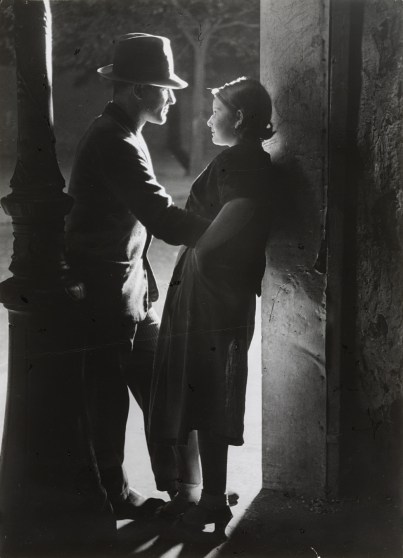
Brassai Lovers Under a Street Lamp

Brassai– Lovers Under a Street Lamp


To feel the love of people whom we love is a fire that feeds our life.

– Pablo Neruda


Since Valentine’s Day falls tomorrow, I thought I would just focus on love today with one of Brassai’s photos of Parisian lovers in the the 1930’s, a line on the fire of love from the poet Pablo Neruda, and a song that kind of sums it all up, The Fever.

The song was written by Bruce Springsteen in 1973 and somehow never made it onto his early albums. It ended up being passed on to Southside Johnny and his band, the Asbury Jukes, by Steve Van Zandt who was managing them at the time.

Southside Johnny was a Jersey Shore blue-eyed soul belter and the song was perfect for his delivery. It became one the main tracks from the Jukes’ first album in 1976, I Don’t Want to Go Home. That album spent a lot of time on my turntable back then and this song is one that is feels like it is meant to be heard in the dark with only the faint glow of the stereo receiver setting the tone.

I would bet anything that Neruda and those Parisian lovers under that street lamp felt The Fever.


Read Full Post »

An Orderly Life

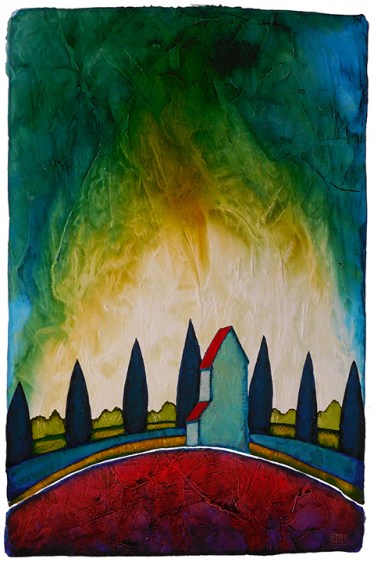
GC Myers- An Orderly Life sm

An Orderly Life– At the West End Gallery


The man who believes that the secrets of the world are forever hidden lives in mystery and fear. Superstition will drag him down. The rain will erode the deeds of his life. But that man who sets himself the task of singling out the thread of order from the tapestry will by the decision alone have taken charge of the world and it is only by such taking charge that he will effect a way to dictate the terms of his own fate.

Cormac McCarthy, Blood Meridian, or the Evening Redness in the West


I hesitated a bit about the use of the excerpt above from a book by author Cormac McCarthy, Blood Meridian, that I read probably thirty years ago.

It’s considered by some as McCarthy’s magnus opus and one of the greatest of American novels. My memory of it is of its powerful imagery of the relentless chaotic violence that marked the tale, which is set in  the Texas-Mexico borderlands in the late 1840’s. It’s a powerful told story that has the feel of the most lurid Hieronymus Bosch painting one could imagine.

It’s a book I would like to revisit but I keep putting off, especially in the context of America at this moment in time. It might be too disheartening to see parallels from that book in a contemporary reality.

Even so, the excerpt above describes what I see as the basis for much of my work, which is the need to seek some sort of order in the chaos, mystery, and seemingly senselessness which this world presents to us on a daily basis.

It might be a fool’s errand. I’ve said that many times before. But to not seek some sense of order in the swirl of chaos, some light in the dark, is unimaginable. Unacceptable.

To seek order means that we have not ceded control over our lives and fates to superstition and fear. That we have chosen to think and reflect on those mysteries of life.

And maybe if we can somehow pull one single thread of order from that vast tapestry of mystery and chaos, we will count ourselves among the fortunate ones who live outside the realm of chaos and fear.

Just one thread…

Read Full Post »

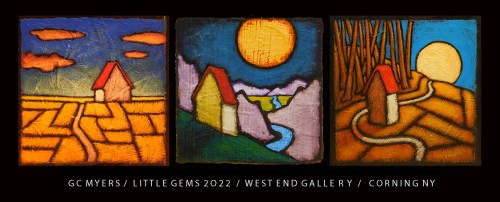
Little Gems 2022

sHEET


This year’s edition of Little Gems opens today at the West End Gallery in Corning, NY.

It’s an annual exhibit of small works that is near and dear to my heart as the 1995 show marked the first time I showed my work publicly. I have detailed that show here several times over the years, describing how I was torn between exhilaration and terror.

At the time, it was all new and unexpected. When I had started painting after injuries from a serious fall from a ladder left me with some time to fill, the idea that it could turn into something more than a way to burn off nervous energy wasn’t on my radar. But something clicked and it became an obsession, one that filled my evenings once my injuries healed.

A chance remark in a conversation with artist Tom Gardner, who co-owned the West End Gallery with his then wife Linda, led to an improbable critique of my work. Even then, I had no expectations and was anticipating that he would tell me politely that I had little talent.

But that didn’t happen. Linda came over as Tom was going through my ragtag milk crate portfolio of bits of paper and after a few minutes asked if I could have some of the pieces ready for their next show in couple of weeks.

That was that.

Though I had never framed or matted a painting in my life, I somehow got together 10 or 12 pieces for the show and suddenly began to believe in earnest that something could come from this thing that had been my preoccupation for the past year.

I didn’t know what that thing might be but it was exciting just to ponder the possibility.

The show itself is a blur now. I remember standing off to the side. I wasn’t close enough to let people know that they were my paintings but close enough that I could watch people and perhaps catch anything they might have to say about it.

That sounds creepy but, hey, I felt a bit desperate at that point. I viewed this as perhaps a narrow window of opportunity, one that might close as quickly as it had opened. So anything I could glean from the viewers’ reactions that might encourage or help me in keeping that window open was an imperative.

I didn’t sell anything from that show but I wasn’t discouraged. It served its purpose. It revealed a new path that could finally see with some clarity and strengthened my resolve to make my work speak with more force  so that I could move forward on that path.

And best of all, I knew that I could do it on my terms and in my voice, from my own mind and hands.

Something I could call my own.

You can see why I view this show with great regard.

This year’s version is a truly beautiful show and the gallery has went through a renovation with new flooring and improved lighting that illuminates the work at its absolute best. I hope you can make it out to the West End Gallery for this one.

Read Full Post »

The Audacity

GC Myers-The Audacity

The Audacity– At Little Gems show , West End Gallery


Men much more Loyal, tho’ not half so loud;
But these poor Devils were cast behind the Croud.
For bold Knaves thrive without one grain of Sense,
But good Men starve for want of Impudence.

–John Dryden, Epilogue to Constantine the Great by Nathaniel Lee


Another small painting that is part of this year’s edition of the Little Gems show which opens tomorrow, Friday, February 11, at the West End Gallery. This small piece, filled with warm tones, is titled The Audacity.

Audacity or boldness is something tat many of us run away from. It can be a scary thing, after all. Being bold means that you have put yourself out there for all to see which means there is the possibility for failure or ridicule.

And nobody wants that.

It’s sometimes easier to simply keep our heads down and blend in, never raising a fuss nor airing our desires. We just go with the flow.

As a result, those who are bolder among us, those who dare to yell the loudest and make the biggest spectacle– regardless of merit, honesty, righteousness, or popularity– often get the greater part of the attention and its accompanying rewards.

As they say, the squeaky wheel gets the grease.

This is in plentiful evidence since we live in a time where fools flourish in their boldness. Even encouraged to do so.

As Dryden wrote:

For bold Knaves thrive without one grain of Sense,
But good Men starve for want of Impudence.

Sometimes we can’t politely and timidly stand by for fear of failing or being ridiculed. You have to let the world know what you want and expect from it. This holds true for many aspects of our lives, both private and public..

You have to step up and let your voice be heard.

And hope that you are not of those knaves without one grain of sense.

But consider this: If you have any  concern at all about being that fool, you probably are not. So be audacious. It might do you a world of good.

Don’t take my word for it. As Robert Frost wrote:

Freedom lies in being bold.

Read Full Post »


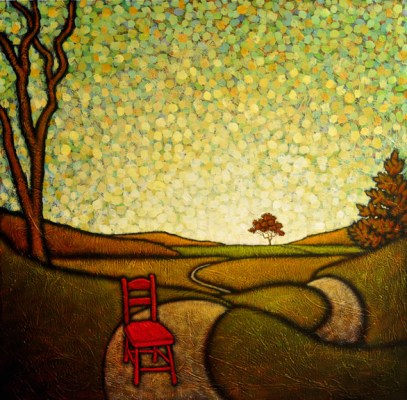
GC Myers- Come Into the Clearing

Come Into the Clearing-  At the Little Gems exhibit, West End Gallery


It is a pity indeed to travel and not get this essential sense of landscape values. You do not need a sixth sense for it. It is there if you just close your eyes and breathe softly through your nose; you will hear the whispered message, for all landscapes ask the same question in the same whisper. I am watching you – are you watching yourself in me?

— Lawrence Durrell, Spirit Of Place: Letters And Essays On Travel


Author Lawrence Durrell was writing about travel in the excerpt above that describes the traveler looking for some part of themselves in each new landscape they come across.

I think the same can be said for art.

We look for something in each work of art that engages with a part of ourselves, something that either reinforces our self-identity or illuminates parts of it that we had not yet recognized.

That painting on the gallery wall might well be whispering that question as you stand before it: I am watching you – are you watching yourself in me?


Read Full Post »

« Newer Posts - Older Posts »