Feeds:
Posts
Comments

Archive for July, 2022

Time & Patience


GC Myers- Time & Patience

Time & Patience— Coming to the West End Gallery

The strongest of all warriors are these two — Time and Patience.

― Leo Tolstoy, War and Peace


Have patience with everything that remains unsolved in your heart. Try to love the questions themselves, like locked rooms and like books written in a foreign language. Do not now look for the answers. They cannot now be given to you because you could not live them. It is a question of experiencing everything. At present you need to live the question. Perhaps you will gradually, without even noticing it, find yourself experiencing the answer, some distant day.

― Rainer Maria Rilke, Letters to a Young Poet


I struggled with the title for this new painting, a 10″ x 20″ piece on aluminum panel, that is part of my upcoming solo show at the West End Gallery that opens on Friday, July 22. Though it is a simple sparse composition, there is a lot to be gleaned from it.

I am drawn to its soothing calmness and sense of stillness. At first, I thought it had the feel of waiting but it doesn’t. Those crows in that tree aren’t waiting for anything, aren’t anxious for answers or solutions. They are just patiently being crows, knowing that the sun will rise, the clouds will pass, and the world will turn as it always has before. They will fly when the need to move, seek food when they are hungry and drink when thirsty.

They are the epitome of time and patience.

There’s a lot to be said for setting aside anticipation and expectation, to just let the world turn. It will often eventually turn to you. And when it doesn’t, don’t fret. Be patient and take in the colors of the sky, the bend of the path, and the rise of the distant hills. Let the sun warm you and feel the dirt beneath your feet.

The world is still turning…


Read Full Post »

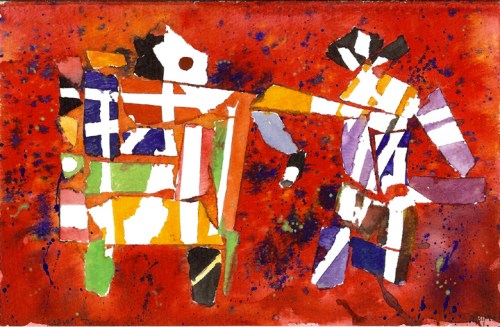
GC Myers Kabuki TV 1994


To exist is to change, to change is to mature, to mature is to go on creating oneself endlessly.

― Henri Bergson, Creative Evolution, 1907


Whenever I come across this little experiment from back in 1994, I linger over it for a few minutes and smile a little. There’s a lot going on with plenty of bright colors and sharp angles but with a narrative element within it where I saw a person watching a Kabuki performance on their television. But more than that I am reminded of the decision to move away from this experiment and continue in the direction that eventually led me here.

You see, I enjoyed doing this work, enjoyed the process and the final product. I could have easily followed this path and been fairly happy. But it lacked something that, while I couldn’t really put a finger on it at the time, was found later in the work that I eventually produced in later years.

Heart? Soul? I can’t say. But it was fun at the time and makes me smile now. Plus, the lesson in learning what you can and can’t be is beyond value.

I wrote a bit more on this subject, also set off from this little painting, back in 2010:

Just looking through some old things, mostly little pieces that are from the time when I first started painting, and I came across this. At the time I was playing around with color and masking, where you put something such as tape on the painting surface and paint over it then peel it away to reveal the unpainted surface underneath. It can be a big part of traditional watercolor painting and I wanted to see if it fit with the way I thought and wanted to paint. It didn’t. But I did come up with this little abstraction that always catches my eye and makes my mind’s gears turn.

It’s always interesting to see these little pieces because it inevitably triggers memories of that time when every day was bringing new discoveries as I tried to learn more and more about color and different mediums. Sometimes things clicked and it was revelatory to discover my strengths. Other times, it was a struggle, and the end product was muddled, labored. But there was still something to be learned there. Like identifying my weaknesses and learning how to strengthen these areas or, at least, downplay them.

I guess that this is the process for development in any area of your life, playing up your strong suits and trying to cover your weaknesses. Perhaps that is why I like to see these old experiments, to be reminded of my growth, artistically and personally, through the years. 

At least, what I perceive as growth.


This a replay of a replay of a post from 2010. When I came across this post with the 1994 Kabuki TV experimental piece earlier, it made me smile, as it always does. Figured that it would be an acceptable match for today’s Sunday Morning Music which is The Way It Goes from a longtime favorite of mine, Gillian Welch, along with her husband, David Rawlings. I put in two versions of the song– the 2011 album track and an audience filmed live version from 2018.


Read Full Post »

Chaos & Light

Chaos & Light— Show Opens July 22 at the West End Gallery


It partook … of eternity … there is a coherence in things, a stability; something, she meant, is immune from change, and shines out (she glanced at the window with its ripple of reflected lights) in the face of the flowing, the fleeting, the spectral, like a ruby; so that again tonight she had the feeling she had had once today, already, of peace, of rest. Of such moments, she thought, the thing is made that endures.

― Virginia Woolf, To the Lighthouse


My yearly exhibit at the West End Gallery opens two weeks from today, Friday, July 22. I am calling this year’s show Chaos & Light. The painting above, a 16″ by 40″ piece on canvas, carries that same title.

Chaos has been a theme in my work in recent times, showing itself in the random slashing brushstrokes that make up the skies in many of my works. It is above and around us all the time and we try to find some sense of order, some means of tolerating it, in our lives beneath it.

This theme of chaos is most likely a result of my perception of the times in which we live. I say perception because maybe chaos as a state of being is based more on one’s tolerance and resistance to it. Maybe chaos is the natural state, and we have internal mechanisms that keep it at bay, that keep it barricaded away, unseen, from that part of us that allows us to live and even thrive in some orderly fashion in this world.

The broken irregular rhythms of chaos go unheard and unseen and we live our lives, simply and naturally.

Perhaps sometimes chaos, like a virus, gets past those internal barricades. Chaos becomes apparent, visible and heard. Its rhythms disrupt, infect, our own. Life then becomes more and more filled with chaos. Finding order and simplicity becomes more and more difficult.

Maybe that is the purpose of art, to serve both as a vaccine and a curative to hold chaos outside our selves.

I don’t know.

I know that it makes some small degree of sense to me. I sometimes feel like chaos has infected me, that it runs rampant through my system and my own rhythms have been replaced by those that seem unnatural to me.

But then a dose of art, simple paint on a surface or the sound of a simple tune or the arrangement of words in a book or even the image of light breaking over the horizon in the morning, restores me for at least a short time.

I am sure this sounds crazy to some. That’s okay. They most likely have kept chaos away their whole lives and can’t even begin to understand the plight of those infected by chaos.

This holding off of chaos is what I see in this painting. In many of my paintings, actually. I can’t say that it works as art, that’s not for me to say. But as a soothing balm, it serves the purpose.

Read Full Post »

Cratered

GC Myers- In the High Country

In the High Country– At the Principle Gallery Exhibit


I don’t believe anyone ever suspects how completely unsure I am of my work and myself and what tortures of self-doubting the doubt of others has always given me.

-Tennessee Williams


My yearly solo show at the Principle Gallery has ended and I am in the final weeks of painting and prepping for my annual show at the West End Gallery that opens July 22.

This quick turnaround between these two shows is a routine that I have lived with for over twenty years. I know the routine and, for the most part, how to deal with the ins and outs and the ups and downs in what I guess you could call phases in the process.

These phases in this timeline for these two shows are pretty much the same for every other show. I think I can say that with some authority as I’ve done my share of solo exhibits. Probably more than 60 solo shows by now but I’ve lost count.

Right now, as I near the end of prep for the upcoming show, I am in my least favorite phase, one of extreme self-doubt. I’ve detailed it here many times in the past, probably because it hits me the hardest and is therefore closest to the surface when I sit down to write this blog.

Every show has had this period that finds me calling into question every piece I’ve done, every creative decision I’ve made, every strand of my ability and my overall judgement. Maybe I am delusional about how I see my work?

The funny thing is that the depth of the crater created when this doubt hits is usually directly and inversely related to how satisfied and confident I have felt about the work in the prior phases of this timeline.

The better I feel about the work, the deeper the crater of doubt.

I am in a pretty deep crater at the moment. Maybe I should feel okay about that since it means the work has already sparked great satisfaction in me.

And it has. I feel strongly about the work in this show, much as I did about the earlier Principle Gallery show.

But I don’t feel okay at the moment. The doubt is like a banshee with a hammer that comes to beat on the back of my brain. I know that it will pass soon, maybe as early as today when I am at work on the current piece on my easel, and I will return to my normal, more manageable, levels of doubt and uncertainty.

But at 5 AM I find myself with a miserable knot of doubt in my gut.

I don’t know why I am sharing this aspect of what I do with you. It doesn’t necessarily have a lot to do with what you might see in the work, so I wouldn’t be surprised if most folks don’t give a hoot about this. I guess I just want to give a little glimpse inside this job, this life as an artist.

Like most jobs in which you express or give of yourself, it has its highs and lows. The lows of this moment are simply the price to be paid.

At least, in my version of this life.

Okay, got to go climb out of this crater and the only way to do that, for me, is to get to work.

Here’s a song that kind of works for me this morning. It’s All That You Dream from Little Feat and their classic live album Waiting For Columbus.


Read Full Post »

Gun Flag


If we could learn to look instead of gawking,
We’d see the horror in the heart of farce,
If only we could act instead of talking,
We wouldn’t always end up on our arse.
This was the thing that nearly had us mastered;
Don’t yet rejoice in his defeat, you men!
Although the world stood up and stopped the bastard,
The bitch that bore him is in heat again.

Bertolt Brecht, The Resistible Rise of Arturo Ui


The Great American Fourth of July.

Barbecues. Fireworks. Parades. Flags waving.

Mass shootings. Bodies in the streets.

I am not just speaking of the horrific scene at the Highland Park, Illinois parade. Over the long holiday weekend, the four days from Friday until yesterday, there were 16 mass shootings that resulted in 17 deaths and 97 wounded citizens. That doesn’t even count the two police officers shot last night at the Philadelphia fireworks display.

[ Late addition: Gun violence spiked over Fourth of July weekend, with shootings reported in nearly every U.S. state that killed a total of at least 220 people and wounded close to 570 others, according to the Gun Violence Archive.  Mass shootings get our attention but the underlying carnage that we just accept as somehow being normal is even more staggering]

Can it get any more American than this?

I can’t say I am shocked. I think anyone who says they are shocked and surprised is being a bit disingenuous. I am no psychic nor prognosticator, but to anyone who has been paying attention during the past few decades this seemed to be totally predictable and practically unavoidable.

It is what we have chosen to be. It is the result of choices we have made and of the power we have ceded to people who only seek to serve themselves and their monied constituency– not we the people. We have too often placed our trust in those not worthy of our trust

It’s the result of our inability to think for ourselves and our easy acceptance of any information, however farfetched or wrong it might be, that confirms our own beliefs and biases. This leaves us susceptible to falling into cult-like behavior.

The cult of guns. The cult of trump. The cult of personality and fame. The cult of money and power. The cult of conspiracy. The cult of religion. The cult of race supremacy. The cult of ignorance that despises and distrusts science and education.

The cult of victimization. This might the most potent of all in that it enables all the others. All the followers of those other cults– and those are just the ones that came immediately to mind– share a sense of victimization. They feel they have been wronged in some way and that others are responsible for everything that has gone wrong in their lives.

Answers? I got nothing this morning, folks. This has been building and building over the decades and there are no easy answers. No quick fixes.

It will take a wide societal change that requires real effort and sacrifice from each of us. And I don’t think we, as selfish people who always seek the easy way out, are up to that.

Will we ever be up to the task?

I just don’t know. But the odds seem set against it.

We possess so much potential for good in this country, yet we seem set on squandering it at every turn. We could be a beacon of hope for the rest of the world but instead we opt for serving as both a horrorshow and a laughingstock.

It leaves me just bone tired of it all, both its senselessness and its inevitability. You and I both know that some other event like this will happen again in the coming days, maybe three or four times. And we’ll go through the same bullshit with the hope that someone will suddenly unveil the easy answer that has evaded us for so long.

Brace yourselves: That ain’t happening, folks.

Wish I had something more hopeful to say this morning. But things need to be said if only to say that I did so. That job, that futile task, is done and I will venture back to the refuge of art tomorrow, I promise.

Read Full Post »

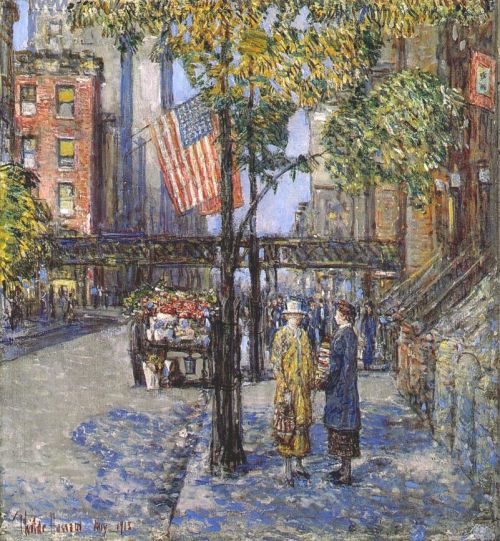
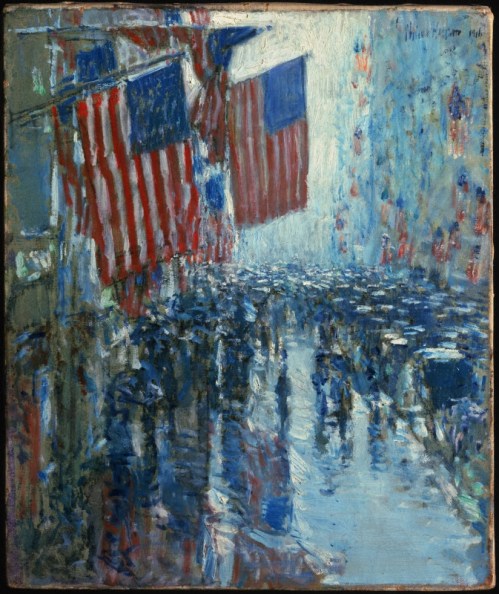
Hassam’s Flags

This is a compilation of a previous post with a few more images and a video showing the breadth of the work from artist Childe Hassam.


Childe Hassam Flag PaintingWe’re quickly moving into our most American of holidays, the 4th of July. It brings to mind images of fireworks, parades and picnics. And flags, plenty of American flags, that familiar red, white and blue.

I am a big fan of the flag paintings of Childe Hassam, the American Impressionist painter who lived from 1859 until 1935. His flag series was the most popular work in his long career.

He started this series of paintings in 1916 as the buildup to our entry in World War I was reaching a crescendo.  In many cities around the country there were Preparedness Parades that displayed the general population’s escalating enthusiasm for entering the fray.  The most famous of these was in San Francisco where, at one such parade in July of that year, a bomb was exploded by radicals of the time that killed 10 bystanders and injured many more. However, Hassam was in NYC and the displays on the avenues of multitudes of flags among the canyons of the growing city inspired him to produce a number of powerful paintings, not bombs.

Childe Hassam Fourth of July 1916I think these paintings say a lot about America, especially at that time. The cityscape shows an expansion of urban growth brought on by the influx of an immigrant population and a prospering, industrialized economy. The flags represent a unifying bond that ties together all these diverse groups, a simple symbol that speaks easily to the wants and desires of the population. Their dream of America. Perhaps it also covered up many of the injustices and inequalities rampant then. And now.

But I tend to think of it in the better light, as a call to our better nature and to a society of choice and opportunity. An image of possibility and hope.  And Hassam’s paintings do that for me in a beautiful, graceful manner. The flag in its best light…

So, as we prepare for this year’s Fourth of July, I think of these paintings and the symbolism that they hold for myself and hope that we find a return to being that nation of possibility and hope, a society of choice and opportunity. Have a great Fourth!


Childe Hassam The_Avenue_in_the_Rain- 1917

Childe Hassam flags-on-the-friar-s-club 1918Childe Hassam Rainy Day Fifth AveChilde_Hassam-Avenue_of_the_Allies-1917Childe Hassam-Flags_on_the_Waldorf- Amon_Carter_Museum

flag_hassam_4th_16_lg

Childe Hassam- Flag

Read Full Post »

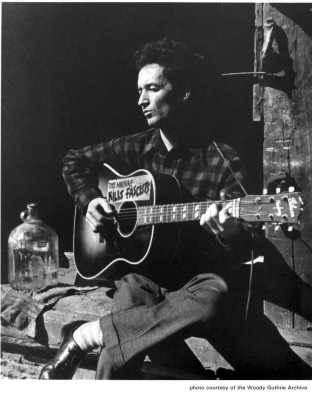
woody_guthrie

Woody Guthrie- This Machine Kills Fascists

Since we’re in the midst of the Fourth of July weekend, I thought this Sunday’s musical selection should be something with a definite American flavor. The song is This Land Is Your Land from the great Woody Guthrie.

You are no doubt familiar with this song, probably thinking of it as a cheery, upbeat song about the beauty and breadth of our democracy, sung often by smiling church and school choruses. It’s become a kind of populist national anthem which is sort of ironic given its beginnings and the words of the song. You see, there are verses that are seldom sung by the choruses and flag waving nationalists, verses that very much change the tone and meaning of the song.

Guthrie wrote the song in the late 1930’s in response to the immense popularity at that time of the Kate Smith version of God Bless America, written by Irving Berlin. Guthrie saw the world coming apart due to the nationalistic extremism that had spread through Europe, producing fascist leaders such as Hitler in Germany, Mussolini in Italy and Franco in Spain.

The original intro to God Bless America had the lines: 

While the storm clouds gather far across the sea / Let us swear allegiance to a land that’s free / Let us all be grateful that we’re far from there, / As we raise our voices in a solemn prayer.

That phrase that we’re far from there was later changed to for a land so fair.  Guthrie saw it as a call to an isolated form of nationalism, one that cast a blind eye to the perils lurking abroad that were beginning to spread here as well as our own problems at home. Problems like poverty and inequality.

Guthrie wanted to address these problems in his retort to Berlin’s song.  At first, Guthrie sarcastically called his song God Blessed America For Me before naming it This Land Is Your Land.

Below are the two verses in the original version of This Land Is Your Land that are always omitted from those cheery civic versions speak to the ills of this country as Guthrie saw them, most noticeably the greed which led to the great chasm of inequality between the wealthy and the poor of this land. He questioned how a land with so much wealth and beauty, one based on the equality of man, could tolerate the extreme poverty and injustice he saw in his travels across this land.

There was a big high wall there that tried to stop me.
The sign was painted, said ‘Private Property.’
But on the backside, it didn’t say nothing.
This land was made for you and me.

One bright sunny morning in the shadow of the steeple,
by the relief office I saw my people.
As they stood hungry,
I stood there wondering if God blessed America for me.

It’s an interesting song that speaks to this perilous time in the world as blind nationalism rises abroad and here in the USA.  Give a listen to this wonderful version below of the song from Sharon Jones and the Dap Kings and pay special attention to the words. Have a great Sunday and a great 4th.


I ran this post six years ago on this day. At the time, in the months before the 2016 presidential election, writing about the possibility of an insidious amalgam of fundamentalist/fascist/nationalism grabbing control of this nation seemed hyperbolic.

Six years later, it doesn’t seem so far-fetched, doesn’t feel like wild-eyed conjecture. In fact, it sounds like the monster we once laughed off and downplayed as a mythic creature is very much real and is now on the porch, kicking in our front door.

We got work to do. people.

As in the original post, I am including the Sharon Jones version of This Land Is Your Land below. I have added the Avett Brothers’ roots-americana version, which also includes the original lyrics, to give you a musical choice.

Or you can choose to not listen to either.

Freedom is about choice, after all.


Read Full Post »

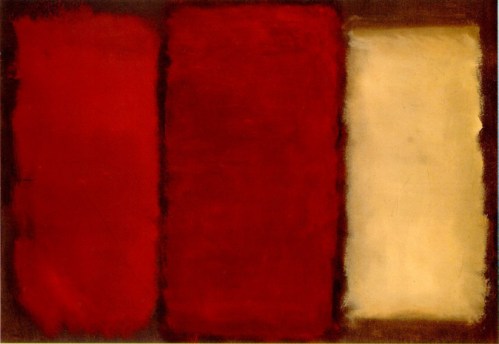
mark_rothko


It is a widely accepted notion among painters that it does not matter what one paints as long as it is well painted […] There is no such thing as good painting about nothing.

Mark Rothko


From 2015:

I have often said, often without much grace, that the subject for a painting is secondary, not really that important so long as the painting says something, expresses feeling and evokes emotion within the viewer. I think the work of Mark Rothko is a good example of this sentiment. They are simple of blocks of opposing colors set one over the other or, as in the case of the piece above, one alongside another.

Seemingly without subject.

Seemingly about nothing.

But as Rothko states, there is no such thing as a good painting about nothing. And this is a good painting. It allows the viewer’s own emotions into its space, lets their own story become the story and subject of this work. That space is the subject and purpose of this work.

So, every picture does tell a story. Some dictate the story, forcing the viewer to follow a set storyline through the picture as though they were the plot of a murder-mystery novel. Others do so like a song or poetry, evoking feeling with a suggestion or a gentle nudge. The viewer here is complicit in the fulfillment of the art.

For myself, I prefer the latter but have enjoyed works with more obvious subjects.  Perhaps not as deeply felt but enjoyable, nonetheless. I still question where my work falls on this scale. I am sure it has been both and I know I am much more satisfied when it appears more poetic. But being able to dictate the nature of the work is often beyond me. It sometimes appears in the poetic form seemingly on its own, without my direction.

And that is most satisfying.  And elusive.

Here’s a song that echos Rothko’s sentiments. Sort of. It’s the classic Every Picture Tells a Story from Rod Stewart. I am not a big Rod Stewart fan but when he hits the mark, it’s pretty special. He hits the mark pretty hard here.


Read Full Post »

« Newer Posts