It must be this rhapsody or none, The rhapsody of things as they are.
–Wallace Stevens, The Man with the Blue Guitar
I decided to pair the painting above with this couplet from a Wallace Stevens poem. It just seemed to fit this piece that, to me, deals with the rhythm and rhapsody of the universe.
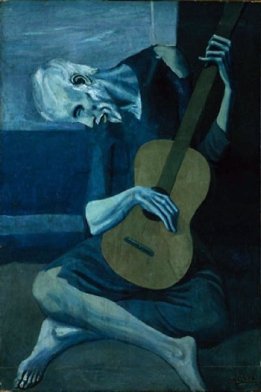
Then I realized that the poem, The Man with the Blue Guitar, was written about the famed Picasso painting with that same title that was the featured image in yesterday’s blog post.
Just one of those interesting coincidences that pop up once in a while. Or maybe it’s some form of synchronicity, an alignment of consciousness of the kind referred to in this painting.
I can’t say for sure. But I do see a rhapsody of being in this painting. By that, I mean the recognition, acceptance, and exultation of both our significance and insignificance in this world.
The joy in simply being.
The rhapsody of things as they are.
Okay, since we’re using the term rhapsody today, how about filling out our dance card with a bit of music? Here’s the always entertaining Lang Lang and his performance of the Hungarian Rhapsody #2 from FranzLiszt.
Painting is a blind man’s profession. He paints not what he sees, but what he feels, what he tells himself about what he has seen.
–Pablo Picasso
I love this quote from Picasso.
I think that is what all art really is– an expression of feeling. Emotion.
I know my best work, or at least the work that I feel is most directly connected to who I truly am as a human being, is always focused on expressing emotion rather than depicting any one place or person or thing. At its best, the piece as a whole becomes a vehicle for expression and the subject is merely a focal point in this expression. The subject matter becomes irrelevant beyond that. It could be a the most innocuous object, a chair or a tree in my case. It doesn’t really matter because the painting’s emotion is carried by the painting as a whole- the colors, the texture, the linework, the brushstrokes, etc.
In other words, it’s not what you see but what you feel.
I think many of Vincent Van Gogh‘s works are amazing example of this. They are so filled with emotion that you often don’t even realize how mundane the subject matter really is until you step back to analyze it for a moment.
I’ve described here before what an incredible feeling it was to see one of his paintings for the first time, at the Met in NYC. It was his vase of irises. A few flowers in a pot. How many hundreds of thousands of such paintings just like this have been created through the years by artists all over the world?
That’s unknowable, of course. But Van Gogh’s pot of irises transcended the mundane, seeming to vibrate with feeling, the electricity of life on the wall. Van Gogh resonates not because of the subject matter, not because of precise depiction of the flowers or the vase. No, it was a deep expression of his emotion, his wonder at the world he inhabited, inside and out.
I also see this in a lot of music. It’s not the subject but the way the song is expressed. How many times have we heard overwrought, schmaltzy ballads that try to create overt emotion and never seem to pull it off? Then you hear someone interpret a simple song with deep and direct emotion and the song soars powerfully.
I often use Johnny Cash‘s last recordings, in the last years and months before his death, as evidence of this. Many were his interpretations of well-known songs and his voice had, by that time, lost much of the power of his earlier days. But the emotion, the wonder, in his delivery was palpable. Moving.
Likewise, here’s Chet Baker from just a few months before his death. He, too, had lost the power and grace of youth due to a life scarred by the hardship of drug abuse and violence. But the expression is raw and real. It makes his interpretation below of Little Girl Blue stand out for me.
I came across this Picasso quote again early this morning and it reminded me of this post from back in 2012. Felt like a good time to replay it.
Man is not what he thinks he is, he is what he hides.
― André Malraux
The words above from Malraux quite often ring in my ears when I think about acquaintances and friends. Actually, anybody, even those who I see in a negative light.
I always wonder what secrets they hold, what details of their life and personality they withhold from others. How do they see themselves? Does their self-image align with the image they present to others?
And if not, which is more accurate? Are they more transparent or is their existence more opaque, mainly comprised of the untold secrets they bear?
It generally has me asking: How well can we ever fully know someone?
But that question inevitably leads to another: Do we really want to know the secret self of everyone we know?
I don’t know the answer to that last question. But realistically, I don’t think I would want to know all secrets. I base that on the last several years which have revealed more than enough info about the heretofore unknown thoughts and beliefs of people who I thought I knew better than I actually did.
Of course, there are those whose secrets I would like to know better. Mainly they are those whose words and actions confuse me. I wonder why they do what they do, what drives them to act in such ways. But even that desire to know more is tempered with the acknowledgement that the secrets of others are none of my business, so long as they don’t intersect with my own secrets or unduly affect the lives of others.
I have tried to be transparent in my art and life, but I often wonder if that is truly possible. Can one ever fully reveal their secret self? Are we ever even fully aware of all the secrets we hold?
I don’t know. Maybe that’s the burning secret that is behind the title of the painting at the top.
Excuse me for rambling a bit here. The secret self we hide is an easy subject to find tangents to explore. I have to go so you’ll have to figure it out for yourself.
“It was lunar symbolism that enabled man to relate and connect such heterogeneous things as: birth, becoming, death, and resurrection; the waters, plants, woman, fecundity, and immortality; the cosmic darkness, prenatal existence, and life after death, followed by the rebirth of the lunar type (“light coming out of darkness”); weaving, the symbol of the “thread of life,” fate, temporality, and death; and yet others. In general most of the ideas of cycle, dualism, polarity, opposition, conflict, but also of reconciliation of contraries, of coincidentia oppositorum, were either discovered or clarified by virtue of lunar symbolism. We may even speak of a metaphysics of the moon, in the sense of a consistent system of “truths” relating to the mode of being peculiar to living creatures, to everything in the cosmos that shares in life, that is, in becoming, growth and waning, death and resurrection.”
― Mircea Eliade, The Sacred and the Profane: The Nature of Religion
I was looking for something to start this blogpost, a quote or passage that would set the tone and came upon the bit above from Mircea Eliade who was a 20th century Romanian religious historian who died in 1986.
I liked what he said here, about how our relationship to the moon has connected us to many phases and events in our lives and, in ways, giving our lives a sense of meaning. It felt like it could well describe the echoes referred to in the new painting above, Echoing in Time.
After all, is the moon we look at now, sometimes for some sort of answer to the questions of our soul, not the same one that silently communed with our most distant ancestors?
That is, of course, a condensed version, of Eliade’s words and that might be enough to describe what I see in this painting.
The interesting thing for me, though, was the echo that came back at me from the past on seeing Eliade’s words.
Many years ago, I came upon his two-volume autobiography in a bargain bin at a now unremembered bookshop. I had no idea who he was, and the life of a religious historian certainly doesn’t seem like it would be fascinating reading at this moment. I can’t imagine that it was at that moment either. But for some reason, most likely the autodidactic impulse, I grabbed it and ended up struggling through it.
I can’t remember a lot of it. Most of the events of his life and the concepts of which he wrote have either faded or merged into the kettle of the thoughts and ideas that swirl around in my mind with hazy attribution and even hazier recollection.
But seeing his words brought me back to that time when I came across his work. An echo of a time past.
Some echoes are good and some bad. This was neither. It made me sad, to be honest, because it reminded me of the vagaries of time and the diminishment of certain faculties of the mind. I was sad that I wouldn’t even pause now to browse through such a book, let alone devote the effort of trying to read it through. Sad that my attention span is like that of a fruit fly, as is my memory.
But even so, it was an echo that came back to me. That counts for something. Perhaps a connection to the world and a sense of meaning in it?
I don’t know.
Hopefully, we will always hear and pay attention to those echoes that come to us through the moonlight. I dread the dark night when we fail to do so.
To complete the triad of painting, word, and song, here’s David Gilmour of Pink Floyd with a shorter acoustic version of their song, Echoes.
It has bothered me all my life that I do not paint like everybody else.
–Henri Matisse
Well, Mr. Matisse certainly did not paint like everybody else and I, for one, am glad of it.
But I believe I know what he is saying. As an artist, you’re always torn between poles of confidence.
When it is at its highest point, you believe so strongly in what you are doing that it doesn’t matter what everybody else’s work is like.
But at the low points, you lose confidence in the credibility of your own voice and vision. At these low points it seems like it would be easier to have the comfort of being able to judge your own work against others who do the same type of work so that you could gauge whether your creations were worthy of notice.
I certainly have swung wildly between these two poles and have at points wished that I painted more like other artists, as though I would somehow benefit from their credibility. I know that this sort of thinking is misplaced and the result of low self-esteem in that moment, but it happens. And on a more regular basis than one might think.
But the work itself is usually the voice of reason, the thing that brings me around once more. Just getting lost in the creation of a piece and sitting in front of it in the aftermath, still fully immersed in the life force it then exudes, washes away that need to be like everybody else.
But even in that moment, I know that nagging feeling, that desire to be like everybody else, will still be there waiting for me when I inevitably swing back to that other pole.
So, Mr. Matisse, thank you for not being like everybody else. I know how hard it sometimes must have felt but we appreciate you staying true to your own voice.
I am not in the studio this morning and decided to replay the post above from a few years back. Since it’s Sunday morning, I added a piece of music that somewhat echoes Mr. Matisse’s message at the top. This is an early (and favorite) song from The Kinks called I’m Not Like Everybody Else.
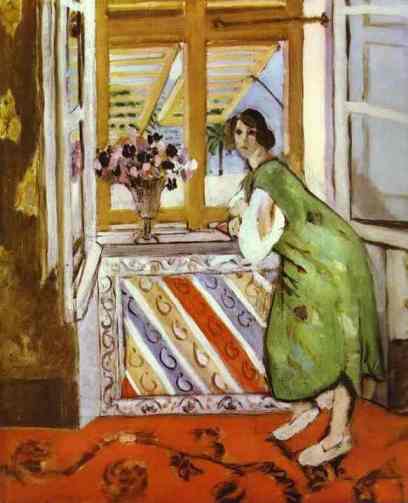
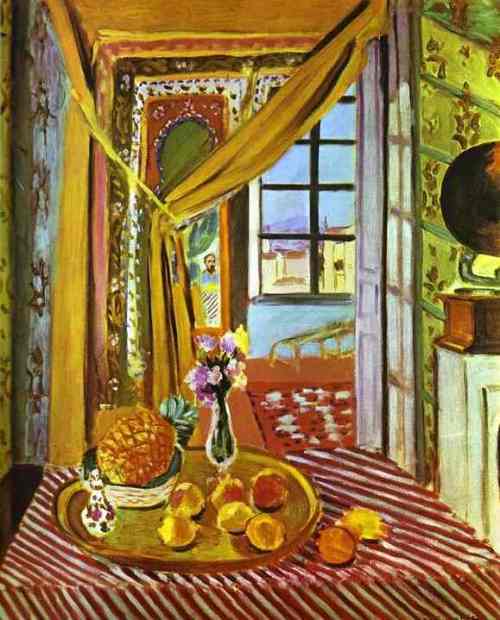
And below the video are a few more of Mr. Matisse’s interiors, a group of work that I really enjoy.
But there is a greater comfort in the substance of silence than in the answer to a question. Eternity is in the present. Eternity is in the palm of the hand. Eternity is a seed of fire, whose sudden roots break barriers that keep my heart from being an abyss.
The things of Time are in connivance with eternity…
― Thomas Merton, “Fire Watch, July 4, 1952”
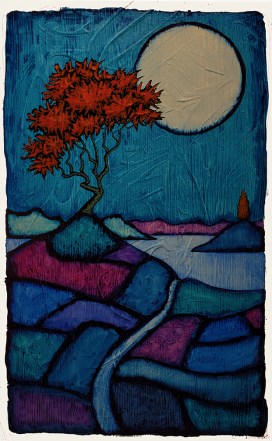
The painting above is titled Comforter and is part of my current show at the West End Gallery in Corning. The title feels self-evident in the painting with its shades of blue that are underlaid with layers of magenta that give it a warmth that I find comforting. The warm light of the moon also has a calming effect and the patchwork effect of the fields speaks directly of a quilt or comforter.
As I said, the title speaks for itself.
Merton’s passage adds a layer of spiritual comfort to this piece. It comes from an epilogue for his book The Sign of Jonas and details one of his first duties as a novice monk performing a fire watch. It entailed walking through the monastery in the early hours of the morning making sure that all was well, that no accidental fires or water leaks were taking place. It was a task filled with silence and vigilance but also one that offered comfort in the knowledge that all was well.
And that seems to fit with this small painting. The Red Tree seems to be overlooking all while pondering its own existence, its own purpose. And in doing this silent duty, it finds comfort.
Another passage from Merton’s essay seems applicable as well:
And now my whole being breathes the wind which blows through the belfry, and my hand is on the door through which I see the heavens. The door swings out upon a vast sea of darkness and of prayer. Will it come like this, the moment of my death? Will You open a door upon the great forest and set my feet upon a ladder under the moon, and take me out among the stars?
Perhaps the Red Tree is looking for that ladder under the moon.
I need to think on that a bit more. In the comfort of silence.
‘Light came from the east,’ he sang,
‘Bright guarantee of God, and the waves went quiet.
I could see the headlands and buffeted cliffs.
Often, for marked courage, fate spares the man
It has not marked already.’
And when their objection was reported to him —
That he had gone to bits and was leaving them
Nothing to hold on to, his first and last lines
Neither here nor there–
‘Since when,’ he asked,
‘Are the first and last line of any poem
Where the poem begins and ends?’
― Seamus Heaney, The Fragment
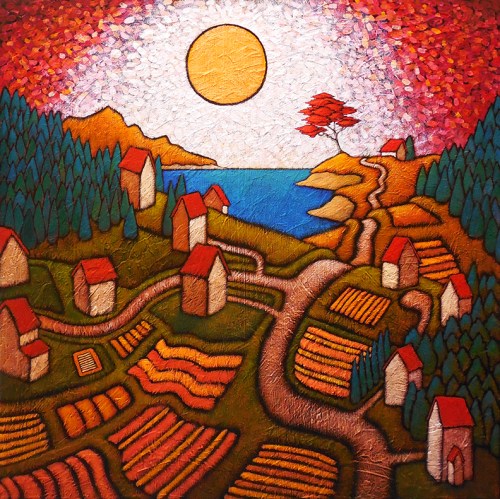
The short poem above from Seamus Heaney made me think about this painting, Where the Road Ends, and a number of my other pieces.
So often I think of my paintings as taking the viewer into the picture toward an ending point. Everything carries the eye inward to a desired point within the picture.
The end of the painting, its destination.
But maybe I should reconsider and see it as being a beginning, a point of departure where the central object of the piece, the Red Tree in this case, begins an outward journey, one that takes it away from me and all I have both invested and taken from it.
Maybe the poem that I see in it is not coming to an end but only beginning.
I guess, in a way, I have always known that. The tree in my Red Tree paintings is always the last element added and that carries with it a finality. That final brushstroke on the Red Tree generally marks the end of my creative input.
It is the place where the road ends for me.
But at that point, the painting is just beginning its life, its journey. Like the lives of many people, its journey in this new life may be one filled with days of boredom, of neglect, and feeling underappreciated. It might even be hidden away or discarded, replaced with something newer
But on the other hand, it might be the beginning of a life where it inspires and is loved and appreciated.
I can never know for sure which way it might go when my ending with these works becomes a beginning for them and someone else. I can only hope for good things for them and savor my time and experience with them.
Out beyond ideas of wrongdoing and rightdoing there is a field. I’ll meet you there.
When the soul lies down in that grass the world is too full to talk about.
― Rumi, 13th century Persian poet
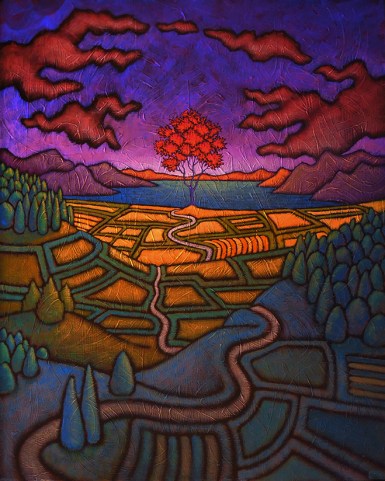
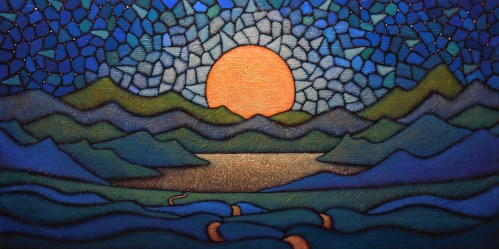
The new painting at the top, an 18″ by 36″ canvas, is titled Symphony of Silence. It is currently included in my Chaos & Light show at the West End Gallery.
I have written in the past about what I see as the connection between painting and music, how I see some of my pieces as simple songs and others as more intricate compositions. Perhaps symphonies or concertos.
This, in my eyes, is one that seems simple at a first glance. It is sparse and without many details. But the more I look at it, the more I see in it. How each element and color plays off the next and how they are fortified by each. It feels like there are rhythms and melodies running through it, from side to side as the terrain flows and up and down with rise of the moon. There is inward and outward movement with the light of the stars and the undulation of the trail. The blocks that make up the night sky seem to swirl and rotate in all directions. The far mountains appear almost as sound waves.
There is seemingly constant movement throughout the landscape and the skyscape. Almost a cacophony.
Almost.
It is silence.
Somehow the movements, the rhythms, and contrasts all run together at some point.
Harmony. Made up from the light of stars in motion countless lightyears away. Made from the ancient wisdom contained in the stillness of the land and water. Made from the poetry of landscape shaped by the forces of nature.
A harmony that is always there, existing in silence.
It is a simple piece but one that never fails to divulge something more to the viewer who is willing to share their own silence with it.
Here’s a piece of music to accompany it, a longtime favorite of mine and one that has played a large part in how I came to view my own work. It’s from composer Arvo Pärt and his composition Tabula Rasa. This is the second movement, fittingly titled Silentium. It feels right with this painting.
I can’t run no more With that lawless crowd While the killers in high places Say their prayers out loud But they’ve summoned, they’ve summoned up A thundercloud They’re going to hear from me
Ring the bells that still can ring Forget your perfect offering There is a crack, a crack in everything That’s how the light gets in
–Leonard Cohen, Anthem
Storm clouds came across and a thunderbolt rocked the Plains last night.
One word: Kansas.
I am not going to say anymore, not going to explain. But I will add, as in the lines from Leonard Cohen, there are cracks appearing and light is beginning to come through.
Kansas, of all places, gives me hope for the future. It makes me believe that people are finally recognizing the fragility of this democracy and are capable of standing in large number against the threat and treachery of minority-rule authoritarianism.
I sometimes think we have become too distracted and complacent, too docile in trusting that things will just naturally work out without our attention and effort.
However, it doesn’t work that way. Our history is one of an almost constant battle to gain and maintain basic rights and freedoms for all. The events and potentials which we face now may exceed those fevered battles of the past because all of the prior victories are at risk again. and could be quickly lost.
Kansas gives me hope that victory is possible.
It is a distinct moment in our history so please embrace it.
Look for the light and relish the fight.
As Ralph Waldo Emerson wrote of another such time:
If there is any period one would desire to be born in, ⎯ is it not the age of Revolution; when the old and the new stand side by side, and admit of being compared; when the energies of all men are searched by fear and by hope; when the historic glories of the old, can be compensated by the rich possibilities of the new era? This time, like all times, is a very good one, if we but know what to do with it.
― Albert Camus, The Myth of Sisyphus and Other Essays
Or, to put it a different way:
having nothing to struggle against they have nothing to struggle for.
–Charles Bukowski
Just asking questions this morning. I certainly don’t have answers, at least, none that have actual proof of being correct. Most of my questions refer in some way to what I see in the painting at the top, a new piece titled Struggle and Will, which is included in my current show at the West End Gallery.
As the title suggests, I see it as being primarily about struggle and perseverance against opposing forces, both external and internal. The struggle between desire and reality. Between justice and injustice, right and wrong. Between truth and illusion. Between comfort and impoverishment.
I have been thinking lately about how passion, particularly creative passion, is often fed by these same struggles.
This begs the questions:
Is there creative passion without struggle?
What is the primary driver of creative passion?
Does sheer ability or craftsmanship equate to or even supersede passion? That leads to: Can the talented truly produce art without possessing passion?
I hope the answer to that last one is a no but then again, I don’t know.
I am certain I could answer from differing viewpoints on any of these questions and each would be valid, anecdotally. I suppose creative passion, like art in general, exists without rules. Creative passion might grow in someone who seems from the outside to have had an easy life with, if any, few struggles. Conversely, it may not exist at all in someone who has had to fight and struggle every day of their life.
Probably not a right answer to any of these. Maybe these aren’t even the right questions to be asking.
Maybe the question should be: What defines struggle?
Or: For what do you struggle?
Again, no answers here. But writing this just now, I am reminded of a line from the classic film The Third Man. Orson Welles, playing the post-war racketeer Harry Lime, speaks in a roundabout way about passion produced in struggle:
After all, it’s not that awful. You know what the fellow said – in Italy, for thirty years under the Borgias, they had warfare, terror, murder, and bloodshed, but they produced Michelangelo, Leonardo da Vinci, and the Renaissance. In Switzerland, they had brotherly love, they had five hundred years of democracy and peace. And what did that produce? The cuckoo clock.
He was factually off a bit as the cuckoo clock is a German creation, but the point is well made.
 Painting is a blind man’s profession. He paints not what he sees, but what he feels, what he tells himself about what he has seen.



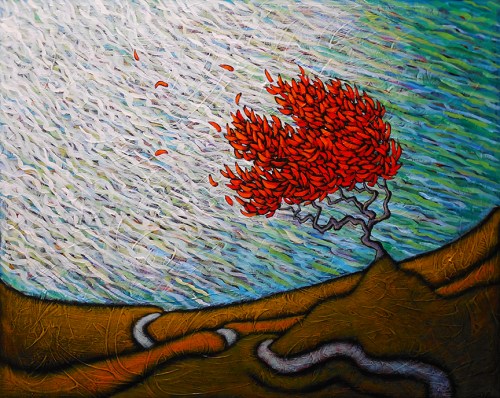
 Redtree Times