Great art is the outward expression of an inner life in the artist, and this inner life will result in his personal vision of the world… …The inner life of a human being is a vast and varied realm.
—Edward Hopper, ‘Statements by Four artists’, ‘Reality’ 1, Spring 1953
When I find myself struggling with my work, I usually turn to some of my favorite painters. Sometimes just examining again those paintings which once provided so much inspiration often gets me back in rhythm.
Maybe it as simple as seeing a pattern or rhythm or color and recalling how I had once integrated my versions of those things into my own work. Maybe my versions have changed or now absent. Or maybe the future in which I now sit, with some gained knowledge and skills, allows me to glean something new that I had missed in earlier examinations.
Or maybe it is just a break from being immersed in my own work. Reviewing the personal vision of others sometimes allows me to reset and reorganize.
Steady the ship, as it were.
And Edward Hopper does that as well as anyone for me. And it’s not just the work. There is something I get from the limited number of quotes he provided that jibes well with my own views on working as an artist. For example:
The man’s the work. Something does not come out of nothing.
That is akin to something that I have told students I have addressed art classes in the past. Talent and skill is wonderful but without something to say, without being a well rounded person, it will often not amount to much.
And then there’s this:
So many people say painting is fun. I don’t find it fun at all. It’s hard work for me.
I have long stated that this is, like most jobs, a hard and demanding field. It is often frustrating and certainly humbling. And even humiliating when you factor in the amount of rejection to which one is subjected.
It sometimes feels like you are running an endless marathon in which you are continually losing speed. You realize that winning the race is out window and all you can do is keep moving ahead with the hope you can someday reach the finish line having ran the best race you could.
That being said, I wouldn’t choose to do anything else at this point.
It’s what I do.
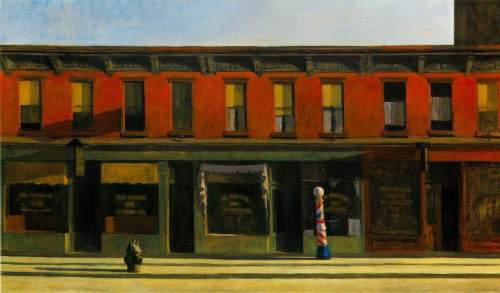
Let’s look at some of Hopper’s better-known works, okay?
The last mad throb of red just as it turns green; the ultimate shriek of orange calling all the blues of heaven for relief and support… each color almost regains the fun it must have felt within itself on forming the first rainbow.
–Charles Demuth, Letters of Charles Demuth, American Artist, 1883-1935
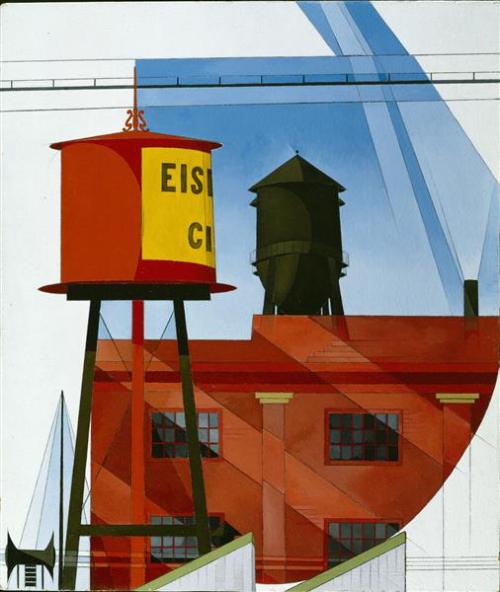
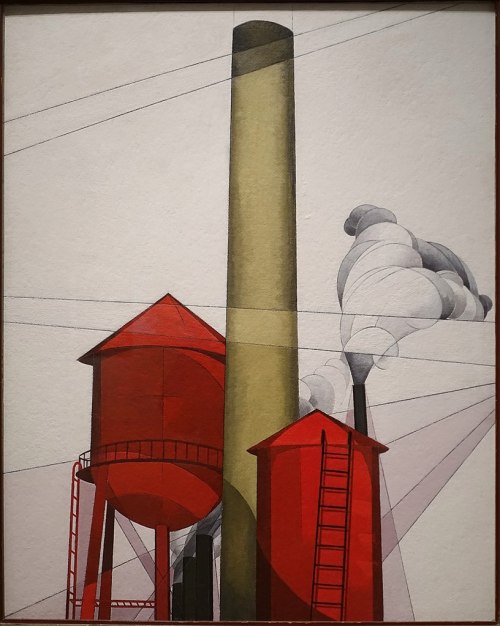
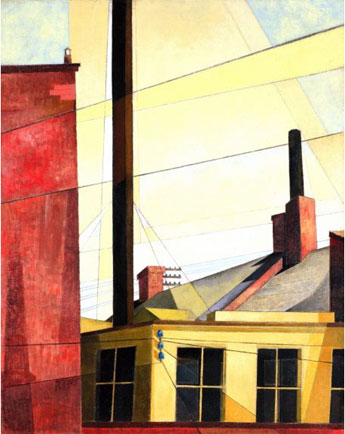
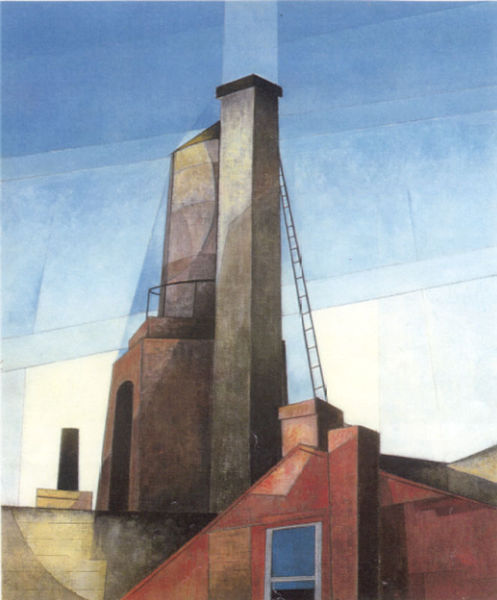
Running very late this morning and thought I’d run a post from way back in 2009 about a favorite painter who I have only mentioned once or twice in all those years, Charles Demuth. His coloration in his Precisionist paintings were a big influence on my early work and examining them again always refreshes me.
And I feel the need to be refreshed.
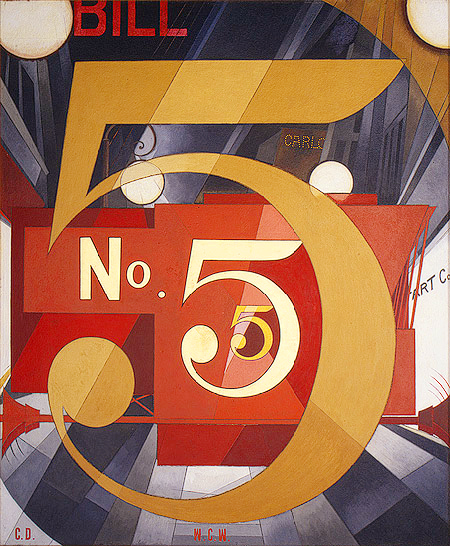
I’ve been a fan of Charles Demuth since the first time I saw his work. He was considered a part of the Precisionist movement of the 20’s, along with painters such as Charles Sheeler and Joseph Stella among many others, with his paintings of buildings and poster-like graphics such as this painting, I Saw the Figure 5 in Gold. He was also one of the prominent watercolorists of his time and while they are beautiful and deserve praise in their own right, it’s his buildings that draw me in.
Demuth’s work has a tight graphic quality but still feels painterly to me. There’s still the feel of the artist’s hand in his work which to me is a great quality. There are photorealist painters out there whose craftsmanship I can really admire but who are so precise that they lose that feel of having the artist’s hand in the work.
I like seeing the imperfection of the artist. The first time I saw one of the Ocean Park paintings from artist Richard Diebenkorn, it wasn’t the composition or color that excited me. It was the sight of several bristles from his brush embedded in the surface. To me, that was a thrill, seeing direct evidence of the process. The imperfect hand of the artist. I get that feeling from Demuth.
He also had a great sense of color and the harmony and interplay of colors. His colors are often soft yet strong, a result of his work with watercolors. His whites are never fully white and there are subtle shades everywhere, all contributing to the overall feel of the piece. His work always seems to achieve that sense of rightness I often mention.
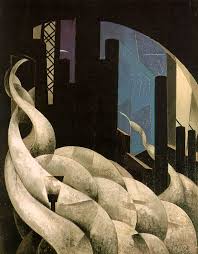
His works, especially his paintings of buildings, have a very signature look, marked by a repeated perspective where he views the buildings above him. His paintings are usually fragments of the building’s upper reaches. There’s a sense of formality in this view, almost reverence. I don’t really know if he was merely entranced by the forms of industrial buildings or if he was making social commentary.
Whatever the case, do yourself a favor and take a look at the work of Charles Demuth. It’s plain and simple good stuff…
I saw a cold, dark, black emptiness. It was unlike any blackness you can see or feel on Earth. It was deep, enveloping, all-encompassing. I turned back toward the light of home. I could see the curvature of Earth, the beige of the desert, the white of the clouds and the blue of the sky. It was life. Nurturing, sustaining, life. Mother Earth. Gaia. And I was leaving her.
Everything I had thought was wrong. Everything I had expected to see was wrong.
I had thought that going into space would be the ultimate catharsis of that connection I had been looking for between all living things—that being up there would be the next beautiful step to understanding the harmony of the universe. In the film “Contact,” when Jodie Foster’s character goes to space and looks out into the heavens, she lets out an astonished whisper, “They should’ve sent a poet.” I had a different experience, because I discovered that the beauty isn’t out there, it’s down here, with all of us. Leaving that behind made my connection to our tiny planet even more profound.
It was among the strongest feelings of grief I have ever encountered. The contrast between the vicious coldness of space and the warm nurturing of Earth below filled me with overwhelming sadness. Every day, we are confronted with the knowledge of further destruction of Earth at our hands: the extinction of animal species, of flora and fauna . . . things that took five billion years to evolve, and suddenly we will never see them again because of the interference of mankind. It filled me with dread. My trip to space was supposed to be a celebration; instead, it felt like a funeral.
I learned later that I was not alone in this feeling. It is called the “Overview Effect” and is not uncommon among astronauts, including Yuri Gagarin, Michael Collins, Sally Ride, and many others. Essentially, when someone travels to space and views Earth from orbit, a sense of the planet’s fragility takes hold in an ineffable, instinctive manner. Author Frank White first coined the term in 1987: “There are no borders or boundaries on our planet except those that we create in our minds or through human behaviors. All the ideas and concepts that divide us when we are on the surface begin to fade from orbit and the moon. The result is a shift in worldview, and in identity.”
–William Shatner, Boldly Go: Reflections on a Life of Awe and Wonder
A convergence of things this morning. One of the first things I came across was a short excerpt from the new autobiography from William Shatner that came out earlier this week. This excerpt, featured above, was about his voyage into near space that took place last October.
Reading it, I could easily imagine the feelings he experienced, the dread and grief of seeing all you know and love beyond reach as you plunge into the deepest darkness of the universe.
Geez, I get that feeling when I have to venture beyond the mailbox at the end of our driveway.
It reinforced my own feelings on this planet. I like this place and, while I kind of understand the desire to venture boldly toward new frontiers, feel that we are extraordinarily fortunate to be here.
Earth is a gift.
With cooperation and an eye to its fragility, this Earth could easily provide us with all we need for all foreseeable time.
I feel some of that same dread and grief knowing that we probably don’t have the ability to transcend our shortcomings– greed, bigotry, and any of the other Seven Deadly Sins— in a way that would allow us to achieve widespread cooperation or provide the needed care.
But we are here.
Earthlings.
We live in a world that is filled with beauty and wonders, yet we dream of hurtling through space toward near planets that are inhospitably hot or cold, with unbreathable atmospheres and without water or lifeforms. At least any that we can recognize or understand.
I don’t know that there’s any point to this. Shatner’s words just rang out at me this morning.
The convergence I mentioned came after I had decided to write about the excerpt from Shatner’s book. I opened the YouTube opening page to find a matching song for post and for this week’s Sunday Morning Music. The first thing I saw was a recommended listing for a song called Earthlings from Nick Cave and the Bad Seeds.
I had featured Nick Cave earlier in the week and don’t usually like to share two songs from the same artist in the same week (though I had done this already this week with John Prine) but this just seemed to match up too well to not use it. Plus, it has a seasonal touch with its mention of Halloween.
So, here’s that song from Nick Cave, for all of us– Earthlings and non-Earthlings alike.
“Hello babies. Welcome to Earth. It’s hot in the summer and cold in the winter. It’s round and wet and crowded. On the outside, babies, you’ve got a hundred years here. There’s only one rule that I know of, babies-“God damn it, you’ve got to be kind.”
― Kurt Vonnegut
I used the words above from the book God Bless You, Mr. Rosewater from the late Kurt Vonnegut, as the opening for a post on kindness a couple of years back. It was a short little essay that for some reason gets a number of views seemingly every day.
It surprises me but it also makes me glad that a post like this attracts people.
After all, kindness is a good thing and I would like to think that anything that furthers kindness among others is good, as well.
The words above are spoken to the infant twins of a neighbor as part of a baptismal speech from Eliot Rosewater, the book’s protagonist. It seems like a ridiculous bit of advice to speak over infants at a religious ceremony, but the sentiment is striking in its simplicity and practical application.
Contrary to Mr. Rosewater’s advice, it may not be an actual rule. But if you got to be something, why not be kind? Don’t cost a thing, you seldom have to apologize for it, and you might even make someone else’s day. Or week. Or month.
Hell, why not?
Here’s a simple and kind song, You Got Gold, from the late John Prine.
I do what I can to convey what I experience before nature and most often, in order to succeed in conveying what I feel, I totally forget the most elementary rules of painting, if they exist that is. In short, I allow faults to appear, the better to fix my sensations.
–Claude Monet, 1912
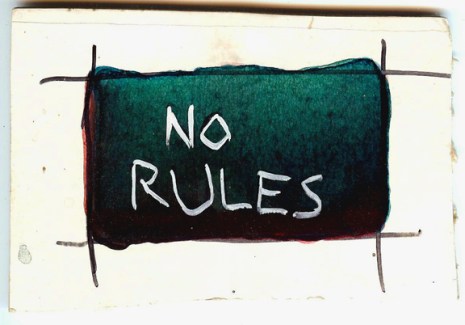
I’ve been in this studio for 15 years now and it has gotten to the point that I now look past certain things. They begin to barely register so I try to periodically stop and take things in. This morning I decide to look at the things on a built-in nook on a wall in my studio kitchen. A couple of shelves of art books, books of essays and poetry and odds and ends. Two small early favorite paintings on the top shelf. A stained-glass experiment and a piece of pottery from a late friend. An agate with a polished face. A couple of other small things but my gaze stopped when it fell upon this little sign.
It’s a little stained now. It’s been with me for what seems like forever, in my house, in my old studio and now here, in this place. It’s not much but its meaning has meant a lot to me over the past quarter century.
I realized in that moment this morning that I hadn’t fully looked at it for quite some time. And that I needed to heed its advice now.
I thought it was worth a replay of the post that I wrote about this sign back in 2012.
I have had this little sign hanging in my studio for the last 16 years [over 25 years now], a rough reminder to myself when I begin to feel like my work is bending to the rules and judgments of others. It reminds me that I am working in my own realm, my world beyond the reach of others. I control the parameters of what is possible, of what defines reality in my work. The rules of others mean nothing in my little painted world.
Over the years I have glimpsed this small sign at times when I have been feeling that my work is stagnating or beginning to adhere to accepted conventions. At those times I have been spurred to push my work in some new direction. It might come in the form of heightening the intensity of color or introducing new hues that seems incompatible with nature, for example.
It’s as though these two words are prods that constantly tell me that nobody can control me when I am here in my created world. There’s a great liberation in this realization and I find myself trusting my own judgment of my work more and more. Because I have created my own criteria for its reality, criticism from others means little now.
I think that’s what I am trying to get at here, that an artist must fully believe that they are the sole voice of authority in their work, that they, not others, determine its validity. Maybe that’s why I am so drawn to Outsider artists, those untrained artists who maintain this firm belief in their personal vision and create a personal inner world of art in which it can live and prosper. Rules mean nothing to them- only the expression of their inner self matters.
Come sail your ships around me And burn your bridges down. We make a little history baby Every time you come around. Come loose your dogs upon me And let your hair hang down. You are a little mystery to me Every time you come around.
—Nick Cave, The Ship Song
It’s a busy time right now as I prep for an upcoming show in early November at the Kada Gallery in Erie. Seems like the sand in the hourglass that marks my remaining time for the show is falling faster and faster. It’s been that way for every show in recent years. It just takes longer to get ready.
I don’t know to what I should attribute this. Age? Process? Something else completely apart from painting itself, some sort of mental distractions?
Sometimes I think it is a result of aging. It takes me longer to do everything and painting is no exception. You would think after all this time that it would be quicker and more efficient.
But it’s not. So, maybe it’s process. After all, my process was never set in any traditional manner of painting, never done in one way only. It was always freestyle–whatever worked in whatever way– and it was always evolving. Things like different technique and elements come and go, some gone forever. But more things have been added than subtracted over the past 25 years and, as a result, I find that each piece requires much more time and effort.
Factoring that into an aging body and an all too often distracted mind, it makes sense. I try to compensate by being more efficient in the prep stages for these shows, things like photographing and framing the work, and it helps somewhat.
But I still find myself short on time. Like now.
There’s much work to be done in order to get my show’s ship to port. In that vein, here’s The Ship Song from Nick Cave and the Bad Seeds.
The height of the pinnacle is determined by the breadth of the base.
–Ralph Waldo Emerson
Just a couple of quick hits here this morning. First, last night Aaron Judge finally broke the Major League Home Run record down in Arlington, TX. It was his 62nd blast, breaking the 61 year old record held by the late Roger Maris.
I laid out the reasoning in an earlier post why I believe that this is the true record. The others who have had more home runs all did so in a window of time that had juiced baseballs, juiced players and possibly juiced bats, for those of you who remember the Sammy Sosa broken bat incident. At that time, it was not unusual for a player who had never been a prodigious slugger in their career to suddenly hit 50 or more homers.
It was fun to watch at the time. But for baseball traditionalists, the numbers rang hollow. It would be like being a basketball fan and they suddenly lowered the rim while at the same time making it larger. The records after that change would certainly be regarded with some suspicion.
The beauty of Judge is that he exemplifies the qualities one hopes for in their heroes. Sure, he’s huge and powerful. But he’s also exceedingly humble, hard-working, disciplined, and team oriented. When he hits a 450-foot home run that would have others flipping their bats and striking poses as they make their way to first base, Judge simply puts his head down and trots the bases quickly. I’ve watched many hundreds of Yankees games with Judge playing and you can see how well regarded and liked he is by his interactions with the players from the other teams. Even with the bitterest of rivals, there is always a lot of smiles and joking around.
Nice to see a good guy who does things in the right way reach the pinnacle.
Next, country great Loretta Lynn passed away at the age of 90. I wrote about the Queen of Country a couple of times here. She had an air of authenticity that couldn’t be faked or manufactured. I think that’s why when she her attempt at reinvention with her 2004 Grammy Award-winning albumVan Lear Rose, a collaboration with rocker Jack White, was such a success– even though it was a stylistic departure, her authenticity burned through it.
It was still all her. Another real person at a pinnacle.
So, here are two tracks from Van Lear Rose. I was tempted to play some of her earlier tracks like Fist City or Rated X but these fit better this morning. Both are true Loretta Lynn songs, the autobiographical High on a Moutain Top and Mrs. Leroy Brown, a hard charging country stomper with a guitar sound that would make Jerry Reed proud. RIP, Loretta.
I’m awfully tired of the same old business Kiss the babies, make ’em cry I’m only lookin’ for one good woman Cross my heart and hope to die Stick a needle in my eye, eye, eye
–John Prine, Stick a Needle In My Eye
A John Prine song came on early this morning in the studio, one that I hadn’t heard in a while. But while I haven’t actually heard it in my ears, it’s one of those songs that is in my head a lot. When things are going poorly, usually of my own doing due to my sheer stupidity or carelessness, its short chorus inevitably finds its way to my mind:
Stick a needle in my eye, eye, eye
Usually makes me chuckle. And that’s a good thing at those low moments. I always figured that if I had taken some sort of a beating and could still laugh about it, it wasn’t as bad as it could have been. I knew then that I was going to get through it and be okay.
I’ve had some very good laughs on some very bad days.
Better to laugh than cry but sometimes it comes down to laughing while crying.
Stick a needle in my eye, eye, eye
Funny how a song or image or a few words can trigger so many memories, good and bad. Hearing this song made me think of this little painting at the top, one that I did a number of years ago. It was done on a quick whim at one of those moments when things weren’t going so well all the way around. It was meant for just me and I knocked it out in 15 or 20 minutes. It’s not much but it served a great purpose for me, much like that short chorus.
I showed this little painting here a couple of years back in a post about the Power of Hopelessness, which remains a personal favorite of mine. I think that essay and this painting and song all link together in a way. I think it’s all about how one reacts to adversity. You can give up or you can laugh in its face then get to work at somehow climbing out of whatever hole you’re in.
Solitary Song— At the Principle Gallery, Alexandria, VA
“And what, you ask, does writing teach us?
First and foremost, it reminds us that we are alive and that it is gift and a privilege, not a right. We must earn life once it has been awarded us. Life asks for rewards back because it has favored us with animation.
So while our art cannot, as we wish it could, save us from wars, privation, envy, greed, old age, or death, it can revitalize us amidst it all.”
― Ray Bradbury, The October Country
Sunday morning and it’s still dark here as I write.
A cool and sleepy autumn morning in October.
The perils of the world seem far removed on such a morning. It’s a welcome respite, this time each morning when I devote a small bit of my day to music and words and art.
Maybe that is the revitalization that Ray Bradbury refers to in the passage above. It certainly lends a small sense of purpose, maybe one that allows me to pay back Life for its given gift.
I don’t know. Maybe.
Anyway, I’ve been sitting here for a while listening to music and now the clouded light is starting to filter in through the trees around the studio. It’s time to take this bit of regained vitality and face the world again. Here’s a song, a favorite from Neil Young that I thought I had played recently but discovered that it has been eight years since it last played here.
Time creeps away, don’t it?
Here’s Neil and his Harvest Moon from a performance from some time back at the venerable Ryman Auditorium in Nashville. Good stuff.
Since baseball time is measured only in outs, all you have to do is succeed utterly; keep hitting, keep the rally alive, and you have defeated time. You remain forever young.
–Roger Angell, Once More Around the Park: A Baseball Reader
Just wanted to share a drone tour of Wrigley Field, the fabled home of the Chicago Cubs, that was released yesterday. The team produced this video as an end-of-season gift to their fans and it gives every fan an intimate and fascinating view of the park, inside and out. I would have to believe that this required a tremendous amount of planning and expertise to produce such great results.
It’s a fun watch for even non-baseball fans.
I thought I might try my hand at generating some AI (Artificial Intelligence) images through one of the free online generators. These were fromdeepai.org. You basically type in a short description of what you would like to see, and they pop up moments later. Sometimes the results surprise you.
I made two requests, one a Picasso painting of Babe Ruth and the other a baseball player in a Van Goghlandscape. I’m kind of partial to the Van Gogh ballplayer.
 Running very late this morning and thought I’d run a post from way back in 2009 about a favorite painter who I have only mentioned once or twice in all those years, Charles Demuth. His coloration in his Precisionist paintings were a big influence on my early work and examining them again always refreshes me.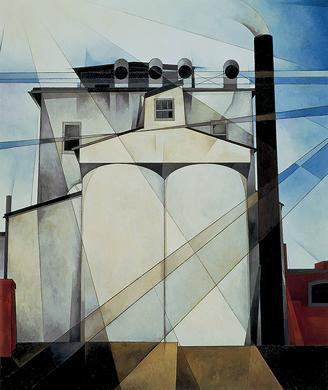





 Redtree Times