Feeds:
Posts
Comments

Archive for October, 2024


The post below is from four years ago, in the runup to the 2020 presidential elections. It was a time at the end of an administration that had buffeted the American people for nearly four years of continuous lies and divisive hate-filled rhetoric. It culminated in the events of January 6, 2021. It’s four years later and the person responsible for that division and violence is frantically operating at an even greater magnitude of darkness in his appeal to his followers. Tomorrow, we will be a mere four weeks from Election Day. The same person who stoked the storm that was January 6 is desperate and is once again attempting to set a whirlwind upon us that he hopes will tear us apart so that he might once more take power.

I thought this post was appropriate to this time, as it was four years before and as it was in 1936. Be mindful, my friends, for there are perilous weeks ahead of us.


Lately, I have been reading bits and pieces from a book of Carl Sandburg poems called The People, Yes. Published in 1936, It is a broad work that attempts to span the multitudes, much like Whitman and his Leaves of Grass. It is a deep reflection on the American people at that time, in the midst of the upheaval of the Great Depression and the rise of Fascism and Naziism in Europe.

As I say, I have been reading it piecemeal, picking it up at loose moments. Each time I am struck how relative it is to this time even though it is nearly 90 years old. For all the technological and societal changes that have occurred, for all the progress and sophistication we assume took place, we are still pretty much the same and pretty much in the same place. Still maintaining many of the same conceptions and misconceptions, still as biased and still as vulnerable to being manipulated.

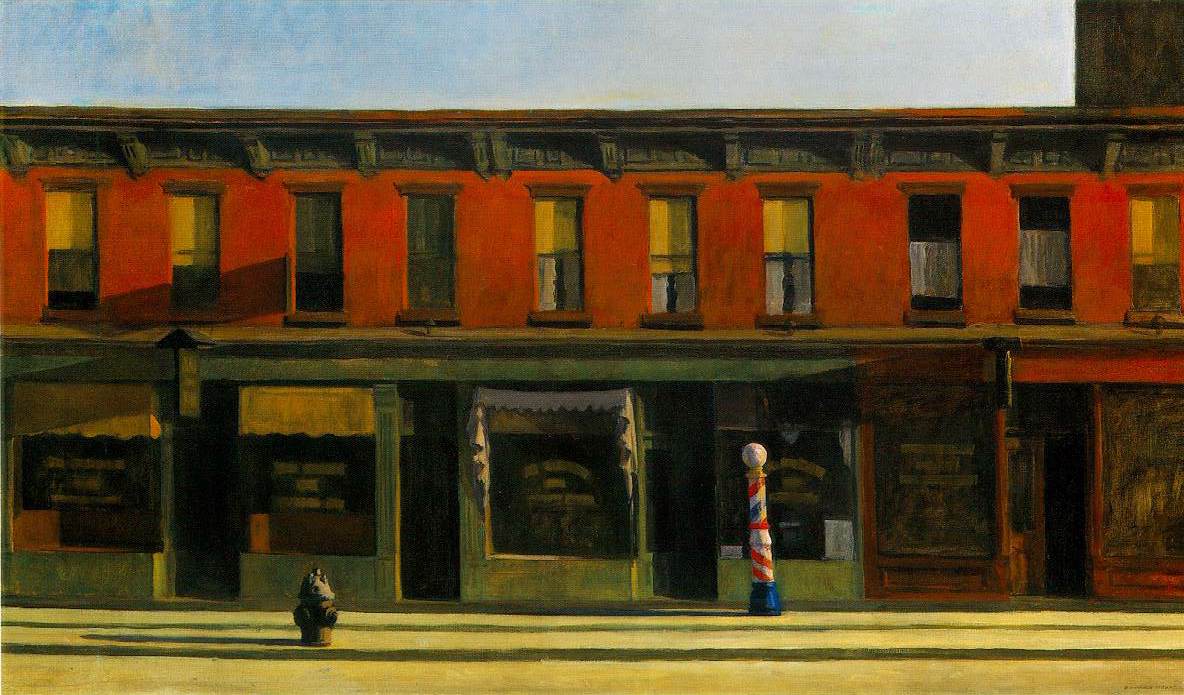
One verse from this book that I keep coming back to is shown above, at least its beginning, #102.

It begins with bits from President Lincoln’s July 4, 1861 speech to Congress, one in which he justified his actions in the aftermath of the Confederate’s attack on Fort Sumter. In it, he outlined how the leaders of the Southern rebellion stoked the enthusiasm for conflict among the people living there through the dispersal of misinformation and fallacies. Some things never change, eh?

Reading Sandburg’s take on this is a bit scary. It seems to reflect what has happened here so well. The public has been barraged with lies and hateful, divisive rhetoric for the last four [now eight] years to the point that we are without moorings. Many of us have lost the ability to discern truth from the lie and right from wrong. And now, in this unsteady state, we are experiencing the convergence of events that have been precipitated by these actions.

We are reaping the whirlwind.

And, unfortunately, the man and his accomplices who have done this, who have unleashed this awful power, can no longer control its direction or the scope and range of its destructive power.

As Sandburg put it:

Is there a time to repeat,
“The living passions of millions can rise
into a whirlwind: the storm once loose
who can ride it? You? Or you? Or you?
only history, only tomorrow, knows
for every revolution breaks
as a child of its own convulsive hour
shooting patterns never told of beforehand”?

As I say, some things never change. There will always be those who try to benefit from inciting chaos and division upon the people. But, as it has always been, these devious people have never been able to reliably predict or control the whirlwind they let loose.

The public mind generally has the final word in such matters.

And it is speaking now.


Let us hope the people answer the call in the coming four weeks…
Read Full Post »

GC Myers- Night's Dream

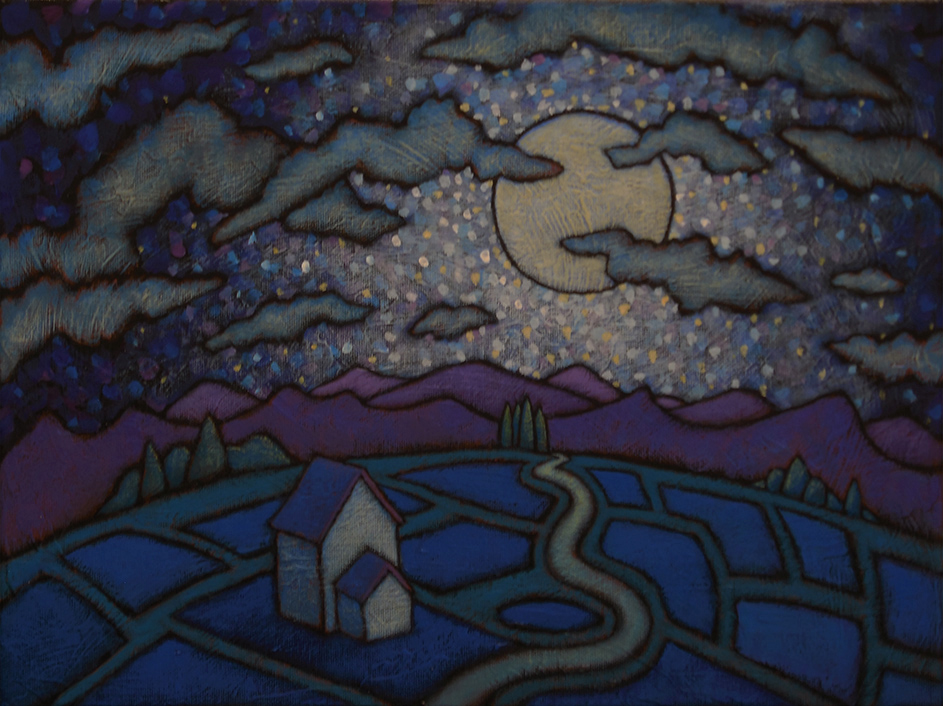
Night’s Dream–At Principle Gallery


If a little day-dreaming is dangerous, the cure for it is not to dream less but to dream more, to dream all the time.

–Marcel Proust, Within a Budding Grove (1919)


Time for some Sunday Morning Music. And that’s all. I have too much dreaming ahead of me this morning to spend much time here. Feel like I might be in a dream deficit. I would explain but I have said too much already.

Let’s just leave it with a line from Proust, a painting of mine from the Principle Gallery, and a song from a longtime favorite album by Richard Thompson. This is You Dream Too Much from his 1991 Rumor and Sigh album.

Do what you will with this triad then hit the road, folks– you’re standing on my dreams…


Read Full Post »


GC Myers- In Eminence 2024

In Eminence– At Principle Gallery, Alexandria

“This is why alchemy exists,” the boy said. “So that everyone will search for his treasure, find it, and then want to be better than he was in his former life. Lead will play its role until the world has no further need for lead; and then lead will have to turn itself into gold.

That’s what alchemists do. They show that, when we strive to become better than we are, everything around us becomes better, too.”

— Paulo Coelho, The Alchemist


This is a rehash of a post from 2013. It was originally about a solo show from that year titled Alchemy I chose that title because it often feels as though art is akin to alchemy, the ancient and mysterious practice that is defined by its stated goals of turning base metals into gold or silver and creating an elixir that would give man’s life great longevity, possibly immortality.

Most of us likely think of it in terms of some wild-eyed, wild-haired scientist futilely seeking a way to transform lead into gold.

But at the heart of alchemy is the simple concept of the transformation of something ordinary into something more than it initially appears to be. That really strikes home for me. I have often written of sometimes feeling surprised when I finish a piece, as though the end result, the sum of my painting, is often far more than what I have to personally offer in terms of talent or knowledge. Like there is a force beyond me that is arranging these simple elements of this work into something that transcends the ordinariness of the subject or materials or the creator.

This feeling has remained a mystery to me for almost twenty years, driving me to write here in hopes of stumbling across words that would adequately describe this transformation of simple paint and paper or canvas into something that I sometimes barely recognize as being my own creation, so marked is the difference between the truth of the resulting work and my own truth.

Even as I write this, I can see that my words are inadequate to describe this vaporous process. So, I will stop here. But, of course, I will probably continue to try to describe it again and again in the future.

And will inevitably come up short.

I chose the painting here for this rehash because I thought it was a good example. It is simply composed with basic elements. While I was working on it, it felt as though it was a bit dull. Flat. Then at a certain point, it suddenly transformed in almost every way. It felt like it had come to life, from a leaden, flat surface to animated being within the blink of an eye.

It must be alchemy…

Read Full Post »

GC Myers- Time Patterns 2024

Time Patterns– At West End Gallery


The point is, art never stopped a war and never got anybody a job. That was never its function. Art cannot change events. But it can change people. It can affect people so that they are changed… because people are changed by art – enriched, ennobled, encouraged – they then act in a way that may affect the course of events… by the way they vote, they behave, the way they think.

― Leonard Bernstein


This is not meant to be a political post and I will try to not veer into rhetoric. But, as I have pointed out in the past, everything ultimately is political in some way.

I have been thinking lately about the difference between the two presidential candidates. Not the obvious things. Those are too glaringly obvious in almost every way to go unnoticed. I don’t have to go into detail here. You see and know. Even those people who say they don’t know Kamala Harris can see the differences.

And I am not talking about gender or skin color.

The difference that sticks out for me is a little less obvious. It is something that the felonious former president*** lacks, at least in my observations. And it makes me wonder if this particular deficit is a bond between him and his most ardent followers.

What I see him lacking is a sense of art. He is a person who has obviously never felt nor been changed by art. He has seemingly never felt the communion that occurs between someone and any particular piece of art that stirs something deep within them.

For him, art is like everything else in his world–a transactional tool or commodity, something to be used to gain something tangible for himself alone. When he encounters art, it is to be used, not experienced or felt with awe or joy.

There is not art for art’s sake in his worldview.

You could see it in the years he was in office. There was no music in the White House. No celebrations of music and culture at the Kennedy Center. It was a time when the titular leader of our nation refused to honor the arts because its purpose and meaning both evaded him and failed to serve him.

It was a time devoid of art and joy for us a nation.

And that begs the question: Is that same deficit of feeling for art one of the unifying bonds between him and his most slavish followers? Have they never been changed by art, never responded to deeper feelings that art offers? Have they not seen themselves in, and been transformed by, the words, images or music of others?

And if they do lack this relationship with art, does it make them resent those who openly experience and feel art, seeing them as being somehow elite?

I don’t know that there is an adequate answer or if this is even a legitimate question. I just find myself wondering. It seems like it could be so.

But again, I don’t know.  I just feel that art, while it may not end the suffering felt by so many, expands the experience one feels of this world, creating new avenues of reality. And denying art limits our possibilities as humans. Much like the sage words at the top from Leonard Bernstein.

One guy’s opinion…

Read Full Post »

GC Myers-  In the Pocket of Time sm

In the Pocket of Time, 2014


The crystal sphere of thought is as concentrical as the geological structure of the globe. As our soils and rocks lie in strata, concentric strata, so do all men’s thinkings run laterally, never vertically.

Ralph Waldo Emerson, The Method of Nature (1841)


I came across the passage above from an Emerson essay and decided to look it up to find the context from which it came. It originated in an essay/oration that was written in the 1839-1841 period and was titled The Method of Nature.

I am still trying to glean the exact meaning of the essay but the section that contained the line above speaks about how those who, in any time, claim to have the answers to existential questions or insights into the deepest concerns of mankind eventually reveal themselves to be superficial. Their thoughts seldom, if ever, dig deeply enough to reveal eternal truths that might unify all people and times.

As he put it, their thinking runs laterally, not vertically.

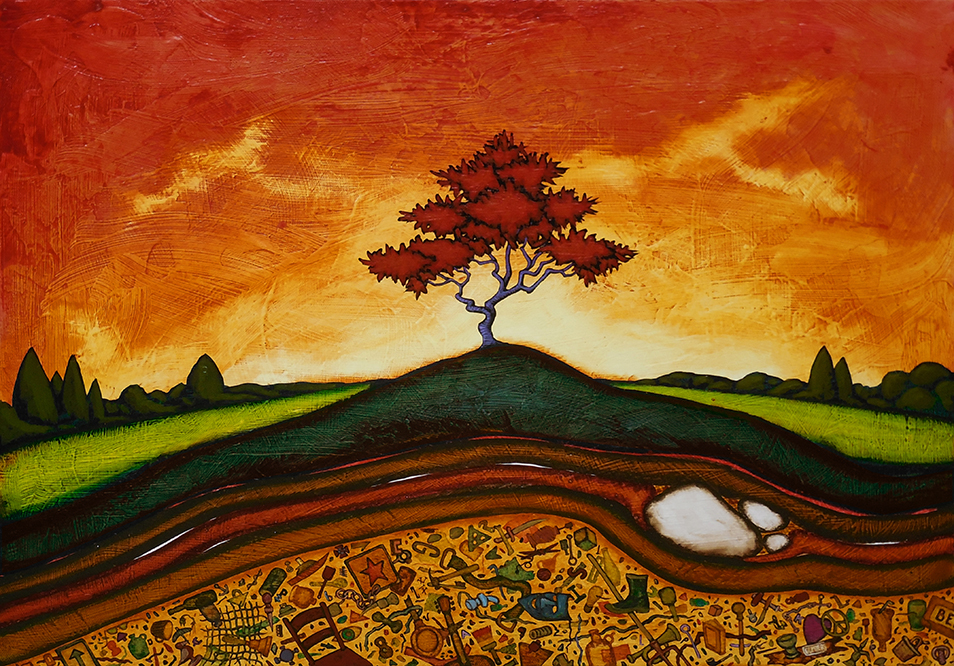
I immediately felt that this might be applied to the painting the top, In the Pocket of Time. It’s a painting (30″ by 24″ on canvas) from 2014 that I brought to the Principle Gallery this past weekend as part of a group of work featured at my Gallery Talk there. It is from a subset of my Archaeology series that I call my Strata work. It is much like the Archaeology pieces without evidence of humans, focusing instead on the layers below the surface.

This particular painting from that Strata series has been with me for a while now. It hung for the last few years in a back bedroom/storage space of my studio. It reminds me of fine wine as it seems to get better with time. I am more and more struck by its surface finish and the rhythm of the strata, as well as how well it transmits its feeling and message from the wall. It’s a piece that speaks directly to me.

Putting Emerson’s thought to it deepened my appreciation of it. I could see in it how we deal always with what is presented on the surface and how seldom we recognize how much more there is to discover if we would only dig a little deeper.

That might be a gross simplification. Or not. Who knows? The words and the mage just seemed to click for me and maybe that’s enough to say.

Let’s tie this up with some music. Here’s a 1992 song from Peter Gabriel titled Digging in the Dirt.  The video is from the same time frame as his Sledgehammer song/video and, like it, this video has some interesting visuals.


Read Full Post »

Edward Hopper -Early Sunday Morning 1926

Edward Hopper -Early Sunday Morning 1926


Freedom’s just another word for nothing left to lose
Nothing don’t mean nothing honey if it ain’t free


Things have been a bit hectic and I failed to mention the death of Kris Kristofferson this week at the age of 88. The line above from his song Me and Bobby McGee, has echoed in my mind since I was a kid. So much so that when a high school English teacher asked our class how we would define freedom, I quoted that line as my answer. He took off his shoe and threw it at me.

The following paragraphs are taken from a post from a few years back, on his 85th birthday.

Kris Kristofferson was many things in his life, as the bio on his website points out:

He was an Oxford scholar, a defensive back, a bartender, a Golden Gloves boxer, a gandy dancer, a forest-fighter, a road crew member, and an Army Ranger who flew helicopters. He was a peacenik, a revolutionary, an actor, a superstar, a Casanova, and a family man. He was almost a teacher at West Point, though he gave that up to become a Nashville songwriting bum.

Definitely one of the more interesting people of our time. And a helluva songwriter.

As I mentioned, Me and Bobby McGee is burned into my brain, especially the version from Janis Joplin. He also dated Janis for a while, which adds to his interest factor. There are plenty of other songs to mention– Help Me Make It Through the Night, Why Me, For the Good Times, etc.–but for me, my mind always goes to either Bobby McGee or to Sunday Morning Coming Down, whose big hit for Johnny Cash remains a favorite of mine.

The feel of Sunday Morning Coming Down is unmistakable and for someone who grew up when the Blue Laws were still in effect and Sundays were, for the most part, shut down affairs, it rings true. The Edward Hopper painting at the top, a favorite among many other Hopper favorites, captures that same feeling for me.

The angle of the sunlight creates an unflinching glare on the storefronts that feels like it is burning off the sins of the night before.  It has that stillness that comes after long Saturday nights spent knowing that the following day was there for recuperating.

And it brings up the memory of the weekly Sunday dinner from that time. Ours was often a roast chicken meal, if we weren’t going to another relative’s home for the meal.

The song opens up floodgates of memory and feeling. Though the world is now 24/7 all systems go-go, this song takes me back to those slow-moving Sundays of my childhood. There were many Sunday mornings and throughout my life that had that same quality of sunlight and stillness. That surge of personal memory makes this song so memorable for me.

Anyway, here’s the late Kris Kristofferson and Johnny Cash performing his Sunday Morning Coming Down. Thanks for the music and good travels to you, Kris.


Read Full Post »


GC Myers-- Archaeology- The Golden Age Beyond

Archaeology: The Golden Age Beyond — At Principle Gallery


At Saturday’s Gallery Talk at the Principle Gallery, I started by speaking about how my painting came about as a result of a lifelong search to identify my own belief system. I feel that everyone has some sort of belief system– even atheism is a belief system– and had always wanted to understand why we were here and what our purpose truly was.

Eventually, the talk turned to the Red Tree. That was fortuitous since it has become an icon for me of some sort of the sort of cobbled together belief system I have come to hold. I went on to read a passage from Hermann Hesse on his own feelings on the meaning and importance of trees.

Hesse holds a place in the formulation of my belief system, something I didn’t mention this during the talk. At a dark low point in my life, I had come across a book, Demian, by Hermann Hesse that I believe saved my life. I have read many of his other works and have gleaned bits here and there but that one resonated most with me and the turmoil I was experiencing at the time.

But I was equally affected when I came across the passage from Hesse below on what we can learn from listening to trees from Hermann Hesse. The late Nobel Prize winning writer included this in his 1920 book, Wandering: Notes and Sketches. It well describes much of what I have received from the Red Tree, things that have contributed to my belief system.

There is a lot to like here but I was most struck by the line: Home is neither here nor there. Home is within you, or home is nowhere at all.

That line would be included in the Proverbs section of my belief system.

I thought it would be fitting to include his essay here once again. I have also included a reading of this selection at the bottom. I have listened to several and they often miss the mark for me. This one is fairly good, in my opinion. But perhaps you should just read it in your own voice. Here it is, if you choose that route:

For me, trees have always been the most penetrating preachers. I revere them when they live in tribes and families, in forests and groves. And even more I revere them when they stand alone. They are like lonely persons. Not like hermits who have stolen away out of some weakness, but like great, solitary men, like Beethoven and Nietzsche. In their highest boughs the world rustles, their roots rest in infinity; but they do not lose themselves there, they struggle with all the force of their lives for one thing only: to fulfill themselves according to their own laws, to build up their own form, to represent themselves. Nothing is holier, nothing is more exemplary than a beautiful, strong tree. When a tree is cut down and reveals its naked death-wound to the sun, one can read its whole history in the luminous, inscribed disk of its trunk: in the rings of its years, its scars, all the struggle, all the suffering, all the sickness, all the happiness and prosperity stand truly written, the narrow years and the luxurious years, the attacks withstood, the storms endured. And every young farmboy knows that the hardest and noblest wood has the narrowest rings, that high on the mountains and in continuing danger the most indestructible, the strongest, the ideal trees grow.

Trees are sanctuaries. Whoever knows how to speak to them, whoever knows how to listen to them, can learn the truth. They do not preach learning and precepts, they preach, undeterred by particulars, the ancient law of life.

A tree says: A kernel is hidden in me, a spark, a thought, I am life from eternal life. The attempt and the risk that the eternal mother took with me is unique, unique the form and veins of my skin, unique the smallest play of leaves in my branches and the smallest scar on my bark. I was made to form and reveal the eternal in my smallest special detail.

A tree says: My strength is trust. I know nothing about my fathers, I know nothing about the thousand children that every year spring out of me. I live out the secret of my seed to the very end, and I care for nothing else. I trust that God is in me. I trust that my labor is holy. Out of this trust I live.

When we are stricken and cannot bear our lives any longer, then a tree has something to say to us: Be still! Be still! Look at me! Life is not easy, life is not difficult. Those are childish thoughts. . . . Home is neither here nor there. Home is within you, or home is nowhere at all.

A longing to wander tears my heart when I hear trees rustling in the wind at evening. If one listens to them silently for a long time, this longing reveals its kernel, its meaning. It is not so much a matter of escaping from one’s suffering, though it may seem to be so. It is a longing for home, for a memory of the mother, for new metaphors for life. It leads home. Every path leads homeward, every step is birth, every step is death, every grave is mother.

So the tree rustles in the evening, when we stand uneasy before our own childish thoughts: Trees have long thoughts, long-breathing and restful, just as they have longer lives than ours. They are wiser than we are, as long as we do not listen to them. But when we have learned how to listen to trees, then the brevity and the quickness and the childlike hastiness of our thoughts achieve an incomparable joy. Whoever has learned how to listen to trees no longer wants to be a tree. He wants to be nothing except what he is. That is home. That is happiness.


Read Full Post »

« Newer Posts