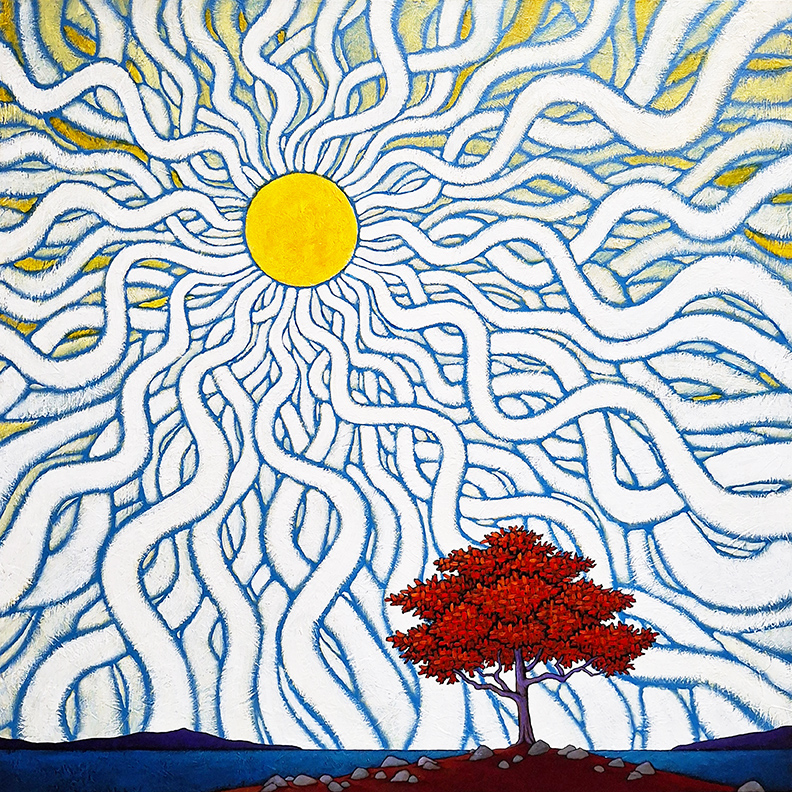
Quiet Revelation-Now at Principle Gallery
The problem in middle life, when the body has reached its climax of power and begins to lose it, is to identify yourself, not with the body, which is falling away, but with the consciousness of which it is a vehicle. And when you can do that, and this is something learned from my myths, What am I? of which the bulb is a vehicle?
One of the psychological problems in growing old is the fear of death. People resist the door of death. But this body is a vehicle of consciousness, and if you can identify with the consciousness, you can watch this body go like an old car. There goes the fender, there goes the tire, one thing after another— but it’s predictable. And then, gradually, the whole thing drops off, and consciousness rejoins consciousness. It is no longer in this particular environment.
~Joseph Campbell, The Power of Myth
That is a great question: Are we the bulb that carries the light, or are we the light?
While I believe there may be an absolute answer that is deeply etched in whatever makes up and energizes the universe, the answer for our time here in this small world is determined by each of us.
We can see ourselves as being only a physical being. A body with a brain that is simply another part of it. And maybe that is all the brain is, a control module that exists to help the body maneuver and survive this world, with very little to do with our actual consciousness– that light, that lifeforce, that we carry and emit.
Or we can see ourselves as that light that is something apart from and only temporarily contained by our physical vessels. That we are that lifeforce that exists beyond our time here in this plane.
In our youth, we tend to see only the physical nature of our being- strength and beauty and the quickness of the mind. I thought that way for a while. But over the years, witnessing others struggle with disease and death while experiencing my own aging with the dings, dents, and slipping gears that accompany it, to continue the old car metaphor Campbell employed above, I definitely see things more in the latter mode, that we are the light, the consciousness, that is carried by the bulb that is our body. And someday, sooner or later, when our engine is blown and our fenders rotted off as the tow truck comes to haul us to the junkyard, our consciousness will go on.
Cosciousness shall rejoin the greater consciousness. Our light will rejoin the greater light.
Just a thought, my own viewpoint as an old Subaru, this morning. I could go on, of course, and maybe I am remiss in not doing so. But I think I’ve said enough this morning and I’ll let you fill in the blanks like it’s some sort of philosophical Mad-Libs.
Besides, I want to get to the Sunday Morning Music for this week.
Here’s a great version of This Little Light of Mine from bluegrass legend Ralph Stanley. I had the great pleasure of seeing him perform a number of years back at Radio City Music Hall as part of the Down From the Mountain tour which featured the many singers and musicians– Alison Krauss & Union Station, Emmylou Harris, Gillian Welch, Patty Loveless, and Stanley— whose music played a large role in the film O Brother, Where Art Thou? Stanley’s performance of O Death was perhaps the most powerful moment from a memorable show.
 Redtree Times
I love bluegrass, and Ralph Stanley, and this song. Your selection brought to mind this fabulous collaboration that you need to see if you already haven’t. There’s a list of the musicians involved in the description.
As for Campbell’s metaphor, who knows? Maybe we’ll end up discovering that death’s nothing more than a return to a high end body shop that’s capable of restoration to factory condition!
But there’s always the possibility that if you were a little lax in caring for your previous vehicle, you might come back as a 1987 Yugo.
Love the Earl Scruggs video. I had not seen this particular one but have seen him play a number of times with very eclectic groups of musicians. One of my favorite Flatt & Scruggs songs was their cover of Dylan’s “Down in the Flood.”
This piece isn’t just a reflection on aging—it’s a hand extended into the mystery of being. The question “Are we the bulb or the light?” quietly reverses the usual way we relate to ourselves. The body isn’t the self—it’s the vessel. The light is what we truly are.
Watching our body age, he writes, is like watching an old car rust away—and if we can identify with the consciousness instead of the vehicle, death becomes less frightening and more like returning home. That’s not escapism—it’s clarity.
Thank you for pointing out that our real identity isn’t in our parts, but in the light that carries on when the parts have done their work.
Yes, you’re correct–there is clarity in this idea of returning to our normal state of being after a short time spent here in the physical plane. And it does indeed make it less frightening. Thanks!
“Exactly — that return softens the edges of fear. When seen this way, aging isn’t a dimming but a rejoining, like the bulb being set aside yet the light itself remaining untouched. Thank you for framing it with such grounded clarity — it turns mystery into comfort.”