Feeds:
Posts
Comments

Archive for the ‘Advice’ Category

I was going through the blog from a few years back and came across this post, one that had slipped my mind. Reading it again was what I needed this morning. Sometimes you need a reminder to just sit down and be quiet. Thought it might be a good replay for these hectic days..
GC Myers- Trio:Three Squares
I came across this poem from author Wendell Berry on Maria Popova‘s wonderful site, Brain Pickings. It’s a lovely rumination that could apply to any creative endeavor or to simply being a human being. I particularly identified with the final verse that begins with the line: Accept what comes from silence. I’ve always thought there was great wisdom and power in silence, a source of self-revelation. Perhaps that is why so many of us shun the silence, fearing that it might reveal our true self to be something other than what we see in the mirror. Berry’s words very much sum up how I attempt to tap into silence with my work.

At the bottom is a recording of Wendell Berry reading the poem which gives it even a little more depth, hearing his words in that rural Kentucky voice. It’s fairly short, so take a moment, sit down, be quiet, and give a listen.

HOW TO BE A POET
(to remind myself)

Make a place to sit down.
Sit down. Be quiet.
You must depend upon
affection, reading, knowledge,
skill — more of each
than you have — inspiration,
work, growing older, patience,
for patience joins time
to eternity. Any readers
who like your poems,
doubt their judgment.

Breathe with unconditional breath
the unconditioned air.
Shun electric wire.
Communicate slowly. Live
a three-dimensioned life;
stay away from screens.
Stay away from anything
that obscures the place it is in.
There are no unsacred places;
there are only sacred places
and desecrated places.

Accept what comes from silence.
Make the best you can of it.
Of the little words that come
out of the silence, like prayers
prayed back to the one who prays,
make a poem that does not disturb
the silence from which it came.

Wendell Berry

Read Full Post »

A blog post that ran here a couple of years back with some advice from poet e e cummings is consistently one of my most popular, always getting a number of hits. For example, there was quite a pop in its numbers yesterday. I don’t know what brought it on but it made me want to revisit the post. Reading it again made me appreciate even more the words. Even though it was aimed at potential poets it rang equally true for me as a painter, especially when I substituted the word painter for poet, paint for words, and painting for poetry.

I thought I’d replay it today doing just that. Where there is a word like [thiswith brackets, I have substituted an equivalent word. And if you’re not a painter, feel free to use any word that describes what it is you do to express yourself.

I think you might find it inspiring.

+++++++++++++++++

Whenever I am asked to speak with students I usually tell them to try to find their own voice, to try to find that thing that expresses who they really are. I normally add that this is not something that comes easily, that it takes real effort and sacrifice. It is a never-ending struggle.

The great poet e e cummings (you most likely know him for his unusual punctuation) offered up a beautiful piece of similar advice for aspiring poets that I think can be applied to most any discipline.

Or to anyone who simply desires to feel deeply in this world.

I particularly like the line: To be nobody-but-yourself in a world which is doing its best, night and day, to make you everybody else-means to fight the hardest battle which any human being can fight; and never stop fighting. That line alone speaks volumes.

Take a moment to read this short bit of advice and see what you think– or feel.

*******************

A [Painter’s] Advice To Students

Borrowed from (e e cummings)

A [painter] is somebody who feels, and who expresses his feeling through [paint].

This may sound easy. It isn’t.

A lot of people think or believe or know they feel-but that’s thinking or believing or knowing; not feeling. And [painting] is feeling-not knowing or believing or thinking.

Almost anybody can learn to think or believe or know, but not a single human being can be taught to feel. Why? Because whenever you think or you believe or you know, you’re a lot of other people: but the moment you feel, you’re nobody-but-yourself.

To be nobody-but-yourself in a world which is doing its best, night and day, to make you everybody else-means to fight the hardest battle which any human being can fight; and never stop fighting.

As for expressing nobody-but-yourself in [paint], that means working just a little harder than anybody who isn’t a [painter] can possibly imagine. Why? Because nothing is quite as easy as using [paint] like somebody else. We all of us do exactly this nearly all of the time-and whenever we do it, we’re not [painters].

If, at the end of your first ten or fifteen years of fighting and working and feeling, you find you’ve [painted one part of one real painting], you’ll be very lucky indeed.

And so my advice to all young people who wish to become [painters] is: do something easy, like learning how to blow up the world-unless you’re not only willing, but glad, to feel and work and fight till you die.

Does this sound dismal? It isn’t.

It’s the most wonderful life on earth.

Or so I feel.

Read Full Post »

A number of artists, take Picasso and De Chirico for examples, talk about about trying to maintain the mind of a child in order to create art. I think there is definitely something to that.

I know that I feel best about my work when kids are attracted to it and know a work is at its best when a kid gives it their approval. They look at it without preconceptions and biases, judging it solely on how it speaks to them personally. They often can read the emotional tenor and meaning of the work without needing explanation of any sort. They seem to have a built-in ability to read the innate symbolism of art.

How to stay in that dreamlike state, that mind of a child? That is the real question and I don’t know that there is an answer. Maybe not trying to answer the question is part of the answer. Just do the work with the trust that you are being open and honest without condescending your message to anyone. Perhaps then the work may approach that goal, might speak with and to the mind of a child.

Or so I hope.

Read Full Post »

+++++++++++++++

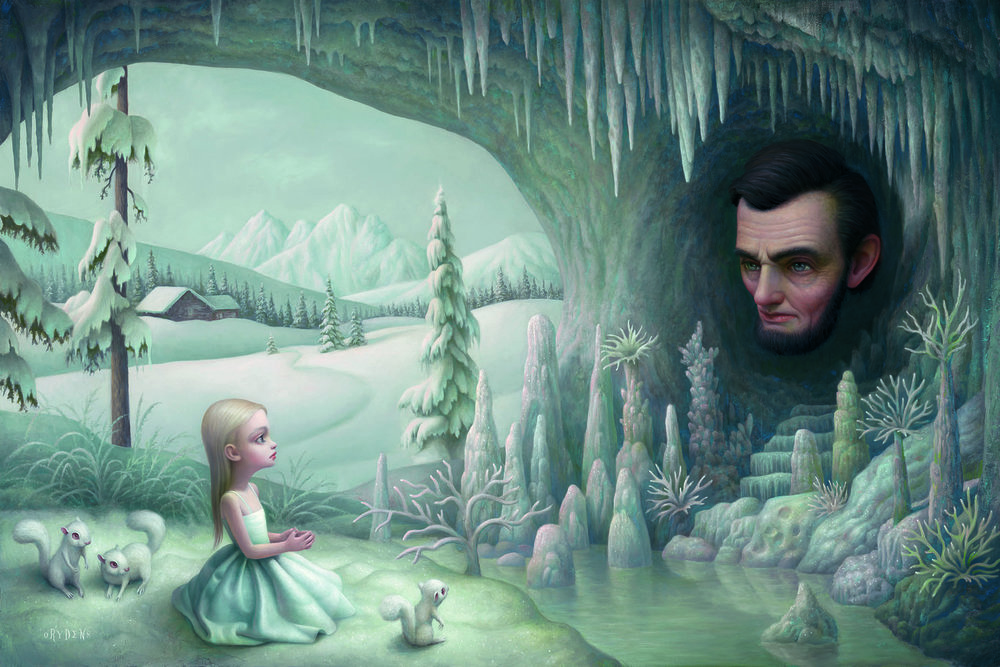
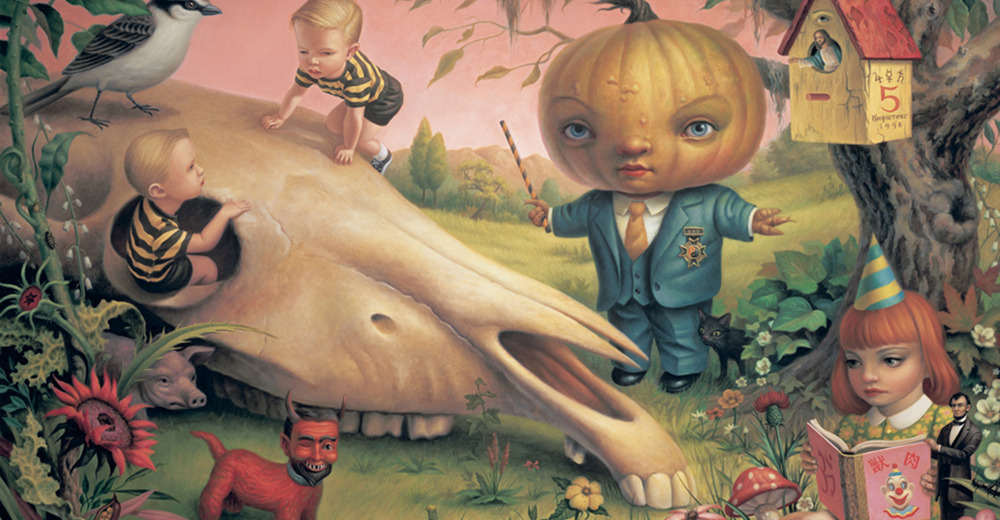
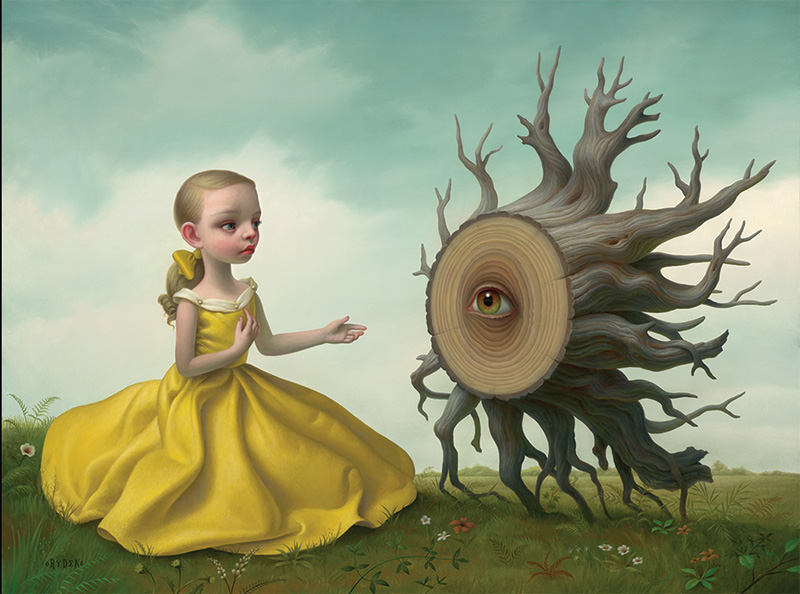
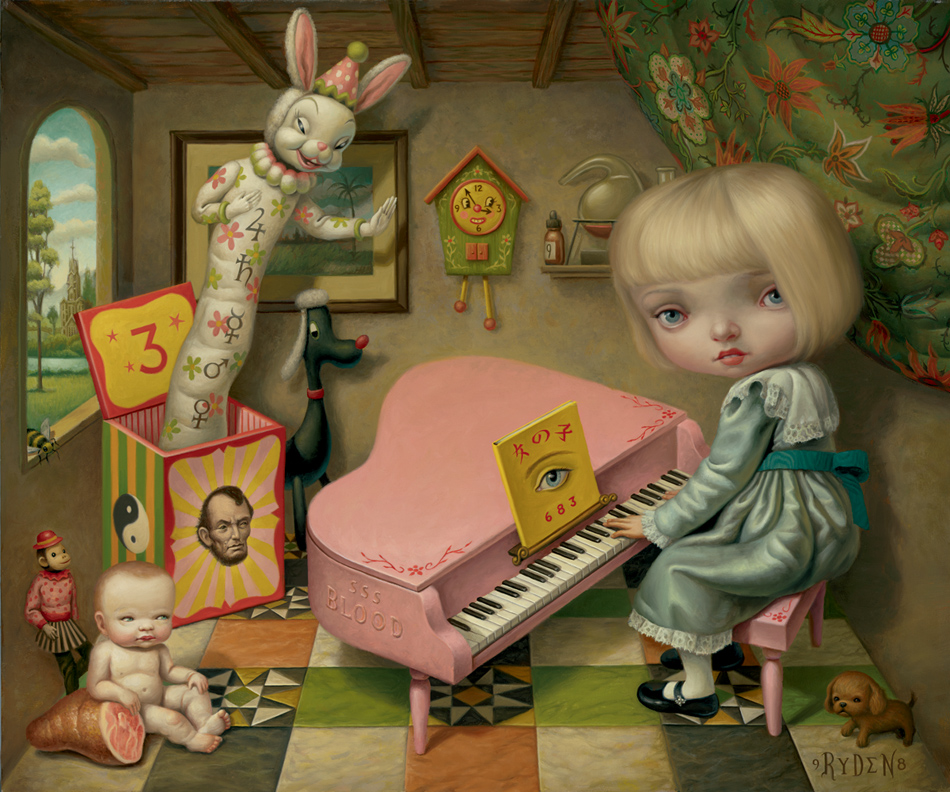
People have the idea that an image must stand for something else, that the real meaning needs to be described with language. Instead it is the image itself that is the meaning.

Mark Ryden

+++++++++++++++

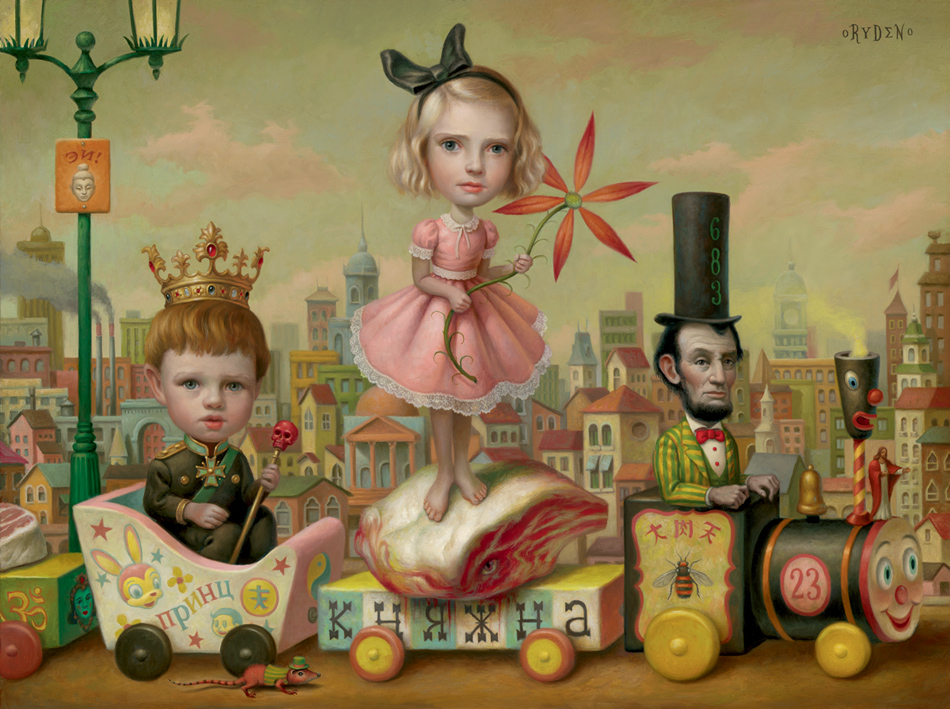
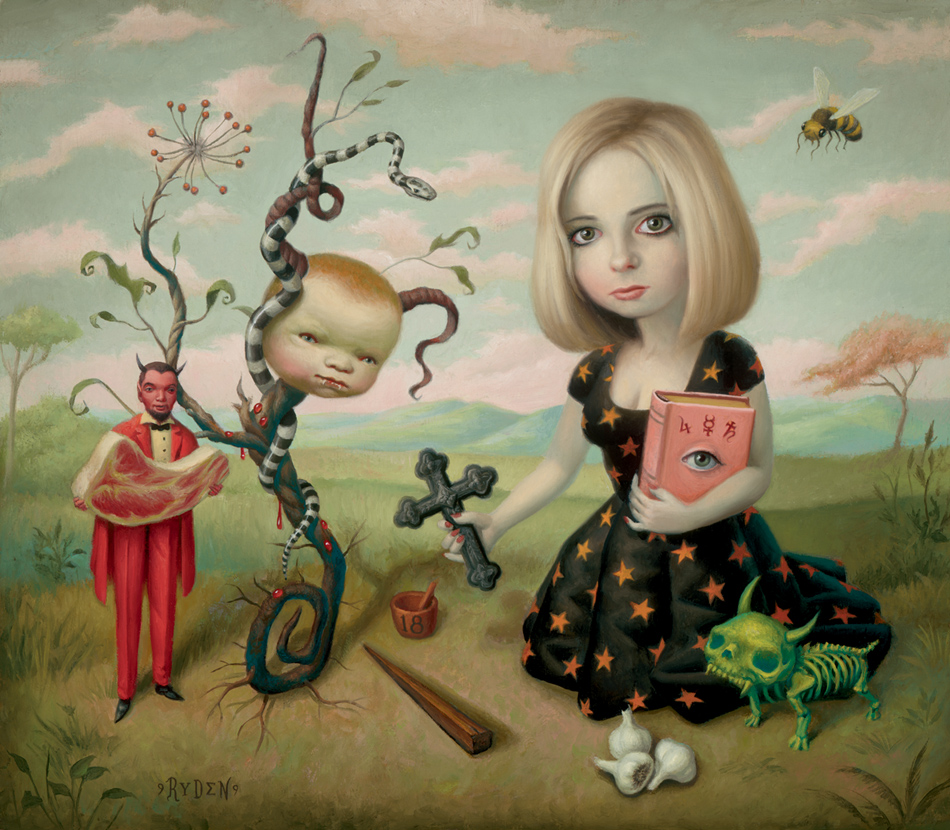
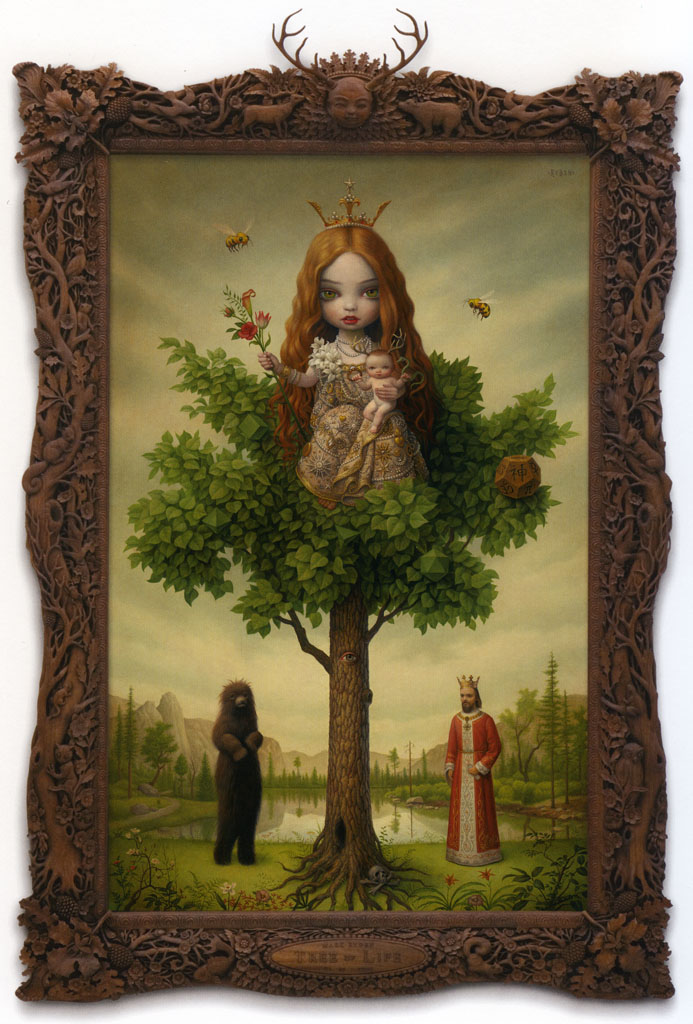
I came across the quote above from contemporary artist Mark Ryden and it struck a chord with me. So, often an image has a feeling to it  that is beyond words that adequately describe it. I know I have sometimes written about a piece of  mine and even though I have tried to fully describe how it strikes me, I often feel that the words fall well short.

Sometimes you just have to let the image be what it is.

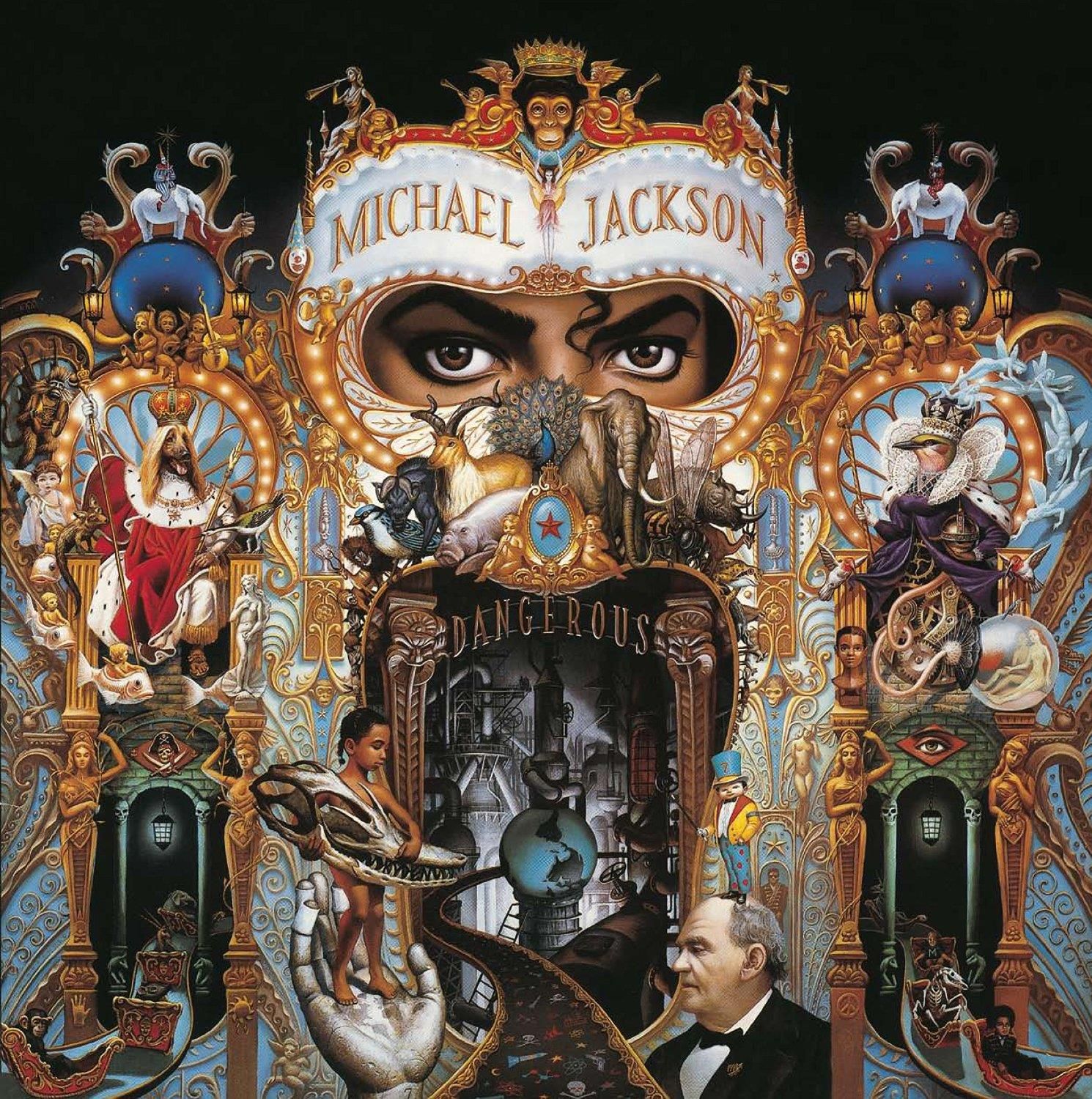
Now, to be honest, I don’t know a lot about Mark Ryden except that he is a contemporary big name artist that works in the genre of Pop Surrealism. His work is sometimes also called Lowbrow which is a movement that began in LA in the 1970’s based on underground comix, punk music and other fringe pop references such as the tiki and hot rod cultures of the region. You may best know his work from his album cover painting for Michael Jackson’s Dangerous.

His work is engaging and appealing on many levels with recurring themes that run through the work. It is rich in symbolism though I think there is so much ambiguity that one could get lost in trying to decode many of the paintings. Which makes his statement about the image itself being its own meaning even more understandable.

I also came across another quote from Ryden that hits close to home for me: I believe if you follow your heart and do what you love, success will follow. If you enchant yourself, others will be too.

It’s something I have been saying for many years now. The biggest challenge as an artist is creating in yourself an excitement with your own work. If you are excited– enchanted in Ryden’s words– by it, more likely than not, it will excite others as well.

I can see where Ryden would be exchanted in his own work. It is something to which any artist in any field should aspire.


Read Full Post »

_________________________

Art is not a handicraft, it is the transmission of feeling the artist has experienced.

-Leo Tolstoy

_________________________

I don’t know about the accuracy of this quote. Tolstoy did write about art and the transmission of emotion through it but I can’t vouch for the precision of the wording in the widely accepted quote.

But I do heartily agree.

Craftsmanship– handicraft– definitely has a part to play but that alone cannot transport the viewer to that inner spring from which their emotions flow. Something might be beautifully crafted but unless it is constructed from the empathy, the love, the awe, the wonder and the wide assortment of feelings that define tour humanity, it remains just a lovely object.  Beautiful but coolly devoid of feeling.

And there is nothing wrong with that.

But the aim of the artist, at least to my mind, should be to engage the the emotions of the viewer ( or listener or reader, whatever their medium might be) with their own. To create a sort of communion of feeling between the artist and the recipient.

Can this be taught? I don’t know. I try to tell students to read, to look, to listen, to practice a sense of empathy in their daily lives. Widen their view and become a fuller person. I think art comes from an equal blend of one’s handicraft and their sense of humanity.

That’s just my opinion and it may be as flawed an idea as the mind that thinks it. But I can stand behind that thought and hope, in some small way, to achieve that blend in my own work.


The painting at the top is Find Your Light, a 36″ by 36″ canvas, that is a central part of my show, The Rising, at the West End Gallery that ends tomorrow.

Read Full Post »

++++++++++++++

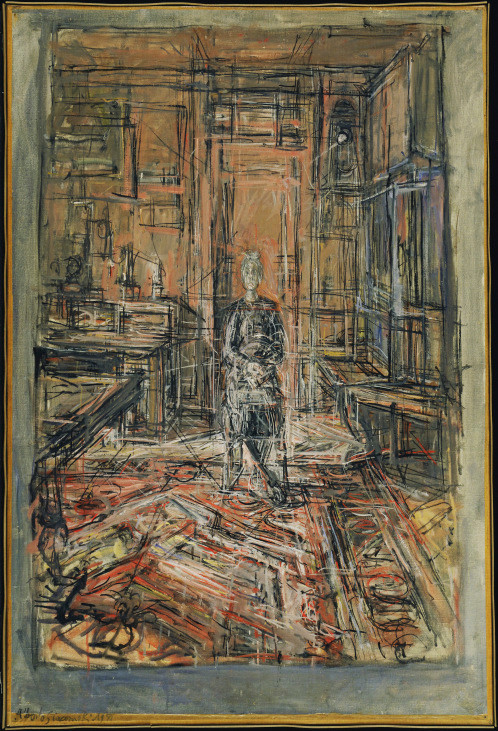
If only someone else could paint what I see, it would be marvelous, because then I wouldn’t have to paint at all.

Alberto Giacometti
.
++++++++++++++
.
This quote from the great sculptor/painter Alberto Giacometti reminds me of a bit of advice I’ve attempted to pass on for a number of years: Paint the pictures you want or need to see.
.
This idea that I wasn’t finding what I sensed I needed to see drove me early on and still does today.
.
It makes me wonder if I had been aware of someone painting the pictures that I now paint when I was first starting out, would I be painting now? Would there be a need?
.
Even though I want to say that, yes, I would definitely still be painting, I really can’t fully say that mainly because the little spark of doubt it creates makes me think it might well be true. But, of course, it would have to fully satisfy my need and maybe no one artist could do that. Or maybe even seeing that needed work might spark a new need, a further boundary.
.
Hmm. Something to chew on this morning. Now, I best get to work. If no one else will paint the pictures I need to see, I better get going.

Read Full Post »

+++++++++++++++++++

GC Myers-  Inner Perception smallThis is a painting from a few years back that has toured around a bit and found its way back to me. Called Inner Perception, it has been one of my favorites right from the moment it came off my painting table. Maybe the inclusion of the the paint brush (even though it is a house painter’s brush) with red paint in the bristles makes it feel more biographical, more directly connected to my own self. Or maybe it was the self-referential Red Tree painting on the wall behind the Red Chair.

I don’t know for sure. But whatever the case, it is a piece that immediately makes me reflective, as though it is a shortcut to some sort of inner sanctum of contemplation. Looking at it this morning, the question I was asked at the Principle Gallery talk a week or so ago re-emerged, the one that asked what advice I might give my fifth-grade self if I had the opportunity. I had answered that I would tell myself to believe in my own unique voice, to believe in the validity of what I had to say to the world.

I do believe that but I think I might add a bit to that answer, saying that I would tell my younger self to be patient and not worry about how the world perceives you. That if you believed that your work was reflecting something genuine from within, others would come to see it eventually.

I would also add to never put your work above the work of anyone else and, conversely, never put your work beneath that of anyone else. I would tell myself to always ask , “Why not me?”

This realization came to me a couple of years ago at my exhibit at the Fenimore Art Museum. When it first went up it was in a gallery next to one that held the work of the great American Impressionists along with a painting from Monet. I was greatly intimidated, worrying that my work would not stand the muster of being in such close proximity to those painters who I had so revered over the years. Surely the greatness of their work would show me to be a pretender.

But over the course of the exhibit, that feeling faded and the intimidation I had initially felt turned to a type of defiant determination. I began to ask myself that question: Why not me?

If my work was genuine, if it was true expression of my inner self and inner perceptions, was it any less valid than the work of these other painters? Did they have some greater insight of which I was not aware, something that made their work deeper and more connected to some common human theme? If, as I believe, everyone has something unique to share with the world, why would my expression of self not be able to stand along their own?

The answer to my question was in my own belief in the work and by the exhibit’s end I was no longer doubting my right to be there. So to my fifth-grade self and to anyone who faces self-doubt about the path they have chosen, I say that if you know you have given it your all, shown your own unique self, then you must ask that question: Why not me?

Read Full Post »

++++++++++++++++++

Charles Burchfield- Sun and Rocks- Albright-Know Art GalleryAn artist must paint not what he sees in nature, but what is there. To do so he must invent symbols, which, if properly used, make his work seem even more real than what is in front of him.

–Charles Burchfield

*********************

I am a big fan of the work of Charles Burchfield (1893-1967), a western  New York painter who lived and painted in the Buffalo area for most of his life. His work was decidedly visionary in its scope, taking the environment that he knew around western New York and embellishing it with a life force and energy that he sensed beneath the surface. That’s what he was referring to in the quote above– taking what you see around you and not simply recording it but painting how it moves you emotionally. To me, his work is as emotionally charged in the same way as that of Van Gogh.

Charles Burchfield- An April Mood- Whitney Museum of American ArtCreating symbols, as Burchfield refers to in the quote, has been a big part of my work. I have long emulated his use of creating a visual vocabulary that moved through a body of work. It becomes a sort of language of its own  that people who take it in and understand it find easy to read and absorb as they move from picture to picture. Those who can’t read it find less in the images and feel less drawn into them. In an earlier post featuring Burchfield, I wrote about an artist friend who just didn’t get Burchfield’s work in any sense.  He just one of those people who couldn’t read the language clearly written in the work.

I also have been influenced by the way Burchfield would constantly go back to earlier work and use it as a new starting point, as though the added knowledge gained through the years would take this work in a new direction. I often do the same thing, constantly revisiting images and motifs from years ago looking for a thread or path to follow anew.

Even this post is a revisitation, going back and looking at an influence, trying to pull that original inspiration from it. With Charles Burchfield, that’s always an easy thing to accomplish.

Charles Burchfield- Childhood's Garden

Read Full Post »

Jacob Lawrence

Jacob Lawrence- This Is Harlem 1943

+++++++++++++++

My belief is that it is most important for an artist to develop an approach and philosophy about life – if he has developed this philosophy, he does not put paint on canvas, he puts himself on canvas.

Jacob Lawrence
+++++++++++++++
Exactly right.
 .
I often echo the advice in these words from the great Jacob Lawrence when speaking to students. Having all the talent and skill in the world doesn’t matter if one doesn’t have a viewpoint or don’t have something to say to the world.
.
Having a philosophy about life and a need to express their viewpoint guides the artist, allowing them to make the most of whatever talents and skills they do possess.

Read Full Post »

+++++++++++++

How often have I found that wanting to use blue,

I didn’t have it so I used a red instead of the blue.


–Pablo Picasso

++++++++++++++++

This year’s edition of the Genius series begins this coming Tuesday on the National Geographic Channel. This well done series premiered last year with a season dramatizing the life of Albert Einstein. This year it focuses on the life of Pablo Picasso, with Antonio Banderas portraying the artist. Given Picasso’s knack for pushing boundaries and stirring the pot, it could be an entertaining series.

He is probably the most quoted of artists, though many things are mistakenly attributed to him. It’s a case that if it sounds interesting and you’re not sure who might have said it, you credit him or Shakespeare or Lincoln or some other iconic figure.

But I have a feeling that the quote I chose here today is actually his. I can’t see Lincoln saying it.

I certainly know the circumstance to which he refers.

Been there, done that.

In a pinch, you just make do with what you have because you can’t always wait until you have perfect conditions, all the materials you desire and a moment of inspiration are in complete alignment. Sometimes inspiration is there and you don’t have what you would ideally want to use but you still want to make that mark.

A number of years back, I was having some real back problems. I had to that point always painted in a standing position but the pain forced me to sit. I found that there were points where I would reach for a color that I would normally use in certain instances and find it out of reach, across the room. Instead of straining out of my seat and limping to get it, I would take whatever was within my reach and try to either replicate the color or completely substitute another color.

In many ways, it was a good experience. Where I had used reds before, there were blues or greens. Turquoise tended to turn to purples and maroons.

Because my work doesn’t depend on accuracy in depicting natural color, it actually stretched the work a bit more and reinforced that idea that one must make do with what one has at hand. It’s something I have often tried to impress on young artists, that they should never use not having everything they think they need to start as an excuse to not start.

If they have a real creative urge, then they will make do, they will find a way.

The results may exceed what their mind had imagined.


Read Full Post »

« Newer Posts - Older Posts »