Feeds:
Posts
Comments

Archive for the ‘Biographical’ Category

++++++++++++++++++++

There is an electric fire in human nature tending to purify – so that among these human creatures there is continually some birth of new heroism. The pity is that we must wonder at it, as we should at finding a pearl in rubbish.

–John Keats

++++++++++++++++++++

I find myself nodding in agreement with the above words from the poet John Keats. It seems that there is ample evidence that humans have the desire and capability for living heroic lives. Yet to do so is a rare and wondrous thing.

A pearl in rubbish, as he says.

Maybe our failure is that we only see heroism defined in epic terms, not in the bravery of the responsibility that comes in making everyday decisions that opt for doing what is right and not expedient or self-serving. Not every hero wears a cape or jumps from buildings.

It’s a matter of perspective.

I think of when my mother was dying from cancer many years ago now. In her final months, she had a picture next to her bed of my father in a small cheap frame with press-on letters on the bottom leg of it that spelled out the word hero.

Now, hero is not a term I have often equated with my father, a man who is deeply flawed in many ways. I confess that, in this aspect, the apple doesn’t fall from the tree.

But this was especially evident when it came to his relationship with my mother. Most of their life together was loud and contentious. They were always one word or a single side glance away from their next battle royale, the horror shows of mine and my siblings’ childhoods.

But somehow through the years of anger and adversity she still saw something in this man that she recognized as being heroic. Maybe it was that he had simply stayed, had maintained a sense of responsibility and caring for her that became very obvious in her last days.

I will never know for sure. The psychology of it all evades me. But that cheap frame on a dying woman’s bedside table with that word hero on it still lingers with me and always will.

It’s a matter of perspective.

I didn’t plan on writing this for today’s post, didn’t seek to be so personally biographical. It just came and I guess I can live with that. I only wanted to jot down a little something to introduce the song below for this Sunday morning music. It is one of my favorite David Bowie songs, Heroes, performed by the Ukulele Orchestra of Great Britain. I know it sounds like it should be a joke or a parody but it’s a wonderful version. I think my mom might well understand it.

Have a good day. Be a hero to somebody.


Read Full Post »

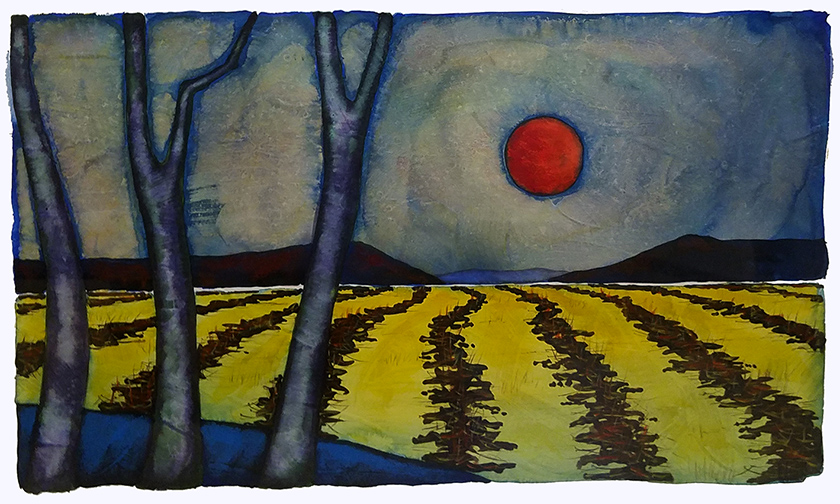
I was in my basement earlier moving some things around, trying to get somewhat organized, when I came across a box with a handful of giclee prints of my work  from 2001. I hadn’t went through this box in a while so took a few minutes to see what was there.

My eyes settled for a bit on the piece shown above, titled Give the Wind Its Due. I’d looked at it many times over the years but it was always for but an instant, just in quickly passing over it. But this morning, I took a minute and really looked. It tried to remember what I could of it from back in 2001. It was a large painting, I remember that, measuring 36″ high by 48″ wide on birch panel.

It was painted with oils rather than acrylic. I used oils as often as I would use acrylics around that time. I transferred almost solely to acrylics in the next few years, that medium better matching my technical and thought process. I found that I was too impatient to wait to get the effects I wanted with oils. The quicker drying time of acrylics allowed me to dive back in sooner while I was still focused in on what I was seeing and where I saw it going.

But this piece oil worked well as it was. It still worked and stood out for me now. Hopefully, whoever has ownership of this piece thinks so, as well. Unfortunately, I have no idea where the original painting is. Like this piece, there are many paintings that will be forever lost to me. I would love to see some of these earlier pieces just to examine the surfaces closely. Look at the edges and how the colors layer together.

In looking, I try to remember what I was doing then that I don’t do now, sometimes from just forgetting how it was done in that particular moment. I sometimes have memory problems when it comes to procedural items.

There are maintenance things that I have to do every year around the house or studio and I often have to go to the printed directions because my memory refuses to hold those details. Unfortunately, this also sometimes extends to my own work procedures. Revisiting older work sometimes is like looking at those printed directions and I find myself saying to myself, “Oh, so that is how I did that!

I find that there’s a lot to be learned from looking back periodically.

Maybe that applies to life as much as art. Or maybe not.

I can’t really say.

Read Full Post »

I came across this blogpost that first ran back in 2009. It’s about a fellow that was in my family’s orbit as teenager. He would probably be classified as marginal, someone who didn’t fit into most categories or social classes. Sadly, these marginal folks are most often quickly forgotten. But sometimes they leave a deep impression. Take Fat Jack, for example.

+++++++++
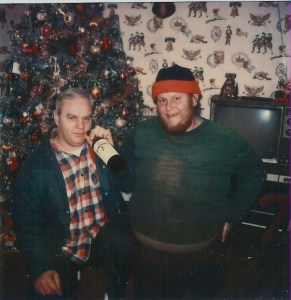
I came across this old photo from the early 70’s and was instantly sent back in time. The two gents in the shot from a Christmas season long ago are my Uncle Joey (holding the Seagrams 7 bottle– I’m not sure that he was just mugging for the camera) and Jack Reynolds, who everyone called Fat Jack , Jackboy or, as my Dad would say, Jackeee.  You need to pronounce all three e’s to get the full effect.

In 1972, we moved from one edge of our county to the other, to a little remote brick house on a high hilltop plateau where the wind always swirled and the view south went for many dozens of miles, across a multitude of hilltops down across the border into northern Pennsylvania. It was exquisitely quiet there, often many hours passing before a car might appear on the narrow road.

My aunt Norma and her husband, Bob, ran a large dairy farm just over the ridge and Fat Jack would often be seen there tinkering with the equipment, his short, round body rolling around in the dirt under tractors in his ever present filthy bib overalls, crudely cut off at the cuffs to accommodate his short legs. On his feet were his ever present dime store canvas sneakers.

Jack and his dad lived at the bottom of the hill in a  home that his father had started building in the 50’s. When Jack’s mom died, they had only finished the basement and that is where they stopped. The father and son lived in the small walkout basement, that had a dark and dank appearance when you drove by.

At the time when I first met him, Jack was in his early 20’s and didn’t have a driver’s license. But he could seen chugging up the hills on an old Ford tractor pulling a wooden trailer with a large collection of his tools and paraphernalia. I can still vividly see him in my mind with his little rig of tools chugging along the cow pastures to my aunt’s farm.

Jack absolutely loved and was fascinated with tools. Any kind. Any spare money he earned went directly towards buying tools, the tool department at Sears being the primary recipient of his spending.

Jack couldn’t read or write very well, if at all. But while he couldn’t read the words, he could read diagrams and schematics like a first language. That was vital to his natural ability for figuring out how things worked. It was an ability made him a valuable asset to a farm where there are always things in need of repair. Bob, as well as several other local farmers, was always asking him to work on this or that at the farm.

But if Jack didn’t want to do something for whatever reason, he would just say “Nope” with his stained and gapped with missing teeth grin and pick up his tools. But he’d stick around for the conversation and maybe a meal.

When we moved up on the hill, Jack started coming to our house to do a few repairs there. He took an instant attachment to my dad and my dad took to him as well. He became a regular fixture at our house, fixing things around the place and more often than not eating dinner with us or drinking a beer with Dad. He had an appropriately large appetite for both food and drink. Bob called him my father’s third son.

Jack was not big on hygiene.  That’s actually a gross understatement. His overalls were always dirty and oil-stained from working on machines and engines. His hair was a greasy mat under the stocking cap that seemed permanently attached to his head and there was often a pungent odor that was a mix of used motor oil, fried food and sweat.

Night after night he would plop himself in one of my mother’s upholstered chairs in our living room to the point that there was a dark, greasy line on the arms of the chair where his ample belly would rest. My mother kept a pristine house so it drove Mom crazy to the point she would bellow at him–she wasn’t shy about yelling at anyone in her house. Jack would just grin.

And though she might have been mad but she would never think of not letting him sit there or at our dinner table. She had a soft spot for marginal people as well.

Eventually, after his own father died, Jack parked his tractor and started driving an old yellowish Ford Econoline— the kind with the flat front sort of like the one the gang drove on the Scooby Doo cartoons!– van packed with his tools. He didn’t have a license but that didn’t stop him from buzzing around the hills around us, being well known to most of the farms in the area. Dad, who was with the Sheriff’s Department, turned a blind eye. Dad would eventually help Jack get a driver’s license and as well as helping him find work as a maintenance man at a local nursing home.

For a while, Fat Jack seemed to be thriving.

Fat Jack passed away sometime in the 1980’s when his Econoline slid off the road not too far from his basement home and hit a viaduct. In the impact, his tools were thrown forward against him, killing him. He probably would have appreciated the irony of it. His funeral was a large affair at Mt. Saviour Monastery which was a short ways from his home. He had also did a lot of work over the years for them.

His basement home is no longer there, long ago bulldozed over and there remains no trace of Fat Jack anywhere but in the memories of a handful of people who got to know this strange little character.  I know I haven’t fully captured the man here but I just felt that he deserved a few moments of recollection.

Everybody does, don’t you think?

Read Full Post »

++++++++++++++++++++++

….This is what you shall do: Love the earth and sun and the animals, despise riches, give alms to every one that asks, stand up for the stupid and crazy, devote your income and labor to others, hate tyrants, argue not concerning God, have patience and indulgence toward the people, take off your hat to nothing known or unknown or to any man or number of men, go freely with powerful uneducated persons and with the young and with the mothers of families, read these leaves in the open air every season of every year of your life, re-examine all you have been told at school or church or in any book, dismiss whatever insults your own soul, and your very flesh shall be a great poem and have the richest fluency not only in its words but in the silent lines of its lips and face and between the lashes of your eyes and in every motion and joint of your body….

—Walt Whitman, Preface to Leaves of Grass

+++++++++++++++++++++++

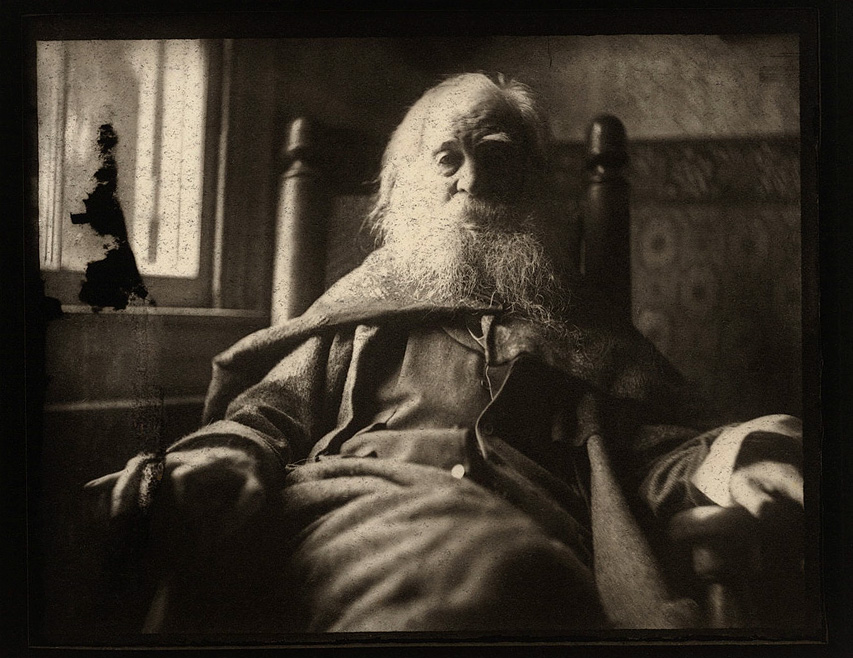
I have always been moved and inspired by the writings of the American poet Walt Whitman. I can find something that speaks directly to me in almost everything of his I come across. For me, he remains one of the most intriguing and unique characters in the American experience in so many ways.

This comes across in the photos of him, including the remarkable portrait above that was taken by the great American painter Thomas Eakins in 1891, a year before Whitman’s death. It has a remarkable feeling of earned wisdom and understanding.

I had always felt a familial bond with him anyway, having called him Uncle Walt for as long as I can remember. He seemed like he was the wise old uncle I wanted growing up, someone who watched over me and imparted bits of wizened advice to me from time to time. So with this great reverence for the man, you can imagine how excited I was when my genealogy revealed that we were related.

Not an uncle.

Cousins.

Okay, 6th cousins. We share a grandparent going back to the early 1600’s, five generation before Whitman and nine generations before me. So, that makes us 6th cousins, 5 generations removed.

That’s like being in the furthest reaches of relationship in the game of 6 Degrees of Kevin Bacon. Sure, we’re related by these tenuous bonds but it is so far removed that it is academic at best. There are probably several hundred thousand, if not a million or more, people with this same bond. So it is certainly no big deal. Interesting but absolutely meaningless and without value.

But when I read a line from Whitman that makes my heart race a bit, that makes my brain and soul stir, I have to admit that it makes me happy that we share that silly, insignificant bond.

I just call him Cousin Walt now.

Read Full Post »

I have been going through my files lately, trying to find some misplaced or lost images and somewhat organize twenty plus years of chaos. I came across this video which I thought I had shared at some point but couldn’t find any evidence anywhere of having done that. So I guess today is a good time to do so.

This slideshow is a group of the images from my Exiles series set to one of my favorite pieces of music, Gymnopédie #1 from composer Erik Satie. I believe this was put together back in 2006.

I’ve written about the Exiles series a number of times here. It was created around the time of my mom’s death back in November of 1995 and focused on how I saw her suffering in the last several months of her life as lung cancer ravaged her body. It’s a personal series, one that was important to me in many ways.

This film is flawed and doesn’t contain all the series images but it captures the series perfectly, at least in how I saw it then and see it now.


Read Full Post »

I have been in a funk in the studio for the past couple of weeks. It feels as though any momentum or confidence about my work that I thought was permanently embedded in myself seems to have completely evaporated. I should have known better than to think that things had changed, that I had somehow gained some new kind of unwavering confidence that would inure me to my natural uncertainty. This happens quite often with me, as I have documented here before. Like the words from Goethe below, my own progression as an artist moves in a spiral, sometimes pulsing forward and some times retreating.

Evolution and dissolution.

I went back to a post that I have twice posted here that describes a time not much different than my current situation. I felt out of sorts and uncertain, definitely in need of a pep talk that could only come from my own experience of overcoming this inertia. Here’s that post:

Robert Smithson Spiral Jetty

Progress has not followed a straight ascending line, but a spiral
with rhythms of progress and retrogression, of evolution and dissolution.

– Johann Wolfgang von Goethe

***********

I was looking at a book catalog yesterday, just browsing for something new and I spotted a book on the works of Robert Smithson, who is best known for his monumental earthworks. The most famous is shown here, the Spiral Jetty, which juts out into the Great Salt Lake in Utah. I’ve always been somewhat fascinated by earth-moving on a large scale and have admired Smithson’s work whenever I came across it.

The reason I mention this now is that I found myself thinking smaller lately, painting smaller paintings for a smaller economy. Part of this was a conscious decision but part was the result of just becoming a little more wary with all the turmoil in the world. There has been a period of introversion marked by a noticeable withdrawal from thinking boldly. Seeing this reminded me of the need to think big.

I realized I had become a bit fearful of pushing myself, perhaps afraid of exposing my limitations. I had lost a little faith in my own abilities, including the ability to adapt to new challenges.

I was being safe. It was the retrogression that Goethe talks of in the quote above. I was in the spiral.

This all flashed in my head within a few seconds of seeing the spiral jetty. Funny how a single image can trigger a stream of thought with so many branches off of it.

I had forgotten that I had to trust myself and throw the fear of failure aside, that thinking bold almost always summons up the best in many people. Once you say that you don’t give a damn what anyone says, that if you fail so be it, the road opens up before you and your mind finds a way to get you on it.

So I have to remember to think big.

To look past the horizon. Just freaking do it.

Then progress will come…

Read Full Post »


“America is the wealthiest nation on Earth, but its people are mainly poor, and poor Americans are urged to hate themselves. To quote the American humorist Kin Hubbard, ‘It ain’t no disgrace to be poor, but it might as well be.’ It is in fact a crime for an American to be poor, even though America is a nation of poor. Every other nation has folk traditions of men who were poor but extremely wise and virtuous, and therefore more estimable than anyone with power and gold. No such tales are told by the American poor. They mock themselves and glorify their betters. The meanest eating or drinking establishment, owned by a man who is himself poor, is very likely to have a sign on its wall asking this cruel question: ‘if you’re so smart, why ain’t you rich?’ There will also be an American flag no larger than a child’s hand – glued to a lollipop stick and flying from the cash register.

Americans, like human beings everywhere, believe many things that are obviously untrue. Their most destructive untruth is that it is very easy for any American to make money. They will not acknowledge how in fact hard money is to come by, and, therefore, those who have no money blame and blame and blame themselves. This inward blame has been a treasure for the rich and powerful, who have had to do less for their poor, publicly and privately, than any other ruling class since, say Napoleonic times. Many novelties have come from America. The most startling of these, a thing without precedent, is a mass of undignified poor. They do not love one another because they do not love themselves.”

Kurt Vonnegut, Slaughterhouse-Five, 1969

++++++++++++++++++++

The above was written almost 50 years back by Kurt Vonnegut. I first read my now worn copy of Slaughter-House Five about 45 years ago and re-read it a number of times in the years that followed though it has been decades since I last read it. When I came across the excerpt above this morning I realized how much it informed and shaped my views on the world.

And how little this country had changed in the 50 years since.

If anything, this loathing of the poor or just those who may not be doing as well as ourselves has accelerated as the sheer numbers have grown due to a population that is now roughly 70% larger than in 1969. It provides some explanation for how the poor and middle-classes could somehow stand behind that thing now lurching around our White House. He is everything they would normally detest: a privileged, loud, rude elitist who flaunts his good fortune and mocks and derides those he sees as being beneath him. Who brags about dining and playing golf with the wealthiest people and hates to shake the hands of the common folk out of fear of their germs. An amoral man who is a known liar and a cheat, especially when it comes to bullying those with little sway who have worked for him.

The why of this is in Vonnegut’s words. It’s the same dynamic that allows people to get angry at the supermarket when they see someone in line ahead of them, especially a person of color, using food stamps. You can see them seething, almost mouthing the words welfare queen. These same people would have no problem with a man, especially a white man in an expensive suit, accepting billion dollar checks as a bail-out for the mistakes of these same men.

Maybe that is what we are seeing, common folks glorifying their betters, as Vonnegut put it. Except this person, this so-called leader, is not their better. He is a glaring symbol of the very worst of their qualities. He is well beneath them if they would only look beyond the cheesy gold patina.

To put it crudely: a gold-plated turd is still just a turd.

And even more than that, he is compromised and beholden to several other nations now.

And these same folks, by extension, are compromised as well. They have forsaken their principles and beliefs for empty promises that were never meant to come true. They would turn their head to corruption and possibly murder so that a wealthy man in a nice suit could make some more money.

It was true in 1969 when Slaughter-House Five came out. It’s true today.

Time to read the book again.

Art here tomorrow. Promise.


Read Full Post »

Last week a notification came up on my Facebook feed of a painting of mine that was being offered for sale locally. It wasn’t the best of photos but I immediate recognized the painting. It was from back in 1999 and was titled Black Opal Night. The price was very reasonable and I immediately contacted the seller, offering to buy the painting back.

In our back and forth, she asked why I was buying this painting back. It seems that artists buying their work back is not a normal thing.

I replied that it was from the years between 1996 and 2000, a five year period that was pre-Red Tree and an evolutionary step to my subsequent work. It was also a time from which I have practically no remaining work and would love to have a few more pieces. I have been very fortunate in that almost all of the work from that time have found new homes. The few that remain with me are pieces that most likely should have never left the studio in the first place. They have major flaws– poor color quality, composition balances that seem off a bit and so on– which I would now consider disqualifying, that would keep me from showing it publicly.

I may have been a little less discerning in earlier times.

This piece, from what I could see in the photo and could glean from my memory of it, didn’t seem to fall into this category.

Another part of wanting to acquire this piece was that my documentation at the time was pre-digital and spotty. I most likely have slides of this piece but the slide itself is most likely poorly shot. And a poorly photographed slide is still a poor image when transferred to a digital format, which is still an iffy process for me. It would be good to see a painting from the time and get proper photos. I have to admit that the photo here was taken through glass so it is not a perfect image. But it works.

So I picked this up over the weekend and I couldn’t have been more thrilled. First, the image itself looked new even though the frame, a blue-green color that I no longer use, was a bit less fresh looking. It was definitely of the time. I could see where I was at the time from a process standpoint, how I was still embracing techniques that are now deep embedded.

I often speak at gallery talks about the 60 or 70 thousand hours spent in the studio over the past two decades. This piece was from the beginning of that time and offered a glimpse of how the work had evolved and changed. This piece was pushing at the edges of my abilities at the time which gives it an excited feel. I can almost feel my excitement in painting it from the time. There are surface flaws that are integral to the energy of this painting that give it a rawness that I think was a big part of the strength of that early work.

That rawness is something I don’t see as much in recent work. Oh, the excitement is still there but the expression of it is more refined, more controlled. And looking at this painting makes me wonder if I am pushing myself enough. Am I staying too far inside the lines? How do I regain that raw energy?

And maybe the answers to these questions are the real reasons for me re-acquiring this painting. Even though it’s simply an older painting in my body of work, it has given me so many things to ponder.

Let’s see where it goes from here.


Read Full Post »

Ten Years

In the hubbub of the last few weeks, I lost sight of the fact that this past late September marked ten years that I have been writing this blog.  The first Redtreetimes showed up on September 19, 2008. It was very short and featured two of my earliest paintings. The first contemporary piece of mine from that time to debut here was the 2008 painting above, Coming to a Realization, on the next day.

There have been almost 3000 posts in those ten years. Occasionally I riff back through the online archives and am proud of some of the posts and disappointed by others. But the one thing I think it has been is consistent. I don’t cringe at the opinions I have expressed and am not embarrassed or ashamed by the personal flaws I sometimes expose. If anything, the blog has served in much the same way as my work in giving voice and form to the fact that I exist, that I am here in this place at this time.

Has it been worth the time and effort? I think so but there are days when I really can’t be so positive about that. It might look like there should be little effort in throwing this together each morning but that is an illusion. If there are 3000 posts then I figure I’ve spent at least 3000 hours. Most likely much more when you factor in the posts that are written only to be sent to the trash, never to see any other screen but mine. There have been plenty of those.

Or the many posts that takes multiple hours to write. Writing is real toil to me and it often takes much longer than you would think for me to squeeze out a couple of hundred words. And I can’t help but think how long it might take if I took the time to reread and edit them before posting them.

But overall, I think this blog has been a great supplement to my work. It has exposed a lot of people in far flung locations to my paintings and the stories and thoughts behind them.

In the past, the gallery system provided the background stories and ideas behind an artist’s work to the public. I am fortunate in that I have worked with galleries that still do much of that for me. But that is a rarer quality today as many brick and mortar galleries struggle. So more and more, it is important for an artist to be proactive and take matters into their own hands and do things like social media and blogs.

I can’t say if this increased exposure on the net has increased the sales of my work. I believe it has. More importantly, it has helped shape the way in which I see my own work and how I want it presented to the outside world. It has introduced me to many folks who provide valuable feedback and sometimes thought provoking opinions. This has no doubt shaped the work as well.

I want to send a hearty Thank You to those of you who still pop in and out after all these years to check out my work or the work of others. I try to keep it interesting and show a broad range of material without becoming too esoteric or deep. I think fully it reflects the thought I expressed here years ago, that like a river I may appear to be a mile wide but am mostly only inches deep.

Take that for what you will. And thanks, again.


Read Full Post »

Ave Maria

It’s a cool and wet morning here with a soft rain falling that I wasn’t expecting. The ground around the studio is saturated like sponge and when you walk through the grass there are spots where the green of the tall grass– my lawn needs mowing– is overtaken by the brown of the muddy soil.

It sets a quiet tone within me. The last several days have been so busy that I haven’t had the chance to just spend the time in the studio to which I have been accustomed for the past decade or so. It’s not just time spent painting but, more importantly, time spent mulling things over and trying to set things in an orderly way that allows me to more fully function.

Not having that time makes me uneasy, like I am on the verge of losing my balance.

So the quiet of the cool air and the soft rain and the muddy steps in the grass feel good this morning. This quiet allows me to slow my thoughts, to abate the tensions of those things which I can’t control.

Oh, they’ll be back soon enough but for  a short time I recede into this quiet. And that is a good start.

For today’s Sunday morning music I am featuring a group that flew under my radar until this week’s painting workshop. One of the attendees, Frank who has been with me for three of these workshops, excitedly told me that he had discovered that one of his most favorite groups was performing at the Smith opera House in nearby Geneva. Frank normally drives in to these workshops in from about an hour or so away. This year he and his wife were staying in Penn Yan  and would be able to see the performance. He was ecstatic.

The group is a renowned, Grammy Award winning male vocal classical ensemble from San Francisco called Chanticleer. They have been performing with a revolving roster of voices for 40 years and this performance was part of their anniversary tour. The clip below is the group performing one of their better known selections along with another elite male ensemble, Cantus, in a bar where the two groups had met up.  The song is Ave Maria from the 20th century composer Franz Biebl.

It’s a stunning display and, unlike Thursday’s judiciary hearing, there are no red-faced mean drunks anywhere to be found. That in itself is refreshing. Give a listen and have a great Sunday.

Read Full Post »

« Newer Posts - Older Posts »