Feeds:
Posts
Comments

Archive for the ‘Biographical’ Category

magritteI conceive of the art of painting as the science of juxtaposing colours in such a way that their actual appearance disappears and lets a poetic image emerge. . . . There are no “subjects”, no “themes” in my painting. It is a matter of imagining images whose poetry restores to what is known that which is absolutely unknown and unknowable.

–Rene Magritte, 1967

    In a letter two months prior to his death

********************

I am giving my annual Gallery Talk at the West End Gallery this coming Saturday, August 9.   I don’t usually come in with a prepared speech, instead speaking off the cuff and responding to the audience, but I still prepare myself in a few different ways.  One is to go over possible themes and clarify my thoughts on these subjects to minimize awkward pauses at the actual talk.  Oh, it doesn’t eliminate them but it helps to have some sort of thought formed beforehand.

The quote above from Belgian Surrealist Rene Magritte reminds me of an instance where I didn’t fully get across what I was trying to communicate in response to a question.  While speaking to a regional arts group consisting of enthusiastic painters, some amateurs and some professional, a question was brought up about the importance of subject.  Magritte elegantly stated in his words what I was trying to say that evening, that the purpose of what I was doing was not in the actual portrayal of the object of the painting but in the way it was expressed through color and form and contrast.  To me, the subject was not important except as a vehicle for carrying emotion.

Of course, I didn’t state it with any kind of coherence.  Hearing me say that the subject wasn’t important angered the man who  was a lifelong painter of very accomplished landscapes.  He said that the subject was most important in forming your painting.  I fumbled around for a bit and don’t think I ever satisfied his question or got across a bit of what I was attempting to say.

I think he was still mad when he left which still bothers me because he was right, of course.  Subject is important.  It is the relationship that you have with the subject that makes it a vehicle for accurately carrying the emotional feeling  you are trying to pull from the painting.  While I am not interested in depicting landscapes of specific areas, I am moved by the rolls of hills and fields and the stately personae of trees and that comes through in my painting.  Yes, I can capture emotion in things that may not have any emotional attachment to me through the way I am painting them, which was part of what I was saying to that man that evening, but it will never be as fully realized as those pieces which consist of things and places in which I maintain a personal relationship.

It is always easier to find the poetry of the unknown in those things which we know.

Hopefully, I will not be as inelegant Saturday as I was on that evening.  I hope you can come to the West End Gallery around 1 PM and test me a bit.  I think I’m ready.  Plus, you might walk away with a painting from my studio!

See you then…

Read Full Post »


Time changes everything except something within us which is always surprised by change.
–Thomas Hardy
*********************

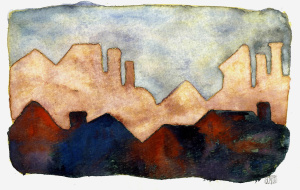
1994 Bottle Factory - GC MyersI came across a group of work the other day and realized that they were from a week almost exactly twenty years ago when I had worked on them.  For instance, the piece above was done twenty years ago yesterday.   The sheer idea of twenty years passing seemed fantastic in the moment.  So much has happened and so many things changed over that time yet I still feel new in what I am doing, still feel like the person who looked with wonder at the painting above.

GC Myers the-heights 1994There have been only a few moments, most in the last year or so, when this passing of time has fully sunk in and I feel as though I am a veteran at what I do, feel as though I am what might be termed an established artist.  Maybe seeing these pieces will cement that feeling in place.

Looking at them, I can see my  confidence burgeoning in my work as I began to better understand the materials I worked with and how to control them.  It was all about learning control at that time.  At the time these were painted I was still torn over how and what I would paint.  I still didn’t fully understand the importance of personal vision and was only trying to harmonize forms and color in a pleasing way.   The  work still captured emotion but it was simply a by-product of being immersed in the process so deeply that it could not help but reflect what I was feeling internally.

As I said, I still feel very much like that same person from twenty years ago.  Outside of my marriage, this is the only thing that I have stuck at for so long and that is probably due to the ever-changing  and constant sense of newness and wonder it produces.  That same feeling that I felt years ago when I painted these is still felt today when I work on something new.  Thankfully, that is one thing that has not changed.

GC Myers factory-view 1994

Read Full Post »

Archaeology: All We Leave Behind

Archaeology: All We Leave Behind

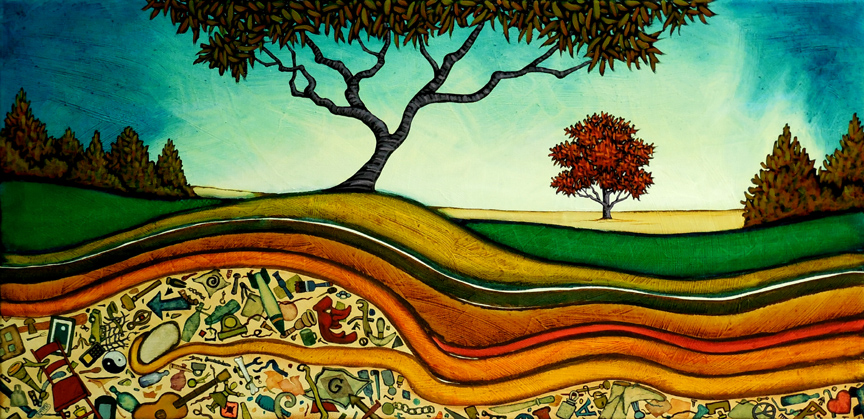
As the title suggests, there are a few paintings from my Strata and Archaeology series in the Layers show that opens Friday at the West End Gallery.  The piece above, Archaeology: All We Leave Behind, is a 12″ by 24″ canvas is the latest and perhaps last entry in the Archaeology series.

I am considering retiring this series that started back in 2008 although I can’t say I won’t revisit it at some distant point in the future.  It has been a series of paintings that has been among my favorites, both in painting and in delving deeper into them, as well as being important to my development as an artist.  When I first started the series, it came at point when I was in need of inspiration and was questioning my future as an artist.  These paintings gave me footing, a firm base to rest on while I gathered what I needed to move on.

Looking at these pieces, I am almost always surprised when I get to inspect the underground artifacts.  So many of the items  were painted  without any forethought or afterthought so once they were done and I had moved on to the next item in the debris field, they sometimes escaped my notice of their singularity.  They just became part of a larger pattern of forms and color.  But going back and looking at the items later gives me little surprises that sometimes make me smile and sometimes scratch my head, wondering what the hell some not quite recognizable thing is or what I might have meant by its inclusion.

But all things must come to an end, which is actually the theme of this series.  And this piece, which took over a year to complete as I worked on it a bit at a time,  seems like a fitting end.  And if it does end up being the last in its line, what better place to show it than where my little journey as a painter began back in 1995, the West End Gallery.

Here’s another Archaeology piece in the show, Archaeology: Formed in the Past,  one from a few years back that has a favorite of mine from the minute it was completed:

Archaeology: Formed in the Past

Archaeology: Formed in the Past

Read Full Post »

GC Myers- The Empowering smWhat we achieve inwardly will change outer reality.

-Plutarch

**********

I am in the very last day of preparations before delivering my show to the West End Gallery for next Friday’s opening of my show, Layers.  It’s a day that mixes the tense anticipation of how the work will be received at the show with the relief of finishing all the tasks required to make it happen.

Fear and elation from moment to moment.

This is just an accepted part of the process by now.  But it’s all too easy to let the fear part of this little dance grow, to imagine worst-case scenarios where the show is an abysmal flop and the work fails to move a single person on any level.  I can only imagine that  anyone who creates or performs has these fears.  The trick is to not succumb to them, not let them drown out what you know to be true in your work.

That’s where the elation part of the process comes in.  When I am framing and prepping, the work is arranged in stacks so that I can’t see much of it as I go through the process.  I am engrossed in doing these tasks and put the work itself out of my mind as I proceed.  But as I go along, I get to each individual piece, turning it over to reveal an image that had escaped my mind.  It’s exciting, like seeing it for the first time, and I find myself appreciating aspects of the painting that I had overlooked or not even noticed when it was consuming me in its creation.  It’s a moment that wipes away the fears and reinforces my own belief in the work.

That’s what happened yesterday with this piece, an 18″ by 18″ canvas painting that I call The Empowering.  It had slipped from my sight and memory and upon turning it, it just seemed to glow among the other work.  It really bolstered me and had me setting up pieces in my framing space so that I could see it alongside the other paintings in the show.  The fears were washed away and I was left with a great sense of internal satisfaction that this group was already a success, regardless of my fears.

Here’s hoping that Plutarch’s words hold true and this inner belief becomes an outward reality.

Read Full Post »

GC Myers- Solitary Song smThere are certain songs that immediately take you back to specific moments when you hear them, songs that are imprinted in you as a sort of timestamp.  Whenever I hear Grazing in the Grass I am instantly sent back to the summers of my youth.  Impressions of bright yellow sunlight seen through closed eyelids, dried  and brown cut grass on bare feet and the endless search for something to fill your summer days.  We lived relatively isolated in the country and it was a time without instant connection to the outer world– no computers, video games, DVDs, around the clock satellite television or even FM radio– so there was always a pervading sense of boredom.

But, in retrospect,  this boredom was a gift and a wonderful thing.  It made me create my own entertainment and trained me to bide my time within myself.   It gave me time to experiment and explore, to read and to look at the world around me.  It seems that I am eternally busy now and I find myself  missing  that boredom, of wondering what to do next. Or not.

I think boredom has gotten a bad rap with so many parents feeling that they need to fill each moment of their child’s life, depriving  the kids of developing self-reliance and  a certain creative ability.  I know that for me boredom seemed like a curse when I was a kid but was sorely missed once it was gone.

And that all comes to me with this song.  And it can be either version, the original Hugh Masekala instrumental #1 hit from 1968 or the Friends of Distinction‘s vocal hit from the following year, which I  personally prefer, if only for the chance to sing along with the chorus that ends with Can you dig it, Baby?!  I’ve included both versions below for comparison.

So enjoy your Sunday.  I hope you find a little time to be bored.


Read Full Post »

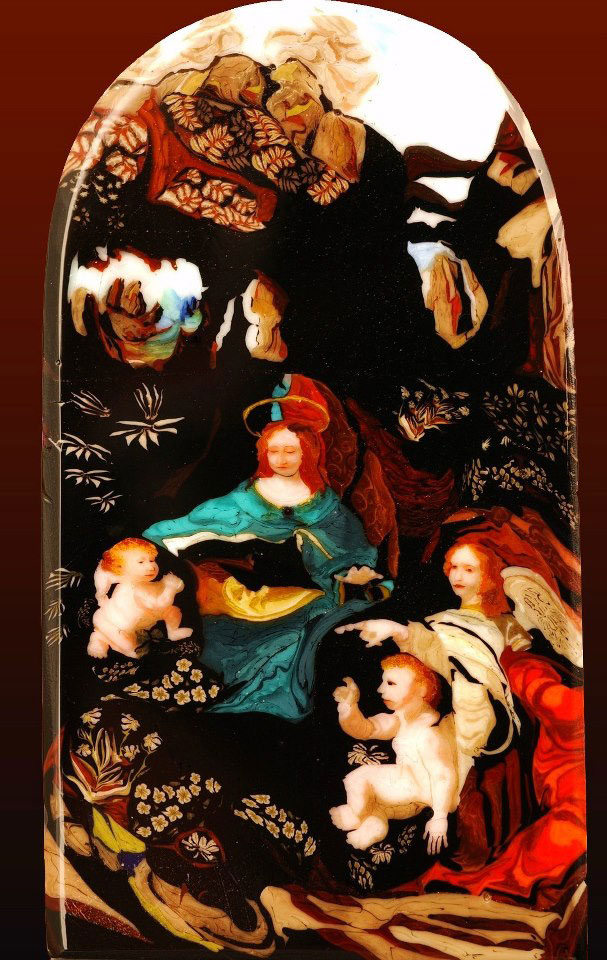
Murrine Glass by Loren StumpI came across this photo of a piece of murrine glass, which is made in long rods that contain patterns that run trough the entire length of the rod.  When the rod is cut at any point it reveals the same pattern.  It is normally done on a small scale that results in small cut discs with colorful patterns that are used in jewelry and in glass paperweights, among other things.  This masterwork of the form, done  by Sacramento-based artist Loren Stump, takes the form to a grand scale with a Renaissance-inspired scene with several full figures and a wonderful dark background that sets off the deep colors.  You can see more of his work at his website, Stumpchuck, or you can take a week long class with him at the nearby Corning Museum of Glass at the end of July.

Seeing this work reminded me of when I worked at the old A&P factory many years ago.  It was a huge building that sprawled over 37 acres that made all sorts of foods.  They claimed it had the capacity to produce enough each day to feed everyone east of the Mississippi.  In my time there,  I worked a number of jobs throughout the plant from  cleaning out the antique looking machines that bagged and sewed the teabags that were filled with tea that came from wooden crates with exotic markings and locales like Ceylon and scouring the inside of huge semolina tanks in the pasta department to making all forms of candy– jelly beans, candy corn, chocolate covered cherries, etc.

One thing I never did was make the rock candy which so reminds me of the murrine glass.   But I really enjoyed seeing them make it.

Cut-Rock-CandyI would often stop while passing through the hard candy department and watch the workers work the masses of glass-like candy on tables with mechanical arms that came in from each side to knead the candy into a ball.  They would then place the mass on heated rollers that would turn the mass into a uniform roll.  They would take these rolls of various colors and arrange them into patterns within one large roll on those same rollers.  They would then hoist the larger roll onto a machine that had telescoping rollers that fed the candy into a machine that stretched it until it was small enough to cut into bite size chinks of candy, like those shown just above.  It was fascinating to watch as were many of the processes there.

It seems like there is little in common between this candy and the work of Mr. Stump, which is shown in more detail below, but it is the same basic principle.  I wonder if you can buy cut rock candy with such an elaborate design?Murrine Glass Detail Loren Stump

Read Full Post »

GC Myers-Tree Waltz smIt’s the last Sunday of June and I sit in my studio early this morning surrounded by new work in varied states of completion that is headed to the West End Gallery for my show there at the end of July.  There are paintings on easels and on chairs, some propped against the walls, on ledges above the fireplace as well as leaning against the hearth– everywhere I turn they’re facing me.

I take a moment and just sit back and take them all in, just letting them meld together as a collective group.  For a moment, there’s a disconcerting feeling like looking at mirror that is shattered but still in place, a hundred different angles of myself staring back at me.  But there is a quick adjustment, like my eyes coming into focus, and they’re no longer images of myself.  Oh, I’m in there and I am part of what they are but they are more like a group of friends surrounding me, each with their own life but still maintaining a close relationship with me.  I know them well, know their secrets, know what they mean to me.  And they know me, hold my secrets and share a past with me.

In that moment, there’s a feeling like I am in a room full of friends and it is warmly reassuring.  I’m not sure I can do justice with my description here.   It makes me think of a favorite song of mine, Feeling Good Again, from Robert Earl Keen.  Whenever I hear this song I am reminded of  time in my youth spent with my father.

On many Saturdays we ended up at the horse track and before heading out would stop at a beer joint in town.  It would only be about 9 or 10 in the morning but the place would be busy with  some guys drinking their morning coffee and some their first of many beers.  When we walked in, there would be shouted greetings from around the bar.  Everyone knew each other and there was a terrific sense of friendship and camaraderie in their banter.  Looking back, I can  see how that place was a safe haven for a lot of tough lives and how those friendships, though maybe not deep, were reassuring, something on which to hang.  Feeling good again.

So when I hear this song, I am transformed again to that thirteen year old kid drinking a coke while my old man joked around with his buddies and looked over the Racing Form with his cup of coffee.  Have a great Sunday.


Read Full Post »

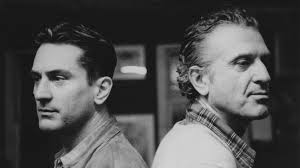
Remembering the Artist-Robert De Niro Sr.The other day I watched the HBO documentary Remembering the Artist: Robert De Niro, Sr., a film produced by actor Robert De Niro to better illuminate the work of his late painter father.  Robert De Niro, Sr. had been a rising star in the New York art world of the 40’s and early 50’s, working in a style that was expressionistic and abstract yet still representational, very much influenced by earlier painters such as George Rouault and Henri Matisse.

He gained some fame early with an acclaimed solo show at the Art of the Century Gallery ran by Peggy Guggenheim who later began the museums bearing the Guggenheim name.  But fame was fleeting as the art world’s flavor of the month changed from the figurative Expressionism which he maintained as the primary vehicle for his artistic voice  to Abstract Expressionism in the 50’s  to the Pop Art of the 60’s.  He was left toiling in a style that was viewed as outdated  while others who he may have viewed as inferior talents or at best equals were lifted in the spotlight, earning the fame and fortune that he sought and  thought his work deserved.  This left him bitter yet to his credit, he remained faithful to his style and his own artistic voice.

It’s an interesting portrayal of the artist in general, touching on many areas that resonate with anyone who works in a creative field and struggles to make their work visible to the world.  His resentment in having his work, which represents everything he understands himself to be,  marginalized is a feeling that many artists will find familiar.  I know that I have felt that same bitterness, that same resentment at times in my career.  But I have come to recognize that it is simply part of the deal I bargained for in becoming an artist, that my work would sometimes find itself as a flavor of the month and at other times simply exist as a possible favorite for a few.

An artist in the film explained this with a great analogy, saying that artists are like characters on a stage in a play.  The spotlight moves around the stage and sometimes falls upon you but soon passes on to the next character and that moment in the spotlight is gone.  But if you persist and stay consistent and in character, eventually the spotlight will cycle around to you again.  He felt that much of De Niro’s life was in between those moments in the spotlight.  And for some, like De Niro, that can be a very difficult thing with which to live.

For me, that was the thing I took from this film, that as an artist you cannot control, the spotlight, cannot control how your work is received or perceived.  You can only do that work that comes from your core– staying consistent and in character, true to your inner voice– and bide your time on the stage, hoping that the spotlight will once again come around.  I fit does, great.  If it doesn’t find you, you have the solace of the work itself, knowing that you have maintained your vision,  and the hope that it will find a champion, as De Niro Jr, is for his father,  in its life after you are gone.

I encourage you to watch the film.  It’s an interesting look at an interesting painter in an interesting era.

Read Full Post »

dadIt’s another Father’s Day.  I’ve written briefly about my Dad here in the past, one post describing why the photo shown here of him from about 50 years ago is one of my favorites.   I’ve described him as my hero and boon companion when I was a kid and that is the truth.  I remember one year when I was in Little League.  Our team lost it’s first five games and our coach quit, leaving us without any guidance.  I don’t know how excited he was about it but Dad took over and things immediately turned around for us.  We won the remainder of our games but more importantly, what had been a chore for our kids became a lot of fun.

Dad was was surprisingly easy going and uncritical of the kids, never getting excited when we screwed up a play or made a bad pitch.  But  by making sure that every kid played a part in that team and showing us ways to win with his knowledge of baseball, the game became joyous again.  As an example, my best friend’s little brother was part of the team and before Dad came had hardly played at all.

He was a tiny kid and still pretty unskilled so the prior coach had him ride the bench and begrudgingly gave him a single at bat or two.  But Dad saw his tininess as a strength and he became our secret weapon when we needed baserunners.  His strike zone was about the size of a postage stamp,  especially after Dad showed him how to crouch to make himself even smaller, and the opposing pitchers just didn’t have that kind of skill to throw three strikes to him.  He became a walk machine and his whole game improved as did his enjoyment level.  I saw him a few years ago for the first time in almost 40 years and one of his first questions was about Dad. That’s not uncommon when I run into childhood friends.

Another of my memories is riding in the car with him as a child when he would sing.  Some of the songs were nonsense songs that he had made up, one with few words but a melody that I still carry to this day.  Another was the chorus from the polka,She’s Too Fat For Me.  I remember these moments now with great fondness but when I was a very little kid I didn’t like to hear my Dad sing and would yell like a spoiled brat to make him stop.  That bothers me now because he seemed to be having so much fun that I should have just enjoyed that moment and let him belt it out.

So, Dad, if you’re reading this, here’s She’s Too Fat For Me.  Feel free to sing along and have a happy Father’s Day.

Read Full Post »

GC Myers- Freedom DreamWhat are we when we are alone? Some, when  they are alone, cease to exist.

Eric Hoffer

*************

I was contacted by another author for use of one of my images for inclusion in his upcoming book.  It was an old image, one that I still possessed and had used on the this blog, so I began to go through my files to find it.  Shuffling through the old work, many from before I began exhibiting publicly, brought a number of surprises.  There were pieces, like this one here on the right,  that had slipped my mind and seeing them rekindled instant recognition and memory, like stumbling upon an old acquaintance who you had not thought of in ages.  But there were others that had been lost in my memory and seeing them still only vaguely brought traces of their origin, as though you were again coming across someone who knew you but you couldn’t quite remember them even though there was something familiar in them, something you knew that you once knew.

Looking at these old pieces made me think of  all the time spent alone with these images.  The quote  above from Eric Hoffer came to mind.  What are we when we are alone?  Is that the real you? Or is the real you that person that interacts with all the outside world?  Looking at these pieces, I began to think that the person I was when I was alone had evolved slowly over the years, becoming closer to one entity.  What I mean is  that the person I was when I was alone, my inner voice,  did not always jibe with my outer voice and over time, especially as I have found a true voice in my work, has come closer and closer to becoming one and the same.

I don’t know if I can explain that with any clarity.  It’s a feel thing,  one that instantly comes from holding one of these paintings and still seeing the division that once was in them and in myself.  It is not anything to do with quality or subject or process.  It’s just a perceived feeling in the piece, an intangible that maybe only I can sense.  But it’s there and it makes me appreciate the journey and the work that brought these two voices closer together.

My alone time immersed in these pieces has seldom felt lonely and,  going back to Hoffer’s quote, never did I feel that I ceased to exist in my oneness.  I know people who are like that, that need constant interaction in order to feel alive and vital, but for me it has often felt almost the opposite.   That probably is a result of that division of my inner and outer voices that I have been trying to describe.  When I was alone I was always comfortable with my inner voice and the work that resulted from it served in the forms of companions.

I definitely exist  in my solitude and my work, my constant companion, is my proof.

I am going to stop now.  Enough confession for one morning.  I have new companions on the easel to which I must attend.

Read Full Post »

« Newer Posts - Older Posts »