Feeds:
Posts
Comments

Archive for the ‘Biographical’ Category

A place belongs forever to whoever claims it hardest, remembers it most obsessively, wrenches it from itself, shapes it, renders it, loves it so radically that he remakes it in his own image.

–Joan Didion

***********

My friend Linda from Texas one day in her blog  brought this quote from Joan Didion to my attention and it has stuck in my mind for some time.  It seems to especially apply itself to those places and memories from our past that have long passed from the sight of the general public, places that I often run across when doing genealogical research.  Towns that have vibrant stories and a rich , interesting past but are nearly vacant now, the memories of that place now resigned to an existence in a few aging minds and a few timeworn photos.

My nephew and his wife recently went up through the Adirondacks and I told him to look for the village of Forestport where my grandmother’s family had a large presence in the late 1800’s and early 20th century.  Her father, my great-grandfather was a prominent member of the logging industry there, employing hundreds of loggers who harvested the timber of the Adirondack and sent it on barges down the Black River Canal to the Erie Canal and onward to build the booming cities of the east.  After his trip, he said that he had been through Forestport and there wasn’t much there.

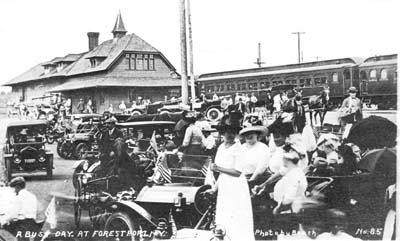
In my research, the town had taken on its own life.  There are many photos like the one above of the rail station where my grandmother used to come and go (she might even be in that crowd) give evidence of a bustling place full of life.  There are a few books that document the town at that time, talking about the many characters who built the village in the southern forest of the Adirondacks and rebuilt after it burned to the ground on several occasions.  Other books document its place on the Black River Canal, the barge builders who worked there and the men who kept the locks made the canal work.  All attest to a place full of life.

Yet now that is all nowhere to be seen.  That life is a mere reflection in a few minds who have any interest in such places.  Like me.

I wonder often how close the memory I have wrestled from reading and looking jibes with what actually was.  Have I added more life, more vibrancy than actually existed?  I suppose that’s where Didion’s words enter the equation.  Because I care for some reason, that past, that memory of place has become my possession somehow.  Remade in my image, as she said.

It’s an interesting concept and one that doesn’t necessarily just pertain to place alone.  It may work for all memory, all history– events and people, for instance.  History belongs to those who remake it in their own image, for better or worse.

Read Full Post »

Before…

Back home, safe and sound.  Sweet.

First, many,many thanks to everyone who came out to the Gallery Talk  at the Principle Gallery yesterday.  You were a great group and made my time in front  of you  very easy and enjoyable.  I hope I was able to pass on somethings you might not have known or answered whatever questions there may have existed.  If not, let me know and I’ll try to rectify that. 

I could talk much more about yesterday’s talk  and how much I appreciate those who attended but I guess I should at least way in on the obvious part of this date.  It’s, of course, the tenth anniversary of the 9/11 attacks .  I’m sure there’s not a soul out there who hasn’t been made to remember this fact by the almost constant coverage by the media over the last several days. 

In yesterday’s talk, I tried to avoid mentioning this, wanting to provide some sort of diversion, but somehow ended up talking about it anyway.  I think it came about when I was trying to explain how much the support and energy that I received from these folks over the years had transformed my life.  It reminded me very much of a feeling I felt on September 10 in 2001, the day before the attack.

It was a spectacular late summer day with hints of autumn in the air, a pure blue sky and a sun that was softly warm but not harsh.  Purely pleasant.  I remember walking around my pond that day.  I was at the point in my year when I was done with shows that I was going to do for the year.  Both had been wildly successful, beyond what I ever expected, and  I finally had a bit of time to relax and really think about this as I strolled around the pond.  I thought about how different my life was now, in 2001, than it was ten years before.  I had felt myself  a lost soul at that time, living a purposeless life with little prospect of doing much with it.  But over the years, art had come into my life and everything was different.  I found a form of expression, began to see clearer those things that were there in my life that had always been there and were core to my existence but I had somehow overlooked as I stumbled around in prior years. 

I found myself and a reason for living.  As I stopped by the pond with that clear sky above, it all struck me on that day, that September 10.  I felt myself the most fortunate man in the universe that day.  My life felt as complete and satisfying as I could imagine and I was filled with an overwhelming sense of appreciation for my good fortune.  I had trouble believing it was my life I was indeed living.

Of course, within 24 hours that feeling disappeared in the smoke and devastation of the events of that day.  It’s taken ten sometimes awful years to somewhat approach that feeling again and yesterday, as I felt the warmth of that group,  I talked about this feeling and my appreciation for them for allowing me to regain that feeling.  I don’t know that I made it clear but one doesn’t always speak easily about matters of grace.

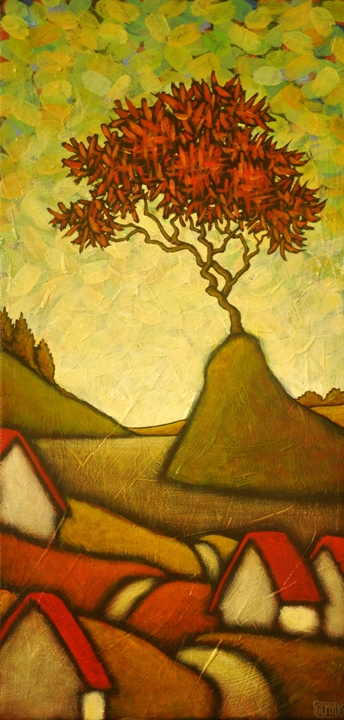
The painting at the top was painted on that day and reflects very much the fullness and contentment I felt for my life at that point.  It is filled with that sense of peace and grace I hinted at above.  It came to be titled Before…  

There was a strange twist to this painting.  I always number my paintings so that I can more easily record and track them over time.  The serial number for that painting was 99-911.  I did nothing to make it fit this way, and in fact didn’t even recognize this number’s relationship to the date until some time later.  Just an eerie coincidence.

It  is a painting that I deeply regret ever letting go and though I know that the folks who now possess it have their own deep feelings for this piece, they will never know how much it still  lives with me, how much it reminds me that day, that September 10th when life seemed as good it could be and how rare and fleeting that moment can be.

Thanks again to everyone from yesterday.  Have a good and peaceful day.

Read Full Post »

Another Labor Day

Just another Labor Day, the annual holiday here that marks the end of the summer.  Most of us don’t even think for a moment about what the name of this holiday anymore, don’t realize that this holiday was meant to honor the trade and labor unions that have been so demonized in recent years. I know that I’m aware of the history of this holiday and even I forget it most of the time.  And that is a shame because we all could use a reminder of how the working class of this country has truly built the great wealth of the nation.

I guess I’m a labor guy.  My first real job was in a grocery store, a Loblaw’s, and we were unionized.  My next two jobs were also unionized and for a couple of years I was  a Teamsters’ union steward for my department  when I was working in the A&P Food Processing Plant.  I learned a lot from that experience, things that shaped how I still view the world today, thirty years later. 

There were some good guys who were supervisors at the plant. Bosses.  Management.  I could  see how people would say there’s no need for all the labor regulations and the protections of unions when I worked for these select few.  They were fair and pragmatic in their approach to dealing with the workers and most of us worked harder than hell for these guys. 

 But many were not fair-minded and used their position of authority as a hammer to try to pound everyone under them as though they were nails.  They continually tried to circumvent every rule and regulation and were constantly at odds with their workers.  These guys were the face for me of why there was a need for labor unions in many places.  I can still see many of their faces so vividly in my memories of that time.  They were the first layer of management, the least trained and most ill-equipped, and they would do anything to meet the demands that the layer of management above that had placed on them, even if it meant abusing the rights of the workers under their supervision.

It’s not that they were bad guys.  They had goals set for them that had to be met and they were simply not very skilled at dealing with people, specifically their workers.  So they would try to bully and punish.  Probably in the same way that they had been dealt with most of their lives.  As a union steward, I could see that the behavior of these abusive bosses made the need for protecting the workers imperative even though there were other fair and just bosses out there.  There would always be some bad bosses, especially at the lowest and middle levels, and they were the ones who dealt primarily with the labor force.

We were built with our labor force and we have prospered most as a nation when the labor force shares equitably in the wealth being created.  On this labor day, we should remember that and be thankful for the sacrifices made by those workers and unions before us in creating protections against the bad bosses of this world.


Read Full Post »

I was going through a pile of old work, mostly rougher  stuff from when I first started painting that had small glimpses of promise but lacked real spark or cohesiveness in the way they came together, when I came across this piece from 1994.  It’s about 12″ by 16″ on rough Arches watercolor paper and has the words Bradford County written in pencil at the  bottom corner of the paper. 

It’s a piece that I always found attractive but seeing it really brought me to a stop.  I so recognized that time when it was painted and could now see several potential directions where my work might have headed other than the one it eventually followed. 

This piece was very much in a more traditional watercolor style, with no treatment of the paper and the colors pure.  The colors had not yet come around to the palette that I later adopted.  For instance, the sky is a single uncomplicated shade of blue.  There are no other colors, not even other blues in it.  I had yet to make the move to more complex colors even though there is a hint of it in the foreground and the hills.

It also is a depiction of a real place, as denoted by the Bradford County.  Growing up, we lived on Wilawana Road just a few short miles from the NY/PA border and if you followed the road into PA you found yourself in Bradford County.  That part of the border is at the base of steep hills and is filled with rural valleys that I spent many hours exploring.  This scene was purely based on that place even though it is not any one location there.  I had not yet made the leap into creating my own landscape, forming the felt space rather than real space of Ralph Fasanella that I had mentioned in an earlier post.

To me, this is a time capsule that takes me back to the time when I painted it.  It suggests potentials that seem a million miles away from where I finally landed at the present.  It shows the possibility of staying strictly as a traditonal watercolorist or painting solely as painter of reality.  A depicter of the what is with the proper colors and forms.  I wonder how my work might look today, how it might differ,  if I had followed any of those other possible routes for the work? 

 I suppose many of us can look back at certain points in our lives and see times much like the one captured for me in this simple painting, times when we are at a junction in our lives and must decide which path to follow.  I’m sure some of us would look at such a time with a certain level of regret but for me, I am happy with my decisions made at and after the point of this painting so for me this is a warm memory, a reminder of the path I was about to follow.

Read Full Post »

Ego

I was asked yesterday what I was going to speak about in today’s gallery talk at the West End Gallery.  I kidded that I was going , of course, to speak about me.

Me, me, me.

I went on to explain  how I approach these talks, trying to read the group in attendance and finding something of interest in the work that sparks a dialogue where they participate.  The hope being that they leave with a little more insight into the work  and I leave with with a little more knowledge of how they view it.   But that offhand joke yesterday about me has stuck in my craw.  Just joking about it has bothered me somehow. 

One of the conundrums of art is that you are expressing a sometimes very personal aspect of yourself in a public forum, exposing one’s weaknesses and flaws to the world for all to see.  The need to do this is the need for an affirmation of one’s own existence in this world.  I know that this has been the case for myself.  I have often felt insignificant throughout my life in this world, unseen and unheard.  But it seemed to me that my life, like all others, had to have meaning of some sort and that my feelings and thoughts mattered as much as any other being’s.  If I was here and thinking, I mattered.

Cogito ergo sum.

 Until I fell into painting I never found a way to affirm this existence, an avenue to allow my voice to be finally heard.  But having found a method of expression, the question becomes: What part does ego play in this?  Where is  that line that separates the need for self-expression from base self-glorification?

This has always bothered me.  Even though I want to express myself and want my work to hopefully affect others, this constant self-promotion puts one at least on or near this dividing line.  For me, that’s an uncomfortable position.  Don’t get me wrong.  When it comes to my work, I certainly have the confidence of ego.  It may be the only part of my world where I have supreme confidence and on many days even that is shaky.

But on days like today, when I have to talk about me, me, me, I always get a sick feeling in the pit of my stomach both before and afterwards.  Before because of the dread of exposing myself as a fool and afterwards from the fear that I did just that. 

Oh, well.  All just part of the job…

Read Full Post »

I have always regarded manual labour as creative and looked with respect – and, yes, wonder – at people who work with their hands. It seems to me that their creativity is no less than that of a violinist or painter.

-Pablo Casals

******************

I came across this shot of working hands and it made me think of how I’ve viewed hands through my life.  I’ve always looked at people’s hands since I was a child.  The liver spotted hands of my grandmother had thin ivory fingers, for instance. 

 The hands of Art, the landlord of an early home and a farmer, were thick and strong and missing at least one digit down to the knuckle, the result of an impatient personality and old farm machinery.  Not a great match.  I saw quite a few farmers with missing fingers.

 Fat Jack, who I wrote about here a ways back, had hands whose nails were longer than you might expect and permanently rimmed with the black from the oil and grease of the machines on which he was always working.  His hands were round and plump, like Jack himself, but surprisingly soft and nimble, good for manipulating the small nuts and bolts of his world.

There was a manager when I was in the world of automobiles who was a great guy but had extremely soft and damp hands.  It was like handling a cool dead fish when you shook hands.  A mushy, damp, boneless fish.

I admired working hands.  They reflected their use so perfectly, the scars and callouses  serving as badges of honor and the thick muscularity of the fingers attesting to the time spent at labor.  They seemed honest with nothing to hide.  They were direct indicators of that person’s life and world.

My own hands have changed over the years.  They were once more like working hands, calloused and thickening from many hours spent with a shovel.  There are a number of small scars from screwdrivers that jumped from the screwhead and into the flesh time and time again and another on the end of my middle finger from when I cut the very end of it off while trying to cut a leather strap with a hunting knife.  Not a great idea. 

I always felt confident when my hands were harder and stronger.  Now, I have lost some of that thickness of strength and the fingers are thinner and a bit softer from doing less manual labor.  I look at them now and wonder how I would have judged them when I was younger, when I measured a man by his hands, something that  I don’t do  now.  I now know there are better ways to measure a life, that the work of the mind is now a possibility– something that seemed a million miles away then.  But when I come across working hands, strong and hard, I find myself admiring them still.


Read Full Post »

Everyone has his own specific vocation or mission in life; everyone must carry out a concrete assignment that demands fulfillment. Therein he cannot be replaced, nor can his life be repeated, thus, everyone’s task is unique as his specific opportunity.

——Viktor Frankl

**********************

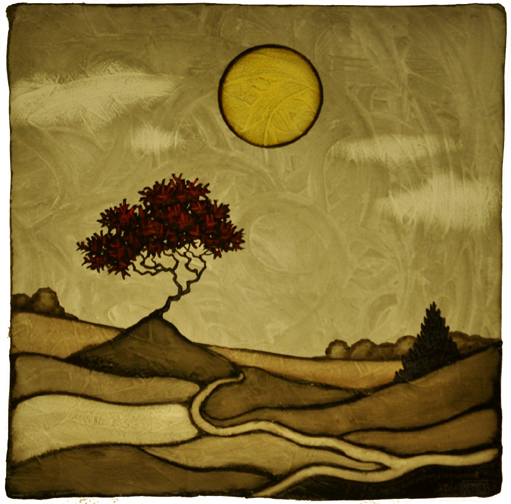
The words of Viktor Frankl, the WW II concentration camp survivor who went on to greater fame as a psychotherapist and author, seemed to ring true for this square painting after I finished it.  I saw the Red Tree here as one that finally saw its uniqueness in the world, sensing in the moment that with this individuality there came a mission that must be carried out.

A reason for being.

I think that’s something we have all desired in our lives.  I know it was something I have longed for throughout my life and often found lacking at earlier stages.  I remember reading Frankl’s book, Man’s Search For Meaning, at a point when I felt adrift in the world.  I read how the inmates of the concentration camp who survived often had  a reason that they consciously grasped in order to continue their struggle to live.  It could be something as simple as seeing the ones they loved again or finishing a task they had set for themself. Anything to give them a sense of future.  Those who lost their faith in a future lost their will to live and usually perished.

 At the time when I read this, I understood the words but didn’t fully comprehend the concept.  I felt little meaning in my life and didn’t see one near at hand.  It wasn’t until years later when I finally found what I do now that I began to understand Frankl’s words.

We are all unique beings.  We all have unique missions.  The trick is in recognizing our individuality and trusting that it will carry us forward into a future.

I’ve kept this short.  There are many things that I could say here but the idea of finding one’s mission, ones meaning, is the thought that I see in this piece.  This paintings is titled The Moment’s Mission and is 11″ by 11″ on paper.  It is part of the Principle Gallery show that opens Friday.

Read Full Post »

Well, the show for this year’s Principle Gallery show is delivered.  Everything went smoothly yesterday and I was home by late afternoon.  The only thing for me to do now is wait for the opening next Friday.  I know that this is something I’ve written about here before, this time in the interval between delivery and the actual show. 

It’s always filled with a lot of mixed feelings.  There is relief that the work is done, that I have completed a task.  But that’s usually countered by the fact that the opening is still ahead, that there is still some work to be done. Now, it is relatively pleasant work, standing around and talking about paintings.  It certainly beats the hell out of some of the things I’ve done as work in the past.  But it is work.  A required task.

The time is also filled with creeping doubts about whether the show will be received well.  There is an almost schizophrenic swing between feelings of complete satisfaction and excitement in the work I’ve done and feelings filled with dread that I’m seeing things in the work that others won’t, that the work is too directed to my own sensibilities and won’t translate to others. 

This usually leads to a questioning of why I do what I do and why anyone would be even casually interested.  I mean, I smear paint on canvas and paper in my house in the woods.  Is there any real importance in this?  I’m not saving lives, not actively helping or serving people, not building truly useful objects.  I can think of an endless list of things people do  that might actually be of more importance in the overall scheme of things, from researchers looking for bits of data that might lead to cures for deadly diseases all the way through to the person who fills my popcorn bucket at the movie theatre.

But despite this, it remains important to me and this makes me care about the work I do.  It has a purpose for me, at the very least, and if someone else finds something in it that makes it important for them as well– well, that’s simply a bonus.  A little extra gravy,  if you will. 

So, as you can see, I have the ability to make what should be a perfectly pleasant week into a neurotic nightmare.  It’s just an occupational hazard and, while it sounds somewhat tortured, it has just become commomplace in my life.  And that’s okay.  It’s what I do.

**********************

The piece at the top is also a new painting for the Principle show.  Called Connecting Light, it’s an 11″ by 11″ image on paper.

Read Full Post »

I just love this photo.  It’s a classic from around 1920 from the great Lewis Hine, the photographer who is best known for his photos of children at work in the mines, factories and fields of  early 20th century America, images which aided in the crusade for child labor laws.  Hard to believe but nationwide child labor laws weren’t fully enacted as law until 1938, about 30 years after Hine started his documentation.  I will show some of those photos at another time.  They are extremely powerful and human and should be seen by those of us with short memories for our not so distant past.

But Hine also was fascinated by the interaction of the worker with the machinery in the burgeoning industrial world.  Man and machine.  His photos are very poetic, the beautiful curves of the machine encompassing the straining form of the worker. Beautiful work.

For me, I am reminded of the A&P factory where I worked for several years as a candy cook.  Our equipment was ancient, much of it built in the 20’s and 30’s with these same curves and weightiness of material.  I always felt like the building was one large machine with multiple parts and we, the workers,  were a sort of  flexible cogs that connected the various parts.  I often felt dwarfed by the sheer size and power of some of the machines but after a bit found that there was a wonderful sense of rhythm and empowerment in mastering a machine.  That’s sort of what I see in this photo.

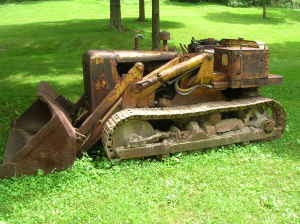
I’m also reminded of a piece of equipment I bought a number of years ago to clear some of my property here.  It was a late 1940’s Allis Chalmers track loader, much like the one shown here.  I spent as much time working on the machine with big wrenches much like the one the worker is using in the Hine photo as I ever did clearing land.   After many headaches, I finally got rid of it after a few years.  But I did come to appreciate the weight and intrinsic beauty of those big tools and still enjoy feeling them in my hands, if only to hold them for a moment.

Here’s a neat little videoon this photo from the George Eastman House, where much of Hine’s work is held.

Read Full Post »

Yesterday I was working in the basement of my studio which is set up to accomadate the matting and framing operations for my work.  It’s a finished space  that is decorated in a typical 1960’s fashion with woodtone paneling, a drop ceiling  and carpeting with a geometric pattern that has  brown mustard  as its main color.  It has a kind of shmaltzy feel and I always mean to overhaul the space but never find the time. 

I have a number of  long tables throughout the space as well as a couple of large drafting tables, covered  almost  always with something.  Sometimes they contain sheets of heavy watercolor paper as I apply layers of gesso.  Sometimes they are filled with frames in various stages as they are being finished or with canvasses that are being coated with their final protective varnish.  At one end there are heavy industrial shelf units that hold unfinished frames and canvasses and stretcher bars.  Along the walls there are several other shelfing units that hold bottle of gesso and varnish and  tape and all the little things that are needed  for framing.  Large rolls of brown and black kraft paper are hung on one wall.  There are several paintings of mine on the wall, a few older pieces that have somehow stayed with me over the years.

 There is also a painting that we bought many years ago from a PBS auction.  Shown above, it’s a folky piece of a black Lab sleeping on a checkerboard pattern surface.  There is no name but we have always called it Winston Churchill.  I can’t remember the reasoning but we both immediately latched onto that name.  It has bounced around with us for a long time and its plaster frame has began to show its age a bit, losing a few of the half  rounds that go around its outer edge.  It’s not a great painting but I have a lot of affection for it.

I mention all of this because yesterday as I was working down there, I had a moment.  I suddenly stopped at one end of the space and turned, looking down the length of it.  I had this odd feeling that I needed to take in the whole scene, register the details in my mind.  It was as thought I knew that somewhere down the line I would be remembering this moment, this view.  It might be in a dream or in a moment of deja vu, those moments where one seems to recognize the occurring instance as being from their past and are reliving it.   This felt pre-deja vu, as though I knew I would someday relive this moment and this feeling.

It was an odd moment and I took in as much as I could, looking from item to item as I stood there.  There seemd to be nothing profound in that instant when I turned from that mundane view back to the frames I was staining.  I wondered how this could possibly matter in the future, why my mind would want to someday recall this moment, this scene. 

I don’t know.  But, as I’ve learned from my painting, sometimes we don’t really know what we know.  We can’t question that moment, that feeling.  Just have to take it in and see where it takes us.

Read Full Post »

« Newer Posts - Older Posts »