Feeds:
Posts
Comments

Archive for the ‘Biographical’ Category

Exceptionalism

I woke up much too early this morning.  Deep darkness and quiet but my mind racing.  Oddly enough I found myself thinking of a person I had come across in my explorations in my personal genealogy.  It was a cousin  several generations back, someone who lived in the late 1800’s in rural northern Pennsylvania.  The name was one of those you often come across in genealogy, one with few hints as to the life they led.  Few traces of their existence at all. 

 At the time, it piqued my curiosity for some reason I couldn’t identify.  He was simply a son of  the brother of one of my great-great grandparents.  As I said, you run across these people by the droves in genealogy, people who show up then disappear in the mist of history, many dying at a young age.  But this one had something that made me want to look further.  I could find nothing but a mention in an early census record then nothing.  No family of any sort.  No military service.  No land or property.  No listings in the cemeteries around where he lived.  I searched all the local records available to me and finally came across one lone record.  One mention of this name at the right time in the right place, a decade or so from when I lost sight of them.

It was a census record and this person was now in their late 30’s.  It was one line with no other family members, one of many in a long list that stretched over two pages.  I had seen this before.  Maybe this was a jail or a prison.  I had other family members in my tree who, when the census rolled around, were incarcerated and showed up for those years as prisoners.  So I went to the beginning of the list and there was my answer.

It wasn’t a prison.  Well, not in name.  It was the County Home.  This person was either insane or mentally or physically handicapped and was living out their life in a home when they could or would no longer be cared for by family.  It struck me at the time that this was someone who lived and experienced as we all do and who has probably not been thought of in many, many decades.  If ever.

This all came back to me in a flash as I laid there in the dark this morning.  I began to think of what I do and, as is often the case when I find myself wide awake  in the dark at 3:30 AM, began to question why I do it and what purpose it serves in this world.  Is there any value other than pretty pictures to hang on a wall?  How does my work pertain to someone like my relative who lived and died in obscurity? 

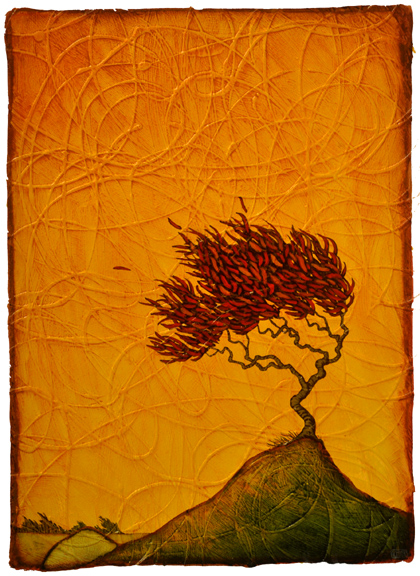
In my work, the red tree is the most prominent symbol used.   I see myself as the red tree when I look at these paintings and see it as a way of calling attention to the simple fact that I exist in this world.  I think that may be what others see as well– a symbol of their own existence and uniqueness in the world. 

If I am a red tree, isn’t everyone a red tree in some way?  Isn’t my distant cousin living in a rural county home, alone and apart from family, a red tree as well?  What was his uniqueness, his exceptionalism?  He had something, I’m sure.  We all do.

And it came to me then, as I laid in the blackness.  Maybe the red tree isn’t about my own uniqueness.  Maybe it was about recognizing the uniqueness of others and seeing ourselves in them, recognizing that we all have special qualities to celebrate.  Maybe that is the real purpose in what I do.  Perhaps this realization that everyone has an exceptionalism that deserves recognition and celebration is why I find it so hard to shake the red tree from my vocabulary of imagery. 

 Don’t we all deserve to be a red tree, in someone’s eyes?

There was more in the spinning gears this morning but I want to leave it at that for now.  It’s 5:30 AM and the day awaits…

Read Full Post »

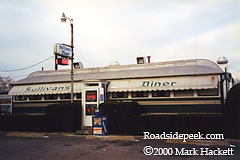
In yesterday’s post on the blog American Folk Art @ Cooperstown, Paul D’Ambrosio wrote about a bas relief carving in the collection of the Fenimore Museum.  It was one of a series concerning Sullivan’s Diner in Horseheads, NY and was carved by renowned folk artist  Mary Michael Shelley, who works just up the road in Ithaca.  The piece shown here is different from the carving in the Fenimore Collection but both feature the diner’s intimate interior with counter that runs the length of the small trailer with round stools.

I was really interested in this blog post for a couple of reasons.  First, I’ve always been interested in bas relief carvings and, as I wrote her before, started carving in the years before I became a painter.  Much of my painting is done very much like a carving , in the way I see and render the elements.  The second, and more important, reason was that Sullivan’s Diner has always been in my sight in some way for my entire life.  Built in the 1940’s in New Jersey, it spent its early years as Vic’s Diner on Elmira’s eastside,  from where my family hails.  I have distinct memories of its appearance on the corner near St. Joe’s Hospital as a child, even a memory where I was sent sprawling on the sidewalk in front of it on my bicycle.

In 1974, it was moved up the road to Horseheads where Art and Fran Sullivan renamed it and ran it.  Art was a railroad fanatic of the highest order and had an actual engine and an attached car behind the diner’s new location on Old Ithaca Road.  Fran ran the restaurant , doling out generous portions of eggs and bacon for many years from the grill behind the counter of this small trailer diner.  This was not one of the larger streamlined beauties you see along the turnpikes of Jersey.  It was cramped inside with a few booths on one side of the aisle and the counter on the other.  The woodwork and feel was more 1930’s even though it was built in the 40’s.  Living in Horseheads, I ate many breakfasts there over the years and always felt like I was walking into Fran’s home kitchen when I walked through those doors, which seemed to transform you back to a much earlier time when you passed through the doors.

The food was okay, simple but satisfying.  The coffee watery but tasty. But the attraction was the sense of community that the place fostered.  Walking in through the old door you felt like you were entering Fran’s personal kitchen and she treated you as though you were a guest in her home.  Even though I was only a sporadic visitor she always made me feel as though I were one of her regulars, making me feel as comfortable as the regulars who laughed and joked at the counter each morning. 

 I haven’t been there often since Fran retired but the place was reopened under new management and seems to be flourishing.  But I do have fond memories of that place and am gratified that Sullivan’s Diner will forever be immortalized in the collections of at least two museums.  The piece at the bottom is the one from the Fenimore Museum and another is in the National Museum of Women and the Arts in Washington, DC. 

Thanks for the fine work, Mary Shelley, and thanks, Paul, for pointing it out.

Read Full Post »

I had an interesting conversation at the opening a week or so back at the Kada Gallery in Erie.  It was near the end of the night and John D’Angelo, the brother of Joe D’Angelo who owns the gallery along with wife Kathy, approached me.  John is in his 80’s but it is not an old 80’s.  He is vibrant and filled with energy.  He is also a very talented man.   After his retirement, John started carving full size carousel animals, copying the masters who crafted the beautiful creatures that adorned the merry-go-rounds of the late 1800’s and the early parts of the 1900’s.  His beautiful beasts were the subject of a show at the gallery that drew huge crowds and raves.

We talked for a short while about the paintings then I asked him more about his carvings.  He talked about  how he just couldn’t sell them.  Not because there was no demand.  On the contrary, he described how many people were upset that he wouldn’t put a price on them, wouldn’t part with them at the show.  He said he only gave them away to family members and held on to the rest.  He talked about the joy of carving the animals and how, after he was done, he would run his hands over the large smooth carvings and be filled with wonder as to how he had done this.  It seemed beyond him, more than he was capable of doing.  He asked if I ever finsihed a painting then ran my hands over it with that same feeling.

I immediately knew the feeling he described.  In fact, it brought back a memory of the piece shown above, Big Fish.  It is a large wide painting that is over 60″ wide in its frame and now spends its days in a very prestigious office in DC.  When it was still in my studio, I was part of a project for a book by photographer Barbara Hall Blumer where she would visit artists’ studios and chronicle them in their work environment.  On the day she visited my old studio, which was infinitely more rustic than my current one, she had me show her around and talk about my process as she snapped away.  At one point, I stood at one of my painting tables where this piece was resting, nearly complete.  As we talked, I absentmindedly ran my hands over the surface of the heavily textured painting, feeling the coolness of the paint on my skin.  Barbara noticed and commented as she took a shot of my hands on the painting, asking if that was something I did regularly.

I thought about it and said I guess I did. 

Thinking about it now, I was indeed doing that very thing that John D’Angelo had described.  I often look at my work after it is done and wonder where it came from, how something so graceful came from someone so often awkward.  About how it seemed more than me,  just as John had described.  I needed to feel it if only to verify that it was real, that it indeed existed outside of my mind.  It’s a strange feeling and one that I was pleased to share with John that night, comforted in knowing he knew that same feeling of surprise and wonder.

Read Full Post »

No Mail

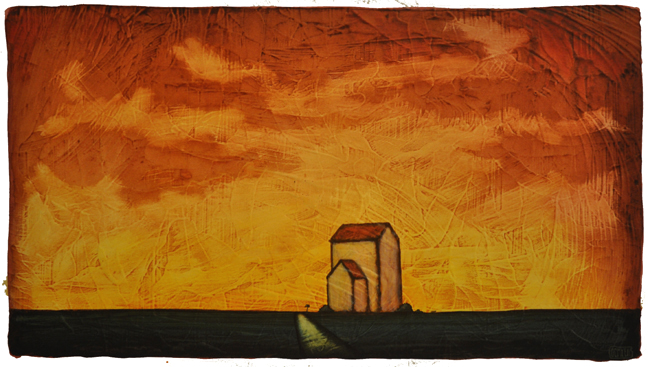
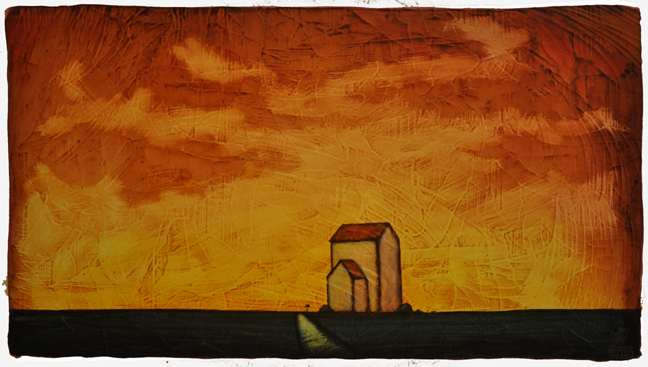
This is a piece that’s been bouncing around my studio for a month or so, one that I call No Mail.  It’s a smallish painting on paper, measuring about 8″ by 14″.  I haven’t decided whether I will show this one or simply hold on to it.  It’s a matter of whether I believe others will see anything in it rather than me wanting to keep it for myself.  Maybe it’s that I see a very personal meaning in the piece that is reflected in the title and I can’t decide if it will translate to others.

For me, this painting reminds me of my childhood and the house I consider my childhood home, an old farmhouse that sat by itself with no neighbors in sight.  Specifically, this painting reminds me of exact memories I have of trudging to the mailbox as an 8 or 9 year-old in the hot summer sun.  There’s a certain dry dustiness from the driveway and the heat is just building in the late morning.  It’s a lazy time for a child.  Late July and many weeks to go before school resumes.  The excitement of school ending has faded and the child finds himself spending his days trying to find ways to not be bored into submission.

The trip to the mail box is always a highlight of the day, filled with the possibility that there might be something in it for me.  Soemthing that is addressed only to and for me, a validation that I exist in the outside world and am not stranded on this dry summer island.  Usually, the tinge of excitement fades quickly as I open the old metal maibox and find nothing there for me.  But occasionally there is something different, so much so that I recognize it without even seeing the name on the label or envelope.

It’s mine, for me, directed to me.  Perhap’s it’s my Boy’s Life or the Summer Weekly Reader.  I would spend the day then reading them from front to back , reading the stories and checking out the ads in Boy’s Life for new Schwinn bikes.  Oh, those days were so good.  The smell of the newly printed pages mingling with the heat and dust of the day to create a cocktail whose aroma I can still recall.

But most days, it was nothing.  Just the normal family things– bills, advertisements and magazines.  Or nothing at all.  The short walk back to the house seemed duller and hotter on those days.

That’s what I see in this piece, even thought it doesn’t depict everything I’ve described in any detail.  There’s a mood in it that recalls those feeling from an 8 or 9 year-old, one of anticipation and one of disappointment.  Childhood days with no mail.

Read Full Post »

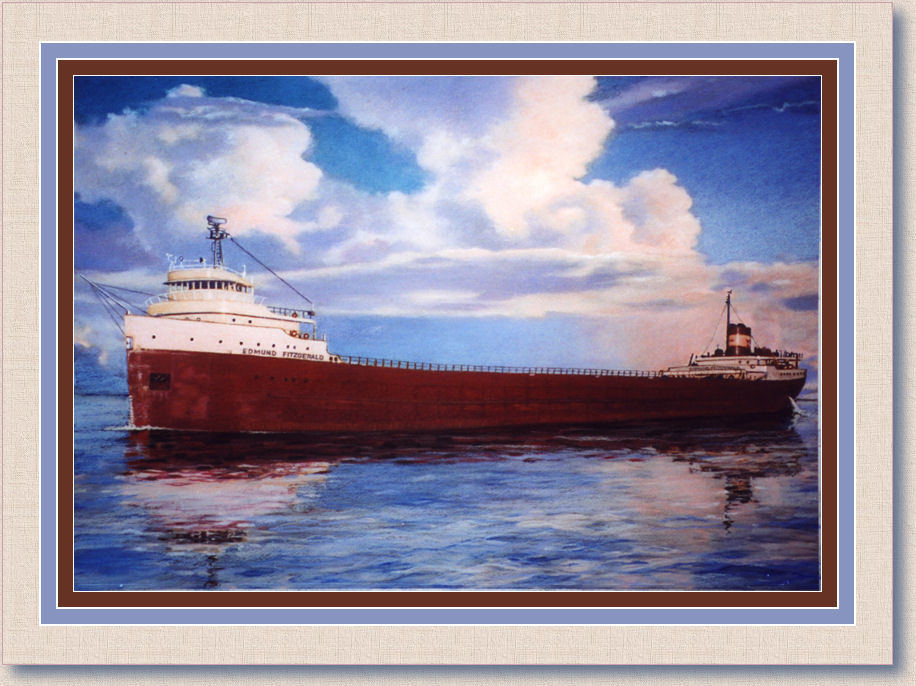
Today is the 35th anniversary of the sinking of the Edmund Fitzgerald, the huge freighter that went down in a storm on Lake Superior in 1975, taking all 29 crew members with it to the bottom.  It’s a tragedy that would’ve faded into obscurity except for Gordon Lightfoot’s hit song that came out in 1976, forever searing the name Edmund Fitzgerald in our collective memory.  Most of us can’t think of the name of another freighter wreck  or freighter, for that matter.  It even turns up on an episode of Seinfeld.

The song always strikes a chord with me and brings back memories of going up to Michigan’s Upper Peninsula in the early 70’s where my sister’s husband was stationed at  Kincheloe Air Force Base, which closed its gates in 1977.   We visited the locks at Sault Saint Marie where the great freighters passed between Lake Superior and Lake Huron, and spent some time looking down on the huge bare decks of the ships as they slowly passed.  For all I know, the Edmund Fitzgerald may have been one of them.

I mention this today for no reason other than the memory of those big boats back then and the song that memorialized it and its 29 crewmen as they went down in the big lake they call Gitche Gumee

Read Full Post »

Solitary Confines

Whosoever is delighted in solitude is either a wild beast or a god.

—-Francis Bacon, Sr,

******************

Monday morning and I’m here in the studio, wondering why I continue to do this blog, to get up each day and struggle to say something new.   In some ways  it comes between me and the precious solitude I have set up for myself here.  It brings in the outside world and exposes my weaknesses and flaws to them.  It frustrates me at times.  It takes away time better spent. 

At least, I think the time might be better spent.

But I do it. 

From the first few days of doing this, I viewed it as a form of art.  I would try to be consistent, try to keep to a certain standard that I felt inside, just as I do with my painting.  I would just put it out there so that the world, if interested, could see it and react. Like painting.

But it is different from painting.  It takes from my solitude whereas my painting adds to it, and that is a big factor for me.  I understand the quote above.  I have often felt the wild beast, the feral dog that exists just outside the human world, sometimes venturing in when the need arises but always retreating to my solitary confines.  A beast, not a god.

And I’m comfortable with that.

But sometimes, some days, there are moments when I feeel that this very act of writing this blog takes away my cover, my solitary den.  Today is such a day.  But I will retreat and hover for a while on the periphery and come back again tomorrow.

Maybe.

Read Full Post »

Dreaming

Woke up late this morning, tired from a night filled with irritating dreams.  Not horrifying.  Not filled with tension.  Just irritating.  Many, many fast-paced scenarios of things that just bugged me but were of no consequence, like trying to rake leaves with a rake whose handle keeps coming loose.   I woke once after one such episode and was angry for having been disturbed from my sleep for such an irksome little nothing.

As a result, I find myself here this morning with little to say but still a little peeved about my dreams of last night.  I wish I had experienced better dreams, even scary ones, so my mind would be at least somewhat sparked.  I’ve had some great dreams over the years but I can’t share them.  Too personal and in some cases, too startling  and a bit disturbing.

The one dream that still lingers in my memory is one that occurred many years ago when I was a child, perhaps 8 or 9 years old.  It was an odd dream, very calm and quiet but filled with a tension I couldn’t identify.  It was a short scene that took place in a very narrow space, perhaps only 4 foot wide,  with a wall on the right hand side from the viewpoint I had in the dream and  windows with sheer curtains on the left that let in bright, almost white sunlight.  In this little space there was a small girl, bathed pale in the white light, who looked at me curiously but without fright.  At this point, my viewpoint in the dream shifted from the person looking at the girl to that of the girl looking at me.  From her viewpoint I saw myself as a Nazi soldier with that distinct helmet and winter coat.  There was a feeling that I, now the girl, had been discovered in my hiding place but that the soldier was not the threat.

It was an odd dream and one that has haunted me for several decades.  I wonder if I was indeed the girl or the soldier and what the circumstances were meant to signify.   I had the dream at a point when I didn’t have a tremendous store of knowledge about World War II or Nazis or the ways that Jewish families hid in the war so as time passed the dream evolved from one of pure scene and feeling to one filled with more symbology.  Yet, I still wonder about that Nazi soldier and see that light-filled space as clearly I did over forty years ago.

I doubt that I will remember any of last night’s pain-in-the -ass dreams forty minutes from now.

Dreams!

Read Full Post »

Summing Up

I had an inquiry yesterday from a museum, asking for more photos and information on my work in order to give them a well-rounded sense of my work.  So, I sat down and began going back through my work over the years, trying to determine how I might encapsulate what I do in a condensed manner that gives them a complete look and satisfies me.

I struggled with the task.  Choosing work that sums me up was difficult.  Can I sum up my work in one or two or twenty or a hundred images?  How do you define yourself at what you yourself consider a midpoint? 

For me, it all feels the same, as though it is part of a continuum.  I see differences through the years but I know that each painting was done with pretty much the same mindset and the same critical eye during the process which makes them equal in my mind which gives them the consistency for their audience that I seek.  Maybe it’s that word egalitarian coming up again, but I want  there to be no difference in the quality and emotional impact between the smallest, most affordable painting and the largest, more expensive work. 

And then there are the series I’ve done through the years.  Obviously, the ubiquitous Red Tree.  But there is also the Red Roofs.  Red Chairs.  Archaeology.  And many other less organized, recurrent groups of work featuring sailboats, cityscapes and small, lone figures.  Or the other figurative work featuring what I call the Outlaws or the early Exiles.  How many of these pieces fall into the category of rounding out an overview of the work?

How do you completely sum up yourself in the most condensed way?

 I had this come up a few years back in nother way.  After a very nice, well written article in the local newspaper, I was contacted by the producers of a national talk show set in NYC on one of the major news networks.  They had seen the article and the host felt I would be a perfect fit for the show which featured a panel of guests from various fields in a fast-paced, short sound bite-y format.  The host would shoot out a question and go quickly to a guest who would have 15 or 20 seconds to give a full answer. 

So, the producers interviewed me separartely then finished with about 20 minutes of the main producer pretending to be the host and throwing questions at me quickly. After we had been doing this for the 20 minutes, with her constantly urging me to be faster with my responses, I was pretty frustrated and finally asked her what she wanted from me.

She said she wanted to summarize what my career was about in 15 seconds. 

 That pretty much ended the interview and, needless to say, I didn’t go to NYC for the show.  I was actually relieved but it made me wonder how someone could adequately sum up themselves in such a short manner.  I still haven’t figured it out and I guess I’ll have to think about this some more.

Read Full Post »

Fortunate One

Yesterday was a fortunate day.

It started with a reminder of my own good fortune in this world.  Early in the morning, I stopped at a restaurant in the Staunton, VA area.  I was craving pancakes.  I made my way to a table to drink my coffee and quietly read my newsapaper.  As I sat, a short balding middle-aged man with a thick gray-white beard hobbled by on crutches to sit three or four tables away.  He sat facing me.

We both ordered and after a bit, as I read the paper.  I heard a voice  directed at me.  It was the man.  His voice  had that southern Virginia twang in a heavy dose.

“You hear if that crazy preacher’s gonna burn those books?”

At first, I dreaded the thought of getting in a public conversation, especially one that started with a question about anything to do with religion.  So I shrugged that I didn’t know and hoped that be the end of it but he persisted, saying that we all just got to get along together.  Finally, his good-natured voice got the better of me and we began talking across the tables.  I ended up taking my pancakes to his table to better hear his story.

He was called Styx for the crutches (sticks) that had been his companion his whole life as a result of cerebral palsy.  He was born prematurely and had weighed less than a pound at birth.  He had a tough childhood and ended up on his own at age 12.  He had  problems as a teen that ended up in trouble with the law ( “I wasn’t like president Clinton.  I smoked pot and, man, did I inhale!”) and a mention of some time spent behind bars.  He had been through 39 surgeries as a result of his affliction and a number of speed-related car crashes (“They had to cut me out of my car four different times”), leaving his witht he claim that he should have been dead at least seven different times in his life.

Yet, through this all,  he kept an upbeat spirit, speaking of his work and his ailing wife.  He did custom car interiors and obviously loved his work and family.  He said that there had been times when he had wished he could walk without the sticks but looking back, he wouldn’t trade his life.  He was a good man with a good outlook and as I left with his business card, I felt I was really fortunate both for having met him and for the relative ease of my own life.  I was glad he had pulled me from my breakfast shell.

A bit later, as I sped along, getting my kicks on Route 66 going into the DC area I came around a bend in the road.  I looked down at the speedometer to see I was going over 80 and as my eyes came back to the road there he was.  A Virginia state trooper.  He had me dead to rights and pulled me over within a very short distance.  I knew I was wrong and was going to take my medicine so when he came to the window, I had my papers at the ready and when he asked how fast I thought I was going I told the truth.  He smiled and said that my speedo must be off a few clicks because he had me at 79 MPH.  He asked where I was going and why I was going there.  Then he calmly handed back my license and asked me to do him a favor and slow down.  And have a good day.

As he walked back to the cruiser, I thought that this really was a good day.  Maybe it was the fact that it was September 11 and it was beautiful sun-filled day that made the trooper be so kind to me.  I don’t know.  I just felt fortunate once more.

So I drove– much more slowly– into Alexandria where I was giving a gallery talk at the Principle Gallery.  There was  a great turnout for the talk and the audience was wonderful and fully engaged, making my job very easy.  They asked insightful questions and we established a nice dialogue,  the talk ending at a point when I had said enough but hadn’t started testing their will to be there.  As I left the gallery later, I commented that I was so fortunate to have the folks who collect my work.  As a group, they collect the work for all ther right reasons– for the relationship they establish with the work itself and for how it makes them feel.  Their’s is not conspicuous consumption.  It is the opposite.  They obtain the work for themselves alone, not to impress others or to make a public statement about their taste.

They are the best. 

I thought about that as I headed north towards the comfort of home.  Once again on this day, I was reminded of how fortunate I truly was.  What a wonderful thought for a beautiful day in September.  Thanks to everyone who allowed me to feel this way.

Read Full Post »

Labor Day

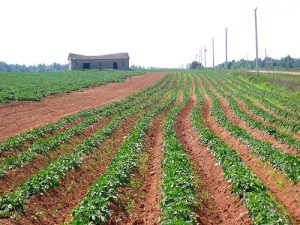
pei-potato-farmAnother Labor Day has come. Most folks have forgotten that this holiday was first celebrated back in 1894, signed in as a federal holiday as an effort to bring an air of reconciliation to the nation which had just endured the widespread and violent Pullman Strike. It is meant to honor the Labor Movement and the workers it represents.

For me, the day reminds me of the first time I worked outside of our home for someone else as a child, a memory that was recently reawakened at a wedding of an old friend near the fields where I first used my hands and back for labor. There was an old potato farmer on the road where I grew up and a friend of mine would periodically go down there and work, most of the time picking or bagging potatoes. One day he asked if I wanted to come along as the farmer was going to lay irrigation pipe that day and could use some extra help. Being eleven years old and wanting to make some extra cash and having no idea what I was getting myself into, I agreed.

It was hot and dusty work. The long pipes weren’t heavy but were awkward and each time they began to dip towards the ground as you carried them brought a gruff yell from the crusty old farmer, was not one to wear out his smile from use. He certainly did a lot of yelling and cursing at us that day.

We had just a short break to eat the sandwich each of us had brought with us and after about eight hours in the fields, I was exhausted and covered with alternating layers of sweat and gray, grimy dust. It was the first real day of work I had experienced. It had been a tough for an untested eleven year old but now I would be rewarded.

As my friend and I prepared to mount our bicycles and head tiredly home, the farmer stood before us in his dusty bib overalls, unsmiling, of course.

“Suppose you want to get paid?”

It came out of his mouth not so much like a question but more like a complaint. We silently nodded, eager in our anticipation of our sweet reward. He stuck his thick, strong farmer hand into a pocket and pulled out a handful of change. He counted out three dollars in quarters to each of us and said, “Okay?”

Again, not really a question. More of a dismissal, more like okay, we’re done here, now go.

We were just kids but we knew we had been taken advantage of that day. But we were eleven years old and afraid to death to talk back to the surly old man, to say that this was unfair. We never worked another day for him and I found out later that this was his modus operandi, working the hell out of kids then underpaying them. If they didn’t come back, so what? There were always kids looking  to make some money.

It was a small incident but it shaped how I viewed labor and the way many people are exploited. It was a clear object lesson, in microcosm, on the value of the labor movement in this country as a unifying force for those of us most susceptible to being exploited.

The labor movement is underappreciated now. Our memories are short and we lose sight of the abuse and exploitation of workers that have taken place over the ages. We take for granted many of the rights, rules and protections in the workplace, thinking they have always been in place. But they are there only because people in the labor movement stood up against this exploitation and abuse. These folks willing to stand against injustice deserve our gratitude on this day. We could use a hell of a lot more of them now.

So, as you spend your holiday in a hopefully happy and relaxing manner, remember those who made this day possible. Happy Labor Day.

Read Full Post »

« Newer Posts - Older Posts »