Feeds:
Posts
Comments

Archive for the ‘Early Paintings’ Category

Babe RuthI recently picked up a book titled Baseball’s Golden Age: The Photographs of Charles Conlon.  It is, as it says, a book of photos of baseball players from the first part of the 20th century.  The photos are all black and white and give the players a grim, rough edge.  Not that they needed the help.

From the time I was a kid I was always interested in baseball from the turn of the century.  I read all sorts of books on my heroes and we had an old souvenir-like program from the 40’s that had many of these same photos with short stories and stats of many of these players.  I spent hours and hours looking at these faces and names until they took on a talisman-like quality in my mind.  Guys like Nap LaJoie, Rabbit Maranville, Wee Willie  Keeler, Cy Young and on and on.  In reality, many of these guys probably wouldn’t shine in today’s game but in my mind they were magic.Ty Cobb

Of course, there was a hierarchy.  Shown above, the Bambino, Babe Ruth, was the king.  An actual Sultan of Swat accompanied by his prince, the steady Iron Horse, Lou Gehrig.  Then there was the nasty tempered Ty Cobb, the Georgia Peach, shown here in one of the most famous of baseball photos of its time.  Renowned for sharpening his spikes and using them on waiting fielders as he stole numerous bases, Cobb was always bitter over Ruth’s dominance of the spotlight.

These players always really stuck out in my mind because of the images and stories I encountered as a kid.  They were brawny and raw looking.  They drank hard.  They fought.  They had a hardened mythic look in their gray wool uniforms.  They didn’t look like the players of my youth.  In the 70’s baseball started to be played in awful multi-purpose stadiums with hard artificial turf surfaces, vast cold edifices that sapped all of the organic quality from the game.  The uniforms were evolving as well.  The 70’s brought these stretchy polyester space suits that only added to the artificial feel of the stadiums.  I always think of Willie Stargell, a large first baseman for the Pirates with a big personality who would’ve fit in well with my old-timers) in this god-awful form-fitting spacesuit.  He looked ridiculous.

Walter Johnson The Big TrainIt was easy at that time to drift away from the game that had provided so much magic when I was young.  I stayed away for almost twenty years, barely checking the races or stats.  I have a huge hole in my knowledge of the game from the 80’s and early 90’s.  The return of smaller stadiums built to fit baseball saw a rebirth but it was the Yankees that brought me back.  I had grown up despising the Yanks ( the voice of their announcer Phil Rizzuto was like fingernails on a chalkboard to me) but this team in the 90’s was a throwback.  They had grit.  They fought. They made plays that became mythic.  They made me feel like I was 9 years old again, reading the wonderful hyperbole of the old sportswriters as they made mighty pronouncements about the exploits of the Bambino.  Baseball was magic again.

So leafing through this book rekindled many memories.  With that I leave you with a short piece of film that simply shows the great Big Train,  Walter Johnson, throwing. I saw a part of this on Ken Burns’ wonderful documentary series on the game and was mesmerized by his extraordinarily long arms and the whipping action his arms.  There is a kind of poetic beauty in the motion.

Maybe that’s the poetry of baseball that people talk of…

Read Full Post »


1998In January of 1998, I was still working as a waiter in a Perkins Restaurant, at the same time painting and showing  my work in three galleries.  I was still unsure as to whether I should make the jump to going full-time as a painter.  Oh, the work was well received and nearly everything I was painting sold but I was never convinced that it was anything more than a temporary whim of the public.  Something that would soon fade.  

So I delayed going full-time.

One day while waiting, a single man sat in my station.  I recognized him as someone who I had waited on a number of times with his family.  It was lunch rush and my station was full so I was dashing around.  I stopped and quickly asked if I could get him something to drink.

“I didn’t come here to eat.  I came to buy paintings.”

I looked at him and my mind was blank.  I wasn’t excited.  Actually, I was a little irked.  I was busy as hell and this guy wanted to talk.  I always sort of prided myself in giving 100% to whatever job I had at the moment, even something that might be considered menial.  Hastily, I told him that this was not the time or place for such a conversation and we agreed to meet later that day at the West End Gallery in Corning.

We met and it turned out that he was a designer/ project manager for Corning, Inc.  He knew me from my waiting on his  family and was always impressed by my service as a waiter.  He said I reminded him of waiters he knew in  Venice who treated waiting as an honored profession and would wait their entire lives.  Because of this favorable impression, when he learned a couple of years before that I was showing my work at the West End, he started to follow the work.  He said he loved the way I worked with color and the personal style of my work.

With this in mind, he was now in the middle of a project, building a new photonics research facility in New Jersey for Corning.  The project was nearing completion and he stunned me when he said he had used my work as the basis for the color scheme of the building.  Now he needed some paintings for some key spots and he thought that my work would only be fitting.  Five or six larger pieces.  And he needed them in about six weeks.  Could I help him?

Instantly my head was reeling with questions on how I could do this.  You see, my work up to that point was very small, generally little things in the 4″ X 6″ or 9″ X 12″ range with a few going up to the 18″ x 24″ range.  I had taught myself a technique that worked really well in small blocks but wasn’t sure if I could translate it to a much larger piece.  And where would I paint?  I had started building my studio but it was nowhere near ready.  I was painting on a folding table in our kitchen/dining area.  How could I do this in the time frame he was giving me?  Was I ready for this?

“Sure,” I said.  “No problem.”  Inside, I wasn’t so positive.1998

I took time off from my job at Perkins and set up on my little folding table.  Since I was only adept at painting small blocks of color, I devised my paintings to be larger paintings comprised of smaller building blocks.  It allowed me to maintain my technique.  I struggled for a few weeks but somehow the pieces came around.  I used acrylic inks, acrylic paint, oil paints, chalk and pastels- whatever fit the need of the moment.  As the deadline approached I finally began to believe that I could do this.

At the end, I delivered five paintings.  Two large single pieces and a large triptych for the boardroom.  They were happy and I was very pleased and exhilarated by the whole experience.  It had given me an opportunity to paint on a much larger scale, to expand my work.  My confidence grew in my ability to create work that was beyond the temporary whim I mentioned earlier.  I could do this.

Within a few months I was painting full-time.  All the fears I had allowed to keep me from doing this were swept aside.  That was eleven years ago and seems like a hundred.

Read Full Post »

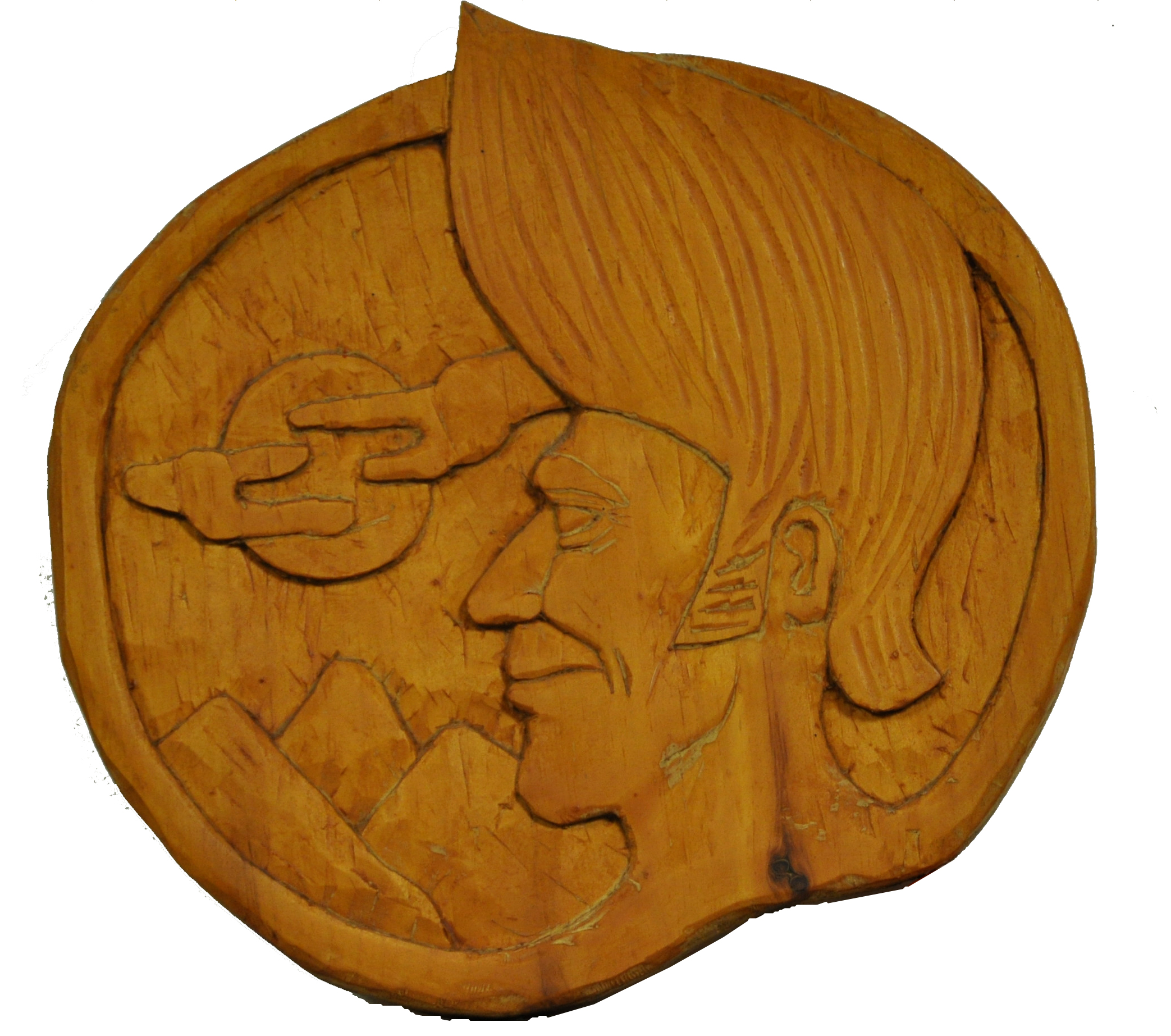
1991Immediately before I started painting in the mid-90’s, my form of expression was wood carving.  It was unpolished and rough but it provided the vehicle that I needed to spark further creativity.  Most were created with an inexpensive set of small chisels and scrap lumber, usually just pine boards leftover from projects.

Actually, the technique that is used in these carvings is linked very much to my earliest efforts at painting which consisted of a heavy layer of paint then removing the parts that didn’t belong leaving the desired image.  This is a technique that I use to this very day.

Clem 1991


The thing that I learned most from doing these pieces is that I wanted to emphasize expression over technique.  By that I mean I did not want to focus so much on refining technique to obtain a very polished final product that the piece became more about craft and less about expression of emotion.  By doing so I realized the pieces would retain my own identity and idiosyncrasies.  It was my first real stab at creating a visual look and vocabulary of my own.SeaKing 1991


I also took the idea of the work having a tactile feel to it.  The attraction of these for me was in holding them and feeling the wood and the weight of it in my hands.  When I first started painting I worked primarily on paper and I got this same feeling from the cotton of the watercolor papers.  It’s something that I also try to insert into my work today as well, through the use of texture and in the way I present the paintings.

When I look at these I’m not particularly impressed by them as art but I do appreciate them for the lessons they provided at a time when I needed guidance, lessons which I took to heart.  To me they are touchstones to a certain part of my life and as such are important to my development as an artist.

Read Full Post »

Exiles: Martyr

MartyrThis is another painting from the Exiles series of the mid 90’s, titled Martyr.  

As I sit here right now, I am at a loss for words to describe this piece.  While there is overt religious symbolism, for me it is not about that.  It is about self-sacrifice, giving everything for the benefit of others.  

But there is also an element that has to do with fear.

When I look at the torso of this character I see it almost as though he has had his skin removed, baring the muscles beneath.  For me, this translates as one being afraid of the consequences of exposing what lies inside.  In my mind, this martyr has been punished for showing who he truly is.

Maybe I’m describing paranoia.  Maybe it’s a form of agoraphobia or just introversion.

I don’t really know.  It’s funny that this piece that has hung above my desk for many years still perplexes me and eludes definition.  I’m sure that one would expect to know exactly what was meant when I painted this but quite honestly, when I started this piece I had no idea where it was going.  Even when the figure neared completion I was still scrambling for the true meaning.  The elements that seem to from a crucifix were not present and weren’t even contemplated at first.

So the piece remains an enigma.  Personally, I like that.  It gives me a sense that the piece is beyond the obvious which is what I hope for all my work. 

Hey, maybe that will be the title of one of this year’s shows:

Beyond the Obvious…

Read Full Post »

The Name Game

The IncantationWhat’s your name? Who’s your daddy?

Is he rich, is he rich like me?

A couple of memorable line from the old Zombies song, The Time of the Season.  

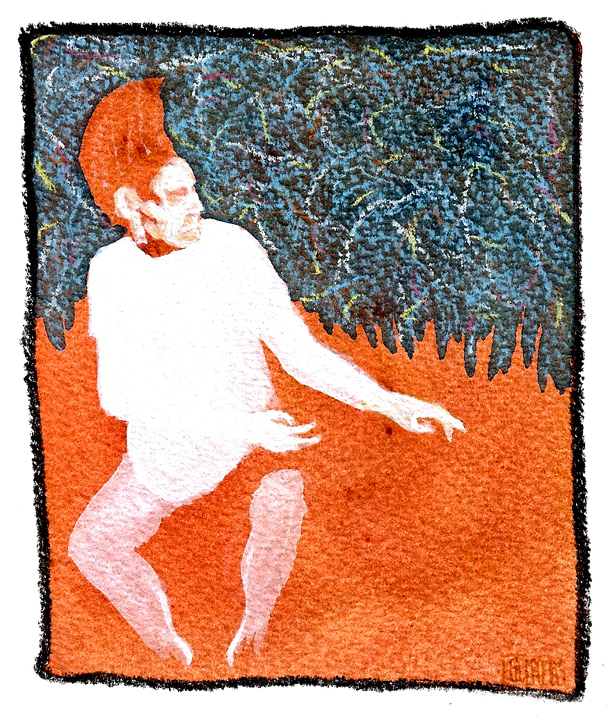
Knowing the true name of something has often been the sign of power over that person or thing. Think of a shaman performing an incantation, perhaps like the one depicted in this older piece I painted  many years ago.  I suppose that means that if one can know the truth, the real essence, of something, they can control or dominate it.

There is obviously something to the concept and  causes me to worry a bit for the open nature of our lives today  as expressed on blogs and social networks.

Maybe it’s a little paranoid, but I would rather be the incantor than the incantee.

Anyway, that’s only the premise to get to a little music.  I bet you thought it would be The Time of the Season ( which is a great song, one where the original is far superior to any subsequent covers) but actually I wanted to play a song that was sung many times over the years and remains a lot of fun to hear.  Plus it’s another great snapshot of the time with go-go dancers and everybody in jackets and ties.  Here’s Shirley Ellis and  The Name Game.


Read Full Post »

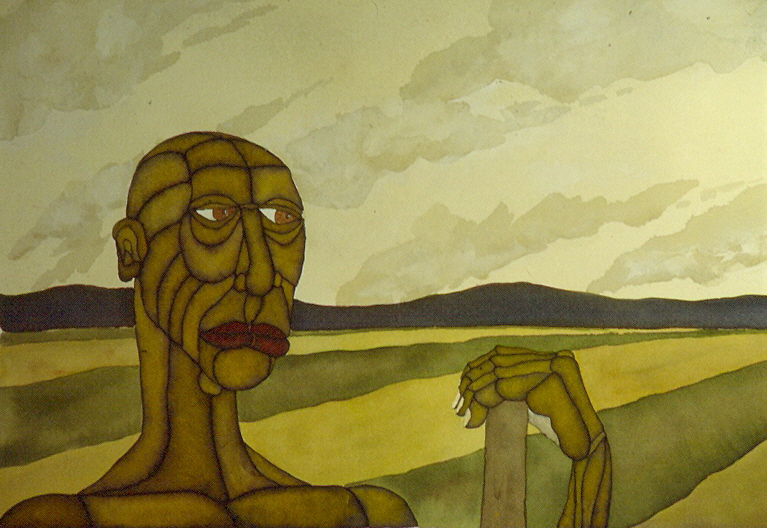
Let Us Now Praise Famous MenThis painting is another of the Exiles series, its title, Let Us Now Praise Famous Men,  taken from a group of Depression-era photos of sharecroppers in the American dust bowl from the camera of Walker Evans.  I have always been taken with these portraits as well of those of Dorothea Lange.  There is a sense dignity and will that has an eternal quality as though anyone in anytime in any culture would know and could empathize with their sorrow, their struggle.

That universal feeling is what I had hoped for this piece.  I am never sure it hit that particular mark but there is something quite haunting for me in this slightly alien face and the sadness written in his face.  He is a true exile…

Read Full Post »

Dedicated Follower of FashionThis is called Dedicated Follower of Fashion, based on the song of the same name from the mind of Ray Davies  and the Kinks.  

I call this one of the Exiles pieces but I’m not really sure if it truly fits.  It was done at the same time back in 1995 or ’96 and performed in the same manner but lacks the emotional depth of the others.  In fact, it’s defining feature is its lack of emotional content.  

I think that this blankness may have been the factor that led me to shape this piece into its final form.  The elements of the face were the first part completed and basically dictate, in the way I work, where the painting goes.  For instance, he could have been place on a vast and deep plain that sweeps to the distance behind him but that didn’t fit for me.

There was something in his oddly colored features that reminded me of the vanity and obsequiousness of many fashionistas. And that’s where the Kinks come in.

So, maybe he doesn’t quite fit in with the other Exiles but maybe that in itself makes him an exile of sorts.

Anyway, here are the Kinks doing the song…

Read Full Post »

The New Day BreaksAnother year, another first painting of that year…

This is tentatively titled  The Coming Light  and is a continuation of the Red Roof series from several years ago that I mentioned in an earlier post.  It’s a 16″ by 20″ canvas and  is painted in a more traditional, additive way than my typical work.  By that, I mean that the paint is continually added to build up the surface.  Typically, my work consists of adding layers of paint then removing much of it until I reach a level of coverage that suits my eye.  Kind of like carving away the paint to reveal what is hidden in it.

Forest Floor-early experimentThe piece to the right is an early experiment in my normal technique and a good example of what I’m trying to describe.  The paper was originally covered with a layer of dark blue-violet paint.  I then went back in and began to lift the paint to create layers of differing coverage to reveal the forest floor and tree trunks.  This became the basis for the technique that  is used in the bulk of my work.

When I do paint in a different fashion, such as in The Coming Light above, the important thing for me is to maintain my style throughout the work.  I want someone who has only seen my typical work to immediately recognize this as mine and to feel the same emotions that I hope are raised.  This continuum is vital and I think this piece achieves the desired goal well.  

I’m working on a larger piece in this manner that I will show in the next week or so.  Stay tuned…

Read Full Post »

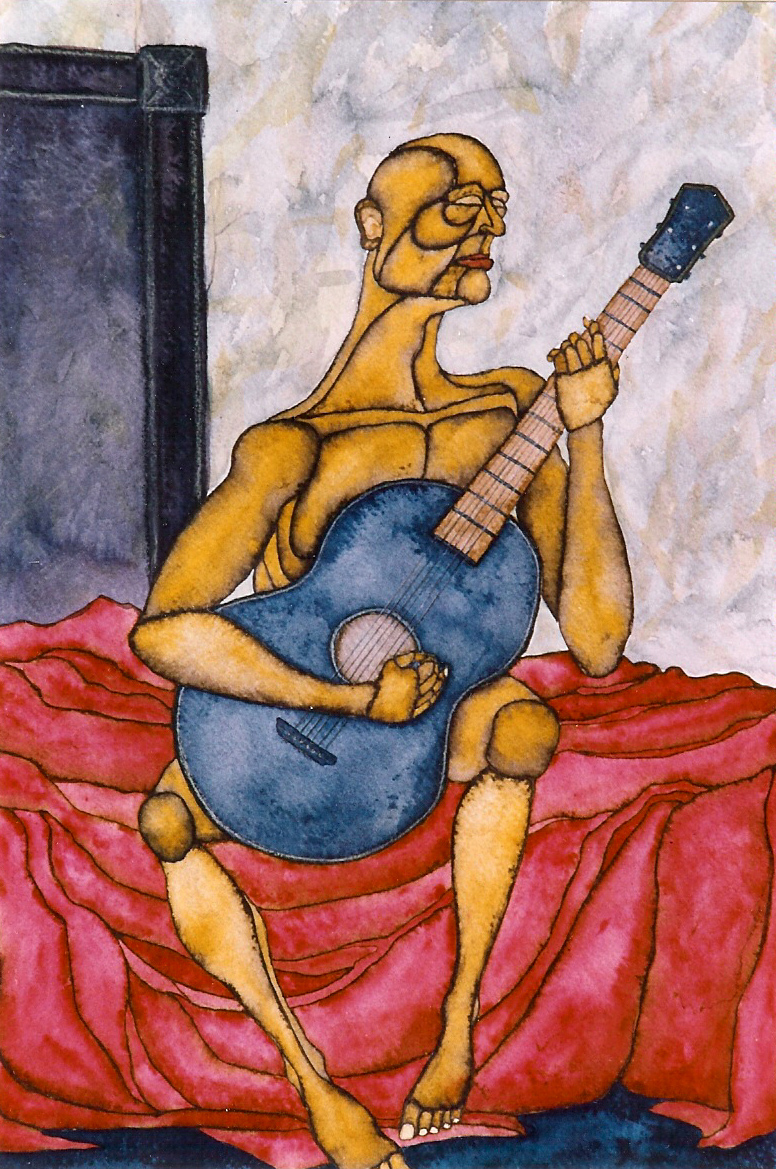
Blue GuitarI wanted to show yet another of the paintings from the Exiles series, a piece titled Exiles: Blue Guitar.  This was larger than the other paintings in the series and was the most intricate in design.  It was the only piece to show a full body, more or less.  The crimson sheets beneath the figure are certainly not typical of my work.  Even the blue guitar was an anomaly.  I think these things, in themselves, make this a distinctive painting and one that is perhaps the one piece I most regret letting go.

I remember painting this piece back in ’96 with great clarity.  The face was based on a portrait of the composer Sibelius  taken by the great photographer Karsh.  I had seen the photo at an exhibit of Karsh portraits at the MFA in Boston (where there is, coincidentally, an exhibit celebrating Karsh currently on display ) and was immediately taken with the face.  The face expressed bliss, but not joy.  A painful bliss, perhaps an ecstasy tempered by the knowledge that the world is an imperfect one and that this moment of grace is a fleeting one, soon to be gone.Sibelius by Karsh  It was exactly the expression I saw for my guitarist and one that I wanted the whole piece to convey.

This was the centerpiece of my first exhibit and remains vividly in my memory.  I hope that whoever possesses this piece appreciates all that it represents and gives this sad, blissful guitarist a bit of attention now and then.

Read Full Post »

CainI thought I’d take a moment and show this painting, Cain, another from the Exiles series that I’ve discussed in past posts.  This is a smallish piece and one of my favorites, one with which  I will never part.

He is based, somewhat, on the biblical story of the original exile, one sent from his homeland to create a new world for himself, never to return.  It is also based on the novel Demian by Hermann Hesse, a book that meant much to me when I went through a trying time years ago.  Actually, it seems a lifetime ago.

In Demian, Hesse uses the mark of Cain as a symbol for those seeking the truth in themselves.  He also discusses the dual nature of man, an idea which has had a very formative aspect in my growth as a painter.  The idea of opposing forces, light and dark,  being contained in one element, one being, always struck a chord in me.  It made sense of the struggles that I observed in myself and many others.

He also made a statement that resonated like a gigantic bell tolling for me.

Whoever wants to be born, must first destroy a world.

Without going into detail, that small sentence was a revelation.  It changed my world forever.

I realize this is a fragmented explanation of this painting and the book that influenced it.  I merely wanted to illustrate what personal meaning some pieces can have for an artist as well the serendipitous nature of moments when art and one’s real life converge.

Maybe I will elaborate in the future.  Maybe not…

Read Full Post »

« Newer Posts - Older Posts »