Feeds:
Posts
Comments

Archive for the ‘Favorite Things’ Category

Batter Up!

Groucho, Chico and Harpo with Lou Gehrig

Baseball season is finally here! 

I consider it one of the best times of the year, when my routine starts to include reading boxscores and checking the standings.  There is nothing like the rhythm of baseball for me and the way it weaves together with the daily lives of people who follow the game.
.
One of the most vivid visual images of my youth are coming up the steps of Shea Stadium at night and suddenly having the bright green grass of  the diamond emerge before you.  Everything was rich and deeply colored.  The greens were dark, the dirt of the infield a warm clay red and the whites of the lines shining like lasers.  It felt like that moment in The Wizard of Oz where Dorothy opens the door and everything changes from a bland, colorless scene to one filled with powerful, vibrant colors.   I still get that same stir of  familiar excitement when I see scenes of a ballpark at night, ablaze in color.
.
So my marathon season begins and, as a fan, I am filled with optimism because my team has won its first game.  Everything is rosy until that inevitable first loss which tastes bitter going down.  Losing and failure, a subject I’ve discussed this week, is all part of the game and it’s how a team or player responds to failure that determines the direction of a season.  That is where the drama lays in baseball.  Can’t wait for the game today!
.
Here’s one of my favorite things, one that I showed here two years ago.  It’s Harpo Marx’s wonderful rendition,  from his appearance on I Love Lucy, of Take Me Out to the  Ballpark, one that strikes that ethereal chord I feel for the game.  Have a great Saturday!  Batter up!

Read Full Post »

I woke up in the dark this morning after a fitful night of sleep filled with horrible dreams.  I don’t want to go into the details but they were awful and constant, each sweeping from desperate scene into yet another.  Dark and tinged in deep colors of black and red.  Hopeless in the scope of their finality and, though I am hesitant to use the word, there was a sense of apocalypse.  I was shaken.  I’ve had many horrifying dreams over the years but they seldom felt so vast and desperately final. 

 As I trudged down to pick up my newspaper I tried to sort out the dream and try to find an equivalence in imagery that I know that captured in some way the feel of these dreams.  As I neared the studio the dark paintings of George Grosz done in Germany in the years before World War I came to mind.  They were forebodingly dark and angry and just the overall look of them made me think of the darkest corners of man’s mind.  The red tones and the way they filled the picture plane along with the chaotic nature of the compositions brought to mind the nightmarish feel of my dreams.

Grosz’s work changed over the years, especially after moving to the New York in the 1930’s where he lived until the late 1950’s when he returned to Berlin, dying there in 1959.  His American work is often considered the wekest of his career, less biting and more esoteric.  There were exceptions such as 1944’s  Cain, Or Hitler in Hell, shown here, which reverts back to the colors and nightmare feel of his early work.  Very powerful work that may not sooth one’s soul but rather documents the darker aspects of human existence. 

I don’t know if my own nightmares have an effect on my work.  Perhaps they come out in work that seems the antithesis of them, work that seeks to calm and assure.  I don’t really know to be honest.  I know that I want to put last night’s visions behind me.  To that end, I think I should get to work and let my nightmares dwell in the work of Grosz for now.

Read Full Post »

“Then who do we shoot?”

These five words uttered by Muley the sharecropper being thrown from his family farm by bankers near the beginning of The Grapes of Wrath echo in my head.  He is frustrated by the seemingly crooked game of cards his world has become and wants to know who has been dealing him these losing hands from the deck of life that is so stacked against him.  And all he gets is anonymity and buck-passing.  He is flailing at boogeymen.

I had John Ford’s classic film of John Steinbeck’s novel on in the studio as I worked yesterday, a ritual I perform at least once a year.  I never cease to be amazed at the topicality of the film in almost any hard time and am moved by scene after scene in the film, even after all these years.  It has long been one of my favorites and has shaded my view of the world since I was a child.

I remember distinctly the first time I saw the film.  It was a very snowy day during our Christmas break.  I couldn’t have been more than 10 years old and my brother and I sat down to watch Ed Murphy’s Hollywood Matinee, a daily showing of a film from the Syracuse TV channel that we were able to pick up with our antenna that laid on the roof of the the old farmhouse in which we lived.  Ed Murphy was a boozy white-haired local TV/radio personality who introduced the movies, which were usually cut haphazardly to fit in extra commercials.  Murphy also presided over the Dialing For Dollars portion of the show where he would pull a telephone listing ( a Syracuse phonebook cut into pieces) and call a lucky listener for a cash prize.  I can’t remember exactly how the rules worked but I remember a lot about watching that particular movie.

I remember thinking how Tom Joad was not a particularly good man, especially as a hero.  He had just been released from prison and talked about killing a man with a shovel in a fight.  He had a quick and angry temper but a tenderness when dealing with Ma Joad and his family.  I also remember seeing in the faces of the bank men and the bosses at the farms and orchards that same mean-spirited bully attitude I  could see in the faces of bullies at school.  actually, there was a great familarity in the whole movie.  I could see traces of my family and many people I knew in the Joads.  People pushed and prodded and never quite able to gain their footing, never in control of their situation.  We weren’t Okies but these people were everywhere–average people who struggled on small farms or worked long hours in factories.

This observed familiarity with these characters has only grown over the years.  I recognize more and more people in the faces of those downtrodden Joads and see many scenes in the film that are  analagous to situations in our times.  It’s a movie that I feel is a must-see for everyone.

Here’s a nice review of the film from the New York Times (short ad at the beginning-sorry!) that includes a couple of clips including Muley with the bankman and Tom’s farewell to Ma, which may be my favorite scene in amy film.

Read Full Post »

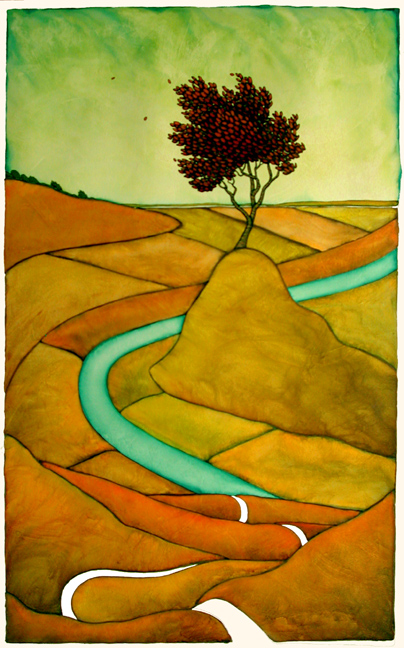
This is a painting from the early part of the past decade that is titled Persevere (Face the Wind).  It is one of Cheri’s favorite pieces and was immediately claimed by her when I finished it.  It is one of my favorites as well and has unfortunately languished in one of the bedrooms of my studio that serves as storage space now until we find the proper place to hang it in our home. 

It’s a very large painting on paper, 32″ wide by 52″ tall, which really enhances the open feeling of the scene.  The colors feel bold and bright but are somewhat muted which allows the central figure to strongly contrast and really dominate the picture.  There is no ambivalence about the subject of this piece.

The path that comes into the foreground is left unpainted, creating a white ribbon that grows out of the unpainted space around the painted image.  I contemplated painting it for a long time but ultimately chose to leave it as is, favoring that  ribbon that comes from the whiteness of nothing.  To me , it adds a different dimension, adds another question that hangs over the image enigmatically.  And I think that’s a good thing.

I periodically go to check on this painting in that back bedroom, moving things out the way to get a better view of it in the small space.  I am always filled with a sense of  liberation when I allow myself into the picture plane.  I feel the wind that blows through the leaves of the tree and feel the strength of the tree as it defies the wind.  It is autonomous and it’s oneness fills me with the reminder that we are all are on our own paths that are self-defined, beyond what anyone else can decide for us.  Our happiness, our concerns and our hopes are all our own. 

I see a lot in this painting with each view, sometimes things new and unexpected, and am glad that Cheri placed her claim on it those years ago.  It’s a piece that feels like a very large part of me.

**********************************

Auction Update

A reminder that tomorrow, Monday, at 12 noon EST is the final deadline for the Auction to Aid Japan.


#1 Full Silence-- Current High Bid $650


#2- Seems Like a New Sun - Current High Bid $810

Read Full Post »

January-- Grant Wood

I’ve expressed my admiration here for the work of Grant Wood more than once.  I find his imagery compelling, especially the way he creates mood and tension in what seem to be typical, mundane scenes.  His paintings and lithographs often have a wonderful rhythm throughout them that sings to me.  I see these qualities captured beautifully in a series of stone lithographs he created that capture the feeling of the winter months in quiet and moody tones.  The subtle shifts in the grays of the ink recreate the seasonal sense of atmosphere, a point illustrated wonderfully in this piece shown above, January.

February- Grant Wood

This print on the left, February, was completed in 1941 and has an ominous yet beautiful quality about it. I love the rhythm in its simple composition, from the patterned fields of the farm in the background to the placement of the dark figures of the horses to the three strands of barbed wire that cross the picture plane.  The way the dark horse in the foreground plays off the graded darkness in the right of the sky.  Just beautiful.

Maybe the foreboding nature of this print was an omen of Wood’s own death from pancreatic cancer the very next February.  He was born in February and died in February, one day short of his 51st birthday.  I am staggered by the work Grant Wood created in his relatively short life and wonder what might have been had he lived to a ripe old age.  I guess that doesn’t matter when he left such a rich legacy behind as it was.

Below, March is tour de force for the kind of rhythmic elements I’ve been describing.  The sway of the farm structures and the bare tree at the top of the frame.  The wagon and draught horse  riding in on the point of the winding path. The roll of the hills and the staccato rhythm of the fenceposts running upward.  Great stuff.  Instant inspiration…

March- Grant Wood

Read Full Post »

When I was a kid there wasn’t much available on the radio beyond the local AM radio stations.  The one I usually listened to was WENY and at the time my favorite DJ was a guy named Paul Lee, who also hosted a late night Saturday monster movie as his alter ego, the Undertaker.  He was entertaining for a 12 or 13 year old kid and had a pretty sharp wit for a DJ in a small market.  He was always runnings call in contests and on one night Iw as lucky enough to be the 20th or whatever caller.  I won a stack of 25 albums and I thought I was in pig heaven.

Of course, they were just getting rid of all the promos that had come their way and never made it on the air.  Most were pretty bad and some were just not the taste for a teenager.  I remember there was an Ornette Coleman LP that was a very conceptual jazz thing that sounded like squawks and buzzes to my ears at the time.  Actually, it still sounded that way to me everytime I’ve pulled it out over the years. But there were a few gems in there.

One was this self-titled first album from David Bromberg.  It was produced by George Harrison who appears on the very enjoyable song, The Holdup.  Several of the songs are Bromberg’s interpretation of blues and traditional classics mixed in with some wonderful originals, including the strange and haunting Sammy’s Song.  I still listen to it on a regular basis and it has always held up through the many years.  Bromberg’s an interesting guy, a folk guitar wiz who basically quit the business for several years to learn the art of violin making.  He has returned and plays several shows a year but maintains a violin shop in Wilmington, Delaware.  He seems like a  man who lives life on his own terms.  A rare and wonderful thing.

Anyway, on this rainy Sunday morning, I’m glad I was the 20th caller and found this album.  Here’s Last Song for Shelby Jean from it:

Read Full Post »

My Girl

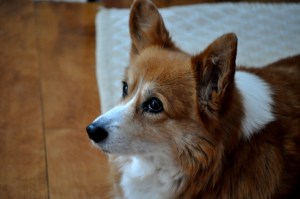
This is my best girl, Jemma Jones, who passed away yesterday.   She was perhaps the sweetest creature to ever grace our lives and Cheri and I will miss her greatly.

Jemma came into our lives a little over five years ago. At that time,  I began looking for another pet to replace our poor little beagle, Mae Belle Brown, who had passed away two years prior and whose story is also a compelling one that I may tell here at another time.  I came across a photo online of this little red Corgi at a shelter about 70 miles away and it was love at first sight.

Jemma, it turns out, was rescued from a puppy mill in Lancaster County, Pennsylvania that was ran by the Amish.  The breeding of puppies to supply pet stores has become a huge cash crop for the Amish and in areas where there are concentrations of the Amish there are generally large numbers of puppy mills.  It was estimated that Jemma was about 7-9 years old at that time and had been bred many times.  She had no name that they knew of, which is not uncommon in these circumstances where the dog is treated as livestock,  so the rescuer gave her the moniker Jemma.  We added the Jones just for balance. 

 When they found her, she was wandering free in a large barn with a couple of hundred dogs in cages.  She was eating kernels of whole corn off the floor ( a practice she continued with us).  The representative of the rescue organization said that she may have been a favorite of the breeder because they had agreed to give her up because of lumps on her breasts rather than simply have her destroyed, which is often the case.  They had no intention of paying vet bills for a sick piece of livestock but were willing to at least let her have a chance else where.  For that, we are grateful. 

Over the next two years Jemma underwent surgeries to remove three of her breasts.  She endured the process with a real peaceful dignity and had great recuperative powers, often back to her happy demeanor within just a day or two after the major surgery.  She also was discovered to have a heart arrythmia and arthritis in her shoulders but despite these physical ailments, including the spectre of recurring cancer which had led the oncologists at Cornell to give her 6 months to two years to live, she lived her remaining years with great joy.  She was fast to excitement and her joy in the things that gave her pleasure was immense.  I have no greater joy in my life than the memory of her on a walk suddenly stopping and flopping on her back to wriggle in grinning ecstasy.  She loved to do this in the snow and even on the night when she went into respiratory distress she wanted to wriggle in the snow when I took her outside into the cold air so that she might breath easier.  But she couldn’t and at that point I knew she was in deep trouble.  She survived in an oxygen chamber at Cornell for five days but none of the many attempts made could relieve her symptoms and the team of doctors there was stumped in finding a cause besides the obvious conclusion that her cancer had metastasized in her lungs.

She was unhappy living in the confines of the oxygen chamber and we knew that it was time to let her go.  We spent quite a long time with her yesterday, just petting her and feeding her treats.  Despite her obvious discomfort in breathing, she was happy.  That was one of her great qualities, this ability to live in the very present, to find instant joy and not carry the past with her.  She went peacefully and quickly.  She has moved on and Cheri and I remain here with broken hearts and loving memories.

I would never insult parents by saying that Jemma was like a child to us.  There are definitely differences in the two, besides the obvious.  Children, when properly raised, become more and more independent until they go out on their own.  Pets become more and more dependent on their owners for their care and comfort as they age and grow sure of the love they receive.  The relationship is not like a parent but  more like that of a caretaker who offers love and protection and is rewarded with unconditional love.  It has been our great pleasure to see Jemma and Mae Belle flourish in the last years of their lives.  Both were exceedingly happy in the last years of their lives despite their physical problems.  And that happiness fills ones soul.

Thanks for coming into our lives, Jemma.  You have  filled my soul.

Read Full Post »

We’ve been spending a lot of time the past few days visiting our little dog, Jemma, in the hospital at Cornell where she is not doing so well. So I’ve been a bit distracted in my blog and my art, as well.  This is a painting on paper that I finished last week that I’m calling A Thousand Miles From Nowhere, after the title of a favorite Dwight Yoakam song of mine.  It’s about 10″ by 17″ in size and has a feeling of detachment that fits the title and my mood this morning.

Enough said.  Here’s the song whose title I borrowed.

Read Full Post »

Glory Run

I talked the other day about painting in series and that brought ot mind a few themes that I have painted over the years that were part of a loose series, not necessarily painted near each other in time but connected through subject and composition.  One such series were a group of paintings done over a number of years that contained a single sail boat riding out the waves.  They were simple compositions, with basic elements that emphasized the motion of the craft yet maintained an almost abstract quality. 

 The piece shown here, Glory Run, is one of my favorites from that series and has that abstraction with the round sun and the crescent sail playing off one another.  The rounded arcs of the waves and the oblong clouds add more geometry to the composition and make it a piece that I can look at without even realizing the subject.  On the other hand, I can sometimes look at this piece and focus solely on the shape of the craft and the sailor at its stern.

Near this same time I also did this piece, Lone Running, working off the same basic theme.  This might be that same sailor.  I’m not really sure.  This piece, to me, plays even more off the way the shapes interact, giving it a very abstract feel.  The crescent sail comes rhythmically off the curve of the wave and creates a nice symetry with the sun.  This painting really works for me in this manner.

Now, as I write about how I see these and what I think makes them work, I have to point out that none of those thoughts about symetry, abstraction or interaction of the elements come to mind when I’m painting.  Oh, they may be there, hidden in the thoughts of simply obtaining a sense of rightness in the piece, which is first and foremost.  They probably do have a say in the back of my mind.  But as I approach the table or easel, they are secondary to the idea of conveying emotion.  After a painting is done it’s then easy to see how these qualities have played a part in bringing out the emotion I was seeking. 

I haven’t painted a boat piece in a few years, haven’t had whatever urge it was that created these pieces.  But I always stop over these pieces and gaze at them for a while.  There’s something there for me that goes beyond breaking down the elements and composition.  Maybe I should soon continue the series…

Read Full Post »

If any artist has stuck more closely to variations on a single theme than Chuck Close, I am not aware of him.  Close has had a long and illustrious career painting portraits based on the grid system often associated with photographic  pixels, taking the contents of each grid placed over a photo and transferring and expanding it in size to a corresponding grid on his canvas, to put it in simplistic terms.  Beginning early on, Close created  huge canvasses where he would capture every single detail and blemish in his subjects’ faces in an extreme photorealist manner.  These have tremendous impact when seen in person, from the massive scale as well as the ultra-clarity provided in the detail.

  But over the years he went beyond the photorealist aspect and created variations.  Instead of replicating each pixel with absolute precision, Close would use the grid to create almost abstract mosaic tiles that captured some of the color and form of the referenced grid but had their own form as well.  The self portrait shown above is such an example. He also used his thumbprints to create portraits in this manner, taking fingerpainting to new heights.  Fanny/Fingerpainting 1985, shown here, is an example.  Hard to believe that this very realistic image is built from thumbprints.

As an artist, I am most intrigued by Close’s dedication to his process and his ability to discover variation within it.  Ultimately, subject matter is not the important part of his body of work.  It is his unique process that makes his work special.  That’s something that you hope young artists realize, that it is more vital to adapt a way of painting, a process,  that meshes with the workings of your own mind than finding interesting subject matter.

There’s a lot more to say about Chuck Close than I’m saying at the moment.  For instance, how he has adapted his process to his physical limitations that resulted from a spinal blood clot in the late 80’s.  That’s a story in itself.  There’s a wealth of info on the web about the artist for those who seek more detail.

Here’s a neat promo for a show from 2009 of Close’s printwork held at the San Jose Museum of Art.

Read Full Post »

« Newer Posts - Older Posts »