Feeds:
Posts
Comments

Archive for the ‘Favorite Things’ Category

I have a book that I often find myself flipping through in the studio.  It’s  Gardens of Revelation: Environments by Visioionary Artists from author John Beardsley.  It is an overview of various atist gardens around the world, documenting the creative and idiosyncratic outdoor worlds made by average folks who have a drive to leave some sort of mark on the world.  It’s a wonderful book that shows how strong this need to create these environments can manifest itself, often becoming the driving force in the lives of those who undertake them.
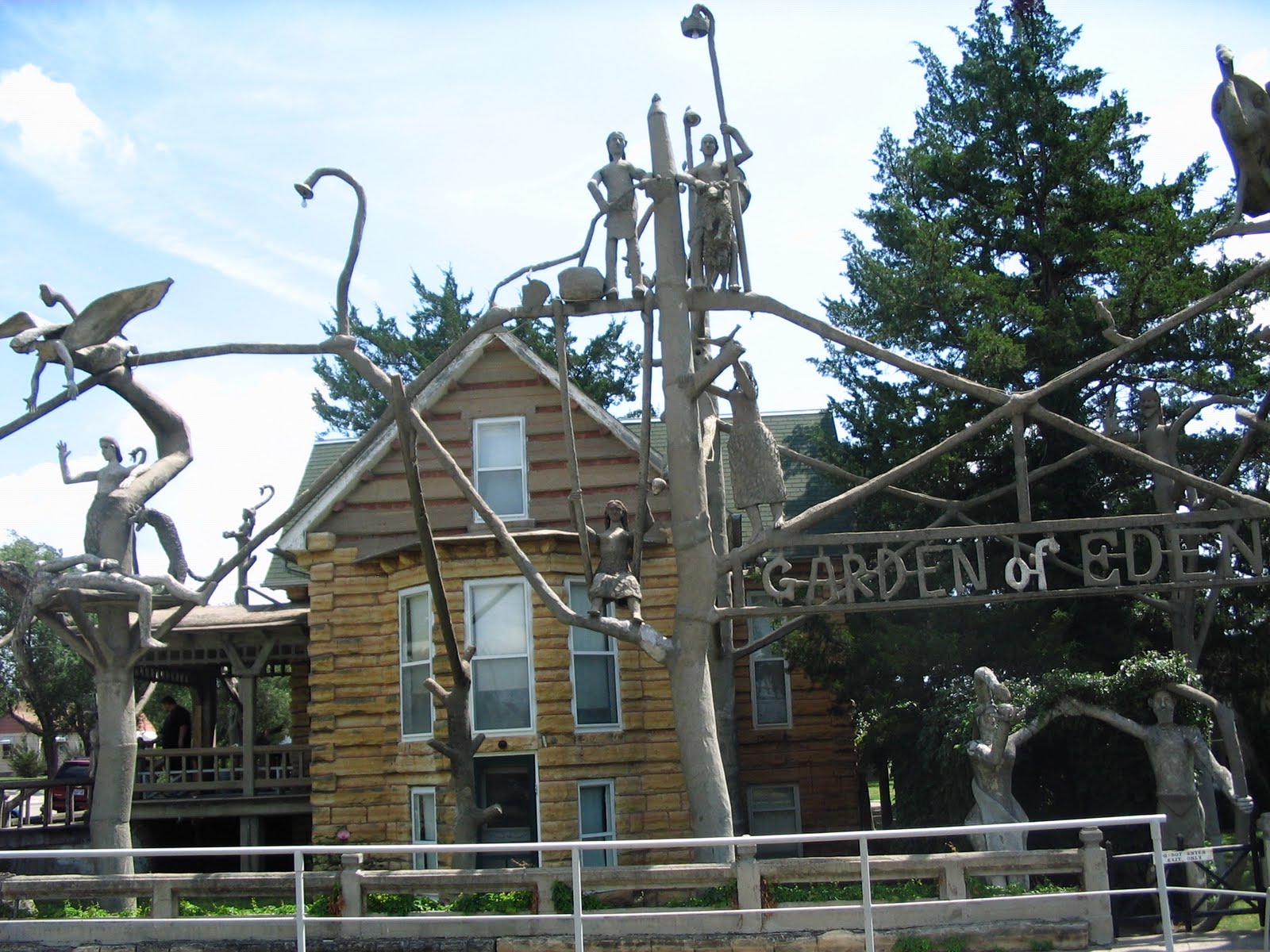
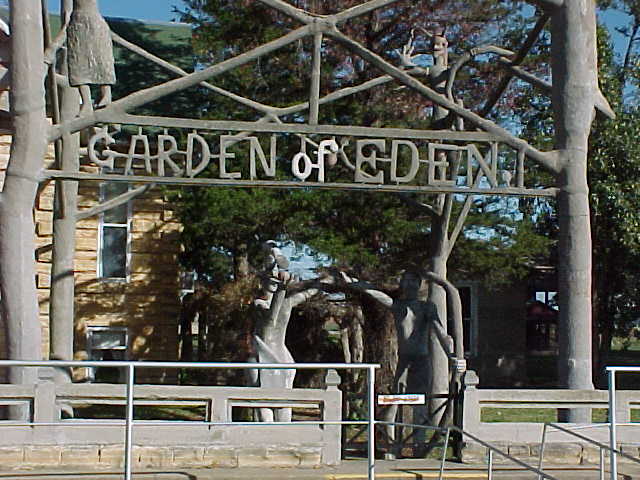
One of my favorites is the Garden of Eden, located in the booming metropolis of Lucas, Kansas, population 460.  Built there by Civil War veteran Samuel Perry Dinsmoor, it started as a home built for Dinsmoor’s family.  In the timber-bare plains of Kansas, Dinsmoor painstakingly built a cabin  from limestone slabs carved to look like logs.  After completing the house, he soon set to building his vision formed from Biblical tales,  mixed in with his unique view of the world at the time, as he saw them.  Built over steel and chicken wire, each element is made with handformed concrete, sealed well to keep it from deteriorating in the unrelenting weather of the plains.  It soon spread to cover most of the 1/2 acre lot and became a well known Kansas roadside attraction. 
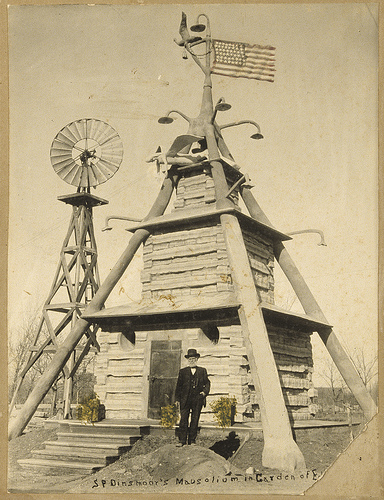
Dinsmoor was quite a character and saw his creation as a way to support his family long after he was gone.  He married his second wife when he was eighty years old.  She was 20 and they had two children before his death in 1932 at the age of 89.  Wanting to still be a presence, he proceeded to build a final structure on the lot– a mausoleum constructed from the same limetone logs as he had incorporated in his home.  In a final attempt to provide for his family after his death , he built a tomb that allowed paying visitors to view his embalmed body through a viewing panel.  You can still take a look at the leathery and somewhat mildewed creator of this Earthly Garden of Eden today.

I’m glad that Dinsmoor’s garden still prospers today.  The sculpture seems to be in great shape, seeming as vibrant as they must have nearly 100 years ago. Someday I must wander across the plains to Lucas and give it a gander and pay my respects to its builder.

Read Full Post »

I’m kind of wired from watching the conflict in Egypt on the tube in real time as though it were some sort of twisted sporting event,  the momentum of each side surging back and forth under a rainstorm of rocks and Molotov cocktails.  The term I heard several times yesterday was medieval and it certainly brings to mind the stories of the siege battles of that era.  Fire falling from rooftops on to the crowd below.  Men with whips racing through the throngs on horses and camel, flailing away as they rode.  Sheets of steel used as shields behind which the advancing forces marched forward.  Men carrying machetes and clubs.  I’m still waiting for someone to drag out a catapult or trebuchet.

Crazy stuff.  I need some sort of relief from the tension of merely watching this horror show.

How about this painting of  H.R. Pufnstuf from my friend  and great painter Dave Higgins?  It’s a tiny piece, about 3″ square, of the title character from the old Saturday morning kids show.  From Sid and Marty Krofft, it ran for a couple of years back around 1970 and featured life-sized puppet-like characters in a storyline about a young boy who is lost and trapped on this enchanted island where everything is alive.  For instance, the houses talk.  The island is ruled by its mayor H.R. Pufnstuf who protects the young boy from the evil Witchiepoo and her minions who constantly try to steal the boy’s companion talking flute.

Actually, it was pretty awful and I remember thinking that as a kid even as I kept watching .  But the awfulness has transformed into a certain  kitschiness over the years and it has achieved a sort of iconic quality.  It’s still pretty hard to watch (you can see episodes on hulu.com) but it has a catchy theme song that uses Paul Simon’s 59th Street Bridge Song (Feelin’ Groovy) as its melody.

This little painting is part of the West End Gallery’s Little Gems show which I’ve written about here before and opens tomorrow night.  I took a walk through the show late last week and when I saw this piece, it stopped me dead in my tracks.  It was such a lovely little piece, mixing the pop quality of Pufnstuf with Dave’s ability to paint beautiful landscapes with the feel of the early Luminist school.  He’s known for this juxtaposition, most notably for his Pimp in the Woods series, shown here.

Long story short, I bought this little gem.  It makes me smile and that’s so much better than what I’ve been seeing on the news.

Read Full Post »

Forms

Periodically I look up from my easel or my computer at a set of shelves that are built into the stonework of the fireplace in my studio.  I have some books and a couple of  small older pieces of mine along with a few mementos.  The one that always catches my eye is an old shoe last (the forms a cobbler would use in making a shoe) that I found here when I moved in.  I was drawn to it from the moment I first saw it. 

It’s carved from what looks to be a fairly soft wood, a fir or poplar.  The weight is deceiving when you pick it up as there are heavy brass inserts on the heel.  On these inserts you can see where the shoemaker has nailled many heels over the years, leaving little pits in the brass.  It has several markings on it.  ITALIO is printed in block letters on one side and the size 8 1/2 D is stamped into the wood.  There is a date as well, Apr 6 1960 on one side.

There’s something very beautiful in the form of this object, a certain rhythm  in the smooth lines of the wood as it rolls up and over the instep.  The graceful nature of the object makes it seem more a work of sculpture than a utilitarian object and when I hold it, the weight of it and the coolness of the wood give it a  tactile quality that belies its true nature.

The forms used in making objects such as shoes or hats are often quite beautiful to my eye.  Seeing the form of the intended object in a material other than the leather of the shoe or the felt of the hat gives a much different impression.  It allows you to look past the object, which may not have even drawn the eye in its intended final state, and see the forms underneath.  The essence of the piece.

I found these hat molds at a site , Just Folk, that is offering them for sale.  Their site has a great opening page with funky music and a slideshow of some their unique objects.  These hat molds have a great look that I’m sure transcends the beauty of the original hats although these designs are very solid.  I wonder how many of these hats are still floating around, stored away in attic chests or propped up in the windows of a vintage clothing store?

Read Full Post »

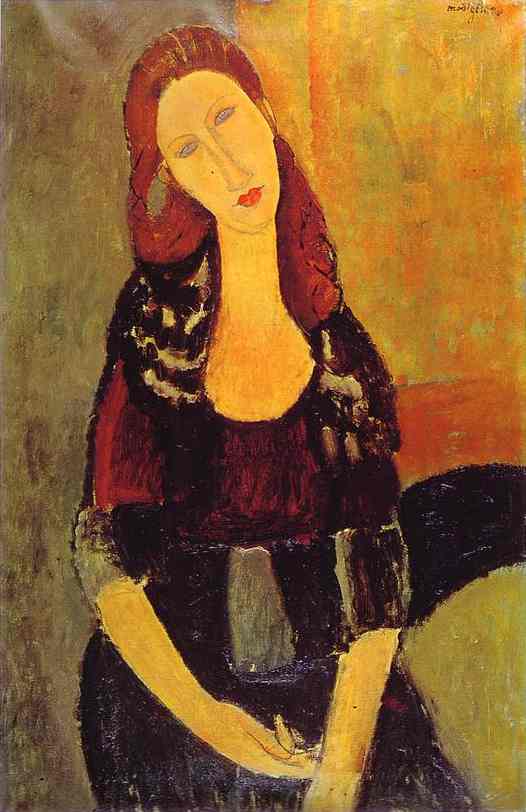
You wouldn’t know it to look at the work of Amedeo Modigliani, but it was quite an influence on my painting.  Modigliani’s work through his short, self-destructive life consisted primarily of stylized portraits and  nudes.  The heads of his subjects were long and oval, often set at an angle aperch an overly long neck.  The eyes are almond shaped and the nose pinched.   Hardly words to describe great beauty yet they maintain a graceful allure that is immediately recognizable as the work of Modigliani.

  His instant recognizability of his style and subjects from across large galleries was striking and was the great message I took from seeing Modigliani in museums over the years.  You couldn’t mistake it for the work of anyone else and as a painter early in my career, still seeking the direction of my work, this was an invaluable observation.  With each Modigliani I came across, the idea that my work should be somehow unique and have a quality of instant recognition was reinforced in my mind. 

Also, his limited subject matter made an imprint.  The idiosyncratic nature of his portraits and nudes made the repetition of his forms seem like a moot point, making the viewer easily enter the picture plane and focus on the unique qualities of the piece in the colors and forms.  It wasn’t the subject that mattered but the way in which it was painted.  Another valuable lesson.

Fortunately, I didn’t learn the lessons of the other parts of Modigliani’s life.  His drug and alcohol addictions, combined with tuberculosis, led to an early death at the age of 35.  Even more tragic is the story of Jeanne Hebuterne, the model for the paintings shown here and the common-law wife of the artist.  She was the subject of at least 25 of Modigliani paintings.  The day after the artist succumbed to death in Paris in January of 1920, a distraught and pregnant  Jeanne threw herself out the window, killing herself and her unborn child.  She was 21 years old. 

 Coincidentally, her death came on this date, January 25.  I didn’t realize that until I just looked it up.  Hmmm…

Read Full Post »

I wrote yesterday, while descibing the initial stages of my painting process for a new piece, about stepping back from the canvas at a distance to take in the piece as a whole.  During these early stages, when I’m blocking in the painting with red oxide, I give it what I call my snake-eyed look. This entails squinting the eyes and sort of unfocusing, taking in the shapes as sort of abstract forms that play off one another.  Without taking in great detail with this snake-eyed look I am also imagining ahead in the process, seeing the shapes taking on color and how they’ll react within the composition.  It’s hard to explain except to say that it is a sort of intuitive visualization.

I got the term, snake-eyed look, from a scene from the movie Little Big Man starring Dustin Hoffman as Jack Crabb, the son of westward bound settlers who are killed in an attack by the Pawnee tribe and is subsequently raised as a Cheyenne after being foundby them  in the wreckage of their family’s wagon.  The story tells of his misadventures in going back and forth between the worlds of the Native Americans and the white man , culminating in him being present at the Little Big Horn where Genral Custer (played brilliantly by Richard Mulligan) meets his death.  Great movie and a great tale based on Thomas Berger’s wonderful novel of the same name.

In one scene Jack is reunited with his sister who also survived the massacre but escaped from their rescuers, certain they would rape her.  The Cheyenne, however, thought she was a man.  She takes Jack out to teach him how to use a handgun.  She tells him to go snake-eyed and to visualize shooting a bottle before drawing his gun.  Kind of like the description I gave above.   It’s a scene that I always think of when I find myself standing back from a painting with my eyes in a snake-eyed squint and I often wonder if I adapted this because of the scene or if my squinting  just came naturally.  Whatever the case, it worked for Jack Crabb and it works for me.

I will show the progress of the piece I wrote of yesterday in tomorrow’s post.  For today, here’s that scene from Little Big Man with that snake-eyed look.  If you haven’t seen the whole film or read the book, I definitely recommend either.

Read Full Post »

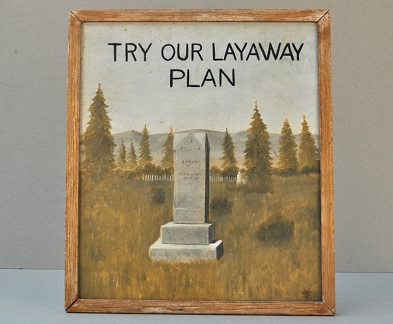
I came across this on  Candler Arts , website that features an eclectic collection of American folk art available for purchase.  I wrote a couple weeks ago about one of their paintings, a nativity scene from Jimmy Lee Sudduth painted with mud and housepaint.  When I saw this piece I gave a chuckle and thought about the reactions it would bring hanging in a shop or gallery. 

It is probably an advertising piece for a monument maker, probably in the first half of the 20th century, probably in a rural region.  Advertising pieces through the last century or so have provided us with some great folk art.  Think of the large cigar store figures.  Paul D’Ambrosio, who writes the vastly informative blog, American Folk Art @ Cooperstown, has written a number of times about the handmade signs and figures that once graced the counters of small shops and stores in earlier America.  Many are a bit rough, like this sign, but all are simply trying to communicate with their customers and did so with a sort of grace that we can still see in them today. 

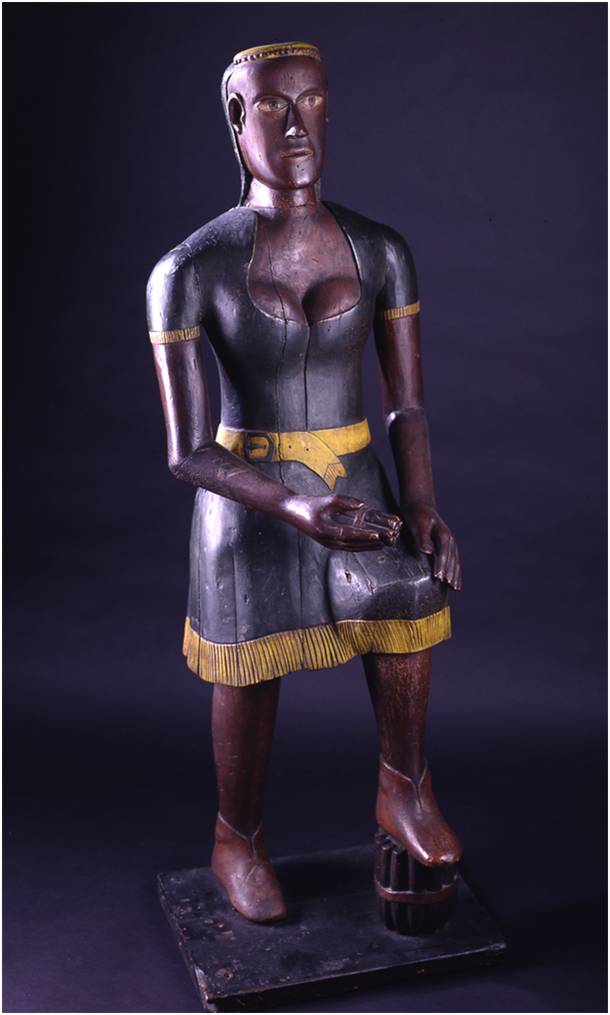
One of my favorites from Paul’s blog is a piece from the Fenimore Art Museum collection believed to be from a freed slave named Job from around 1825.  It is an African-American cigar store figure and is a sensitive depiction of such a figure for the time. A female figure holding out a bundle of cigars, it is not a harsh caricature one often would see at that time.  But is still an eye-catching figure which was the purpose of these pieces, to attract customers into the shops. 

 I would definitely stop and take a serious look today if I saw a carving like this outside a shop.  And maybe I would even ask about their layaway plan.

Read Full Post »

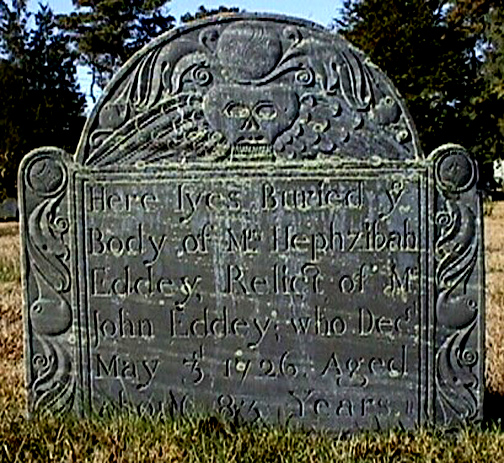
I’ve always been a fan of graveyards, a fact that I’ve proclaimed here in the past.  The monuments and tombstones are an unceasing source of fascination, both in the data provided and the design of the stones. 

 So you can imagine how happy I was to stumble across a relative who also has a great tombstone.  Such is the case with this particular stone, one that marks the grave of my tenth great grandmother on Martha’s Vineyard.  Died in 1726 at the age of 83.  Her name was Hephzibah Doggett who was married to John Eddey.

Hephzibah Doggett.  Got to love that name.

   Before I started venturing into genealogy a few years back I had no idea of any family before the last two or three generations, and even then the history was sketchy at best.  On my mother’s side, it was almost non-existent.  So, to turn previously unturned pages in the family history is exciting and gives a new perspective on how we arrived at this place.  It also provides an opportunity to imagine how the thoughts and mind of a person like Hephzipah relate to your own, to wonder if their eyes saw things in a way that I could understand.

Of course, I will never know the answers to such questions but at least I know that she existed and has left a wonderful monument as her marker on time.

Read Full Post »

Moonlight is sculpture.

Nathaniel Hawthorne

****************************

I find myself with nothing to say this morning.  I am still somewhat seething from listening to media reports from Tucson, hearing the new spin from those on the defensive.  It bothers me that I allowed myself to be pulled emotionally back into the fray caused by this event.  It distracts my mind and keeps me from what I want to be doing so I try to block it out.  Instead I pull up this older piece and remember it and try to focus on the feeling I take from it.

It’s a painting that I’ve always liked from the moment I finished it.  The sculptural quality of the sky  gives the piece a very three-dimensional feel and heightens the sense that it is more than a painting, more like an object.  A relic captured behind glass.  This is something I started to seek in my earlier work and have maintained up to the present day, this sense of being more than a painting of a scene.  A relic.  An icon.  In this case, I feel that it truly works. 

I am pacified greatly by this piece, as though the blues in the sky and water have an absorbent quality that pulls away the tension, allows anxiety to easily slip away.  There is simplicity here and the chaos and idiocy that appears rampant in this world is nowhere to be seen.  All is still.  All is connected.

Okay.  I’m calmer now and maybe tomorrow will bring a more interesting day for the blog.  I’m hoping.

Read Full Post »

Saturday and I’m not in the studio today.  Thought I’d have a little music that feels right for driving.  It’s the  seminal rock song, Hey Joe, recorded by many artists over the decades, most notably by Jimi Hendrix

This is not the Hendrix version.

It’s a version featuring one of my favorites, Tim O’Brien, performing a bluegrass tinged version of the song with the great Jerry Douglas, the master of the dobro.  I saw O’Brien perform several years ago at a local historic church, one that the previously mentioned Mark Twain used to attend.  It was a great acoustic show in a great space, something out of the norm for this area.  I was a fan before the show and his musicianship that evening only made me like his work more.

Anyway, enjoy the song and your Saturday…

Read Full Post »

Turner Classic Movies (TCM) starts a 24 hour marathon tonight  featuring the Our Gang shorts from producer/director Hal Roach

 If you’re not familiar with the Our Gang films (or The Little Rascals, as they were also known), they were a series of shortcomedy  films produced from 1922 up until the late 30’s that featured children as the stars of the storylines.  The children acted in a very naturalistic manner and the stories often had the kids, who were poor, at odds with authority figures and the wealthy.  For the time, there was surprising evidence of racial and gender equality in these films, with girls and young black child actors performing in  starring roles.  There was a level of stereotyping that may not be politically correct today but , at the time, this equality was new and ground-breaking in films.

For those of you who do know them, simply reciting the names of some of the gang are enough to raise some memories.  There was Spanky, Alfalfa, Darla, Chubby, Stymie, Buckwheat ( parodied in a huge way later by Eddie Murphy on SNL), Farina, and Dickie among the many children who appeared in the cast over the years. Not to mention Petey, the white dog with the black ring around his eye. 

I mention this not because of any special love for these films, although I saw and enjoyed most of them over and over again as kid.  I mention it because Hal Roach was a fellow native of this area, born and raised in Elmira, going to the same high school as me.   While known for the Our Gang films, Roach is perhaps better known for his Harold Lloyd and Laurel and Hardy films.  It is legendarily said that Roach’s path in life was greatly influenced by hearing Mark Twain speak at his school when he was a young boy.  Twain spent the better part of twenty summers here in Elmira, writing some of his best loved works from his study overlooking the city, and is buried in the same cemetery here as Roach, who died in 1992 at the age of 100.  I often wonder if those same Eastside Elmira streets above which Twain lived are represented in these Our Gang films.

So, if you get a chance, take a peek tonight or tomorrow at some true Americana.  The Our Gang films represent a unique time in our history and are entertaining,  to boot.

Read Full Post »

« Newer Posts - Older Posts »