Feeds:
Posts
Comments

Archive for the ‘Favorite Things’ Category

I stop every time I go back through old posts on the blog and come across this photo. It makes me think about how we constantly take in information in many forms and what we do with that input– how it affects our perception and vision as we move forward. As an artist, this is the fuel that feeds my furnace. 

************************

I was listening to music this morning as I read email and puttered around. My iPod was docked and in random mode so anything could come on.  At first one of my favorite pieces, Tabula Rasa from composer Arvo Part, played. It’s a modern classical piece that I have always identified with. Tabula Rasa translates as empty slate and was actually very influential in a lot of my early painting, helping me visualize the feeling of wide space as I painted.

Next up was Highway Patrol from Junior Brown, which is worlds away from Tabula Rasa. It’s clunky and chunky and throttles along on Brown’s deep twangy voice and his unique guit-steel guitar licks. I began to think about how the mood shifts so quickly between the two selections, how the mind is suddenly thrown from silence to chaos and how in the vacuum of that contrast something new is being formed

Something very interesting in this contrast. I began to wonder if this has an effect on my painting, on strokes and color selection.  Am I looking for different things in my work when different types of stimuli are present? It’s something I’ll have to examine further.

The picture shown is of a visual/psychological phenomenon called the contrast triangle. Just above the reflected light on the water is a dark triangle in the sky, tapering from the area above the lit reflection on water up to the moon/sun in the sky.

This triangle is not really there.

If you cover the water, the darkness fades away. Go ahead, try it.

The triangle only exists in our eyes and minds. Our reaction to the reflected light creates something new, a different form. Don’t know why I put this in today except that maybe this little area of created vision is similar to the influence of other stimuli on a person’s creative work.

I don’t really know.  I am working off the cuff here, you know.

Here was the next song that came up this morning, perhaps the third leg in my own personal contrast triangle.  It’s another favorite, Gillian Welch performing with her husband David Rawlings, with Miss Ohio.  What this triangle will produce in my eyes is yet to be seen but I am sure it is something.  We’ll see…

Read Full Post »

Maybe it is the extreme coldness or just the prospect of facing another year that might very easily resemble last year. Whatever the case, I find myself in sort of a dark mood, one that has slowed my creative process a bit as of late. I feel stuck in a slightly dark rut but don’t feel particularly worried about it as I have plans on digging my way out of it very soon. But this momentary darkness had me reexamining the work of Ivan Albright, a painter I featured here way back in 2009. I’m replaying that blogpost below with the addition of a video of his work and a few more images. It’s ominous stuff but well worth the look.

**********************************

This painting on the left, And Into The World  There Came a Soul Called Ida, is the work of the late Ivan Albright. Not a household name by any means, but if you’ve seen his work you’ll definitely remember it.

I saw a large  retrospective of his work a number of years ago at the Met and was fascinated ( and a little creeped out, I have to admit) by his subjects and the darkness and tone of the work. But it was the incredible textures of the paintings that I found amazing. They were very sculptural on the surface, with deep moonscapes of color, layer after layer of paint that seemed to be shoved and mashed on to the surface. It was unlike anything I had ever seen.  It was obviously the product of a huge amount of labor but it wasn’t labored. There was something very beautiful there that transcended the unflattering depictions of the paintings.

Albright was best known for the painting he produced that was used in The Picture of Dorian Gray, the 1945  film version of Oscar Wilde’s famous novel of a corrupt young man who defies the ravages of time while his portrait reflects the true result of his debauched life. His painting was the horrifying image at the end of the film.

I’m still fascinated by his work even though I have to admit I get a queasy feeling when I really take in the whole of his characters, like seeing a car wreck and not being to turn away. They are horrible and beautiful at once. I now also really appreciate the epic efforts that must’ve went into creating these pieces, the hundreds of hours that must have been spent.  The patience of maintaining vision.

So check out the work of Ivan Albright. You don’t have to like his work  but you should be aware of it…


Read Full Post »

Spirit in the Night

New Years Eve, folks, and an end to 2017.

Thank god for small favors.

I’ve been recalibrating here at the end of the year, as I’ve explained in some recent entries. I’ve been revisiting old works and writings, trying to blow off the shell of complacency and rediscover that urgent need that drove  my earliest creativity. This also has me re-examining early influences in all things– art, movies, literature and music.

To that end, I found myself watching a couple of hours of old performances early this morning from Bruce Springsteen, mostly grainy black and white films from the 70’s. It may sound odd but Springsteen’s work, his performances and his rapport with his audience throughout his career have informed much of what I have tried to create in my own career. From the first time I saw him perform over 40 years back, I was enthralled by his commitment to growing his work, his complete effort in every performance and his desire to reach out to every member of his audience.

The consistency of his work and his desire to seemingly give more than his audience expects every time speak volumes to me.

So, to end this year I thought I’d go back to a performance at the Capital Theatre in Passaic, NJ in 1978 and one of my favorite Bruce songs, Spirit in the Night, from his first album. It’s great to watch Bruce interact with the audience here.

Have a good New Year’s Eve and let’s hope for better things in 2018.


Read Full Post »

Been taking a little hiatus but still wanted to post something today, maybe just a simple song. I spent quite a bit of time this morning listening to music on YouTube, doing that thing where you keep choosing an obscure but somehow related video on the right side, seeing how far it can lead you down a twisting rabbit hole of oddball songs and forgotten genres. I heard a lot of songs I haven’t heard in years, some good and some not so much.

It was going pretty well and I thought I had my choice when out of the blue, the YouTube algorithm turned up this song from 1979’s Monty Python’s Life of Brian. I knew I had my choice for the day. During the Falklands War in 1982, the British naval ship HMS Sheffield was hit and sunk by an Argentine missile. As the crew was waiting to be rescued, the crew broke out singing this song and it has become tradition among British troops in dire situations.

So whether it’s sinking ship or a nation stumbling along at the end of an odd year, it might be the right song for the day. It made me feel better this morning. Feel free to sing or whistle along…

Read Full Post »

I wanted to play a Christmas song for this week’s Sunday music and thought I’d replay a song that first ran here back in 2009. It’s Must Be Santa from Bob Dylan. It’s a great song, a polka with a klezmer feel and in the the entertaining video you get the bonus of seeing Dylan dance. Good fun for the day before Christmas.

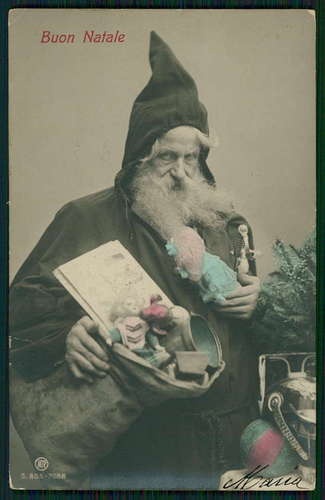
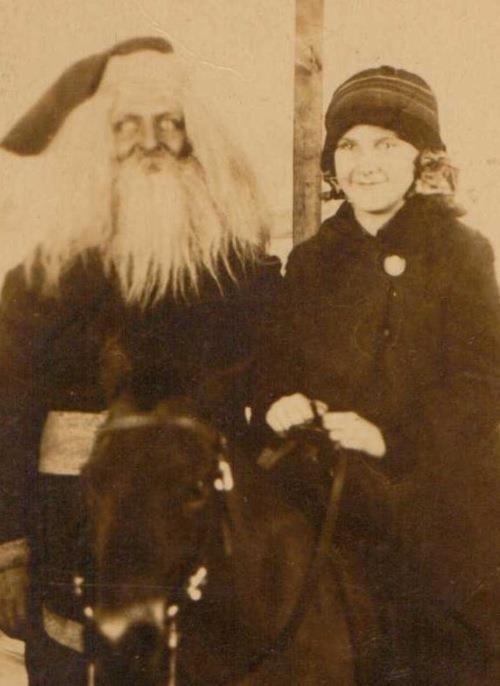
While looking for an photo or two to accompany this post, I browsed through masses of images of Santas from the past and was amazed how many of them crossed that line into outright creepiness. It made me believe that Santa is just about on par with clowns in creep factor. You might see a rogue clown in the woods but Santa is, simply put, a bearded home intruder ( and flamboyant dresser) who slides down your chimney in the dark of night. He knows when you are sleeping, for god’s sake!

I picked a few that are pretty strange. I left out some that actually made me cringe and feel a little queasy. I have a feeling that many of their photos are also in some sort of registry somewhere.

Anyway, enjoy the song and have a good holiday evening. And don’t worry about the weird old man hovering around your home tonight…

Read Full Post »

The painter Pieter Brugel ( 1525-1569) is a favorite of mine,as the color, composition and rhythm of his work quickly draw me into his paintings. I had seen images of the painting above a number of times and had enjoyed it every time by just absorbing it as a whole. But knowing just a few facts about it make it even more interesting.

It’s titled Census at Bethlehem and is from 1566. It certainly refers to the Christmas story of Joseph and Mary arriving in Bethlehem. They are depicted in the lower central part of the image, Mary on a donkey led by Joseph. But it is apparent that this is not the proper time or place for the story for the biblical tale. It is a Dutch/Flemish scene  fifteen hundred years in the future. But it turns out that this was not unusual for Bruegel. He often took myths and tales from other times and cultures and placed them in contemporary settings.

It is also suggested that this painting was a veiled criticism that compared the governance of the Netherlands, marked by heavy taxation and a rough suppression of Protestantism, under the Spanish king, Philip II, to that of the Roman Empire in the Biblical era in Judea. This was painted just a few years before a revolt against Spanish rule broke out.

Seeing this as a political protest adds a layer to its depth. But however you might look at it– as a simple peasant scene, political screed or religious allegory–for me it is a feast for the eyes.

Read Full Post »

Maybe it’s the time of the year. Maybe it’s the weather that brings a certain bleakness. Or maybe it’s the political climate and the anxiety it produces on what seems like an hourly basis. Whatever the case, I have found myself listening to the album Nebraska in the studio on a regular basis lately.

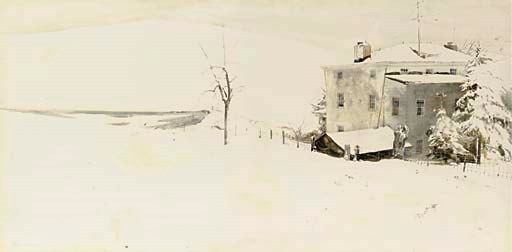
It’s an album from Bruce Springsteen from back in 1982 that was recorded solo in his home on a four track cassette recorder. It was meant to serve as a demo for a new group of songs but Springsteen liked it as it was and released it without a band or much embellishment. It is sparse but has an urgency along with a contemplative and sometimes darker tone,  much like the Andrew Wyeth winter scenes from yesterday’s post, that makes it one of my favorites. I also like the feeling that you are hearing these songs in a pure state, closer to how the artist felt them as they formed, before they’ve went through a hundred iterations in the studio to become something much different.

For this week’s Sunday music I thought I’d share one of the more upbeat numbers, Open All Night. If you’re feeling a bit bleaker – or want to feel that way– I’ve also included My Father’s House, a song that gets little notice but, for me, has great imagery, feeling more like a piece of literature than a song.

Give a listen, if you are so inclined, and have a good day.


Read Full Post »

Wyeth Winters

Andrew Wyeth – Fence Line 1967

I prefer winter and fall, when you feel the bone structure of the landscape – the loneliness of it, the dead feeling of winter. Something waits beneath it, the whole story doesn’t show.

Andrew Wyeth

—————————–

Andrew Wyeth – Over the Hill 1953

Andrew Wyeth- Heavy Snow

Andrew Wyeth- Not Plowed 1985

Andrew Wyeth- Farm Pond Study


Read Full Post »

I pulled a book from the shelf the other day that I hadn’t looked at in some time. It’s a gorgeous book with incredible images and thought provoking allegories. Going through the images was like looking at it for the first time. I thought I’d share a blog entry I wrote about the couple who produce these fabulous photos. I’ve added a few more images to go along with the slideshow. Take a look.

I wrote a week or two ago, after seeing the film Hugo, about the work of early film pioneer George Melies and how wildly inventive it was at the advent of modern cinema.  Melies built elaborate sets and magical illusions to create images that were like scenes torn from a dream.

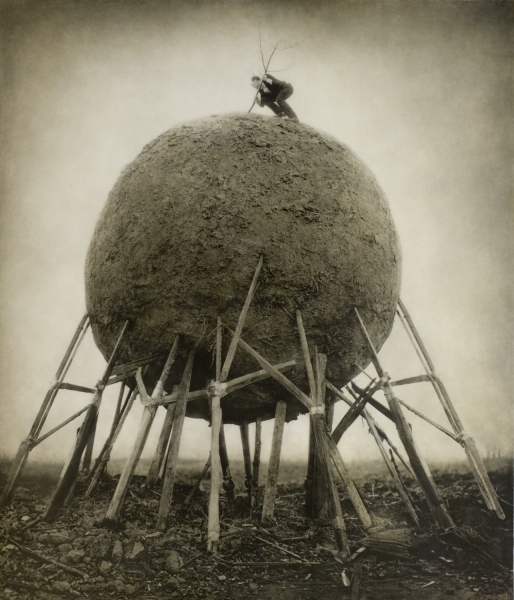
The same might be said for the work of Robert and Shana Parkeharrison, contemporary photographers who create magnificent allegorical landscapes on elaborate painted sets then photograph them.

Old school.

There is no computer generation here.  In their best known series which is captured in a book of the same title from 2000, The Architect’s Brother, they create a monochromatic, sepia tinged world that is both filled with foreboding  and trepidation as well as sheer beauty.  Each image is poetic and thought provoking on some level.

And powerful.

I’m sure I’m not giving as much detail about this couple and their work as you may desire.  I just wanted to pass along their imagery and let you do what you may with that.  Besides, if I write much more, that means I have less time for exploring these photos further.

Here’s a slideshow of the images from the Parkeharrisons’ book, The Architect’s Brother.

[You can visit their website by going to parkeharrison.com.]


Shana and Robert ParkeHarrison- Edison’s Light

Shana and Robert ParkeHarrison- Suspension

Shana and Robert ParkeHarrison- The Sower

Shana and Robert ParkeHarrison- Kingdom

Read Full Post »

I recently came across yet another artist, George Ault who was new to me but whose work really sparked my imagination. Like many of the other under-recognized artists, he led a fairly tragic life, achieving bits of recognition yet struggling to ever find footing. His life was consumed by alcoholism and personal demons that led to his death at the age of 57.

Here’s a brief bio from a 1988 catalog from an exhibit of his work at the Whitney Museum of American Art:

George Copeland Ault (1891–1948) was an American painter loosely grouped with the Precisionist movement and, though influenced by Cubism and Surrealism, his most lasting work is of a realist nature.

Ault was born in Cleveland into a wealthy family and spent his youth in London where he studied at the Slade School of Art and St John’s Wood School of Art. Returning to the United States in 1911, he spent the rest of his life in New York and New Jersey. His personal life henceforth was troubled. He became alcoholic during the 1920s, after the death of his mother in a mental institution. Each of his three brothers committed suicide, two after the loss of the family fortune in the 1929 stock market crash.

Although he had exhibited his works with some success, by the early 1930’s his neurotic behavior and reclusiveness had alienated him from the gallery world. In 1937, Ault moved to Woodstock, New York with Louise Jonas, who would become his second wife, and tried to put his difficulties in the past. In Woodstock the couple lived a penurious existence in a small rented cottage that had no electricity or indoor plumbing. Depending on Louise for income, Ault created some of his finest paintings during this time, but had difficulty selling them. In 1948, Ault was discovered dead five days after drowning in the Sawkill Brook on December 30, when he had taken a solitary walk in stormy and dark weather. The death was deemed a suicide by the coroner. In his lifetime, his works were displayed at the Whitney Museum of American Art and the Addison Gallery of American Art (in Andover, Massachusetts), among others.

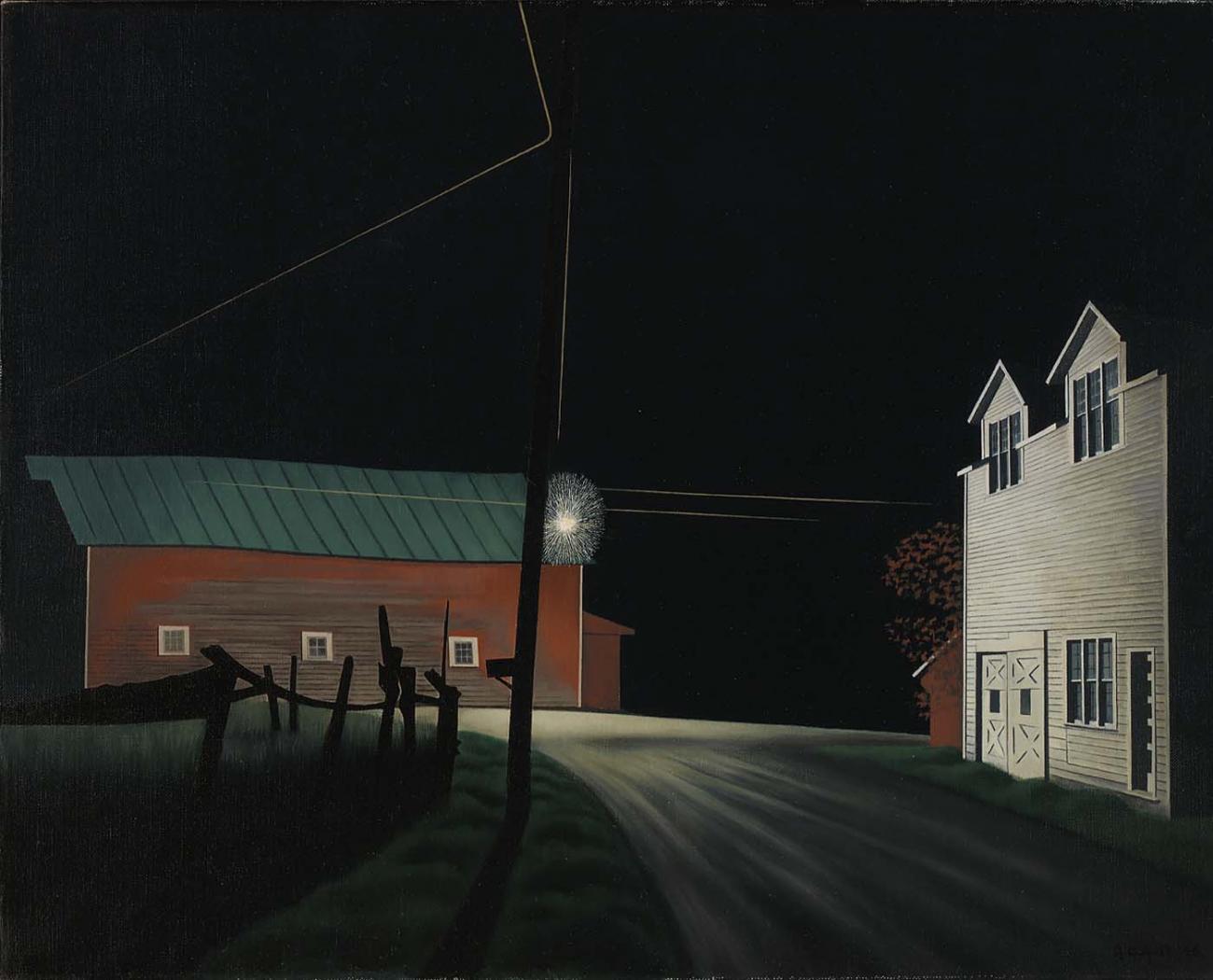
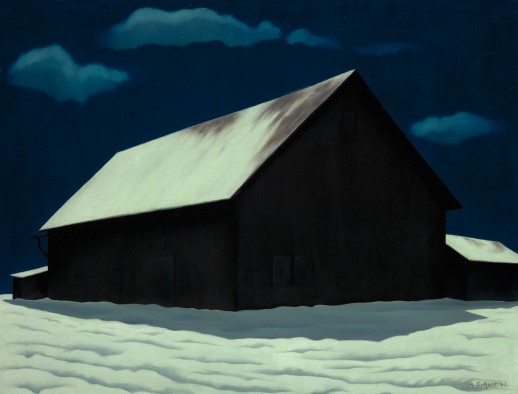
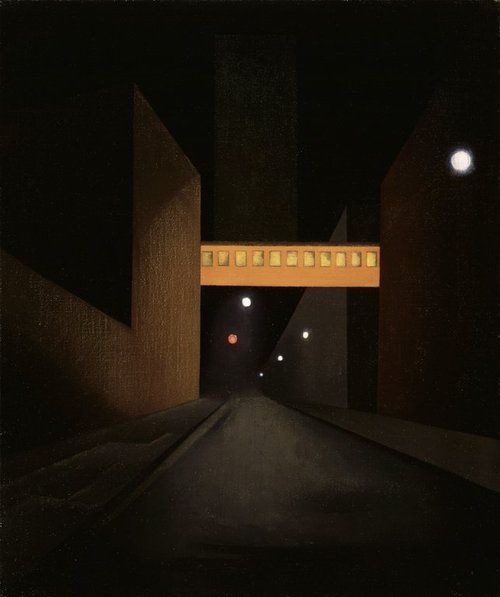
Though I like much of his other work, the work that interests me most are a handful of night scenes. One series of four depicts the same intersection in an area of  Woodstock, Russell’s Corners. Below are the four along with the same scene painted in daylight. You can see how the darkness of night transforms the scene, adding emotional weight and a deepened sense of mystery. I find them to be powerful images, filled with the same ominous darkness that seemed to haunt Ault.

I don’t know if his personal problems contributed to the strength of this work but it seems a shame that he never found peace in his life or in his work, although on that point I am making an assumption. Ault left a fine body of work, one that deserves a look and I am glad to have come across it.


Read Full Post »

« Newer Posts - Older Posts »