
On a morning when I need a chuckle I can always turn to the late, great Shel Silverstein and his slightly skewed take on the world. Like him, there are people that I know who must be from Mars. Check out his site by clicking here.
Posted in Favorite Things, tagged Shel Silverstein on March 28, 2014| 2 Comments »
On a morning when I need a chuckle I can always turn to the late, great Shel Silverstein and his slightly skewed take on the world. Like him, there are people that I know who must be from Mars. Check out his site by clicking here.
Posted in Favorite Things, Influences, tagged Henri Rousseau, Influence, Picasso, Surrealism on March 27, 2014| Leave a Comment »

Henri Rousseau- Self Portrait -1890
I wrote a tiny bit on this site about Henri Rousseau over five years back, showing a few of his paintings that I count among my favorites. Over the years, that little blogpost is consistently my most popular page, receiving a considerable number of hits each day. It’s a testament to the power of his imagery, both in its ability to draw in the viewer and in the timeless quality it possesses in its evocation of mood. I know those are the two qualities that drew me to Rousseau and the qualities I sought to emulate in my own work.
But going through a large book of his work yesterday, I was stuck by one of his greatest attributes, one that I had overlooked: his fearless approach to painting. His work never tried to be something that it was not and always displayed his hand proudly, always declaring itself as his. It gave even his lesser works a strength that is undeniable and true.
It was evidence of a supreme belief in the manner in which he was expressing himself.
That’s not a small thing. I know for myself, there is a constant struggle to maintain my own voice and vision, to not try to conform to the expectations and definitions set down by others in my work. To remain fearless like Rousseau.
 Rousseau was born in 1844 and worked most of his life as a civil servant, a clerk who collected taxes on goods going into Paris. He didn’t start painting until he was in his early 40’s and was not a full-time painter until he was 49. He was basically self taught and worked for the next seventeen years as a painter, blissfully maintaining his fearless work even though he was ignored or disparaged by most of the critics and much of the art world in general.
Yet, among the painters of his day he remains one of the most influential, directly inspiring other giants such as Picasso and many of the the Surrealists. I think they, too, were drawn in and empowered by his fearlessness.
I think he might have been one of the great examples of someone painting the paintings he wanted to see. And that, too, is not a small thing. This and his bold approach are constant reminders to painters who want to maintain their unique voice, who don’t want to be lumped in with genres and styles and schools to stay fearless.
I will try.


Posted in Favorite Things, Music, Video, tagged Billie Holiday, Blues, I Cover the Waterfront, John Lee Hooker, Music, Van Morrison, Video on March 23, 2014| Leave a Comment »
 Sunday morning. Time for some music to fit the mood of the early day. It feels kind of bluesy today but in a quiet way, typical for many Sunday mornings. I immediately go to my default guy, John Lee Hooker and his 1991 collaboration, from his album Mr. Lucky, with another favorite, Van Morrison. The song is titled I Cover the Waterfront. While it shares a title, this song is not to be confused with the more well known song from the 30’s, most famously covered by the great Billie Holiday with a version that is also a fave of mine. I’m sure Holiday’s version influenced Hooker’s song if only in setting the emotional tone and pace.
Both are beautiful in their own ways. What the hell, I’ll put up both versions. Hope one of these sets the tone for a cool and easy Sunday for you.
Posted in Favorite Things, Influences, tagged Degenerate Art, Entarete Kunst, Germany, Lotte Laserstein, Nazis, Norman Rockwell. Last Supper, Potsdam on March 22, 2014| 6 Comments »

Lotte Laserstein- Evening Over Potsdam (Abend Uber Potsdam) 1930
While looking up some the artwork that was branded as being entarete kunst, or degenerate art, by the Nazis in 1930’s Germany, I came across a number of amazing works, many by well known artists but some from artists who were unknown to me. Many of these were Germans who were well on their way to establishing big careers as important artists before the war and its buildup but never really regained their momentum after the war. That is, if they even survived.

Lotte Laserstein at work on “Evening Over Potsdam”
The painting shown above, Abend Uber Potsdam, or Evening Over Potsdam, by German-born artist Lotte Laserstein , stopped me in my tracks when I stumbled across it. It speaks volumes with just a glance. At first, all I could see was a sort of classic Last Supper type arrangement as if painted by Norman Rockwell while he was in the deepest depths of despair. It was big and brilliant. The facial expressions and the body language evoke a mood that is beautiful and tragic at once, perhaps filled with the foreboding of what was to come for these people and that city and that nation.
Perhaps the dog, a sleeping German Shepherd, is symbolic of the German people being unaware of what is ahead, an omen of what is lost when a shepherd is not always vigilant.
This was painted in 1930, just as the Nazis were beginning to make their fateful move to take over the German government. I can only that imagine someone with keen perceptive powers could easily imagine what might be coming with those dark clouds massing over that German city.
 Laserstein grew up in Prussia and was trained as an artist in the creative whirlwind that was post- WW I Berlin . Art in all forms was flourishing, fueled by the desperation and fatalism of living in a post-war world. There was change in the air. Women were becoming more bold and empowered and modernity was pushing away the conventions of the past. Laserstein embraced this life, typifying the image of the single, self-sufficient New Woman. The painting shown to the right, her Im Gasthaus (In the Restaurant), is a great example of that time, showing a single woman with bobbed hair and fashionable clothes sitting alone in a restaurant. The hands are strong and the expression is pensive, thoughtful. It’s a great piece and a wonderful document of the time.
Laserstein was gaining stature at this point but in 1933 was marked as being Jewish and her career began to stall in Germany. In 1937, the same year as the famous Entarete Kunst exhibit put on by the Nazis where they displayed and mocked artwork labeled as being degenerate then destroyed much of it ( a story worthy of another post) , Laserstein was invited to have a show in Sweden. She went there and stayed until her death in 1993.
After the war she basically fell off the radar, although she was active until the end of her life. However, her work after the beginning of World War II lacked the fire of her earlier Berlin work. It was good work but it was less full, less expressive. Perhaps the war had sapped away a great part of her. Her earlier work was rediscovered in her late 80’s and had a retrospective at a London gallery and in 2003, ten years after her death, she returned to Berlin with a large retrospective.
There were many victims of that horrible time. Lotte Laserstein did survive and did produce work for half a century after it so perhaps one might not call her a victim. But there was something lost i n this case and we may never know fully what might have been for her without the war. As it is, she has left us some wonderful work.
Posted in Favorite Things, Influences, tagged Alice Walton, Bentonville AK, Crystal Bridges, Oscar Bluemner on March 12, 2014| Leave a Comment »
A few years back on this blog, I wrote here a couple of times, Oscar Bluemner and Doppelganger, about the work of Oscar Bluemner, the German-born Modernist painter . I feel as close to his work as any artist I have come across. His color choices would have been my color choices. His modeling and blocking of forms are done in a way that came easily to me, without ever knowing of him. It all just fits my mind and eye so well that I feel a real bond with his work Hey, I was even called Oscar a number of times through my childhood– Oscar Myers is too easy a target for other kids not to call attention to it.
 I recently came across a couple of crayon studies that Bluemner had done around 1911 that are coming up for auction. Even these I found fascinating in that I could see myself doing these, so much that they reminded me of early works that I had done in oil crayons. I wouldn’t be surprised to come across these in a box I have that holds this early work. The one shown here on the right, which is being shown as a crayon drawing called Meadow in Connecticut, has an added bonus on its back.
 Flipping the sheet over, there are detailed directions on color placement for the painting that Bluemner was laying out in this drawing. It points out that this is from Sheepshead Bay and in pencil on the right hand side it points out that the resulting painting was a 15″ by 20″ oil that was sold in 1916 to a Mrs. Phillip Lewis Johnson. At least that appears to be the name listed although I could be wrong with my reading of the scrawl. It’s a fascinating further look into the artist’s mind and creative process.
Taking this info, I was able to locate an image of the finished painting, shown below. I can not be positive but everything indicates that it is at the Crystal Bridges Museum of American Art, the spectacular collection and art space built in Bentonville, Arkansas by Walmart heiress Alice Walton. This oil painting is actually listed at 14″ by 20″ so perhaps an inch has been lost over the years. But the vivid quality of the color has not been lost . Again, it’s wonderful to see the process of an artist whose work means a lot to you.
Posted in Favorite Things, Music, Painting, tagged Johnny Burnette, Rockabilly New Painting, Rockin' Billy on March 7, 2014| 2 Comments »
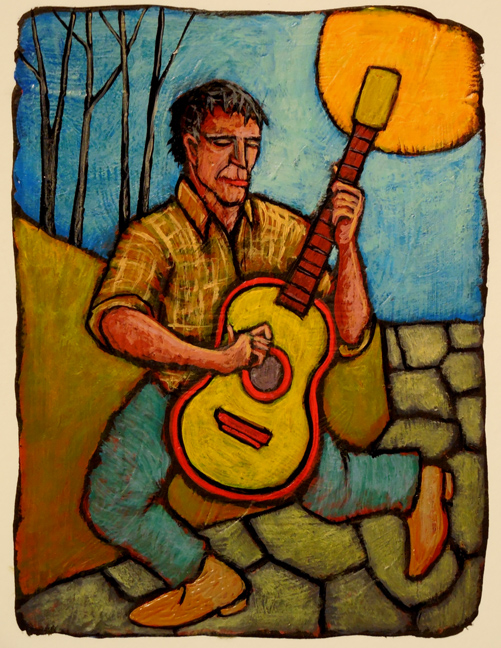 Every so often I try to break things up with my work, go a bit away from my typical subject matter. Usually these are pieces that are mainly for myself, pieces that give me a different sort of satisfaction. They’re not always my best work but just the process of painting them and the pleasure they give personally give me makes them some of my favorite pieces. Such is the case with the painting shown here, a smallish 4 1/2″ by 6″ work on paper that I finished yesterday in the studio.
I have done a number of guitar pieces through the years. While I think it has to do with my love for guitar music, I think it has as much to do with the shape of the instrument and the manner in which it is held, almost in a loving embrace. As I have noted here in the past, the guitar has been a frequent subject of artists through the ages for just this reason. So yesterday, while trying to clear my artistic palette a bit, started my day set on painting a small guitar painting, I had no idea how it would proceed or even the feel that it would hold. I just started with the idea of a guitar.
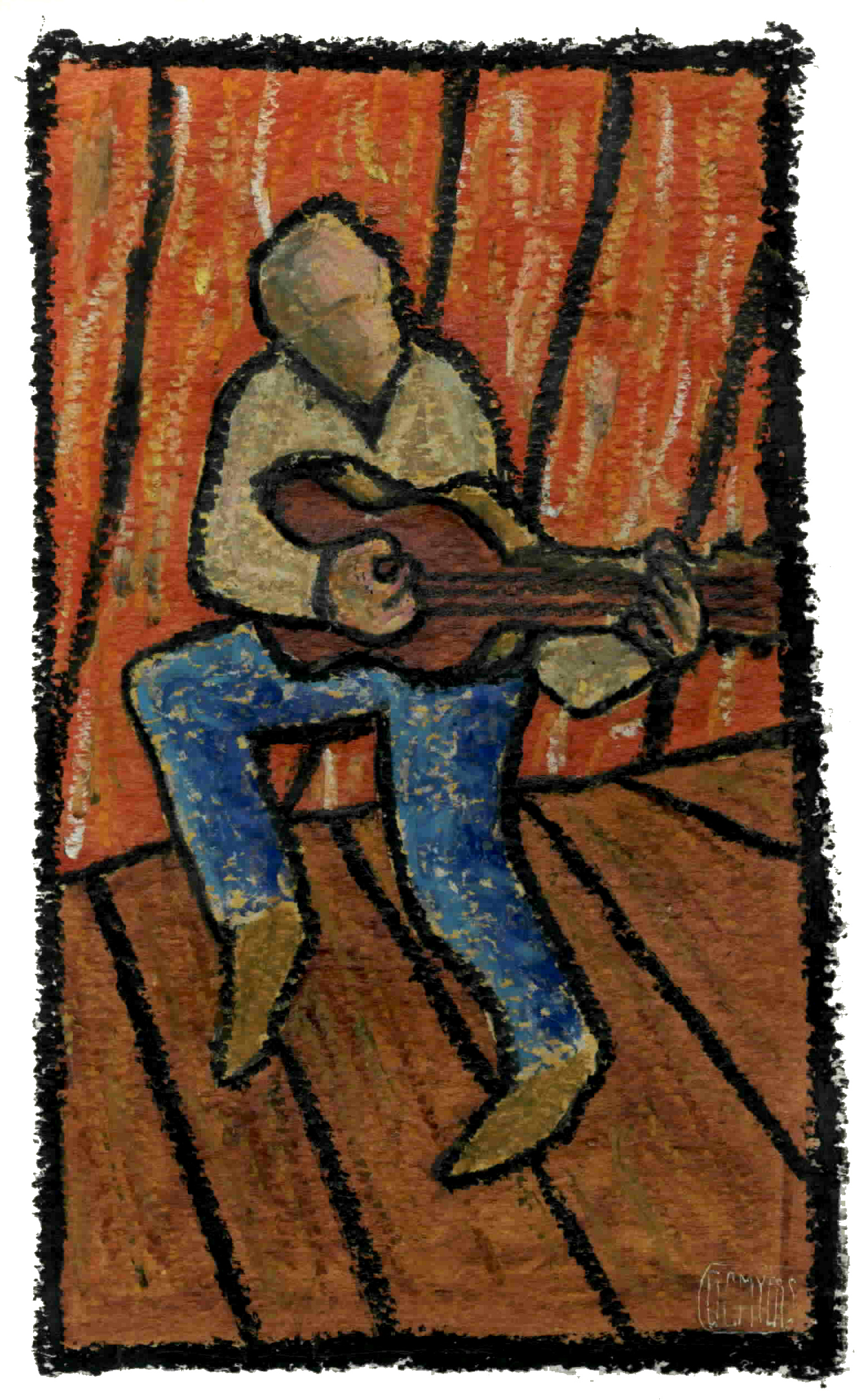 It wasn’t until late in the game that it broke free and became a dancing piece, mainly because I came to a point where I wanted to have the entire figure, feet included, in the frame. Without this , it would be too stiff, too formal, and the manner in which the guitar was painted was anything but that. It’s cartoonish, more like a cardboard prop, especially in the way it was being held. But in order to get the feet in frame I would have to have them askew, in motion.
He suddenly became another Rockin’ Billy, like the oil crayon piece here on the left that I did for myself many years ago. and featured here several years back. At this point, my memory of this piece kicked in and I even modeled the feet in the same fashion. I also kicked up the colors a little more to create a little higher contrast, making it more stylized. It reminds me of a cartoon or a stained glass window.
As I said, it’s not my typical work and probably won’t leave the studio. But I find great enjoyment in this type of work, finding purpose and direction in them that propels me ahead in my other work. I think that makes these pieces memorable for me, makes them stick with me. Plus, it gives me a chance to play a song from Johnny Burnette, one of the early Rockabilly kings, probably a little less remembered than some others. Here’s a song and frantic video that would make my Rockin’ Billy dance, called Train Kept A Rollin’.
Posted in Favorite Things, Influences, tagged Armin Landeck, Columbia University, Etching, Great Depression, Martin Lewis, New York City, Printmaking, The School for Printmakers, Wisconsin on March 6, 2014| 1 Comment »

Armin Landeck- Cat’s Paw 1934
I have often featured the work of artists here who work in black and white, mainly printmakers who work in forms of etching or lithography. For myself, I like seeing the pattern and rhythm of these compositions without the influence of texture or color. Probably because I am always looking for a new way of looking at the normal and these give me a clear view of their construction, their bones. There’s something very pure in that.
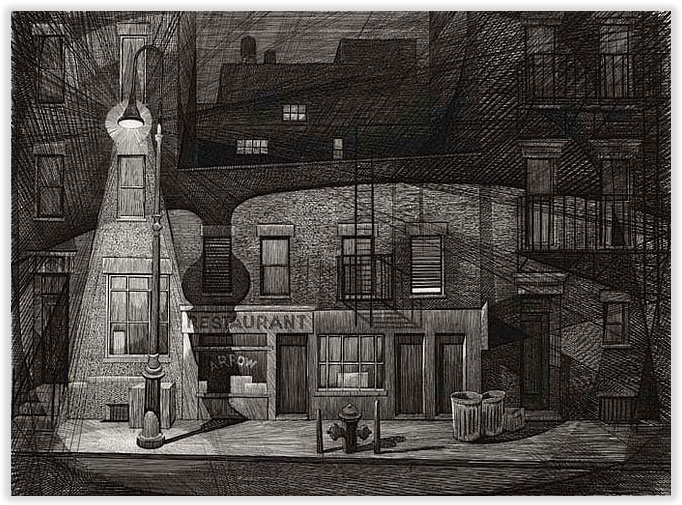
Last week I wrote bout Martin Lewis who achieved some success with his wonderful etchings in the 1930’s only to fade into obscurity in the 40’s until the end of his life. Today I want to feature a contemporary as well as an associate of Lewis, Armin Landeck. Born in Wisconsin in 1905, Landeck came to New York City in the 20’s to study architecture at Columbia University. He and his wife traveled to Europe from 1927 until 1929 where he studied art and became interested in printmaking, producing his fist body of prints there. Returning to the states and not being able to find work as an architect, Landeck turned his complete attention to printmaking.

Armin Landeck- Pop’s Tavern 1934
Like Lewis, he documented the New York of the early 30’s, the tonal nature of his black and white etchings creating a perfect atmosphere for the gritty urban landscapes. The nature and popularity of their work eventually brought Lewis and Landeck together. Together they opened The School for Printmakers in 1934 but it quickly became a victim of the Great Depression, closing in 1935. As I noted, it was during this time that Lewis left NY and work soon fell from favor in the post-war years as Abstract Expressionism and other new trends in art took over the city. Lewis never regained his footing.

Armin Landeck- Chair and Table 1980
Landeck, on the other hand, let his work be influenced by the new atmosphere in the art world, adopting more and more elements of abstraction in it. Without really altering his own unique perspective, his work continued to expand and evolve, remaining vital until his death in 1984.
I like that while I love this work there is also a lesson to be learned here about allowing new influences into your work, not simply cutting yourself off or settling at a plateau at a certain point in time. I will ponder that while I continue to look at Mr. Landeck’s beautiful work.


Posted in Favorite Things, Influences, tagged Australia, Edward Hopper, Etchings, James MacNeil Whistler, Japan, Martin Lewis, New York City on February 28, 2014| 9 Comments »
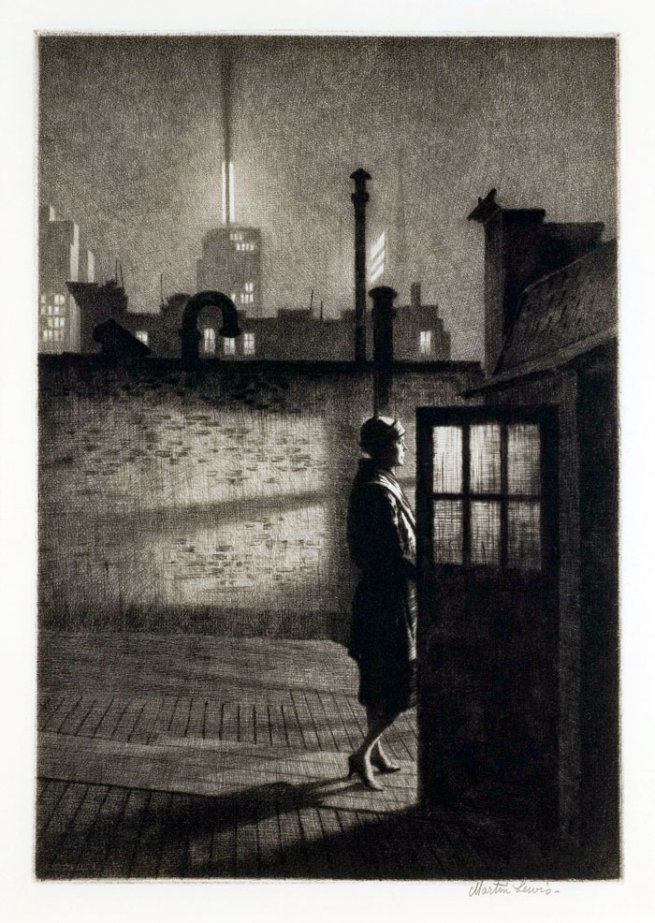
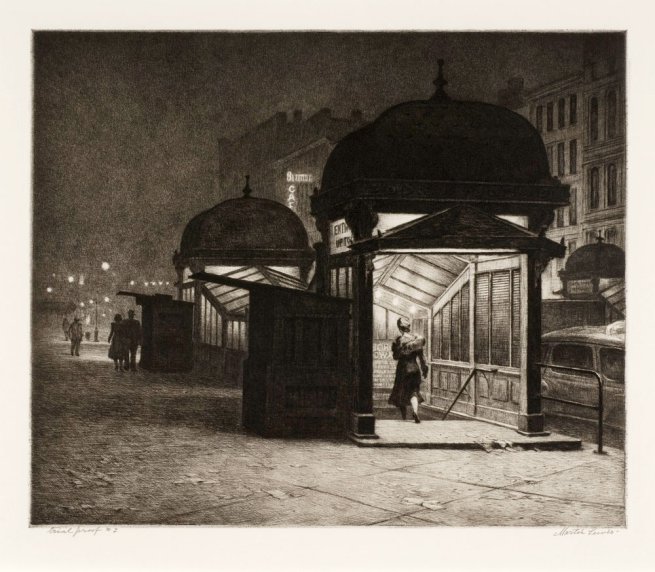 I saw a Martin Lewis etching years ago and was transfixed by the crisp contrast of its darks and lights and the easy moodiness it gave off. I knew nothing of the artist but it was obvious that he was masterful in his etching and in his artistic eye. I had largely forgotten this artist until I came across a group of his etchings that are coming up for auction. Seeing them rekindled that same feeling I felt years ago. Mainly images from New York in the 20’s and 30’s, they often capture a feeling of urban anonymity and isolation, mining the same vein of emotion in which Edward Hopper worked in his paintings. This is probably not a coincidence since Lewis and Hopper were friends, Lewis having taught Hopper the art of etching around 1915.
Martin Lewis was born in Australia in 1881 and ran away from home at age 15, working rough jobs for a few years as he travelled and sketched his way through Australia and New Zealand. He ended up in Sydney where he studied and did illustrations for a local newspaper. He migrated to the US around 1900, arriving in San Francisco where he painted backdrops for the presidential campaign of William McKinley before finding his way to New York City.
 Inspired by the dynamism of the city at that time, Lewis worked as an illustrator and painter. It was a 1910 trip to England, where he was introduced to the printwork of English artists such as James MacNeil Whistler, that inspired him to take up etching. However, it was an 18 month stay in Japan in 1920 that set the groundwork for his signature work which captures light and air and mood so well. He was active and increasingly successful from 1925 until about 1935. However, the Great Depression brought a downturn to his popularity and by the 1940’s his work was out of favor. His work never really took hold after that and he died in 1961, largely unknown. In fact, just finding some of the details on his life for this short blog post took some doing.
I think his work is wonderful and evocative and find it amazing that his work ever fell out of favor. But such is the nature of art. But the etchings of Martin Lewis will persevere through the fickle cycles because they capture something elemental and personal. And that is what real art does.




Posted in Favorite Things, Music, tagged Bruon Mars, George Benson, Jackie Wilson, Michael Jackson, Music, R & B, Shindig, Thriller, Up With People! on February 23, 2014| 4 Comments »
 I flipped on the radio the other day and heard George Benson doing a remake of the song Baby Workout, the 1963 hit from the late, great R & B singer Jackie Wilson. It wasn’t a bad version but it only made me really want to hear the original once more. That’s usually how it goes when I hear somebody cover a Jackie Wilson song. They usually pale to the real thing and Jackie Wilson was the real thing though he is often forgotten these days. But that is somewhat understandable considering he died thirty years ago, in 1984, after suffering through the after-effects of a stroke nine years before.
He just faded from the public’s consciousness.
And that is the shame because Wilson always seemed to live up to his nickname– Mr. Excitement. His powerful stage moves and soaring voice drove his fans into a frenzy and influenced generations of performers. Michael Jackson owed much of his stagecraft to Wilson, acknowledging it in his acceptance speech for his 1987 Grammy for Thriller. You cans eeit also in some of Bruno Mars’ stagework. Wilson’s charismatic performances also garnered him hit after hit. Reet Petite. Lonely Teardrops. The classic Your Love (Keeps Lifting Me Higher). And many more including Baby Workout, which is a personal favorite of mine.
His life had many highs but perhaps more lows: Arrests, shootings, the early deaths of several of his children, drug abuse, divorces, bankruptcy and, of course, the stroke a that consumed the last nine years of his short life. But I don’t want to focus on the tragedy of his life or even the relative obscurity to which he has been assigned through the intervening years. When I hear him sing and watch him perform, he comes alive once again.
And that’s a beautiful thing.
Here’s a version of Baby Workout from the old Shindig show. You can get a good idea of Wilson’s power if you get by what looks to be the cast of Up With People! gyrating around him in their matching sweaters. Anyway, enjoy and have a great Sunday.
Posted in Favorite Things, Influences, tagged Hokusai, James MacNeil Whistler, Japan, Olympics, Vincent Van Gogh on February 19, 2014| 2 Comments »

I don’t have much to say today and am running late plus the Russia-Finland hockey matchup in the Olympics is beginning as I speak. So I am greatly distracted today. But t came across this image from the Japanese master Hokusai that I wanted to share. I had a post several years back that featured the famed waves for which Hokusai is best known. They are such strong images of the power and rhythm of nature that it is easy to see why they are his signature works. But when I saw this quiet still-life of a fish with a few shells from 1840 I truly understood how revelatory this work must have been to the western artists, such as Whistler and Van Gogh among many others,who discovered it a generation later.
It has a wonderful delicacy in its color and it’s also simple and elegant, maintaining an extraordinary modernity through the past 170 or so years. It always seems like it is in the now which is that intangible that most artists , myself included, seek. It is unlike anything you would have found in the west in 1840 yet seems totally at home now. Just a wonderful image to ponder.
 Redtree Times