Feeds:
Posts
Comments

Archive for the ‘Favorite Things’ Category

GC Myers Strange Affair 2010I had this video, Strange Affair,  on the blog about four years ago and just wanted to share it again.  Good sound for a cold and quiet Sunday morning.  Plus the image that I used to accompany the post (a painting that is, of course, titled  Strange Affair)  is one of those images that both sticks in my mind and meshes well with June Tabor’s beautiful interpretation ( accompanied by one of my favorites, Martin Simpson, on guitar) of the Richard Thompson song.

There’s something stark in both the song and the painting that appeals to my sensibilities.  A sort of joy found in certain moments of melancholy.  There was a moment like that last week when I was walking through the woods to the studio.  It was extremely cold with the sky a flat gray slate and there hardly another sound other than the trudge of my footsteps in the snow.  It seemed like such a bleak and sterile moment but then a single snowflake drifted down, dancing delicately in the air, and I was suddenly filled with a joy that I couldn’t quite put my finger on.  It wasn’t happiness.  Just the joy of feeling connected to the world in that moment.

Joyous melancholy.  A paradox.  A strange affair, to be sure.

So, pardon me for showing this image and this video again.  It was four years ago  after all.  Enjoy and have a great Sunday.

Read Full Post »

de-chirico1

Sometimes the horizon is defined by a wall behind which rises the noise of a disappearing train. The whole nostalgia of the infinite is revealed to us behind the geometrical precision of the square. We experience the most unforgettable movements when certain aspects of the world, whose existence we completely ignore, suddenly confront us with the revelation of mysteries lying all the time within our reach and which we cannot see because we are too short-sighted, and cannot feel because our senses are inadequately developed.  Their dead voices speak to us from nearby, but they sound like voices from another planet.

–Giorgio de Chirico

***************

de chirico the disquieting muses 1916I like this quote from de Chirico.  We are surrounded by mystery wonder at every turn yet we don’t even notice.  I especially love the last line — Their dead voices speak to us from nearby, but they sound like voices from another planet.  It has such a poetic rhythm and reminds me of stepping out from my studio and looking up into the night sky to see Jupiter shining so brightly above me, so huge and visible to us yet mostly unnoticed.  Voices from another planet.

De Chirico was an interesting  case. His earlier work, from his metaphysical period like the pieces shown here, is the work that defines him. Definitely the work that influenced me and a host of other artists.  It is work with a distinct and powerful voice, wok that you immediately recognize as his alone.  But in mid-career he basically set it aside and began to paint in a more traditional manner.  It was good work but was not distinctive and set apart from other artists.  It was work that could have been painted by any number of professional painters and lacked both the individual voice and the revelation of mystery that seemed ingrained in the early work.  This later work never garnered nearly the attention that his earlier work had, much to  de Chirico’s consternation.

I can’t say that de Chirico was wrong for following his mind in changing his style.  It was his to change.  But there is a lesson here in that your individual voice is the greatest asset that any person can possess– if you dare to stand apart and pay heed to those voices from another planet.

Read Full Post »

Beatles with Ed SullivanIt was on a Sunday evening on this date  fifty years ago that a touchstone event took place here in the States, one that dramatically altered pop and rock music as well as popular culture.  If you watch television or read newspapers, it has been hard recently to avoid seeing something about this 50th anniversary of the Beatles’ first appearance on The Ed Sullivan Show on this date back in 1964.  For some, especially those later generations, this is probably a puzzlement as they have no context to put this event in any sort of historical context.  They have no idea what a big moment this was or how it dramatically affected music and popular culture.

It’s always hard to describe something to someone who has only known the resulting change.  I used to try to convince those nay-sayers, usually people born in the aftermath of the Beatles’ reign which would be post-1970, of the importance of the Beatles emergence and their music but it became too tiring.  So now I just enjoy the music and marvel at their evolution over their short lifespan as a band.  What an arc of creativity!

Their listeners might have mourned when they disbanded in 1970 but, realistically, they had completed their journey together, had strung together album after album of memorable and constantly evolving and growing sounds.  They were at a peak with nothing more in front of them.  Each went on to highly successful solo careers but none matched the true power of their combined efforts as the Beatles.

The legacy of their music has been so evident in the past few weeks.  I’ve seen a number of lists from critics and other musicians of their favorite Beatles songs and each is so different from another.  There is no consensus of which are their best songs and each list is truly valid as each contains a group, usually ten, of songs that are quite memorable.  Even the list of the top ten underrated Beatles songs would qualify as someone’s best of the Beatles list.   I sat down and tried to make a list of my Top Ten Beatles songs and had such a hard time.  Just when I thought I had it I would remember another and couldn’t imagine it not being on the list.  It is remarkable that they had so many songs that bound themselves so deeply into the fabric of ourselves.

Here’s what I came up with for my Top Ten, in no particular order:

A Day In the Life

Paperback Writer

Day Tripper

In My Life

Hello Goodbye

Norwegian Wood

Taxman

Tomorrow Never Knows

You’ve Got to Hide Your Love Away

Baby You’re a Rich Man

Sitting here now, I can think of twenty ( or forty or fifty) other songs that would fit seamlessly into this list, all songs that are my favorites when I am listening to them.  Oh, well, there are no hard and fast rules here and this is not a very terrible problem to consider so I’ll just put lists aside and enjoy.  Here’s one of my faves from the Fab Four.

Read Full Post »

GC Myers-Serenata Blue This is another of the pieces that are in the upcoming Little Gems exhibit at the West End Gallery in Corning.  This little guy is titled Serenata Blue and is a just a bit larger that 2″ by 4″ on paper.  It’s a continuation of the recent snow paintings as well as another of my solitary guitarist pieces, of which I do a handful each year.

There’s something very appealing to me in the solitary guitarist standing amidst open space as he cradles his guitar.  It usually brings me a wistful, somewhat sad feeling.  Not in a bad way sad.  Just a slight existential melancholy.  You know, the good kind.

I thought that there should be some appropriate musical accompaniment to this painting so I came up with a sad song.  And I mean sad.  This Nancy Griffith’s version of Tecumseh Valley.  It’s an achingly  beautiful and sad  lament that tells the story of a poor mountain girl.  To make this version even sadder, this is from a tribute show from the friends of the song’s writer, the great Townes Van Vandt, right after he passed away in 1997.  But it is a haunting and lovely song so don’t be afraid to listen.

Read Full Post »

“Meaning in a painting is derived from quality. It is reciprocal and will return what has been given to it both to its creator and to the beholder, by a multiple combination in visual concept of pattern, color, form, and that undefined intangible which transcends all classifications. My paintings subscribe o no period or school. If they possess that sustaining power of meaning and authenticity which constitute the basic attributes of a work of art, as well as an awareness of the contemporary scene, they will be illustrative of the progressive trends of their time. Their visible concept may ostensibly reveal characteristics of Time and Place, but the roots reach deep into ethnic strains of ancient culture through which the archetype emerges as indicator of the universal and eternal urge toward creation.”

–Peter Krasnow, 1975

*******************

Peter Krasnow - Edward Henry Weston (24 Mar 1886- 1 June 1958)  1925While looking up some info on photographer Edward Weston, I came upon this portrait of him, shown here on the left, that really caught my eye.  I loved the colors and stylization. The artist listed as the painter was a name that I was not familiar with, Peter Krasnow.  Doing a bit of research, I stumbled upon another interesting life and body of work, one that evolved greatly over time.

Born in in the Ukraine in 1886, Krasnow learned the art of color mixing from his father who was a decorator.  Krasnow was Jewish and came to the US in 1907, fleeing the pogroms that had been taking place in his native land as well as seeking training as an artist.  He lived first in Boston then moved to Chicago to study at the Art Institute.  After graduating in 1916, he and his wife, who he had met in Chicago, moved to New York.

St. Andrew's One Cent Coffee StandHis work at that time was darker in tone, echoing the neighborhoods around their tenement home as well as recalling memories of his native Ukraine.  But Krasnow felt hemmed in by the dark urban landscape and upon the casual recommendation of an art critic, headed west to California in 1922.  He stayed there, except for a short residency in France, for the rest of his life.

In 1923, Krasnow purchased a parcel of land from photographer Edward Weston and built his studio.  Weston became a lifelong friend and Krasnow s0on found himself in a loose knit  group of  avant garde artists.  His palette changed to  lighter and airier colors that infused his landscapes.  After moving to France then returning he began experimenting with abstraction, both in paint and in sculpture, carving wooden totem-like pieces.  It was this work, along with his work as a printmaker, that occupied his career until his death in 1979 in California.

While he is not tremendously well known nor has his work achieved astronomical prices at auction, his impressive body of work work is vibrant and deserving of greater attention.  I really enjoy seeing the course of his work throughout his career, seeing the connection in seemingly disparate styles.  I know that I am glad to have come upon his work and will keep doing some research.

Krasnow  Self Portrait 1925

Peter Krasnow- Self Portrait 1925

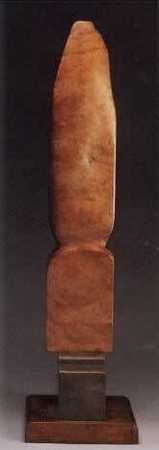
Enigma (K-2) Krasnow  Totem Sculpture Krasnow  The River 1959

Read Full Post »

Pete SeegerPete Seeger died yesterday at the age of 94.  He had a pretty remarkable life, using the power of music as a hammer to pound against the powers of social injustice.  The thing that I admire most is his always evident conviction to whatever cause he was devoted.  For as gentle and jovial a man as he appeared to be, there was no wishy-washiness in Pete Seeger.  He always spoke the truth to power on the most pressing matters of the day– the labor movement, civil rights, the Viet Nam war and the environment.

Of course, anyone with such strong and visible views, wil have some controversy surrounding him and Seeger was no different.  He was blacklisted in the 1950’s for his early affiliation with Communism and his slowness to finally condemn Stalin followed him through the years.  But, to his credit, he did own up to his actions and admit mistakes when he felt they were made.  Probably more so than most of those in power would be willing to admit.

Of course, the music is the legacy of Pete Seeger.  Songs like If I Had a Hammer , Where Have All the Flowers Gone?  and Turn! Turn! Turn! have  all have been covered innumerable times, becoming so ingrained in the American songbook that it seems hard to believe that they weren’t written even longer ago than they were.  Well,  the lyrics of  Turn! Turn! Turn! were a bit earlier as they use the words from Ecclesiastes in the Bible.  I grew up with a single of the Byrds’ version of  Turn! Turn! Turn! never far away from our old stereo console and I still get a chill when I hear those opening chords and a little teary when I listen to the lyrics..

So, for  Pete Seeger, to every thing there is a season.  Thank you.

Read Full Post »

GC Myers-2014

I am still taking in this new painting, an 18″ by 18″ piece on canvas that remains unnamed as I ponder it a  bit more.  It is, at first glimpse, a snow painting.  At least, it was intended to be so.  For me, there is something quite challenging in presenting this surface that translates as pristine but, in fact, is far from it, having multiple layers of color beneath it which show through at points.  The edges show a glow of red oxide and violet, giving it a warmth that belies the coolness of the white blanket.  It’s a departure from the snow of Dale Nichols‘  paintings that I showed here yesterday, which is pure and luminous.

The thing that I have found with using the white of the snow is that it really displays the lines of the forms underneath.  The lines of  landscape in the foreground here, for example, really pop off the surface.  This could be a bad thing if they don’t have an organic sense of rightness,  that vague and elusive quality to which I often refer.  I think this piece has it.

While looking at this painting this morning, I began to ask myself, “What if that isn’t snow?”  This change of perspective gave the piece a very different reading , one that I hadn’t thought of when it was being painted but one that might pass through the mind of some folks.  What if this is some desolate post-apocalyptic landscape, devoid of  vegetation and covered in ash and dust?  The ravaged  landscape of Cormac McCarthy’s The Road immediately came to mind.  The painting suddenly took on a different feel but it still felt warm and even jubilant in a way.  As though the Red Tree,  fatigued at the end of that dark ribbon of road, had finally met the warm gaze of the sun that burned through the hazy sky.  The Red Tree was still standing despite the desolation around it and was rejuvenated, lifted up, by the sun’s energy.

It brought to mind the poem Strange Victory from the late Sara Teasdale, a poem that I have featured here in the past.  It is one of my favorite poems and expresses the contrast that I often try to impart in my work.  I think it fits this reading of this painting very well.

 Strange Victory

To this, to this, after my hope was lost,

To this strange victory;

To find you with the living, not the dead,

To find you glad of me;

To find you wounded even less than I,

Moving as I across the stricken plain;

After the battle to have found your voice

Lifted above the slain.

Sara Teasdale

Funny how a simple shift in perception  can alter the whole meaning of a piece.  It was originally meant as snow and will probably remain so .  But for the moment I find myself asking:  Is it snow?


Read Full Post »
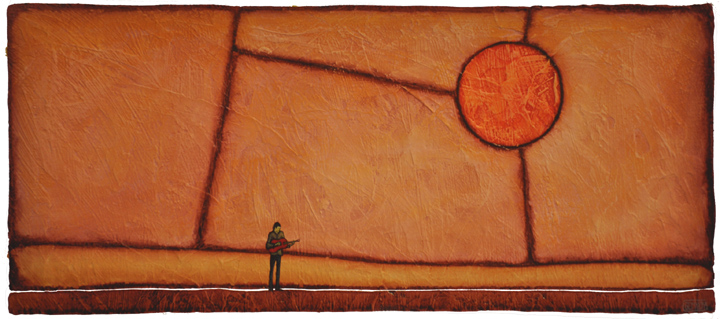
Dale Nichols-  Company for SupperMost likely prompted by the recent weather here as well as a desire to try a slight change of palette, I have been doing a small group of snow paintings recently.  I thought I would look at several other artists, especially those with a idstinct personal style,  to see how they handle snow in their work.  One of the artists whose snow works really stuck out  was Dale Nichols, who was born in Nebraska in 1904 and died in Sedona, AZ in 1995.  He is considered one of the American Regionalists,  that loosely defined group of painters whose work  for which I have long expressed my admiration.  

Dale Nichols- After the Blizzard 1967His biography is a bit sparse with but Nichols lived a long and productive life, serving as an illustrator, a  college professor and the Art Editor of the Encyclopedia Brittanica.  He also spent a lot of time in Guatemala which resulted in a group of work with Meso-American forms that is quite different from his Regionalist work.  

But Nichols is primarily known for his rural snow scenes and it’s easy to see why.  The colors are pure and vivid.  The snow, put on in multiple glazed layers with watercolor brushes has a luminous beauty.  The stylized treatment of the crowns of the bare trees adds a new geometry to the paintings.   There is a pleasant warmth, a nostalgic and slightly sentimental glow, to this work even though they are scenes that depict frigid winters on the plains of Nebraska.  free of all angst, they’re just plain and simple gems.

You can see a bit more of Dale Nichols other work on a site  devoted to him by clicking here.

Dale Nichols- The Sentinel Dale Nichols- Silent Morning  1972 Dale Nichols- Mail Delivery  1950 Dale Nichols-  Bringing Home the Tree

Read Full Post »

Van Gogh-- Sorrowing Old Man 1890I am a fan of Vincent Van Gogh and  am always surprised when I come across a Van Gogh painting that I can’t remember seeing, especially one that has that powerful quality for which his work is known.  Such was the case when I stumbled across this painting.  It’s called  Sorrowing Old Man (At Eternity’s Gate) and was painted in 1890, just a couple of months before his death.

His signature use of line is evident here, especially in the way he uses the color blue to outline the old man. the man and the chair have a completeness while the floor and the background are sparsely painted, almost not there.  It’s a bit of a departure from some of his better known pieces which are densely colored throughout but it focuses the energy of the painting completely on the old man’s sorrowful posture.  Its simple elegance makes for a strong and moving image.

Van Gogh-- Worn-Out-- Drawing  1881-2This painting was based on an earlier drawing made by Van Gogh in 1882.  During that year and the one before, Van Gogh had done a number of drawings of men and women in states of sadness or exhaustion as he was learning to make lithographs.  It is beautifully rendered and has all of the same power of the final painting.

However, for me, Van Gogh’s signature use of color in the painting is what makes the painting much more memorable and moving.  The painting is so recognizable as being his that it carries the cache of his entire body of work, links into the continuum of energy that runs through his paintings.

I am glad I stumbled across this treasure.  While I don’t paint in the manner of  Van Gogh, I find there is almost always something to be learned, always something that can be applied to my own when studying his work.  I think I will look at this a bit longer.

Read Full Post »

David Plowden - The American BarnI recently picked up a book from photographer David Plowden, The American Barn.  It is filled with beautiful duotone images of the grand old barns from the  heart of America, structures that are vanishing from our landscape as the family farm fades away.  The images are nostalgic but not sentimental, with a bit of melancholy in the air.  I’ve always been drawn to the beauty of the barn and often amazed at the scale of some of these structures.  They represent a level of personal industriousness and vision that I can barely imagine today.

David Plowden- HeartlandPlowden has  made documenting the vanishing parts of America  his life’s work, producing 20 books covering all aspects of the the American experience of the last century.  His books have covered the steamboats of the Great Lakes, the great and not-so-great bridges of this country, the railroads and both the small town experience and the grit of the industrial landscape.

The cover of one of  his more recent books, Heartland, has an image that speaks to my own personal vision of the landscape so its no surprise that I find his work engaging.  Looking at his photos brings on a great feeling of déjá vu, as though I have seen and walked in many of these places, at least in spirit.  They are often spaces that are filled with space and emptiness but still have the air of occupancy about them.

Ghosts, perhaps.

You can see more of David Plowden’s work at his self-titled  site.  It’s it definitely worth a look.  If you want a quick overview of his work, do s simple Google Images search using his name.

David Plowden- Abandoned Barn, Barns County, NDDavid Plowden-- Sherman Township, Calhoun Cty, IA 2004


Read Full Post »

« Newer Posts - Older Posts »