Feeds:
Posts
Comments

Archive for the ‘Favorite Things’ Category

Hiroshige -Clear Winter Morning at KameyamaIt just feels like one of these Sunday mornings.  It’s clear and crisp, the colors of the sky outside my studio looking very much like something from a Hiroshige print.  Quiet outside.  Hardly a rustling through the forest as I made my way to the studio this morning.  In my head, I begin to hear those simple quiet notes from the first of  the Gymnopédies, that elegant group of quiet and moody music from composer Erik Satie.

Hearing this music always slows me down, makes me breath.  Ponder  things, both big and little.

But despite all my pondering, don’t ask me the meaning behind the word gymnopédie.  My little bit of research turns up no clear consensus on the meaning from any number of sources.  It could mean almost anything actually.  And maybe that is why Satie chose it– it sounds likes so much more but is vaporous and edgeless.

It fits the music.

Here’s a snip of Gymnopédie #1 to start your first Sunday of 2014.  I think it is interesting that the maker of this video chose images of the universe to illustrate this music.  Big things.   I think an image of a snow flake falling gently against a slatey sky would fit as well. Small things.

Have a good day.

Read Full Post »

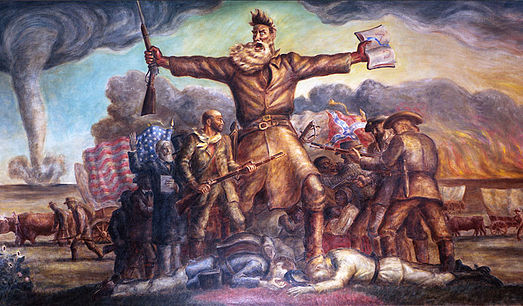
John Steuart Curry-- "Tragic Prelude" Mural depicting John Brown in Kansas

John Steuart Curry– “Tragic Prelude” Mural depicting John Brown in Kansas

One of my favorite genres of art is that of  American Regionalism.  You can lump painters like Grant Wood, Thomas Hart Benton  and  John Steuart Curry together as some of the  better known names in this group.  I am not particularly fond of the use of the word regionalist which seems to hint at some sort of narrow provincialism, a label that Eastern critics tried to pin on this Midwest-based movement of the 1930’s and 40’s.  But these painters and others who have been branded as Regionalists were not sentimental or naive.

In fact they espoused views that were often more aligned with progressive and socialist ideals.  Many of these artists were looking to make their work more accessible to the working class, something that they felt was lacking in the more elitist Modernist work of the time and simply used the landscape and people around them as the vehicle to convey these ideals.  This gave the work an inclusive populist quality that is especially appealing to me.  I like that their work is often simple to approach yet reveals so much more upon deeper inspection.

I have written about some of the more well known Regionalists such as Wood and Benton, as well as some of the lesser known names such as Alexander Hogue and Paul Sample but hope to shed some light in future posts on some of the more obscure names in this genre.

Read Full Post »

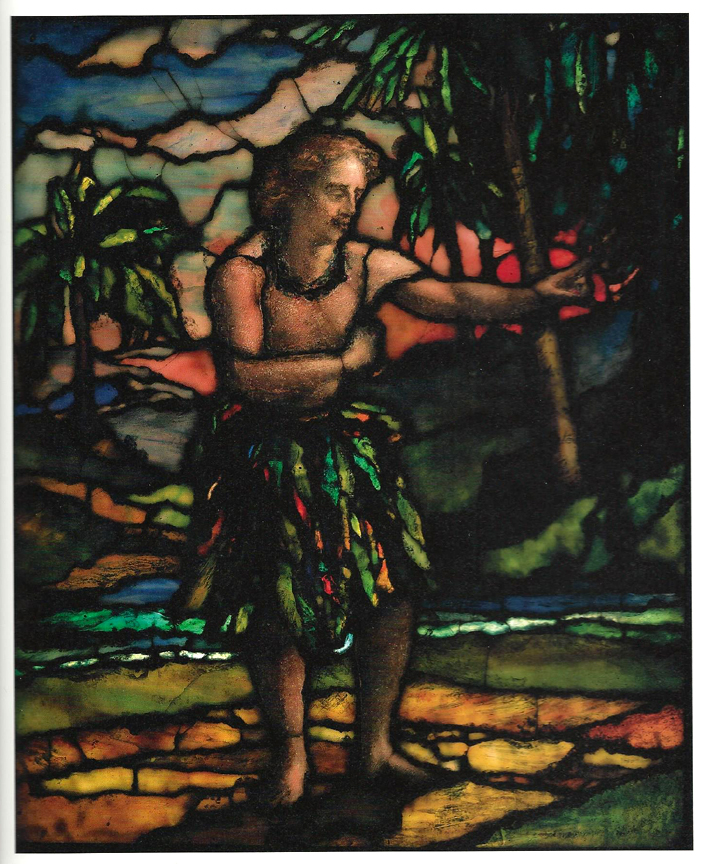
John LaFarge- Samoan Dancing a Standing Siva 1909I am a big fan of stained glass windows.  It has influenced my work in many ways, from trying to emulate the brilliance and glow of the colors to the way in which I see and compose my work.  I have been lucky enough to live in an area with access to the work of Louis Comfort Tiffany who is easily the best known and most stylish of stained glass makers.  The Corning Museum of Glass has a number of his pieces, which are remarkable,  as do several churches in the area.

But there is someone to rival, if not eclipse, the works of Tiffany, someone who actually paved the way for Tiffany’s work with his innovative work in stained glass.  This was John LaFarge.  I can’t remember the exact piece or location of the first time I saw his work except that it was somewhere in NYC.  But I do remember the stunning colors and the lead work which held the glass pieces together.  It  was so different than that of other stained glass windows I had seen which was normally clean and neat, fitting for the solemnity of a church.  But the LaFarge lead work I saw was rough and dark, dividing the opalescent glass but also becoming part of the composition in itself.  His lines were organic and integral to the composition.  It was remarkable.

I came across the image shown above recently,  Samoan Dancing a Standing Siva, in a book about LaFarge’s travels to Tahiti and other South Pacific islands in the early 1890’s and about how this expedition changed his work.  It’s interesting that the other artist whose work was transformed by Tahiti, Paul Gauguin, arrived on the island just days after LaFarge departed.

This piece of stained glass excites me very much in the use of line, especially in the naturalness and organic feel of them, as well as the contrast between the brilliance of the colors and the the darknesses that surround them.  To me,this is simply magnificent, possessing those things that I want to see in my own work.

There is a Pinterest page with many of LaFarge’s more famous stained glass pieces, most of which are a bit more formal than this piece above.  But it gives a nice overview of his work on one page.  To see it click here.

Read Full Post »

Limbourg Brothers- Tres Riches Heures du Duc de Berry FebruaryOne of the great pleasures in being fairly ignorant is the thrill that comes from stumbling across something that is absolutely spectacular without any knowledge of its existence beforehand.  Of course, the flip side of this experience is the depressing realization that sets in when you realize how little you really know.  I know this from experience.

The other day,  while searching for images of medieval snow scenes for the previous post, I also came across a beautiful image taken from a 15th century illuminated manuscript called the Tres Riches Heures.  It was a gorgeous winter scene, very Dutch looking, with a astronomical chart with beautiful blue lapis bands arching across the top of the page.   I was immediately taken in by the image.

Limbourg Brothers- Anatomical Man- Tres Riches Heures du Duc de Berry FebruaryDoing some quick research I discovered that this image was but one of over 130 painted images in the Tres Riches Heures, many of which were done by a trio of Dutch siblings, the Limbourg Brothers, between 1412 and 1416 for the French Duke du Berry.  The Tres Riches Heures is a book of hours which consists of prayers and devotional exercises along with  timetables for specific prayers and calendars for feast days and other days of note in the liturgical year, along with some customized additions.  This particular book of hours was the most spectacular ever produced.

Of course, something this incredible never comes easily.  The Limbourg Brothers, unfortunately, all died within the year of 1416, most likely from the plague, leaving the Tres Riches Heures incomplete.  It was worked on for many years by an unknown intermediate painter, most likely a court painter for French king Charles VII, who had attained the unfinished group work in the years after the Limbourgs died.  Finally, between 1485 and 1490, the work was completed by artist Jean Colombe.
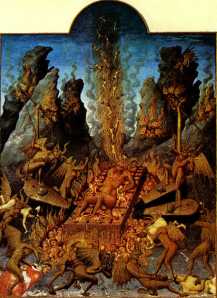
Limbourg Brothers- Hell- Tres Riches Heures du Duc de Berry FebruaryToday, this considered arguably the most valuable book in the world– a book filled with 130 beautiful Dutch paintings, a book that took nearly eighty years to complete.

As I say, I was thrilled to come across it, having no prior knowledge of it or the magnificent work of the Limbourg Brothers or Jean Colombe.  But then I was a bit taken aback by the realization that I had such a gap in my knowledge, especially of a work of such grandeur.  But, that’s the way it goes.  You trudge forward, a blind squirrel periodically stumbling across a nut.

Now I know…


Read Full Post »

Bruegel, Pieter the Elder- Hunters in the Snow (Winter) 1565I was looking for a medieval image of a scene in snow that would fit a piece of medieval seasonal music.  In this instance or most any, you can’t go wrong with a painting from Pieter Bruegel the Elder.  The Flemish painter , who lived from around 1525 until 1569, has long been a favorite of mine with the gorgeous colors of his peasant scenes.  This is one of the more famous of the 45 or so known remaining paintings from Bruegel, titled The Hunters in the Snow  from 1565.  The contrasting darkness of the trees and the hunting party against the lightness of the snow and the atmosphere just make this piece memorable for me.  It is of its time but it feels as though you could step into it, be part of it.

The piece of music I wanted this to accompany is Gaudete, a well known piece that comes from the 16th century which means it, like the Bruegel painting, are not really medieval since that period ended with the 15th century.  But both feel as though they have that medieval feel and, besides,  Gaudete is based on truly medieval Latin lyrics.

The song is a Christmas carol that opens with the line Gaudete, gaudete! Christus est natus which translates to  Rejoice, rejoice! Christ is born.  Gaudete is Latin for rejoice.  While I do not practice any particular religion, this is truly a beautiful expression of the meaning of the season.  This lovely version of the song is an arrangement for 4 voices, arranged and conducted  by Joan Yakkey and performed by 4 adolescents belonging to the Young Madrigalists group of the School of Music of Fiesole, Florence Italy.

Read Full Post »

Peter O'Toole Lion in  WinterI was saddened to discover yesterday that Peter O’Toole had died over the weekend  in London at the age of 81.   He was definitely a favorite of mine.   The Irish-born actor was famous for his partying and brawling alongside his longtime chum Richard Harris, but first and foremost was legend on the stage and on the screen, casting a magnificent presence into all his roles.   And what great roles they were-  the ethereal Lawrence in Lawrence of Arabia,  his comic twist as Allan Swann in My Favorite Year and  my favorites, two times as King Henry II in Beckett and in The Lion In Winter.

O’Toole holds a dubious record , being the most nominated best actor ( 8 times) without ever winning the Oscar.  I can’t fault most of the winning choices in the years that he lost.  Most were incredible performances such as Marlon Brando in 1972’s The Godfather, Gregory Peck in To Kill a Mockingbird in 1962, Rex Harrison in My Fair Lady in 1964, John Wayne in True Grit in 1969, Robert DeNiro in Raging Bull in 1980, and Ben Kingsley in Gandhi in 1982.  All of these are legendary roles.  Even his loss to Forrest Whitaker in 2006’s The Last King of Scotland is understandable.

No, the one where his performance was by far the greatest of that year (and most others in my opinion) was in 1968 when he portrayed  Henry II in The Lion in Winter.  He lost to Cliff Robertson in Charly, which was a great role and a fine movie, the film version of Flowers For Algernon.  I take nothing away from Cliff Robertson but O’Toole’s portrayal was one for the ages, matched as he was with Katherine Hepburn  and a young Anthony Hopkins.  It’s a film that I cannot help but watching whenever it comes on.  O’Toole is mesmerizing in that film, just dominating the screen.  He was truly the Lion in that film.

I think I’ll watch it again today just to see him roar once more.

Here’s a taste:


Read Full Post »

Charles Burchfield- Sun and Rocks- Albright-Know Art GalleryAn artist must paint not what he sees in nature, but what is there. To do so he must invent symbols, which, if properly used, make his work seem even more real than what is in front of him.

–Charles Burchfield

*********************

I am a big fan of the work of Charles Burchfield (1893-1967), a western  New York painter who lived and painted in the Buffalo area for most of his life.  His work was decidedly visionary in its scope, taking the environment that he knew around western New York and embellishing it with a life force and energy that he sensed beneath the surface.  That’s what he was referring to in the quote above– taking what you see around you and not simply recording it but painting how it moves you emotionally.  To me, his work is as emotionally charged in the same way as that of Van Gogh.

Charles Burchfield- An April Mood- Whitney Museum of American ArtCreating symbols, as Burchfield refers to in the quote, have been a big part of my work.  I have long emulated his use of creating a visual vocabulary that moved through a body of work.  It becomes a sort of language of its own  that people who take it in and understand it find easy to read and absorb as they move from picture to picture.  Those who can’t read it find less in the images and feel less drawn into them.  In an earlier post  about Burchfield I wrote about an artist friend who just didn’t get Burchfield’s work in any sense.  He just one of those people who couldn’t read the language clearly written in the work.

I also have been influenced by the way Burchfield would constantly go back to earlier work and use it as a new starting point, as though the added knowledge gained through the years would take this work in a new direction.  I often do the same thing, constantly revisiting images and motifs from years ago looking for a thread or path to follow anew.

Even this post is a revisitation, going back and looking at an influence, trying to pull that original inspiration from it.  With Charles Burchfield, that’s always an easy thing to accomplish.

Charles Burchfield- Childhood's Garden

Read Full Post »

GC Myers-  QuiescenceI had a quote on the last post with a quote from artist Jean Arp about man turning his back on silence.  Instead of savoring the quiet, he runs from it, instead distracting himself with all manner of noise.  Anything to keep him from facing the fears that the quiet represents to him.

It’s a theme that has been large in the background of my work.  Early on, when I felt that I wanted to be a writer, I would find myself writing about large open spaces and the caverns of silence that rested in these places.  I called it the Big Quiet.  Of course, it’s a pretty limited subject and there is a certain redundancy in writing about silence and stillness.  I mean, how can you use the noise of words to aptly describe the absence of noise?

So I gave up writing about it and went on with my life, always with an eye out for this Big Quiet.  I don’t know that I was craving it or fearing it at most points.  My life was pretty much filled with the noise of the world, all the snaps and pops of sound and distraction that creep into every living space.  The sounds that I hoped would lessen my anxiety but instead fed it.  I was like so many others who needed the security blanket of sound to protect them from what they might discover if they were forced to face the silence.

But painting gave me a path to finding this Big Quiet.  It was wordless and calm, creating an inner space absent of the sounds of the world  that I was and am still occupying.  It became a destination, an oasis to turn to when the din of world became too loud, too overbearing.  It eased my fears of looking inward and allowed me to savor the quiescence of the brief moments I actually myself there in those scenes of stillness and calm.  It became real and necessary to me.

I don’t know where this going, this wordy noise I’m creating about the stillness I find now.  I just felt that I should add a bit of context to my work, to give a an understanding of what I hope to take from it for myself.  This moment came about from running across the image above, a piece from several years ago that is called, fittingly, Quiescence.  It’s a piece that brings me quiet immediately and seeing it again made me again think of why I paint.

Read Full Post »

Peanuts Gang from A Charlie Brown Christmas - Chas SchulzI’ve been taking a few days off here around Thanksgiving, taking it a bit easier in the days that kick off the first days of the Christmas season here.  I can’t say I’m as big a fan of the holidays as when I was child but I still feel that same warm fuzziness when certain songs of the season come on the radio.  Nat King Cole singing The Christmas Song or Bing Crosby’s White Christmas, for example.  One of my all-time favorites are the wondeful compositions from  Vince Guaraldi for  A Charlie Brown Christmas.  Hearing the relaxing tones of Christmas Time Is Here with the children’s chorus is like zen candy to me–it just pushes away all the bad things we,ve come to accept as part of the season and fills the void with a peaceful calm.

I thought I’d share Diana Krall‘s take on this great piece.  It lacks the children’s voices but it is lovely nonetheless and a good way to head back into my work.

Read Full Post »

Becoming

GC Myers- Regal One The thought manifests as the word;

The word manifests as the deed;

The deed develops into habit;

And habit hardens into character;

So watch the thought and its ways with care,

And let it spring from love

Born out of concern for all beings…


As the shadow follows the body,

As we think, so we become.

 —From the Dhammapada,

Sayings of the Buddha

***********************

I’vebeen writing this blog for over five years now which I find hard to believe.  Some days I have nothing to say but still feel the need to keep this habit alive.  Sometimes I read through older blog posts to gather inspiration and in doing so, I came across this bit of wisdom from the Buddha that I featured in a 2009 post.  When I used it at that time, I was referring to people’s words and deeds of  incivility eventually hardening into character.  This was of course inspired by extremist nature of the political climate.  But today when I read it, these words didn’t strike me in a cautionary way.

Instead, it seemed like good advice for the young artist or anyone aspiring to something more.  For me it was: Think as an artist.  Act as an artist.  Eventually, the thoughts, words and actions become part of who you are– an artist.  It took many years before this habit hardened into character.  I often questioned the validity of the claim over the years but slowly these doubts faded , replaced by a belief in those words and deeds.  I had practiced the habit of being an artist for so long that I could no longer  feel that doubt.

As I said, this applies to so many things, even simply being happy.  If you think of joy, speak of joy and act with joy, eventually happiness becomes part of who you truly are– your hardened character.  It’s a simple precept, almost too simple to be taken seriously especially on those days when it is challenging to remain joyful.  But it holds true, as the Buddha instructed, for those who can maintain the way.

Have a great Sunday and be happy…

Read Full Post »

« Newer Posts - Older Posts »