Feeds:
Posts
Comments

Archive for the ‘Favorite Things’ Category

I’ve been reviewing past work over the last few weeks for a variety of reasons.  Sometimes I am looking for an idea or motif that has not been in use for some time.  A new lead to re-examine and follow anew.  Sometimes, it’s pure nostalgia, looking at the work as group with a small bit of pride, like a parent looking at photos of their kids. And I sometimes go back through my files because they serve as a form of memory for me.  While I may have the details of most of my work stored somewhere in the folds of my brain, I can’t always pull them forward.  Seeing the images brings back everything in a torrent.

The painting above is a good example of this rush of detail.  Titled Archaeology: The Story Told, it’s a 20″ by 30″ canvas from  the 2008 Archaeology series.  Although I don’t like to publucly state that there are pieces that are favorites, this painting was one of my favorites from this group. 

There is so much I like about this painting from the moody duskiness of the sky with its purples that grade downward to the way the underground boulders create a visually rhythmic counterpoint.  But the thing that always stuck out for me was how the underground debris came together to form a narrative, which is where the title originated.  There was no intent in painting this.  All of the debris was painted in a freestyle manner, with each piece being painted independently from one another outside of possible relationships in size and shape.  It wasn’t until it was done that I began to see a stroyline running through the heap of items.

For me, it was the story of this country starting with  the obvious prompting of what looks to be an American flag at the center of the bottom.  There was a bell that reminded me instantly of the Liberty Bell to represent our Revolution and a Viking helmet that told of the earliest European explorers here.  There was a cowboy boot that symbolized our westward movement and what appeared to be a lance for the weapons that the native Americans used in their defense of their land.  There is a pitchfork for the agriculture that sustained and help the nation expand.  There  is an electric light to represent the inventors like Edison who transformed our country and machine parts for the industrialization.  There is a baseball bat for our national pasttime.  A peace symbol for both its inherent meaning as well as for its use as symbol of protest and our right to speak freely.

It’s all loosely associated and many may not even see them in a unified way but for me it all came together in a single glance and that was how I immediately read the painting.  It’s unlike any of the other paintings in this series in that way and that makes it special for me. 

Gary T., I hope you don’t mind me showing your painting!

Read Full Post »

It’s always a little disconcerting to come across someone, a performer or artist, that is well on their way to a brilliant career yet remains completely off your own radar. That’s how I felt the other day when I saw a segment on the CBS Sunday Morning show, where a reporter, Bill Flanagan,  was talking about music to give this holiday season.  He talked about the new box sets from the big names then he talked for a brief moment about a 21 year-old British singer/songwriter named Laura Marling who he said, “ Is not only wiser than her years – she’s wiser than MY years.”

He also said that older listeners would hear echoes of Joni Mitchell and Leonard Cohen and that young listeners would hear the voice of a new generation coming into its own.

Pretty high praise.  I decided I had better check out this person.

Wow.

I was knocked out.  There were tons of videos out there and going through several, I couldn’t find one that wasn’t verging on brilliant from this very young looking girl with a sad, detached blankness on her face.  You could hear traces of the artists he mentioned in the easy phrasing of her lovely voice which made it somewhat familiar but there was indeed something new in her synthesis of what she had absorbed in  her very young life.  Something well beyond her years.  It was all just wonderful, even the music from her earliest album released just days after she turned 18.  I couldn’t believe I hadn’t stumbled across a talent this big before now.

But thankfully, I have.  As I said, there is a great number of her  songs out there online and I have yet to find a clunker.  Here’s a newer song called Sophia.  I was captured by the line from its chorus–… I am wounded by dust… 

Read Full Post »

After yesterday’s post concerning masks, my friend Gary reminded me of a new book of poems, including one titled Masks, from the incredible imagination of the late Shel Silverstein.  I’ve written about him before here, once about his classic The Giving Tree and another time reprinting his poem Smart for Father’s Day.  His new book is Every Thing On it and is comprised of never before published poems and drawings from the acclaimed poet and songwriter who died in 1999.  I suspect it would make a great and thoughtful Christmas gift for children of all ages.  I know I’m making a gift of it to myself.   Also, take a gander at his website, ShelSilverstein.com.  It has tremendous animations and is a beautiful site, with an emphasis on his work for children.

Really good stuff.

Here’s Masks from his new book. 


Read Full Post »

Scene from Black Narcissus

As an artist, I am of course influenced by color in many things.  Obviously, the colors I have seen in the work of the great painters played a part in how I came to view color, such as the bold use of it by Van Gogh and the deepness of the greens and reds in Holbein’s masterpieces.  But even beyond painters I am influenced by color in so much that I see. 

This makes me think of a Coke television commercial from a number of years back, probably in the late 80’s or early 90’s.  It was in an urban setting with a Latin vibe but it wasn’t the setting that caught my eye.  It was the color of the whole ad.  Deep, dark throbbing colors.  Reds that looked like they poured out of a beating heart.  Gorgeous rich golds.  All shot in a very cinematic manner, much richer in texture than one would expect from a TV ad.  Every time I would see it I would stop and just stare, taking it all in.  I don’t think I was painting yet and it really made a big impression on how I viewed color and made me think that I could find expression in color.

Another influence is in the work of the great cinematographers of the movie world.  I especially think of the movies from the earliest years of color use in the films, movies like Gone With the Wind and The Wizard of Oz, which both were extraordinary in their use of color.  But, for me, the work of Jack Cardiff in the films of Michael Powell and Emeric Pressburger takes the cake.  In movies like The Red Shoes, Black Narcissus, A Matter of Life and Death, The Tales of Hoffman and The Life and Times of Colonel Blimp ( a favorite of mine), Cardiff used color in a way that added even more depth to the story, making the eye want to settle on the scene at hand and take it all in.  The images and the opulent color  from these films often lingered in my head for weeks after seeing them and when I am at the easel I find myself still trying to capture that same atmosphere that he was able to create on film.

I mention this today because I want to remind anyone interested that TCM is featuring the work of Jack Cardiff in January and will be airing a documentary, Cameraman: The Life and Work of Jack Cardiff  along with a number of the films that showed off his great skill, both as a cinematographer and a director.  It’s a great opportunity to see some of his color work that that been called decadent by some writers.  When I read that description, I nodded because that is exactly what it felt like– grand, luscious decadence.

Good stuff.

Read Full Post »

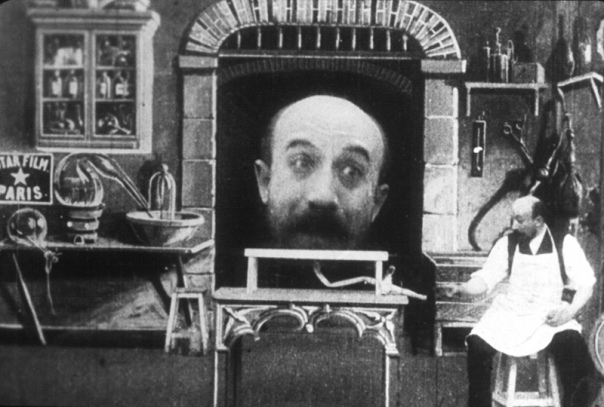
We saw Martin Scorsese’s newest film Hugo yesterday, the story of a young orphan who lives in the clockworks of a Paris rail station.  I enjoyed it very much even with though I am still not yet sold on the need for 3-D in this film.  Or most films, for that matter.  Some of its use in the film was interesting but often I found it distracting and sometimes downright irritating.

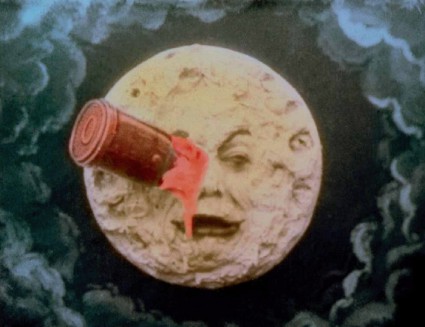
But what I really did like was that one of the main characters in the story was the great pioneering filmmaker, George Melies.  His life and body of work were key elements in the storyline.  It gives an overview of his life from his birth in 1861 through his early years as an illusionist and magician, as well as a maker of automatons, which are self-operating machines that often resemble human forms.  Clockwork robots– another important part of the film. It then documents his career in film , telling how he used his background in magic and illusion to create wonderous worlds in the new medium of film.  He created some of the first special effects seen on film and even toda, with all the CG effects available,  they are quite interesting to see.

The film also tells of his fall from the public eye and the destruction of many of his films, many of which were sold to the French military to be melted down to make celluloid heels for boots.  As in the film, Melies ended up running a toy booth at a Paris rail station before a new generation rediscovered the genius of his early work.  Though much of his work is lost forever, many have been recovered and restored.

Being a fan of early fims, I am glad that Scorsese was able to so beautifully pay homage to this early giant of cinema in Hugo.  I’m hoping that a few moviegoers will find in Melies’ work a huge imagination and inventive spirit  worth exploring more.  There is an amazing amount of wonderful film from the earlest days of the medium and I hope that a new generation will discover these hidden treasures, much like those who rediscovered Melies after World War I. 

Here is a restored Melies film, Le Diable Noir. Like many early films, it is short and a simple story.  For modern filmgoers, the acting will seem a little over the top but you have to remember the time frame here.  In early films, as well as the theatre of the time, gesture was big part of getting across emotion.  But that aside, the effects Melies incorporates are tremendous for the time.  Actually, ahead of his time.

Read Full Post »

Mr. Eddy

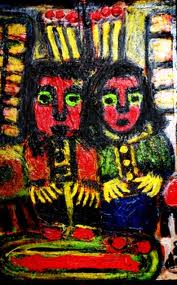
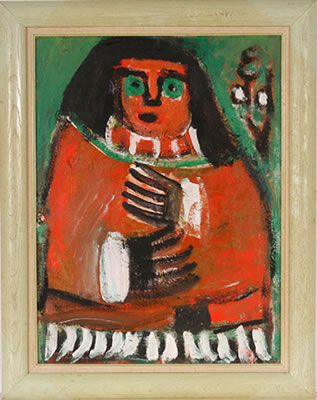
I came across another outsider folk artist whose work really hit with me.  It was from a gentleman by the name of Eddy Mumma who was born in Ohio in 1908 and lived the last part of his life in Gainesville, Florida.  It   Mr. Eddy, as he was known, started painting when he was in his early 60’s and continued in an obsessive fashion until his death at the age of 78 in 1986.  

Having lost both legs to diabetes, his daughter urged him to take some art classes just to get out of the house.  His instructor called his work sloppy.  This both caused him to quit the class and served as the ignition for an obsession that saw him paint hundreds of paintings in his distinctive manner, with heavy layers of paint of mainly figures with round eyes and and five straight fingers on each hand that created a design pattern of their own in his work.  He also painted both sides of his canvasses or boards, sometimes hanging framed pieces with the glassed side to the wall to better show the painting on the back. 

His work was never for sale although he did allow a local artist/teacher, Lennie Kesl, to purchase a number of pieces over the years in exchange for his friendship and assistance in obtaining supplies.  There is a nice recollection of Mr. Eddy from Kesl on the Southern Folk Art site that documents some of Mumma’s idiosyncracies as well as a short bio from Mumma’s daughter.  His work was obtained by a dealer from his family after his death.

There’s something very warm and inviting in the work of Eddy Mumma, something very familiar. In his better pieces, it is bold yet orderly and the repetition of forms that he uses create a running dialogue through his body of work that seems to speak, in a visual manner,  to unspoken parts of the psyches of others.  I often admire the work of obsessives like Mr. Eddy, identifying with that need to experience that  feeling of discovering something in each new piece.  Their work, while appealing to others, is created to satisfy some internal primal need for creation ans expression.  There’s something almost otherworldly in this for me and seeing their work often reinforces that feeling.

I definitely get that from the work of Mr. Eddy.  His work is inspiring to me as any great master and there are things I see in his work that make me want to get right to my brushes. 


Read Full Post »

There are a couple of new paintings that have been added to the group of work I have hanging in my studio.  The two paintings could not be more different yet both have meaning and inspiration for me.  The first is the oil painting shown here, Pig’s Head from David Levine

The late Levine was the celebrated caricaturist whose work was a staple of  Esquire Magazine, the New York Review of Books and other publications over his illustrious career.  I wrote about him a few weeks back in a post about a caricature of Richard Wagner of his that also hangs in the studio.  He was also an easel painter and watercolorist of great renown, particularly his works depicting Coney Island and its people.  He was a really marvelous painter.  This piece was obtained from the estate of the late Thomas Buechner, who was a friend as well as a colleague of Levine, having painted with him and curated exhibitions of his work.

At first, I thought the piece was a bit macabre.  I mean,  it’s a pig’s head on butcher’s paper.   But the more I looked at this painting the more I came to see it in terms of color and form, taking in the light and shadows and the contrasts of color.  I see it as an expression of paint now and am constantly amazed by it when I turn to it from my painting table or desk.  It has real presence on the wall and is a beautiful piece of painting.  I am really proud to hang it with my work and find inspiration in it.

The other painting that graces my studio is from an artist much less accomplished at this point in her young life.  It is an interpretation of my Red Tree done by my friend Olivia from Illinois.  Olivia is a nine year old whose father recently contacted me, telling me how much he and his daughter enjoyed my work online.  I sent them a small print in appreciation and Olivia responded with the wonderful watercolor shown here.  She also sent a thank you that included a drawn self-portrait that I really like a lot.  Nice, strong lines.  Confident.  I can’t tell you how much this gesture from a young artist I may never meet means to me.  Just knowing that she has found something in my work in which she finds inspiration of some sort is gratifying enough for me.

So, there they are, two paintings done by two artists, one whose career is finished and another whose career, in whatever field she may someday choose, has yet to begin.  One is immensely accomplished whose work graces museums and great collections,  and the other just learning.  Yet both hang side-by-side,  both equally filling me with great inspiration and hope.  I can’t thank David Levine but I can send out my thanks and best wishes to my friend Olivia.

Thank you, Olivia, for your kind gift.  You made my day!  Keep up the good work…

Read Full Post »

I have mentioned here that my work will be the subject of an exhibition at the Fenimore Art Museum in Cooperstown , NY next year, running from August 17 through December 31, 2012.  I had not been at the museum for many, many years so last week Cheri and I decided to pay a visit to both see the space where the exhibit will be hung and to see the museum as a whole.

I haven’t been to Cooperrstown in quite a while but from the moment I enter this little gem of a village I remember how much I like the place.  I’ve used the word idyllic several times recently here but must use it again to describe the atmosphere of this village built around the southern end of Lake Otsego, the lake famously referred to as Glimmerglass by James Fenimore Cooper, a name that now graces the renowned seasonal operatic company that resides there, the Glimmerglass Opera.  It is just a lovely  place especially in the quieter days of late autumn when the tourist trade is a bit slower and the beauty of the place shines through. 

Turning by the grand Otesaga Hotel, you head north up the west side of Lake Otsego and come quickly to the museum, resting on a slight rise above the lake.  The museum was built on the former site of the James Fenimore Cooper farmhouse and across the road is the famed Farmer’s Museum with its beautiful stone barns and outbuildings. 

I can’t really tell you how impressed I was with the museum, from the moment I entered the front doors  until the moment we drove away.  It is a truly beautiful space that is maintained to the highest standards.  We met with with Paul D’Ambrosio who we have known for many years and who is the President of the museum.  He gave us a tour through the galleries, giving us an education on many of the pieces.  For instance, the piece shown to the right, Eel Spearing at Setauket from William Sidney Mount, is considered the painting which serves as the face of the Fenimore Collection.  We were told that the lady in the painting from 1845 still has family that lives near the site of this painting on Long Island and that they periodically make the pilgrimage to the museum to visit their now famous ancestor.

After seeing most of the collections, including the  fabulous Thaw Collection of American Indian Art, we finally made our way to the galleries on the second floor and came to the East Gallery, where next year’s exhibit will be held.  I was a bit nervous with anticipation, to tell the truth.  But finally seeing the space and visualizing my paintings in the space helped settle my nerves.  The space is neither small nor large but has a sense of intimacy that I think will serve my work well.  There is a fireplace at one end that I could see my work easily hanging above.  The anxiousness of the unknown faded away and the actual idea of how the show might look began to take its place.  I now had sometihing tangible on which  to build the show.  A different sort of anxiety set in but it is the kind I often have before any show so I view it as an old friend who will ultimately help me in my task.

We talked for a bit about wall colors for the show which I hadn’t even considered.  I began considering colors that will push the work forward off the walls and accentuate the color in my work.  As we were leaving, Paul told me that my show would ne hanging at a great time next year as the show  hanging at that time in the other upstairs gallery would be an exhibit of American Impressionism featuring Mary Cassatt.   They would have a Monet, as well, to show his influence on the American painters.  He said there would be great crowds in the late summer for that show and would be great exposure for my exhibit.

So, we departed and I drove through the rain of that day with new concepts of how the work in the exhibit would relate to the space and to each other.  I began to have second thoughts about some pieces that I had originally thought might be perfect and paintings that I had dismissed began to come back into play.  The visit and the tremendous quality of the space and the works there raised the bar for what I wanted from my own work.  The task now seemed larger than before and I knew that I would have to really focus in order to make it work as I know it can.

In short, it was a good visit.  Thanks for the wonderful tour, Paul!

Read Full Post »

Among  the many great and sad stories in folk art is that of Martin Ramirez, a man born in Mexico in 1895 who came to the United States as a young man to work on the railroads.  The work proved too demanding for the small man and he soon was in despair, losing the ability to speak at that time as well.  He was diagnosed as a catatonic schizophrenic in 1930 and lived the rest of his life in mental health institutions until his death in 1963. 

Years into his institutional life, Ramirez started creating drawings and collages from the everyday objects around him.  This is how his work is described on the Foundation for Self-Taught Artists website:

Exhibiting a kind of iconographic vocabulary, Ramírez’s lovely drawings limn deep, vertiginous spaces through rhythmic repetition, disorienting perspectival shifts, and stagy composition. A mythic presence suffuses the animal, human, landscape, and abstract aspects of the work, all hemmed in by vibratory channels and warrens. A master of line and compositional control, Ramírez used graphite, melted crayons, and found pigments on paper fragments glued together with saliva and oatmeal. He also included collaged elements drawn from magazines and books. Recurring motifs in the work include mounted and armed jinetes (horsemen)—Ramírez was fond of horses and an equestrian back in Mexico—Madonnas, trains and tunnels, cars, and landscapes. Vernacular Mexican and American cultural themes and visual tropes, both nostalgic and resolutely modern, combine in a body of sensuous, dream-like images.

Martin Ramirez and Tarmo Pasto

In the 1950’s, Ramirez’s work was discovered by visiting art psychologist Tarmo Pasto who asked that he be allowed to keep any drawing that Ramirez produced.  Apparently, many pieces had been discarded over time in order to keep the ward clean.  Pasto championed Ramirez’ work and made it possible for the world outside those sanitarium walls to see the creations of this man whose mind seemed to transcend his captive life.  In the years since his death, the works of Ramirez have become some of the most prized in all of folk art and have been the subject of several  exhibitions in major museums.

I have never seen these works in person but am struck, even seeing mere images of them, by the almost trance-like rhythm of the patterns and imagery in them.  There is a beautiful grace in them that is only enhanced in knowing the story of this man’s struggle through his life.  It’s as though Ramirez was creating in his work, portals of release for a captive soul, a new world in which his inner mind finally jibed with the outer world.  That is how I choose to view it  in that I find the work filled with an almost idyllic harmony. 

 Postcards from a better place?  Perhaps.  Whatever the case, it is a gift to us from a world we may never know.


Read Full Post »

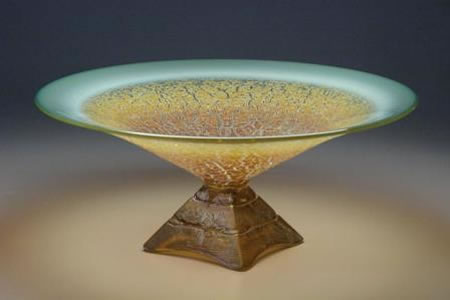
Jade Crackle Pyramid Bowl- Willsea O'Brien Glass

I came across the glass creations, like the piece shown here,  from Willsea O’Brien Glass at the West End Gallery in Corning.   With Corning’s notoriety as one of the glass capitals of the country, the gallery carries a select few glass artists, all unique and extraordinarily talented.  When I saw the Willsea O’Brien pieces, I was immediately taken in by the beautiful, complex colors that ran through them, jades and ambers and golds.  The forms themselves had a classic architectural stability and solidness while still feeling light and graceful.  There was just a real sense of rightness in the work, a feeling that this was work that would be as vital anytime in the future as it was at that very moment that I was first looking at it. 

Timeless.

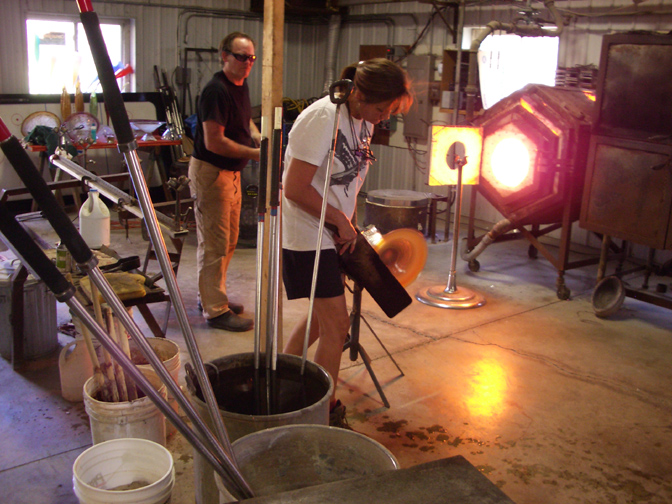
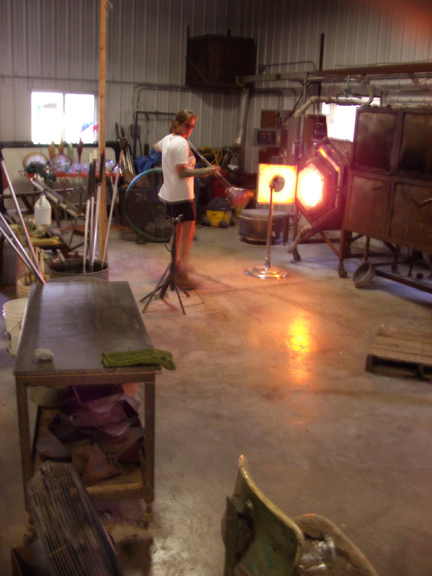
Over time, I discovered that we were mutual admirers of each other’s work and arranged for a visit yesterday to their home studio in a hollow in Naples, a gorgeous area nestled in the Finger Lakes.  When we arrived, the married team that makes up the company, Carol O’Brien and Paul Willsea, were in the midst of a piece.  They worked in an almost silent graceful dance, perfected in the twenty-some years they had been creative partners.  Working in the heat of the several  glory holes and kilns, the two took what  appeared as just a blob of glass when we walked in the door and transformed it within a short time into a version of the bowl shown above.

 I can’t describe in technical terms all the steps that they went through  but it was remarkable to see supremely talented people working their craft with such ease.  It’s one of those things, like watching carpenter Norm Abrams on This Old House.  They make it seem so simple with the sureness and economy of their movements that you begin to believe that you could do that too.  Then you try it and you realize that that ease that you saw was the result of thousands of hours spent at their craft and your appreciation for their talent only grows.

We had a great visit yesterday and were able to find out a but more about their history and how their work has evolved (and continues to evolve) since their early days as a team in Oakland, CA before returning with their children to New York, the original homes of both.   In their idyllic home setting, they have developed their own look and visual vocabulary in their work and have gained well deserved  renown across the countryfor their unique pieces. If you are looking for beautiful objects that are also timeless pieces of art, you could not do much better than the work of Carol and Paul.

Thanks to both for a wonderful visit.

www.willseaobrien.com

Read Full Post »

« Newer Posts - Older Posts »