Feeds:
Posts
Comments

Archive for the ‘Favorite Things’ Category

Comeback Cards!

Up late last night watching one of the greater games you’ll ever see in the World Series.  The St. Louis Cardinals made an improbable comeback not once, but twice, both times down to their last strike to end the game.  The game stretched into extra innings and ended after a towering walk-off home run from David Freese of the Cards sent the St. Louis crowd into a frenzy and the Texas Rangers slouching to their clubhouse.  There, the plastic that had been draped over their lockers to protect them from the champagne that was supposed to be popping in celebration had been rolled up and hovered above the downcast players like a symbolic Sword of Damocles.

Even though my team is not here, I am loving this Series and these Cardinals.  I grew up a Cards fan, worshipping Bob Gibson and his teammates, but have strayed away over the years.  So I can’t say they’re my team.  But this team has such a gritty guttiness that I can’t help but root for them.  In the regular season, they staged one of the great comebacks of all time, coming from 10 1/2 games back  just to squeak into the playoffs where they upset the heavily favored Phillies.  They have been big  underdogs here in the Series but somehow keep fighting back against the stacked Rangers.  I keep expecting Nolan Ryan’s head to literally explode at some point during these tense games.

The beauty of the Cards is that they are doing it with players who are not big names, outside of the legendary status of Albert Pujols.  For example, John Jay is an outfielder who has looked so out of his class through much of this series but somehow comes up with two bigs hits in the tightest situations, when the enthusiasm of the Cardinal fans was beginning to wane.  The same for Daniel Descalso, a utility player who will not be showing up on any fantasy baseball rosters anytime soon.  I can’t help but root for guys who don’t realize and don’t care that nobody is expecting them to win.  They are dong something all the big names who didn’t make it this far couldn’t do— playing in the moment.

So, I guess I’ll be watching the Cards tonight and even if they don’t complete what appears to an appointment with destiny by winning, I will watch to the last out.  You never know what these Cardiac Cards are capable of.
Read Full Post »

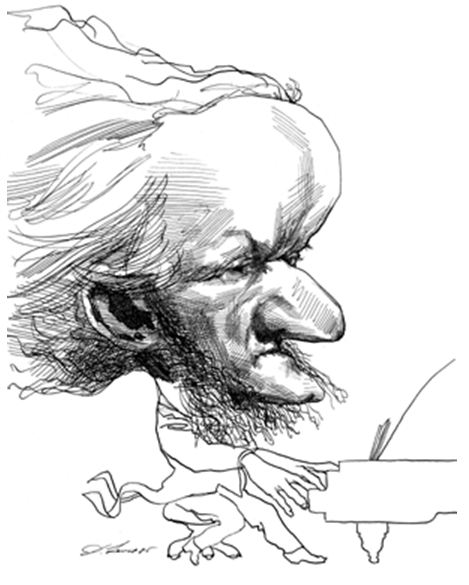
This is a caricature of famed German composer Richard Wagner drawn by the great David Levine.  It was one of the  many,many caricatures that he created in an illustrious career for the New York Review of Books and other major magazines.  Levine was considered the king of caricature and, according to John Updike, was “one of America’s assets.”

I recently obtained this from the West End Gallery from the personal collection of  Thomas Buechner, the late painter/museum director/writer  who had painted with Levine for decades as part of the renowned Painting Group in NYC  (the subject of an HBO documentary in 2007 about the group’s 25 member’s simultaneous portrait of Justice Sandra Day O’Connor, who sat for them) and had written a book on Levine’s work. 

I really like this piece a lot and like the connection it has to Levine and Buechner’s relationship.  I also know that Buechner was a huge fan of Wagner’s work and had undertaken the illustration of Wagner’s Das Rheingold in 1988.  His work was translated into glass and was subsequently displayed at the Metropolitan Opera when they presented the Wagner epic.  I am excited about the prospect of having such a piece with me in the studio and hope it brings even a small bit of inspiration.

You’re probably all most familiar with Wagner through the use of his music in populkar culture such as it’s use in the film Apocalypse Now where it was the soundtrack for the calvary’s helicopter attack.  My favorite use of his music is, of course, as the inspiration for the Bugs Bunny classic, What’s Opera, Doc?   But to show the music in its natural environment, here’s Arturo Toscanini and the NBC Symphonic Orchestra with a little taste.

Read Full Post »

Xavier Mellery

‘He who will manage to have us forget colour and form at the price of emotion will achieve the highest goal of all.’

—Xavier Mellery (1841-1925)

***************************

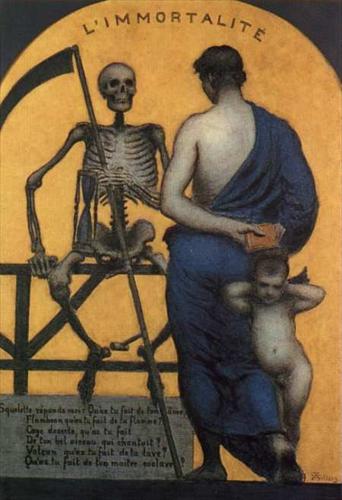
I’ve been spending the last several days putting a new roof on part of my home, so haven’t been as productive in the studio as I would like.  But I have been looking at imagery when I can, much of it some of the symbolist painters who have shown up here in the past few weeks.  One painter whose work always makes me stop and spend a few moments looking is the Belgian painter Xavier Mellery, another artist whose name is not well known to the general public.  In fact, there is not a lot of info to be found.

Mellery did some typical representative work in his career that was quite nice.  Some of his interior scenes are beautifully done and are very filled with a contemplative ponderance.  For instance, After Evening Prayers, shown below, has a wondrful sense of quiet atmosphere, most fitting for the subject.   But the work that really stands out for me are his allegories set against solid, often golden,  backgrounds.  Many incorporate text that speak to large concepts such as death and immortality, such as the piece shown here, Immortality.  They are beautiful in design and execution and, as I say, always stop me in my tracks as I thumb through the few books that contain their images.  I am glad to have come across them and feel inspirations in them that I hope wwill someday show through in my own work.


Read Full Post »

I’ve written here before about the joys of digging through one’s genealogy and finding little bits about your family that have been hidden for generations.  Before I started, I knew next to nothing about my family’s history.  There had been practically nothing handed down and there seemed to be little interest in its past.  For all I knew, we had crawled from under a rock about a hundred years ago and were suddenly just here.  There were times when that seemed like a logical explanation.

But over time, I have uncovered a great depth of material, the sort of things that all families certainly have in their own pasts, that have been really gratifying and have made me feel much more connected to this world and this country than I felt at times before.  I’ve found descendents who fought on both sides of the Revolutionary War, the British Loyalist side being pushed up into Canada before coming back here generations later.  I’ve had many who fought in the Civil War, including a gr-gr-great grandfather who emigrated here from Scotland and fought for the Union  and was a captive at Andersonville.  Another was a nearly 60 year old Canadian who had settled in the northern Adirondacks and enlisted and served with his son, my great-grand uncle.

All folks of which I was unaware of growing up.  The ease of researching today makes this connection to one’s past so much simpler that I, like so many others, can easily fill in the black voids of our own history.

One of my favorites was another gr-gr-great grandfather, someone of who I knew absolutely nothing.  His name was Joseph Harris and when he died, the local newspaper, the Wellsboro Agitator ( I love the name of that paper!), ran a headline for his obit that stated  Well Known Musician Dies.  It went on to say that he had been the US banjo champion at one point in his life.  I have to say that I was pleased by this, even though I had never even heard of this man before my research and his musical talent didn’t trickle down through the generations to me. 

Again, my stories are not exceptional.  We all have this rich fabric in our past that binds us to history and ultimately together if we only choose to look beyond what we see in the present.  Perhaps we can discover more about who we are as a people by examining our families’ pasts.  I know that I feel more invested in my life and my country than I did before doing this research.  And I guess that is a good thing.


Read Full Post »

In yesterday’s I talked a bit about some of the films that I watch in the studio as I work, mainly talking about the real classics.  I didn’t mention some of my favorites simply for the fact that I can’t watch them in the studio.  Some are pretty self explanatory, like silent films or foreign films where attention to the screen is required to simply follow the basic storyline.  I have many, many of these great silent and foreign language films just waiting to be watched when I’m not busy in the studio. I’m not sure when that will be.

But there are other films that I can’t watch because of the  way in which they’re directed and put together.  They are simply too beautifully constructed to not watch, so  much being lost by not seeing every bit of the film.  Take for instance the films of David Lean.  I love so many of his films but seldom watch any of them for just this reason.  Lawrence of Arabia is a prime example.  The scene shown above is a wonder.  There is only a few words of dialogue.  The whole scene is simply two man at a desert well as a rider approaches from far across the desert floor, fading in and out in the haze of the heat as though he were a mirage.  It is almost silent but is filled with tension.  This is only one scene in a film filled with grand wide shots that speak volumes, scenes that should not be missed in order to feel the power of the whole film.

Or take a peek at Lean’s Ryan’s Daughter, set in Ireland in the early part of the 20th century.  The scenes set on a desolate beach as the local townsfolk who support the IRA struggle in a mighty storm with waves crashing all around them to retrieve a shipment of rifles coming in to shore.  It is one of the most amzing scenes in film, mainly because it was all real.  There was no computer generated effects, no wind machines.  This was a dangerous effort, almost as perilous as the scene it depicted.  How could I not look at something like that?

I’m not even getting into his other great films– The Bridge on the River Kwai, Dr. Zhivago or the sublime Summertime, with its spectacular scenes of Venice taken from a train on which Katherine Hepburn’s character arrives.  Nobody used the train as powerfully in cinema as did Lean.  His shots of the train wreck in The Bridge on the River Kwai or his shots of the train crossing the frozen desolation of Siberia in Dr. Zhivago are masterful.

Then there’s his earlier, less epic in scale work.  The moody Brief Encounter or his now classic takes on Charles Dickens’ Oliver Twist or Great Expectations are just perfectly put together films, beautifully shot and full of great nuance. These are the work of a master, a maker of films for adults.  Watching them is really a pleasure in itself. So why would I have something on that I couldn’t fully appreciate.  Makes me want to blow off the day and watch a David Lean film.


Read Full Post »

In the Studio

This is a painting that is from a number of years back, part of a very small group of similar pieces.  Maybe three at the most.  I’m not even sure if I ever publicly showed these pieces, although I think I did exhibit one for a very short time.  This particular piece is 12″ by 48″ and is on a masonite panel.  It sits unframed in the main part of my studio and has remained one of my personal favorites for years. 

 I can’t really describe fully why I so like this painting, it being so atypical of my work. Perhaps it is the color and the sense it gives of light streaming through stained glass.  It has a lovely transparency.  Or maybe it’s simple abstraction of it, the idea of its possibility of representing anything.  For me, it is the obvious– a bird’s eye view looking down on a red road as it weaves down the topography of a hill to a lakeshore. 

But I also see it sometimes at the same time as being a feather from some exotic bird.  The blue circle reminds me of the eye from a peacock’s feather and the green plays off this color in a way that recalls some sort of feather.  I call this piece Red Feather Road but try not to tell anyone for fear it will alter the way in which they see the painting, trying to make their view fit into the title’s parameters.

But maybe I like this piece because it is not typical of my work but I still see myself in it while others may not.  Perhaps it is this sense of disguise that I like.  Like the feel of wearing a mask , walking about in anonymity.  Maybe I should call this painting The Mask.

Read Full Post »

Pooh


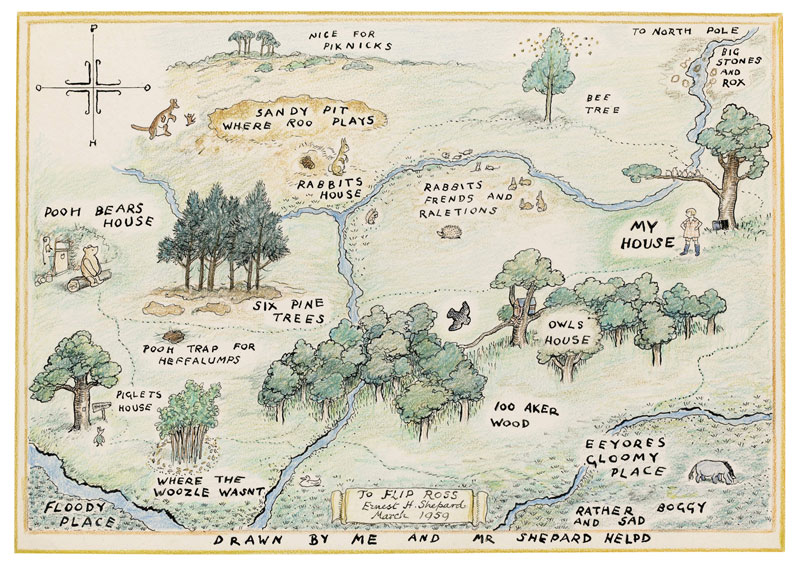
Original Drawing by E.H. Shepherd

It was on this day back in 1926  that  the first of  A.A. Milne’s classic children’s books, Winnie-the-Pooh, was published.  In the 85 years since, the beloved Pooh and Christopher Robin, along with his close group of friends who inhabit the Hundred Acre Wood,  have engrained themselves into the fabric of childhoods around the globe.  So great is this gentle bear’s influence that he has garnered streets name after him in Warsaw, Poland and Budapest.  There was even a Latin translation of the original book that became a NY Times Bestseller– the only book in Latin to ever do so.  Not to mention the countless trinkets and films the series has spawned from the Disney Co.

But while there may have been product overkill over the years, the basic gentleness of Winnie the Pooh remains intact after all these years.  His openly good nature and sweet simplicity still lives on.  And that, I think, is a good thing.  We could all learn a thing or two from this little honey loving bear and his friends.

Map of Hundred Acre Wood from EH Shepherd 1959

Read Full Post »

My internet connection was down due to modem problems yesterday and it made me think about our relationship to technology, how some of us resist  and, at best, tolerate it  even though we enjoy the benefits it provides.  But some folks take to it as though it were part of our genetic makeup, every nuance seeming easy and natural in their eyes.  While I was thinking about this I thought of this image.  I guess it exemplifies someone who has no fear of technology. Or death. Or windburn.

This photo, perhaps the most famous motorcycle image, if of the legendary Rollie Free at the Bonneville Salt Flats in 1948 as he attempted to break the Land Speed Record.  Earlier in the day he had already shattered the old record by over 12 MPH with a speed of 148.6 MPH, riding the bike in his unusual laid out position which was supposed to reduce air drag.  On that attempt he had been wearing protective leathers .  He felt he had lost speed due to the drag of his gear so he stripped down to a Speedo bathing suit and a pair of sneakers and had another go.  The result was a speed of 150.313 MPH, a record which stood for over 20 years.

The bike he was riding that day was the legendary Vincent Black Lightning.  I don’t know much about bikes although I had a fascination with Triumph motorcycles as a child.  But I do know that the name of the Vincent Black Lightning is one of the most evocative names of any vehicle ever produced.  It sounds ominous, powerful and fast and I suppose it must have been based on the record.  It also inspired one of my favorite songs, 1952 Vincent Black Lightning, from Richard Thompson.  I featured it in an earlier post with a bluegrass version from Del McCoury but this photo deserves the real thing from Thompson himself.

Have a great day and if you must ride your bike in this manner, please don’t text!

Read Full Post »

Frantisek Kupka was another one of those supremely talented painters from the late 19th/early 20th century who is little known outside the world of museums these days.  You probably won’t stumble across a Kupka calendar or mousepad.  But when I  see the scope and quality of his work I wonder why.  I know I hadn’t heard of him when I first came across his work in a book of Symbolist paintings.  I saw this image shown here, Resistance or The Dark Idol, and was immediately struck by the tension and drama in its mysterious setting.  I was surprised when I saw his other work that was beautifully colored and striking in other ways.

Kupka- The Yellow Scale (1907 Self Portrait)

Frantisek Kupka was a Czech painter who was born in 1871 and died in 1957 in France.  His career saw his work move from the early symbolic work to pure abstraction.  In fact, Kupka is considered one of the founding members of  the group, Abstraction-Creation, that set off the abstract movement.  While I found much of his abstract work beautiful, it was the early work that really pulled me in.  It was obvious that he could have worked extraordinarily well in any style he chose.  But his relative anonymity remains a mystery to me.  Perhaps he never had that one  iconic image or series that became associated with his name.  Monet’s water lillies.  Van Gogh’s starry night.  Gauguin’s Tahiti. Whistler’s mom.

I don’t know the whys behind this.  But his talent is no mystery at all.  It is evident in every piece I have come across. 

Read Full Post »

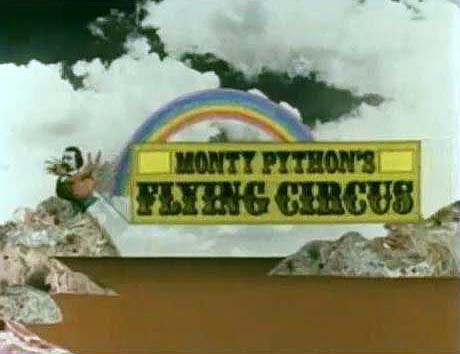
It was 42 years ago today that the BBC first broadcast a sketch comedy show that ran for only 45 episodes over four season but has endured the many decades since, inspiring countless adolescents and adolescent-minded adults such as myself with a brand of humor that was smart and irreverent.  And silly and ridiculous.  I am, of course, talking about Monty Python’s Flying Circus.

While it had a relatively short lifespan on television, the Monty Python name survived through a series of films over the years that have gained cult status including Monty Python and the Holy Grail which became the Broadway hit, Spamalot.  I remember going in high school to first see the film at a downtown theatre that no longer exists.  It was playing on a double bill with a much cruder and pretty much forgotten film, The Groove Tube. I can’t recall much about The Groove Tube but for The Holy Grail I mainly remember laughing with joy, even through the final credits.  I’ve seen the film dozens of times over the years and always find myself giggling like a kid a each.

Many of the skits have become embedded in the consciousness of the population.   You still hear of high school kids today who revere the show and can and do recite many of the skits verbatim, much to the delight of many around them, I’m sure.  Did I say delight?  I meant chagrin.  Okay, the skits are funny– when Michael Palin or John Cleese or the other Pythons are doing them.  But I’m glad that their humor still makes the young giggle in the same way that I experience those many years ago.  Hopefully, when I’m many years older, I’ll be shaking my fists at kids to get the hell off  my lawn and to stop singing that damn Lumberjack song!

Here’s a taste of the Pythons.  It’s their classic SPAM  skit, with all the shrillness that Terry Jones can muster as the waitress.


Read Full Post »

« Newer Posts - Older Posts »