Feeds:
Posts
Comments

Archive for the ‘Influences’ Category

Henri Rousseau- Self Portrait -1890

Henri Rousseau- Self Portrait -1890

I wrote a tiny bit on this site about Henri Rousseau over five years back, showing a few of  his paintings that I count among my favorites.  Over the years, that little blogpost is consistently my most popular page, receiving a considerable number of hits each day.  It’s a testament to the  power of his imagery, both in its ability to draw in the viewer and in the timeless quality it possesses in its evocation of mood.  I know those are the two qualities that drew me to Rousseau and the qualities I sought to emulate in my own work.

But going through a large book of his work yesterday, I was stuck by one  of his  greatest attributes, one that I had overlooked: his fearless approach to painting.  His work never tried to be something that it was not and always displayed his hand proudly, always declaring itself as his.  It gave even his lesser works a strength that is undeniable and true.

It was evidence of a supreme belief in the manner in which he was expressing himself.

That’s not a small thing.  I know for myself, there is a constant struggle to maintain my own voice and vision, to not try to conform to the expectations and definitions set down by others in my work.  To remain fearless like Rousseau.

henri_rousseau_-_a_carnival_eveningRousseau was born  in 1844 and worked most of his life as a civil servant, a clerk who collected taxes on goods going into Paris.  He didn’t start painting  until he was in his early 40’s and was not a full-time painter until he was 49.  He was basically self taught  and worked for the next seventeen years as a painter, blissfully maintaining his fearless work even though he was ignored or disparaged by most of the critics and much of the art world in general.

Yet, among the painters of his day he remains one of the most influential, directly inspiring other giants such as Picasso and many of the the Surrealists.  I think they, too, were drawn in and empowered by his fearlessness.

I think he might have been one of the great examples of someone painting the paintings he wanted to see.  And that, too, is not a small thing.  This and his bold approach are constant reminders to painters who want to maintain their unique voice, who don’t want to be lumped in with genres and styles and schools to stay fearless.

I will try.

henri-rousseau-sleeping-gypsy Henri Rousseau the dream 1910


Read Full Post »

Lotte Laserstein- Evening Over Potsdam (Abend Uber Potsdam) 1930

Lotte Laserstein- Evening Over Potsdam (Abend Uber Potsdam) 1930

While looking up some the artwork that was branded as being entarete kunst, or degenerate art, by the Nazis in 1930’s Germany, I came across a number of  amazing works, many by well known artists  but some from artists who were unknown to me.  Many of these were Germans who were well on their way to establishing big careers as important artists before the war and its buildup  but never really regained their momentum after the war.  That is, if they even survived.

Lotte Laserstein at work on "Evening Over Potsdam"

Lotte Laserstein at work on “Evening Over Potsdam”

The painting shown above, Abend Uber Potsdam, or Evening Over Potsdam,  by  German-born artist Lotte Laserstein , stopped me in my tracks when I stumbled across it.  It speaks volumes with just a glance.  At first, all I could see was a sort of  classic Last Supper type arrangement as if painted by Norman Rockwell while he was in the deepest depths of despair.   It was big and brilliant. The facial expressions and the body language evoke a mood that is beautiful and tragic at once, perhaps filled with the foreboding of what was to come for these people and  that city and that nation.

Perhaps the dog, a sleeping German Shepherd, is symbolic of the German people being unaware of what is ahead, an omen of what is lost when a shepherd is not always vigilant.

This was painted in 1930, just as the Nazis were beginning to make their fateful  move to take over the German government.  I can only that imagine someone with keen perceptive powers could easily imagine what might be coming with those dark clouds massing over that German city.

Lotte Laserstein- In Gasthaus ( In the Restaurant)Laserstein grew up in Prussia and was trained as an artist in the creative whirlwind that was post- WW I Berlin .  Art in all forms was flourishing, fueled by the desperation and fatalism of living in a post-war world.  There was change in the air.  Women were becoming more bold and empowered and modernity was pushing away the conventions of the past.   Laserstein embraced this life, typifying the image of the single, self-sufficient New Woman.  The painting shown to the right, her Im Gasthaus (In the Restaurant), is a great example of that time, showing a single woman with bobbed hair and fashionable clothes sitting alone in a restaurant.  The hands are strong and the expression is pensive, thoughtful.  It’s a great piece and a wonderful document of the time.

Laserstein was gaining stature at this point but in 1933 was marked as being Jewish and her career began to stall in Germany.  In 1937, the same year as the famous Entarete Kunst exhibit put on by the Nazis where they displayed and mocked artwork labeled as being degenerate then destroyed much of it ( a story worthy of another post) , Laserstein was invited to have a show in Sweden.  She went there and stayed until her death in 1993.

After the war she basically fell off the radar, although she was active until the end of her life. However, her work after the beginning of World War II lacked the fire of her earlier Berlin work.  It was good work but it was less full, less expressive.  Perhaps the war had sapped away a great part of her.  Her earlier work was rediscovered in her late 80’s and had a retrospective at a London gallery and in 2003, ten years after her death, she returned to Berlin with a   large retrospective.

There were many victims of that horrible time.  Lotte Laserstein did survive and did produce work for half a century after it so perhaps one might not call her a victim.  But there was something lost i n this case and we may never know fully what might have been for her without the war.  As it is, she has left us some wonderful work.

Read Full Post »

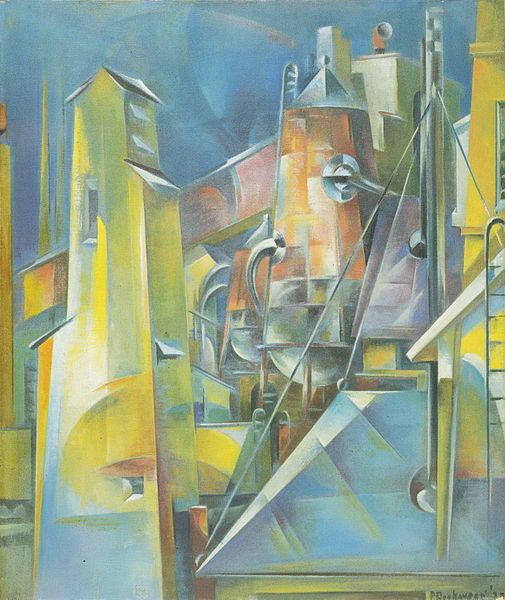
Preston_Dickinson_-_Factory_(c__1920) Columbus Museum of ArtI’m a fan of the Precisionist movement in art which was formed in the early 20th century and often depicted the industrial structures that were fueling the growth spurt taking place in America.  There are some big names in this movement, mainly Charles Sheeler and Charles Demuth, both of which I have featured here in the past.  But, like many of the movements in art, there are many lesser  but equally brilliant stars in their universe.  I recently came across one that really hit with me, mainly because of the energy and breadth of his work.  I thought it was all really good, really strong and evocative.  But it moved in many directions, pulling from many inspirations.  There was some Futurist work, some elements of Cubism and others.  It was as though this was an artist that was so talented that he was having trouble finding that single voice that fit his needs.

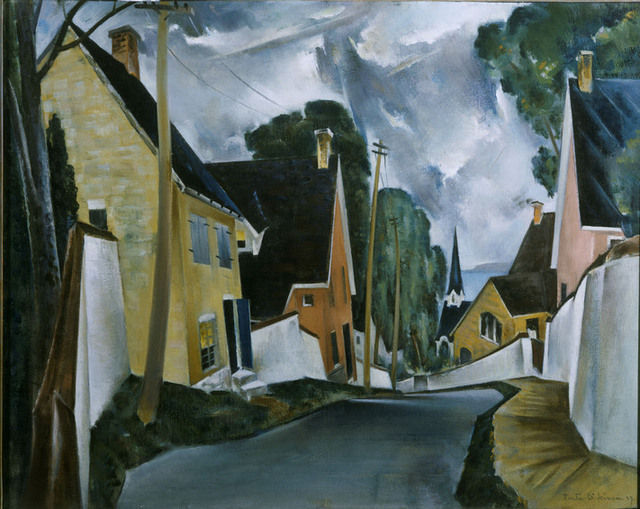
Preston_Dickinson Old Quarter Quebec 1927 - The Phillips CollectionHis name was Preston Dickinson who was born in NY in 1891.  He studied as a youth at the Art Students League under William Merritt Chase and soon after, with backing from a NY art dealer, headed off to Europe to study and exhibit there.  Coming back to America, he moved around a bit but by the late 1920’s was considered among the stars of American Modernist painting.

In 1930, he moved to Spain to live and paint and several months after being there contracted pneumonia and died there.  He was only 39.  He produced only a few hundred pieces of work in the twenty years or so in which he was producing work.

So maybe there is something to this feeling that he was still in the midst of finding his true voice.  It makes me sad to ponder what might have been and what sort of work was lost to the world when he passed away.  He was obviously a huge talent with an active and inquiring mind.

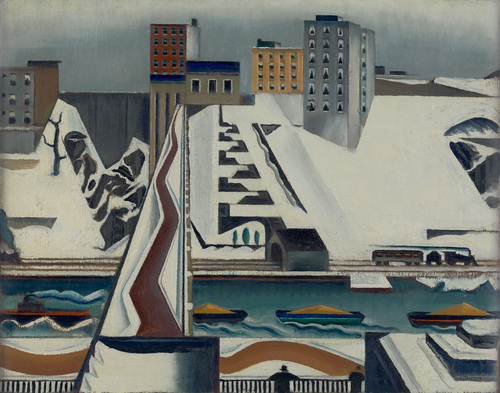
I am glad to have just stumbled across him now and hope that the joy his work brings me somehow moves into my own.Preston Dickinson Harlem River  MOMA

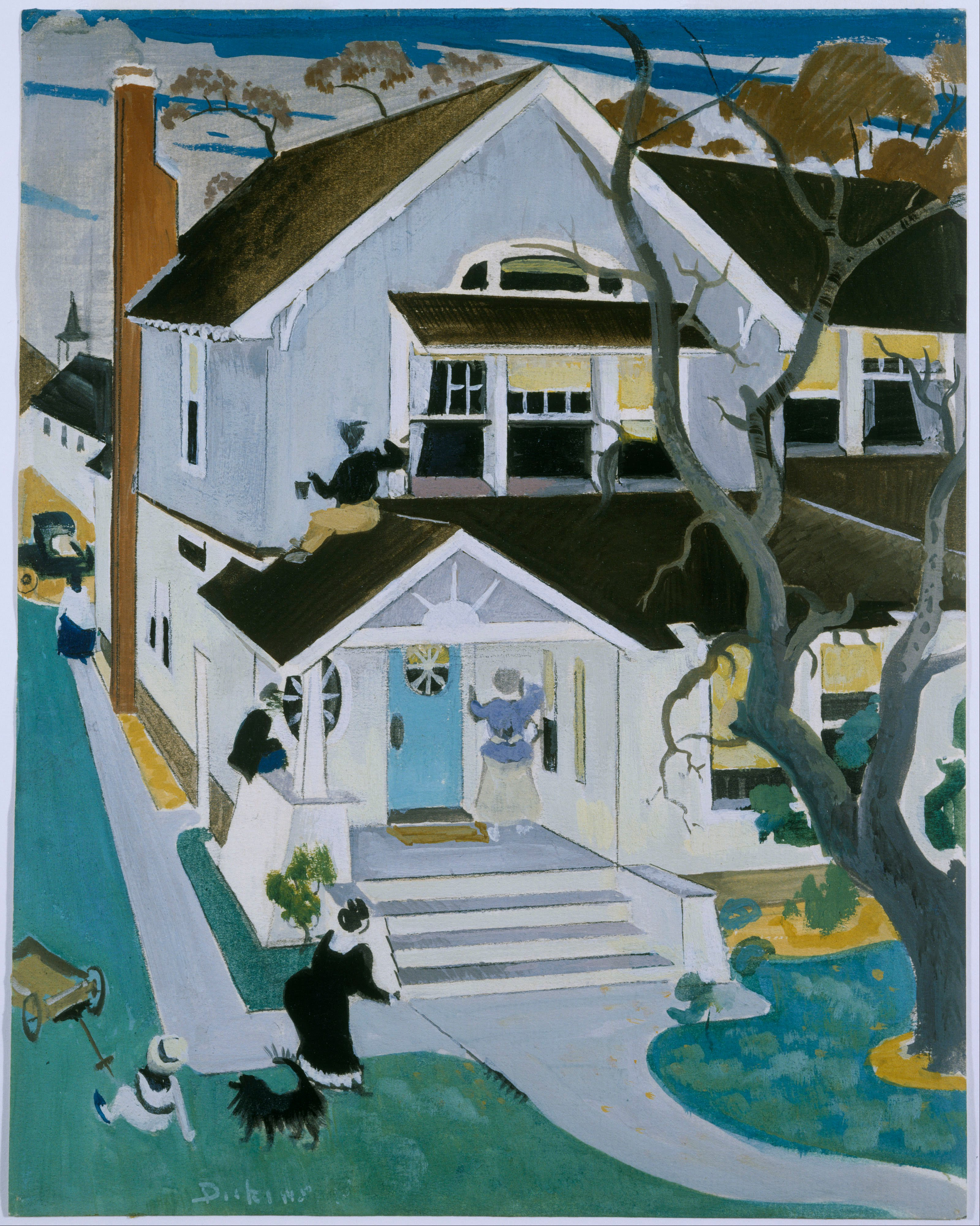
preston-dickinson-tower-of-gold Preston_Dickinson - Street in Quebec- The Phillips Collection Preston_Dickinson_-_My_House_-_Google_Art_Project Preston_Dickinson - Industry 1923- The Whitney Collection


Read Full Post »

GC Myers 1994 Early ReductiveWork6I have been spending a lot of time here in the studio in the last few weeks painting in a more traditional manner, what I call an additive style meaning that layers of paint are continually added , normally building from dark to light.  I’ve painted this way for many years but much of my work is painted in a much different manner where a lot of very wet paint is applied to a flat surface.  I then take off much of this paint, revealing the lightness of he underlying surface.  That’s a very simplified version of the process, one that has evolved and refined over the years,  that I, of course, refer to as being reductive.

When you’re self-taught, you can call things whatever you please.  I’m thinking of calling my brushes hairsticks from now on.

This reductive process is what continually prodded me ahead early on when I was just learning to express myself visually.  I went back recently and came across a very early group of these pieces, among the very first where I employed this process.  I am still attracted to these pieces, partly because of the nostalgia of seeing those things once again  that opened other doors for me.  But there was also a unity and continuity in the work that I found very appealing.  Each piece, while not very refined or tremendously strong alone, strengthened the group  as a whole.  I would have been hesitant to show most of these alone but together they feel so much more complete and unified.

This has made me look at these pieces in a different light, one where I found new respect for them. I think they are really symbolic of some of  what I consider strengths in my work, this sense of continuum and relativity from piece to piece.  It also brings me back to that early path and makes me consider if I should backtrack and walk that path again, now armed with twenty years of experience.  Something to consider.

GC Myers 1994 Early ReductiveWork 1 GC Myers 1994 Early ReductiveWork 3 GC Myers 1994 Early ReductiveWork 5 GC Myers 1994 Early ReductiveWork 2 GC Myers 1994 Early ReductiveWork 4

Read Full Post »

A few years back on this blog, I wrote here a couple of times, Oscar Bluemner and Doppelganger,  about the work of  Oscar Bluemner, the German-born Modernist painter .  I feel as close to his work as any artist I have come across.  His color choices would have been my color choices.  His modeling and blocking of forms are done in a way that came easily to me, without ever knowing of him.  It all just fits my mind and eye so well that I feel a real bond with his work  Hey, I was even called Oscar a number of times through my childhood–  Oscar Myers is too easy a target for other kids not to call attention to it.

Oscar Bluemner Old Barn studyI recently came across a couple of crayon studies that Bluemner had done around 1911 that are coming up for auction.  Even these I found fascinating in that I could see myself doing these, so much that they reminded me of early works that I had done in oil crayons.  I wouldn’t be surprised to come across these in a box I have that holds this early work.  The one shown here on the right, which is being shown as a crayon drawing called Meadow in Connecticut, has an added bonus on its back.

Oscar Bluemner back of crayon workFlipping the sheet over, there are detailed directions on color placement for the painting that Bluemner was laying out in this drawing.  It points out that this is from Sheepshead Bay and in pencil on the right hand side it points out that the resulting painting was a 15″ by 20″ oil that was sold in 1916 to a Mrs. Phillip Lewis Johnson.  At least that appears to be the name listed although I could be wrong with my reading of the scrawl.  It’s a fascinating further look into the artist’s mind and creative process.

Taking this info, I was able to locate an image of the finished painting, shown below.  I can not be positive but everything indicates that it is at the Crystal Bridges Museum of American Art, the spectacular collection and art space built in Bentonville, Arkansas by Walmart heiress  Alice Walton.  This oil painting is actually listed at 14″ by 20″ so perhaps an inch has been lost over the years.  But the vivid quality of the color has not been lost .  Again, it’s wonderful to see the process of an artist whose work means a lot to you.Oscar Bluemner Old Barn at Sheepshead Bay 1911 a


Read Full Post »

Armin Landeck Cats Paw 1934

Armin Landeck- Cat’s Paw 1934

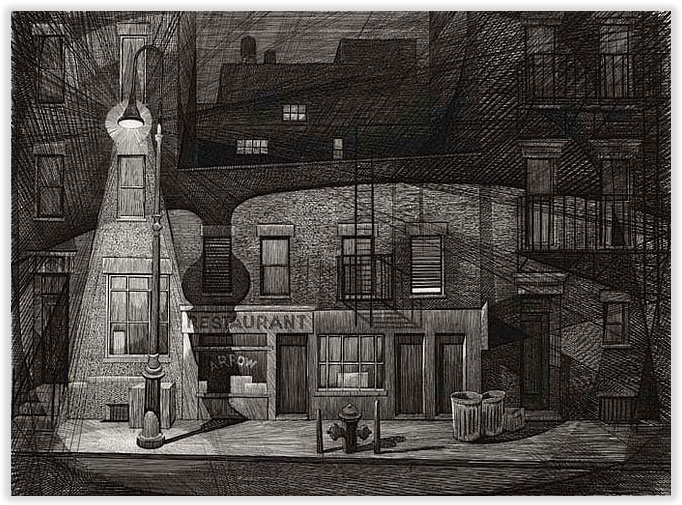
I have often featured the work of  artists here who work in black and white, mainly printmakers who work in forms of etching or lithography.  For myself, I like seeing the pattern and rhythm of these compositions without the influence of texture or color.  Probably because I am always looking for a new way of looking at the normal and these give me a clear view of their construction, their bones.  There’s something very pure in that.

Last week I wrote bout Martin Lewis who achieved some success with his wonderful etchings in the 1930’s only to fade into obscurity in the 40’s until the end of his life.  Today I want to feature a contemporary as well as an associate of Lewis, Armin Landeck.  Born in Wisconsin in 1905, Landeck came to New York City in the 20’s to study architecture at Columbia University.  He and his wife traveled to Europe  from 1927 until 1929 where he studied art and  became interested in printmaking, producing his fist body of prints there.  Returning to the states and not being able to find work as an architect, Landeck turned his complete attention to printmaking.

Armin Landeck Pop's Tavern 1934

Armin Landeck- Pop’s Tavern 1934

Like Lewis, he documented the New York of the early 30’s, the tonal nature of his black and white etchings creating a perfect atmosphere for the gritty urban landscapes.  The nature and popularity of their work eventually brought Lewis and Landeck together.  Together they opened The School for Printmakers in 1934 but it quickly became a victim of the Great Depression, closing in 1935.  As I noted, it was during this time that Lewis left NY and work soon fell from favor in the post-war years as Abstract Expressionism and other new trends in art took over the city.  Lewis never regained his footing.

Armin Landeck Chair and Table 1980

Armin Landeck- Chair and Table 1980

Landeck, on the other hand, let his work be influenced by the new atmosphere in the art world, adopting more and more elements of abstraction in it.  Without really altering his own unique perspective, his work continued to expand and evolve, remaining vital until his death in 1984.

I like that while I love this work there is also a lesson to be learned here about allowing new influences into your work, not simply cutting yourself off or settling at a plateau at a certain point in time.  I will ponder that while I continue to look at Mr. Landeck’s beautiful work.

Armin Landeck Fish 1963 Armin Landeck Rooftop and Skylights 1969 Armin Landeck Restaurant


Read Full Post »

GC Myers Shambhala smAccording to Buddhist tradition, Shambhala is name given to what they consider the Pure Land, a utopia of sorts whose reality is as much spiritual as it is physical.  A place where everyone achieves a state of enlightenment and peace and tranquility.  Author James Hilton morphed the name into Shangri-La for his novel Lost Horizon which describes a group of Westerners who find themselves the guests in a small idyllic nation of this name tucked away in a protected Himalayan valley.

Whatever you call it, the idea of a place of enlightenment and peace seems pretty attractive to me these days, given the many events going on in the world being driven forward by such negative factors as greed, hate and fear.  That tranquil inner place is what I see in this new painting, an 18″ by 36″ canvas that carries this name, Shambhala.  The road , for me, represents the search that leads to this elusive state and the sun  a blissful guide with a warm lure that radiates throughout the sky.  The Red Tree is on a small peninsula set into a calm body of water, still attached to the world  but in an ethereal space.  It is in a state of being where it is firmly in the moment, having set aside the past and disregarding the future.  Just absorbing the now.

That’s what I see and that is what I imagine how that moment might feel but I am still on that path, looking ahead for a sight of that hopeful destination.

Read Full Post »

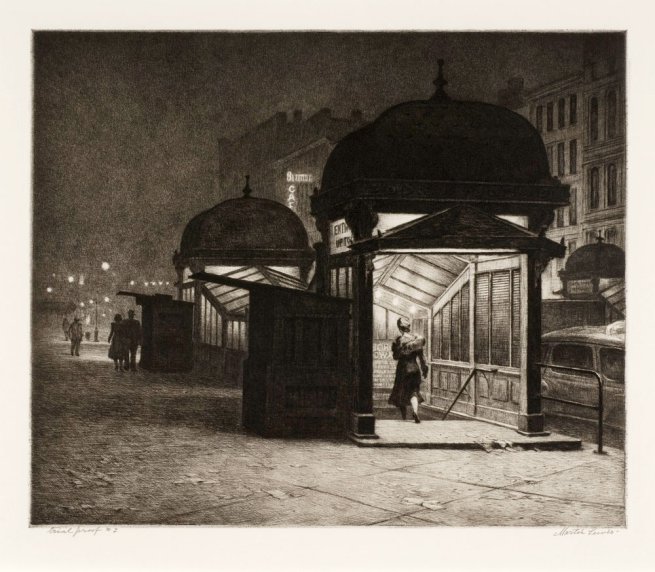
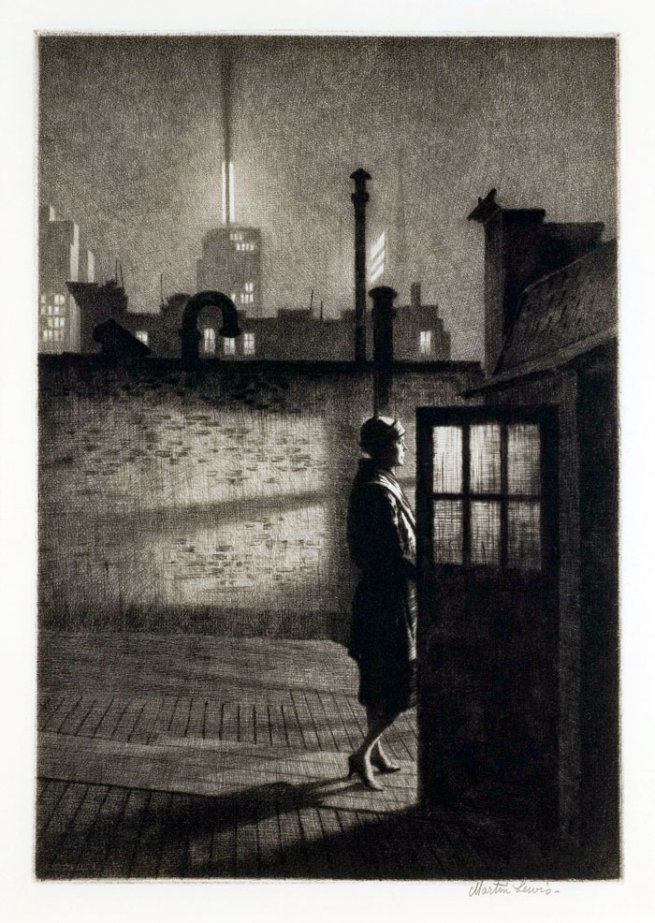
Martin Lewis - Late Traveler 1949I saw a Martin Lewis etching years ago and was transfixed by the crisp contrast of its darks and lights and the easy moodiness it gave off.  I knew nothing of the artist but it was obvious that he was masterful in his etching and in his artistic eye.  I had largely forgotten this artist until I came across a group of his etchings that are coming up for auction.  Seeing them rekindled that same feeling I felt years ago.  Mainly images from New York in the 20’s and 30’s, they often capture a feeling of urban anonymity and isolation, mining the same vein of emotion in which  Edward Hopper worked in his paintings.  This is probably not a coincidence since Lewis and Hopper were friends, Lewis having taught Hopper the art of etching around 1915.

Martin Lewis was born in Australia in 1881 and ran away from home at age 15, working rough jobs for a few years as he travelled and sketched his way through Australia and New Zealand.  He ended up in Sydney where he studied and did illustrations for a local newspaper.  He migrated to the US around 1900, arriving in San Francisco where he painted backdrops for the presidential campaign of William McKinley before finding his way to New York City.

Martin Lewis- Relics (Speakeasy Corner) 1928Inspired by the dynamism of the city at that time, Lewis worked as an illustrator and painter.  It was a 1910 trip to England, where he was introduced to the printwork of English artists such as James MacNeil Whistler, that inspired him to take up etching.  However, it was an 18 month stay in Japan in 1920 that set the groundwork for his signature work which captures light and air and mood so well.  He was active and increasingly successful from 1925 until about 1935.  However, the Great Depression brought a downturn to his popularity and by the 1940’s his work was out of favor.  His work never really took hold after that and he died in 1961,  largely unknown.  In fact, just finding some of the details on his life for this short blog post took some doing.

I think his work is wonderful and evocative and  find it amazing that his work ever fell out of favor.  But such is the nature of art.  But the etchings of Martin Lewis will persevere through the fickle cycles because they capture something elemental and personal.  And that is what real art does.

Martin Lewis- Shadow Dance 1930 Martin Lewis-Tree  Manhattan Martin Lewis- Little Penthouse Martin Lewis- Glow of the City 1928 Martin Lewis - Which Way 1932 Martin Lewis New York Nocturne

Read Full Post »

Hokusai Mackerel and Sea Shells 1840

I don’t have much to say today and am running late plus the Russia-Finland hockey matchup in the Olympics is beginning as I speak.  So I am greatly distracted today.  But t came across this image from the Japanese master Hokusai that I wanted to share.  I had a post several years back that featured the famed waves  for which Hokusai is best known.  They are such strong images of the power and rhythm of nature that it is easy to see why they are his signature works.  But when I saw this quiet still-life of a fish with a few shells from 1840 I truly understood how revelatory this work must have been to the western artists,  such as Whistler and Van Gogh among many others,who discovered it a generation later.

It has a wonderful delicacy in its color and it’s also  simple and elegant, maintaining an extraordinary modernity through the past 170 or so years.  It always seems  like it is in the now which is that intangible that most artists , myself included, seek.  It is unlike anything you would have found in the west in 1840 yet seems totally at home now.  Just a wonderful image to ponder.

Read Full Post »

de-chirico1

Sometimes the horizon is defined by a wall behind which rises the noise of a disappearing train. The whole nostalgia of the infinite is revealed to us behind the geometrical precision of the square. We experience the most unforgettable movements when certain aspects of the world, whose existence we completely ignore, suddenly confront us with the revelation of mysteries lying all the time within our reach and which we cannot see because we are too short-sighted, and cannot feel because our senses are inadequately developed.  Their dead voices speak to us from nearby, but they sound like voices from another planet.

–Giorgio de Chirico

***************

de chirico the disquieting muses 1916I like this quote from de Chirico.  We are surrounded by mystery wonder at every turn yet we don’t even notice.  I especially love the last line — Their dead voices speak to us from nearby, but they sound like voices from another planet.  It has such a poetic rhythm and reminds me of stepping out from my studio and looking up into the night sky to see Jupiter shining so brightly above me, so huge and visible to us yet mostly unnoticed.  Voices from another planet.

De Chirico was an interesting  case. His earlier work, from his metaphysical period like the pieces shown here, is the work that defines him. Definitely the work that influenced me and a host of other artists.  It is work with a distinct and powerful voice, wok that you immediately recognize as his alone.  But in mid-career he basically set it aside and began to paint in a more traditional manner.  It was good work but was not distinctive and set apart from other artists.  It was work that could have been painted by any number of professional painters and lacked both the individual voice and the revelation of mystery that seemed ingrained in the early work.  This later work never garnered nearly the attention that his earlier work had, much to  de Chirico’s consternation.

I can’t say that de Chirico was wrong for following his mind in changing his style.  It was his to change.  But there is a lesson here in that your individual voice is the greatest asset that any person can possess– if you dare to stand apart and pay heed to those voices from another planet.

Read Full Post »

« Newer Posts - Older Posts »