Feeds:
Posts
Comments

Archive for the ‘Influences’ Category

Beatles with Ed SullivanIt was on a Sunday evening on this date  fifty years ago that a touchstone event took place here in the States, one that dramatically altered pop and rock music as well as popular culture.  If you watch television or read newspapers, it has been hard recently to avoid seeing something about this 50th anniversary of the Beatles’ first appearance on The Ed Sullivan Show on this date back in 1964.  For some, especially those later generations, this is probably a puzzlement as they have no context to put this event in any sort of historical context.  They have no idea what a big moment this was or how it dramatically affected music and popular culture.

It’s always hard to describe something to someone who has only known the resulting change.  I used to try to convince those nay-sayers, usually people born in the aftermath of the Beatles’ reign which would be post-1970, of the importance of the Beatles emergence and their music but it became too tiring.  So now I just enjoy the music and marvel at their evolution over their short lifespan as a band.  What an arc of creativity!

Their listeners might have mourned when they disbanded in 1970 but, realistically, they had completed their journey together, had strung together album after album of memorable and constantly evolving and growing sounds.  They were at a peak with nothing more in front of them.  Each went on to highly successful solo careers but none matched the true power of their combined efforts as the Beatles.

The legacy of their music has been so evident in the past few weeks.  I’ve seen a number of lists from critics and other musicians of their favorite Beatles songs and each is so different from another.  There is no consensus of which are their best songs and each list is truly valid as each contains a group, usually ten, of songs that are quite memorable.  Even the list of the top ten underrated Beatles songs would qualify as someone’s best of the Beatles list.   I sat down and tried to make a list of my Top Ten Beatles songs and had such a hard time.  Just when I thought I had it I would remember another and couldn’t imagine it not being on the list.  It is remarkable that they had so many songs that bound themselves so deeply into the fabric of ourselves.

Here’s what I came up with for my Top Ten, in no particular order:

A Day In the Life

Paperback Writer

Day Tripper

In My Life

Hello Goodbye

Norwegian Wood

Taxman

Tomorrow Never Knows

You’ve Got to Hide Your Love Away

Baby You’re a Rich Man

Sitting here now, I can think of twenty ( or forty or fifty) other songs that would fit seamlessly into this list, all songs that are my favorites when I am listening to them.  Oh, well, there are no hard and fast rules here and this is not a very terrible problem to consider so I’ll just put lists aside and enjoy.  Here’s one of my faves from the Fab Four.

Read Full Post »

GC Myers-Memory Way smEvery man’s memory is his private literature.

-Aldous Huxley

***********

As I have stated in the past here, the Red Chair, an icon that often appears in my work, is a symbol to me of people and places and experiences from the past.  In short, my memory.  In this new piece, Memory Way, that is most certainly the case.  This little painting, 2″ by 5″ on paper, is another of my pieces from the Little Gems exhibit which opens Friday at the West End Gallery.

The road here represents to me the continuum of time.  The landscape is almost idyllic, perhaps representing my tendency to block out the worst parts of memory.  At least, to downplay them and keep them in the background and to put what good there was there in the best possible light.  I like to revisit the past occasionally and I have to make it a place where I am comfortable.  A past filled with nothing but dark and fear-filled memories is no place to venture on a regular basis.

Anyway, this little piece makes me happy and fills my mind with a feeling of good memories.  As Huxley said  above, our memory is our own private literature, filled with the memories of our lives and the lives of our ancestors.  I sometimes edit, embellish and redact my life’s literature, all to make it an interesting read for myself.

That’s what I see in this little guy.

Read Full Post »

Pete SeegerPete Seeger died yesterday at the age of 94.  He had a pretty remarkable life, using the power of music as a hammer to pound against the powers of social injustice.  The thing that I admire most is his always evident conviction to whatever cause he was devoted.  For as gentle and jovial a man as he appeared to be, there was no wishy-washiness in Pete Seeger.  He always spoke the truth to power on the most pressing matters of the day– the labor movement, civil rights, the Viet Nam war and the environment.

Of course, anyone with such strong and visible views, wil have some controversy surrounding him and Seeger was no different.  He was blacklisted in the 1950’s for his early affiliation with Communism and his slowness to finally condemn Stalin followed him through the years.  But, to his credit, he did own up to his actions and admit mistakes when he felt they were made.  Probably more so than most of those in power would be willing to admit.

Of course, the music is the legacy of Pete Seeger.  Songs like If I Had a Hammer , Where Have All the Flowers Gone?  and Turn! Turn! Turn! have  all have been covered innumerable times, becoming so ingrained in the American songbook that it seems hard to believe that they weren’t written even longer ago than they were.  Well,  the lyrics of  Turn! Turn! Turn! were a bit earlier as they use the words from Ecclesiastes in the Bible.  I grew up with a single of the Byrds’ version of  Turn! Turn! Turn! never far away from our old stereo console and I still get a chill when I hear those opening chords and a little teary when I listen to the lyrics..

So, for  Pete Seeger, to every thing there is a season.  Thank you.

Read Full Post »

GC Myers- California Dreaming 2014It’s another clear and cold winter day, about 4 degrees outside .  It’s visibly beautiful with the crisp and sparkling snow clinging to the pine boughs.   The contrast between what I see out the window of the studio and what I am seeing in my mind is often hugely different.  This new painting is such an example.

It’s a 36″ by 36″ canvas that I am calling California Dreaming.  It was not done with intention but as I was finishing it I couldn’t shake the feeling that this large piece reminded me of California, at least in some microcosmic way.  The mountains in the rear remind me of the Sierras rising from the Central Valley and even the two smaller hillocks in the foreground felt a small bit like the coastal hills.  When you added in the warmth of the colors, it just felt very California to me.

Having this on the easel then turning my head 90 ° to look out the window is quite the contrast.  Both make me happy but they are worlds apart.  At least, a continent and several temperate zones apart.

The title is, of course, a reference to the famous The Mamas & The Papas song, although my favorite version, out of  the many done of this song, is from Jose Feliciano.  Here’s a really nice instrumental version done by an exceptional guitarist, Michael Chapdelaine.  Enjoy and have a great day, whether you’re warm or just dreaming.

Read Full Post »

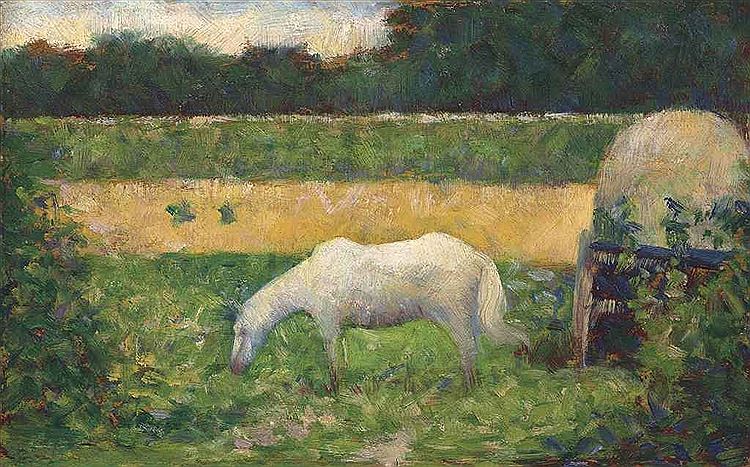
George Seurat -Paysage Avec ChevalI subscribe to a service that provides information such as auction results for artists, both living and dead.  It is always interesting to scan the auction results for my favorite artists, to see how they are currently viewed by buyers.  For example, anything by Vincent Van Gogh still draws huge money, even the work that doesn’t possess the signature brushwork and color of his better known works.  Those pieces that do, go for astronomical sums.  His popularity with the public is as strong as ever.  I guess that is no surprise.

A_Sunday_on_La_Grande_Jatte,_Georges_Seurat,_1884.It’s also interesting to scan the results to see other work from artists than that which we know them by that hangs in museums.  We tend to think of artists by their best work and seldom see the complete chain of work that runs through their career, never really seeing their weak links or developmental work.  The image at the top, Paysage Avec Cheval,  a painting that goes up for auction at Christie’s London, is a good example of this.  It’s a lovely piece but you might not guess the artist.  This is from George Seurat whose work, such as his most famous work shown here on the left,  is forever tied to pointillism.  But scanning through his records, you can get a better sense of the evolution of his work.

I am also looking for consistency in the artists whose work I am scanning through.  Again, we always think of the artists in terms of their best known works and are often unaware of the totality of their body of work.  Some artists are incredibly consistent, even in their early formative years.  Others have high peaks and deep valleys, with a huge disparity between their best and not-so-best work.  I am always encouraged by both types of artists.

I strive for consistency in my own work but have had dips and valleys in my work, particularly in the formative days early on.  In those days, I thought of the great artists only in terms of their best  works that hung in the great museums of the world, thinking that they simply got up each day and turned out incredible work.  I could not fathom the possibility that they had swings and misses.  It’s encouraging to see that those icons whose work I revere often struggled in the same way as me and that the great works we know them for were not created in a vacuum.  They came with great effort and day after day of moving ahead in often small increments.

I think any aspiring artist should take a few minutes to look through the whole of the works of their heroes.  They might be encouraged, as I often have been, to know that the path they are on is not so much different.

Read Full Post »

GC Myers-2014

I am still taking in this new painting, an 18″ by 18″ piece on canvas that remains unnamed as I ponder it a  bit more.  It is, at first glimpse, a snow painting.  At least, it was intended to be so.  For me, there is something quite challenging in presenting this surface that translates as pristine but, in fact, is far from it, having multiple layers of color beneath it which show through at points.  The edges show a glow of red oxide and violet, giving it a warmth that belies the coolness of the white blanket.  It’s a departure from the snow of Dale Nichols‘  paintings that I showed here yesterday, which is pure and luminous.

The thing that I have found with using the white of the snow is that it really displays the lines of the forms underneath.  The lines of  landscape in the foreground here, for example, really pop off the surface.  This could be a bad thing if they don’t have an organic sense of rightness,  that vague and elusive quality to which I often refer.  I think this piece has it.

While looking at this painting this morning, I began to ask myself, “What if that isn’t snow?”  This change of perspective gave the piece a very different reading , one that I hadn’t thought of when it was being painted but one that might pass through the mind of some folks.  What if this is some desolate post-apocalyptic landscape, devoid of  vegetation and covered in ash and dust?  The ravaged  landscape of Cormac McCarthy’s The Road immediately came to mind.  The painting suddenly took on a different feel but it still felt warm and even jubilant in a way.  As though the Red Tree,  fatigued at the end of that dark ribbon of road, had finally met the warm gaze of the sun that burned through the hazy sky.  The Red Tree was still standing despite the desolation around it and was rejuvenated, lifted up, by the sun’s energy.

It brought to mind the poem Strange Victory from the late Sara Teasdale, a poem that I have featured here in the past.  It is one of my favorite poems and expresses the contrast that I often try to impart in my work.  I think it fits this reading of this painting very well.

 Strange Victory

To this, to this, after my hope was lost,

To this strange victory;

To find you with the living, not the dead,

To find you glad of me;

To find you wounded even less than I,

Moving as I across the stricken plain;

After the battle to have found your voice

Lifted above the slain.

Sara Teasdale

Funny how a simple shift in perception  can alter the whole meaning of a piece.  It was originally meant as snow and will probably remain so .  But for the moment I find myself asking:  Is it snow?


Read Full Post »

Dale Nichols-  Company for SupperMost likely prompted by the recent weather here as well as a desire to try a slight change of palette, I have been doing a small group of snow paintings recently.  I thought I would look at several other artists, especially those with a idstinct personal style,  to see how they handle snow in their work.  One of the artists whose snow works really stuck out  was Dale Nichols, who was born in Nebraska in 1904 and died in Sedona, AZ in 1995.  He is considered one of the American Regionalists,  that loosely defined group of painters whose work  for which I have long expressed my admiration.  

Dale Nichols- After the Blizzard 1967His biography is a bit sparse with but Nichols lived a long and productive life, serving as an illustrator, a  college professor and the Art Editor of the Encyclopedia Brittanica.  He also spent a lot of time in Guatemala which resulted in a group of work with Meso-American forms that is quite different from his Regionalist work.  

But Nichols is primarily known for his rural snow scenes and it’s easy to see why.  The colors are pure and vivid.  The snow, put on in multiple glazed layers with watercolor brushes has a luminous beauty.  The stylized treatment of the crowns of the bare trees adds a new geometry to the paintings.   There is a pleasant warmth, a nostalgic and slightly sentimental glow, to this work even though they are scenes that depict frigid winters on the plains of Nebraska.  free of all angst, they’re just plain and simple gems.

You can see a bit more of Dale Nichols other work on a site  devoted to him by clicking here.

Dale Nichols- The Sentinel Dale Nichols- Silent Morning  1972 Dale Nichols- Mail Delivery  1950 Dale Nichols-  Bringing Home the Tree

Read Full Post »

Van Gogh-- Sorrowing Old Man 1890I am a fan of Vincent Van Gogh and  am always surprised when I come across a Van Gogh painting that I can’t remember seeing, especially one that has that powerful quality for which his work is known.  Such was the case when I stumbled across this painting.  It’s called  Sorrowing Old Man (At Eternity’s Gate) and was painted in 1890, just a couple of months before his death.

His signature use of line is evident here, especially in the way he uses the color blue to outline the old man. the man and the chair have a completeness while the floor and the background are sparsely painted, almost not there.  It’s a bit of a departure from some of his better known pieces which are densely colored throughout but it focuses the energy of the painting completely on the old man’s sorrowful posture.  Its simple elegance makes for a strong and moving image.

Van Gogh-- Worn-Out-- Drawing  1881-2This painting was based on an earlier drawing made by Van Gogh in 1882.  During that year and the one before, Van Gogh had done a number of drawings of men and women in states of sadness or exhaustion as he was learning to make lithographs.  It is beautifully rendered and has all of the same power of the final painting.

However, for me, Van Gogh’s signature use of color in the painting is what makes the painting much more memorable and moving.  The painting is so recognizable as being his that it carries the cache of his entire body of work, links into the continuum of energy that runs through his paintings.

I am glad I stumbled across this treasure.  While I don’t paint in the manner of  Van Gogh, I find there is almost always something to be learned, always something that can be applied to my own when studying his work.  I think I will look at this a bit longer.

Read Full Post »

GC Myers-1993 PieceI was looking through some old work, pieces that came from my earliest forays into painting about twenty years ago when I was just beginning to experiment.  I came across this particular piece and stopped as I always do when I am meandering through the old work and this painting appears before me.  It is one of my earliest efforts,  done in late 1993.  It is rough and doesn’t exactly represent where my work has went in the meantime.  I was hesitant in  showing it here but felt that there was something important in it for me.

This  painting, copied in part from another artist’s watercolor,  was done with old air brush paints on very cheap watercolor paper.  As I said, it’s rough and not a piece for which I hold a lot of pride. Nor is it a piece that shows any level of mastery.   Certainly not a piece that I  want many people to see if they are not already familiar with my work from the decades beyond this.  You seldom want to show something that displays a weakness but sometimes there is something of value that goes beyond the surface.

But for me there is something about this piece that propelled me forward, something that gave me some sort of insight into where I might want to go with this whole thing.  I equate it to walking along and suddenly stumbling for what seems no reason.  You stop and look down to see what made you trip and there is nothing but a tiny pebble.  Insignificant in every way.  Certainly nothing that would make you stop at any other time.  But this time it has somehow caused you to loose your balance.  So you stop and stand there, looking down at this pebble.  In the moment, you  begin to see other things that you had never taken notice of before and the path you had been walking before the pebble waylaid you is forgotten.

And that’s what this painting was and is for me– a pebble.  On it’s own it is very little.  Insignificant in every way.  But for me it that thing that tripped me and made me stop to take  notice of a new path.  There were small inklings– the curves of the landscape and the blocking of the colors, for example– in this this piece that sparked thoughts and further explorations that, in turn, pushed me even more as I went forward.

In a very long chain of mostly fortunate reactions, this was the catalyst.  So while I may not hold this painting in high esteem (nor would I expect anyone  to do so) this old work has real meaning for me.

Read Full Post »

« Newer Posts - Older Posts »