Feeds:
Posts
Comments

Archive for the ‘Influences’ Category

I was rummaging around in one of my favorite sites, Luminous Lint, looking for something that would somehow sum up the world of Kodak and Kodachrome film on this day when they file for bankruptcy, the end of an era.  As I flipped through the photos this image caught my eye.  There was a blaze of green that lit up the edge of it and flecked through the faded and vague image of a farmhouse giving it an otherworldly glow. It reminded me of the effect I wanted in much of my early work, of the image seeming to be somehow pulled from time and space, leaving it in a rough-edged cell.

Reading below it I discovered that the photographer was Levi L. Hill and that was taken in 1851 in Greene County in the Catskills of New York.  It also said that this may be one of the first color photos taken and that Hall came across the image accidentally and spent the last 15 years of his life trying to recapture the effect.

Levi Hill Portrait

Intriguing.  I decided I wanted to know more and came immediately across an article from the Catskill Mountain Foundation titled Levi L. Hill: Fool or Fake? by writer Carolyn Bennett.  The whole story is a bit more involved and even more interesting.  It seems that Hill began a Quixotic journey to discover color photography after a discussion with famed Hudson River painter Asher Durand who told him that if he could find a way to capture color with photography he would be far ahead of all of the painters of the time.  The public was crazy for photoimages and especially clamored for color.  The man who discovered a color process would gain renown and fortune. 

So Hill started an intensive search even though he had little training in chemistry or science, performing thousands of experiments.  The image above was one of the few, if limited, successes and that was merely by chance.  His grand quest ended with his death in 1865 at the age of 49.  To get a better sense of this little known bit of photo history I suggest reading the article from the Catskill Mountain Foundation mentioned above or an article from Smithsonian curator Michelle Anne Delaney that talks about Hill’s work and the museum efforts to determine if he was indeed a fraud or a genuine trailblazer.

Whatever the case, I still am intrigued by his image.

Read Full Post »

 In a post from a few days ago and several times before, I have mentioned the stained glass windows that came from the studio of Louis Comfort Tiffany in the early part of the 20th century.  They have been a large influence on my work over the years, from their use of complex color harmonies to the way they are composed using simplified forms and strong lines which divide and define the panels.  I never try to imitate any one piece or even have them in mind when working, but I often find myself comparing my work, after it is completed, to them as far as color and composition are concerned.  Often, the paintings that satisfy me the most have an opalescent quality in their color with each color having elements of several colors combining to create a depth of harrmony in the piece, if done well enough.

The panel shown here is a good example.  It is a panel of magnolias that resides at the First Unitarian Congregational Church in Brooklyn, NY.  This is a little darker and contrasted than the image of this window that the church uses on an available  notecard but , for our purposes, this works well.  It shows distinctly the many colors that make up the distant sky– the multiple blues, yellows and pinks which combine masterfully.  In other hands, such a melange could come off as shrill and sharp.  Even cheesy.  But here it has a glowing harmony.

The beautiful silhouettes of the magnolias that cut the sky are graceful  and delicate yet powerful as they climb across the ocean of color behind.  The whites of the flowers are multi-colored with only hints of actual white.  The landscape that runs to the distanet has greens and blues and purples running through them as they provide a deep counterpoint that only enhances the depth of the sky.

Just beautiful.

So, when I mention the windows of Tiffany, you’ll hopefully have a better idea of what I mean.  We’re very lucky that Tiffany Studios was tremendously prolific and that many of these windows still are preserved for our viewing pleasure.  I am always enthralled when I come across one and never turn away feeling less than inspired.  It is that feeling that I hope most carries through in my own work.

Read Full Post »

I was looking through a book of American Expressionist paintings and came across this piece that completely pulled me in.  It was a scene of Greenwich Village in the 1940’s painted in spectacular fashion by Beauford Delaney, a name with which I wasn’t too familiar.  Looking at it, there was so much going on in this quiet street scene that it was like a luscious meal set before me and I simply hovered over it, savoring it  before I dug in.  I didn’t know where to start.

The colors are big and bold with a blue night sky that brought Van Gogh to mind and a moon that hangs in a crescent  that floats almost sweetly over the near empty street.  It is rough and expressionistic yet elegant and complex in the ways the colors play off one another.  It is quiet yet hardly timid.  It is what it is, a street scene, but its abstracted manner gives it other dimensions and depths.

Just about everything I want in a painting.

Like I said, I didn’t know much about Beauford Delaney, to my embarrassment.  He’s shown here in a 1940 portrait done by Georgia O’keefe, which I thought was pretty interesting as well.  Born in 1901 in Knoxville, Tennessee, he and his brother, Joseph, were both prominent artists and part of the Harlem Renaissance of the 1930’s.  Beauford never achieved the sort of recognition here that his work deserved and he struggled mightily until finally leaving the States in the early 1950’s, settling in Paris where he lived the rest of his life, dying in 1979.  There is an interesting short  bio, A Tale of Two Brothers by Jack Neely, online for those who seek to know a bit more about the man.

I know I will be looking for more of his work.


Read Full Post »

I think I’ve mentioned here that there is some of my early work where my documentation is a bit sketchy.  There is a handful of pieces of which I have no images, which bothers me a bit now.  The rest of the work from that time is from iffy slides, photos and simple photocopies where the work was small enough to fit on a copier bed.  I was trying to organize some of these old images recently and came across one of those photocopies.

It was the piece shown here. This was a 7″ by 9″ image on paper.   I’m still trying to locate it’s title which is a bit embarassing for me, mainly because this painting rekindles so many memories when I see it.  I remember distinctly how this piece came about.  I had been looking at a framing magazine ( this was a time when I was still uncertain of how I would present my work and hadn’t settled on my own framing which I’ve used for about 14 years now) and came across an ad featuring a painting that caught my eye.

I don’t remember who painted that particular painting but it didn’t really matter.  The painting itself did nothing for me.  I wasn’t crazy about the color or tone of the image.  I wasn’t interested in its texture of atmosphere or all of the detail that painter had used in the fields and trees.  But the composition screamed out at me and in my mind I was immediately transforming the composition into my own work, with my own simple forms and lines.  We’re talking a matter of seconds here.

It was like the composition was merely a sculptural armature, a framework underneath, that served as a foundation but could be transformed on its surface.  While I used the armature of that painting in the magazine, it would be hard to see the similarities between my piece and that original image.  That tranformation and how quickly it happened in my mind always remains in my memory, permanently attached to this painting.  I felt like I was really finding my own voice in that moment, where I could synthesize influences in a very distinct  individual manner. 

I wish I could see this piece again in person, to see if it holds that same feeling for me.  To see how the person who owns it now sees it and to let them know how strongly it remains in my own memory.

Read Full Post »

As we end this year, 2011, I thought I’d take a minute and show a few of the Saturday Evening Post covers from the first half of the 20th century that celebrate the new year, all created by  the great illustrator J.C Leyendecker

Leyendecker is credited with popularizing the notion of the New Year being embodied as a baby and for over thirty years his versatile babies hailed in the new year for the popular magazine, often in a timely fashion.  One hundred years ago, he had a baby suffragette marching across the cover and in times of war he had sword wielding doughboys and Nazi-fighting GIs.  The one thing they all had in common was Leyendecker beautiful style.

The German-born Leyendecker came to America as a child in 1882 and became one of the most successful and influential illustrators of his time.  He is perhaps best known for his Arrow Collar Man, a long-running series of ads that shaped how the American man of that time came to be viewed.  He also did so many of their covers that his name was  associated almost synonymously with the Saturday Evening Post, in much the same way the work of Norman Rockwell became after him.

I wonder how Leyendecker might have portrayed this new year’s baby?

Read Full Post »

I wrote a week or two ago, after seeing the film Hugo, about the work of George Melies and how wildly inventive it was at the advent of modern cinema.  He used built sets and illusion to create  images that were like scenes torn from a dream. 

The same might be said for the work of Robert and Shana Parkeharrison, contemporary photographers who create magnificent metaphorical landscapes on elaborate painted sets then photograph them.  Old school.  There is no computer generation here.  In their best known series which is captured in a book of the same title from 2000, The Architect’s Brother, they create a monochromatic, sepia tinged world that is both filled with foreboding  and trepidation as well as sheer beauty.  Each image is poetic and thought provoking on some level. 

And powerful.

I’m sure I’m not giving as much detail about this couple and their work as you may desire.  I just wanted to pass along their imagery and let you do what you may with that.  Besides, if I write much more, that means I have less time for exploring these photos further.

Here’s a slideshow of the images from the Parkeharrisons’ book, The Architect’s Brother.


Edison's Light


Read Full Post »

Thomas Girtin is probably a name most of us have never heard before.  Yet, for a  time he was a giant in the world of art in Britain and was vastly influential in the direction of art there for the next century after his death in 1802.  A lot to say for a young man who died at the age of 27.

He was born in the same year as JMW Turner, the British giant whose worked revolutionized watercolor and served as a leading edge for the work of the later Impressionists.  The two were good friends, having worked together as teens, and rivals and Turner later said  “Had Tom Girtin lived I should have starved”.  When I think of the spectacular work of Turner, especially some it done over 40 years after the death of Girtin,  and see where Girtin was in his work when he died, I am sad to think what the world was deprived in not seeing what he might have accomplished as he matured.  Turner’s work certainly evolved and Girtin displayed a drive for greatness  that would have certainly brought incredible things.

Thomas Girtin -Study for the Eidometropolis

For example, in 1802,  just before his death, he created and displayed a painting called the  Eidometropolis, a huge panorama of 1800 London that measured 18′ tall by 108′ long.  The prodigious effort brought great acclaim, both for its heroic scale and the beauty of the work.  Sadly, the painting no longer exists except for many sketches which were created in the making of it, such as the one shown here.  Girtin died soon after from an asthma attack.

So, in the centuries since, the name of Thomas Girtin never really grew to the stature that it might have reached had he lived.  Perhaps his friendly rivalry with Turner might have spurred on amazing things from him and even more incredible work from Turner.  We will never know, of course.  It’s just hard to not speculate when you see such obvious talent, even genius, ended at such an early point.

Read Full Post »

I was doing a little research on the painter Robert Gwathmey, the social realist painter whose work most often depicted the day to day life of  poor African-American culture of the American South.  I knew that his son, Charles, was a very famous architect but I didn’t know much about his wife, Rosalie.  She was a photographer who chronicled that same rural culture that was the subject of her husband’s paintings.  In fact, her photos were often the source material for his work.

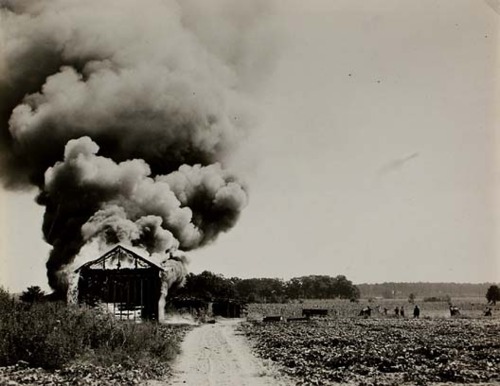
Digging deeper, I came across her photos and found them compelling.  There were poignant shots of families at work and at home, often in abject poverty.  Wonderful compositions of a barn on fire amid the wide flat fields, smoke billowing with an awful ominosity.  All very powerful stuff.

Reading some articles about her I came across a terrific article from 1994 and Erika Duncan in  the New York Times.  It was of an interview with Rosalie Gwathmey, who died in 2001 at the age of 92, focusing on her work as a photographer which, at the time of the article, was being rediscovered as the result of a solo show of her photos.  It turns out that she had been an earnest photographer. associated with some of the other great photogs of the time such as Dorothea Lange,  from around the mid 1930’s up until 1955 when she abruptly put down her camera, destroyed many of ner negatives and gave away her photos.

“I just quit,” was her description.

Reading the rest of the article, she also simply stopped painting at one point, despite having great promise, and she also abruptly ended a long career as a textile designer.  She simply stopped and claimed to have no regrets.

That really made me think.  Was this merely a facet of her personality or could this happen to anyone?   Could I one day suddenly decide that I no longer wanted to paint?  What was it that made her suddenly lose that need to express herself in a certain way?  It became a sort of scary thing to think about for me, as though it were some horrible affliction that lay in wait for me somewhere in the future.  Maybe never but maybe tomorrow.

I don’t know that there are actual answers here, only more questions.  But her quitting is as intriguing an aspect of her life as her wonderful work and makes me wonder how many others have simply walked away from what seems to be a great career.

Read Full Post »

Scene from Black Narcissus

As an artist, I am of course influenced by color in many things.  Obviously, the colors I have seen in the work of the great painters played a part in how I came to view color, such as the bold use of it by Van Gogh and the deepness of the greens and reds in Holbein’s masterpieces.  But even beyond painters I am influenced by color in so much that I see. 

This makes me think of a Coke television commercial from a number of years back, probably in the late 80’s or early 90’s.  It was in an urban setting with a Latin vibe but it wasn’t the setting that caught my eye.  It was the color of the whole ad.  Deep, dark throbbing colors.  Reds that looked like they poured out of a beating heart.  Gorgeous rich golds.  All shot in a very cinematic manner, much richer in texture than one would expect from a TV ad.  Every time I would see it I would stop and just stare, taking it all in.  I don’t think I was painting yet and it really made a big impression on how I viewed color and made me think that I could find expression in color.

Another influence is in the work of the great cinematographers of the movie world.  I especially think of the movies from the earliest years of color use in the films, movies like Gone With the Wind and The Wizard of Oz, which both were extraordinary in their use of color.  But, for me, the work of Jack Cardiff in the films of Michael Powell and Emeric Pressburger takes the cake.  In movies like The Red Shoes, Black Narcissus, A Matter of Life and Death, The Tales of Hoffman and The Life and Times of Colonel Blimp ( a favorite of mine), Cardiff used color in a way that added even more depth to the story, making the eye want to settle on the scene at hand and take it all in.  The images and the opulent color  from these films often lingered in my head for weeks after seeing them and when I am at the easel I find myself still trying to capture that same atmosphere that he was able to create on film.

I mention this today because I want to remind anyone interested that TCM is featuring the work of Jack Cardiff in January and will be airing a documentary, Cameraman: The Life and Work of Jack Cardiff  along with a number of the films that showed off his great skill, both as a cinematographer and a director.  It’s a great opportunity to see some of his color work that that been called decadent by some writers.  When I read that description, I nodded because that is exactly what it felt like– grand, luscious decadence.

Good stuff.

Read Full Post »

Color which vibrates just like music, is able to attain what is most general and yet most elusive in nature.

– Paul Gauguin

****************

I came across this line that Gauguin had written in a letter to the poet Andre Fontainas and it made me think about how I often compare painting to music, how I try to find that  rhythm, maybe the vibration to which Gauguin alludes, in my work that has the same effect on the viewer’s unconscious mind as does music.  That thing that would make my work, like music, communicable across all boundaries.  Something that would easily be absorbed as an emotional response without first having to dissect it intellectually, like music that you hearfor the first time and react to without thinking, often finding it still vibrating in your mind for days and weeks afterward.

It’s a grand aspiration and I am never sure if I ever reach that goal.  But I do keep hoping and trying.

I chose the painting above to illustrate this post because I like the simplicity and harmony of it.  Titled Ever, it’s a 15″ by 18 ” piece on paper that is as much an abstraction, with its spare forms and lines,  as it is a depiction of reality.  My hope is that the color and harmony of this piece creates a vibration or rhythm that overcomes the unnaturalness of it, allowing it to makean emotional  contact before the mind finds some intellectual objection.

Again, a grand aspiration.

Reading back over this, I have to say that I don’t sit before my easel or table and ponder these concerns before I start to work.  I often only think about these matters when I come across a line,  like the one above from  Gauguin, that makes me wonder about my own aspirations for my work, what they are and how they compare to the painters of the past whose work I admire.  I guess I am looking for a commonality in our views that connects us somehow, even though our work may not reflect this bond.

Another grand aspiration. 

Read Full Post »

« Newer Posts - Older Posts »