Feeds:
Posts
Comments

Archive for the ‘Influences’ Category

Collective Memory

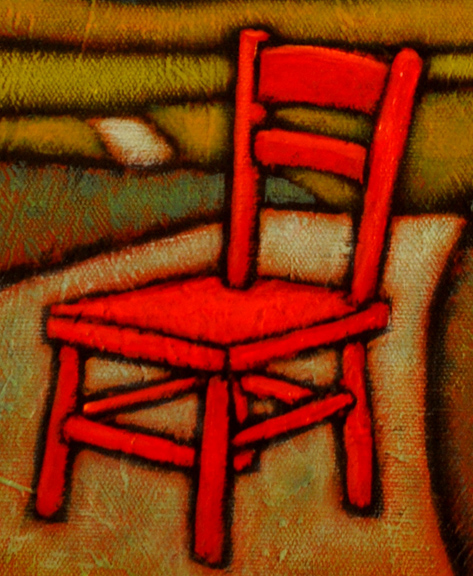
At last week’s gallery talk at the West End Gallery, I was asked what meaning the Red Chair that is a part of some of my paintings held.  It’s a question that I get often but is one for which I have no pat answer.  I described how it came to be in my work and how it had evolved in meaning to what I now see it as now.

I have come to view it as a symbol or icon for the memory, both personally and collectively.  By personal, I mean memory that is distinct to each of us, moments and perspectives that only we hold.  For instance, if I personified the Red Chair as being the memory of my deceased mother, it would be based on my personal recollections of her.  My brother or sister’s memories might be quite different and perhaps might even be contradictory to the point that this Red Chair wouldn’t strike the same emotional chord with her.

The collective memory that I spoke of and tried to explain with little success at the talk is based on a cultural accumulation of memory, an icon for those group memories of events that have affected masses of us, directly and indirectly.  For example, as we approach the tenth anniversary of 9/11, there is a collective memory for that day.  We all have personal memory of our reactions but there is a unified memory that holds for the event as well, a sort of collected emotion that could be represented in an icon.  What that icon would be, I have no idea at this point as I’m just writing off the cuff.  I’m sure there is one, one item or image, that captures that memory of the event for a wide swath of us.  I will have to think about that.

It’s this collective memory that I often see in the Red Chair.  Our collective memory of our past.  Our experiences in war, both here and abroad.  Our struggles as a growing nation with issues of race and social injustice and our westward expansion.  Our saddest days and our days of triumph and joy.  In short, all those thing that make up our cultural identity and define us as a people.

It doesn’t stop with a national identity.  It also applies to the collective memory of us globally, to those events that bind us together as a species, to the memory of ur common bonds and ancestries.  When I see the Red Chair now I see our entire past captured in the bare bones of it. 

 Our past is the seat on which we sit.

Maybe that still doesn’t capture the whole idea but, hey, I’m just thinking here.  I think I have more thinking to do.

Read Full Post »

Goya’s Miniatures

I have written here about a series of small dark pieces that I painted a few years back which I called my Outlaws series, pieces that were of shadowy figures often holding pistols next to windows.  They had been greatly influenced by a number of later silent films of the 1920’s which featured haunting dark imagery as well as a group of small late paintings by Spanish master Francisco Goya that I had seen at the Frick Collection in NYC, along with other works from near the end of his life. 

The Goyas were were painted on small squares of ivory around 4 inches square  that had been coated with a ground of black carbon on which he dripped water which removed the carbon to reveal the shadow of white ivory below.  He would then look into this wetness and manipulate it to produce the images that he saw emerging from it.  The result was a series of small but powerful pieces that really resonated with me, especially in that I easily identified with his process in producing these plates, one that was very similar to the method of painting I first adopted in my earliest forays.

Here is a clip from the introduction to the Frick exhibition that describes his process:

Goya departed from the traditional miniature technique of stippling — applying tiny touches of color with a fine-pointed brush until they coalesce into the desired images — for a broader means of execution. His improvisational process is described by a young painter friend, Antonio de Brugada, who witnessed Goya at work:

His miniatures bore no resemblance to fine Italian miniatures nor even those of [Jean Baptiste] Isabey. . . . Goya had never been able to imitate anyone, and he was too old to begin. He blackened the ivory plaque and let fall on it a drop of water which removed part of the black ground as it spread out, tracing random light areas. Goya took advantage of these traces and always turned them into something original and unexpected.

In transforming the stains of water into recognizable forms, Goya added accents by scratching the surface with a sharp pointed instrument; touches of watercolor were deftly applied; outlines were reinforced in black; and small patches of the surface were wiped to produce a range of shadows and highlights.

It’s an interesting little group of pieces from Goya, one that I’m glad to have stumbled across.  I had looked often at his work and had admired much in it but this was the first work from this master that really hit me, sparking me in my own work.  You can see the rest of these images here.

Read Full Post »

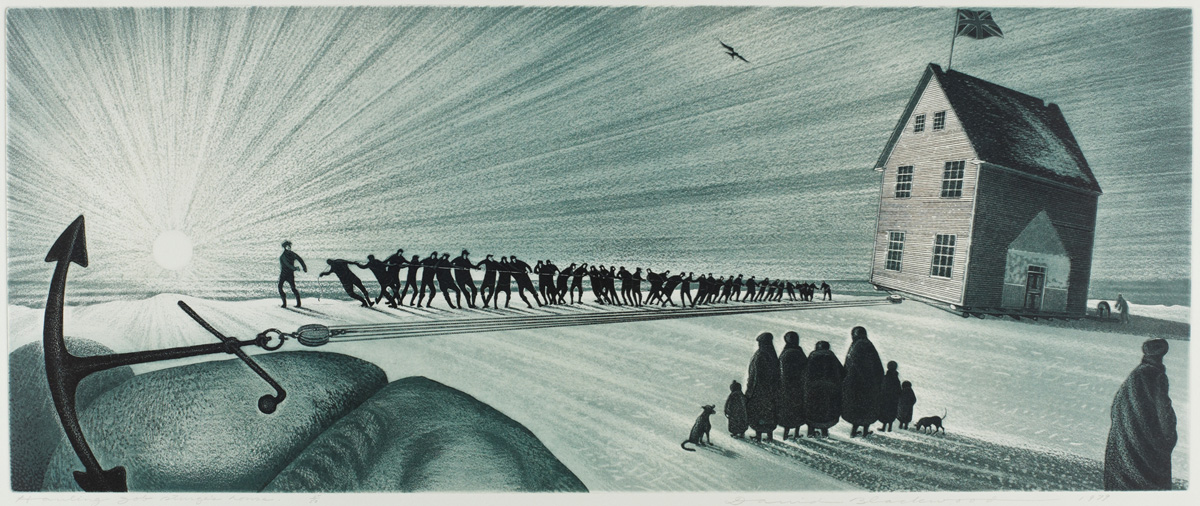
With all the heat lately, I’ve been seeking at least an imagined respite by looking at the work of Canadian printmaker David Blackwood, whose work I highlighted here a couple of years back.  Set in the Canadian North Atlantic provinces of Labrador and Newfoundland,  Blackwood weaves a black and white (sometimes with a bit of color) tapestry that is filled with the myth and mysticism of people who somehow survive in a cold and harsh landscape.  If you know of the book or movie  The Shipping News from Annie Proulx, you’ll be somewhat familiar with some of the tales that shaped Blackwood’s world.

I am always engrossed by both the sheer beauty of his images as well as this world he seeks to both document and create.  The stories have their own narrative but there is a quality to them that seems beyond the local flavor of it, as though they are telling some primal tales that are part of our collective memory, pieces of a whole that we don’t even realize we are part of or that even exists.  Maybe the stark desolation of this world makes this struggle for survival seem more evident, more contrasting.  Whatever the case, I find them beautiful to see and stimulating to the mind.  And they never look like 100 degrees in the shade.

Read Full Post »

I ahve a feeling that most Americans don’t know much about the English artist Stanley Spencer, who lived from 1891 until 1959.  I have to admit that I knew very little until stumbling across a book of his unique paintings.  However, our ignorance doesn’t detract from the man’s greatness or his fame as one of the greatest British painters.  Some maintain that he is their greatest Modern painter.

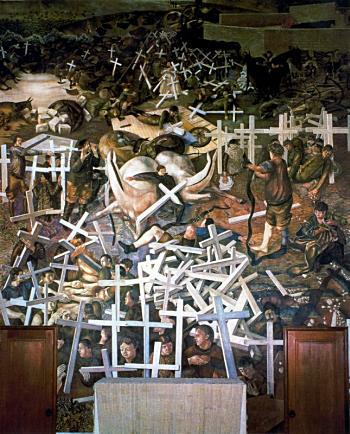
His work is unique and always interesting, with densely colored and arranged scenes that sometimes seem overwhelming to take in at one viewing.  The piece shown here at the top, The Resurrection of the Soldiers, is one such painting.  It depicts the World War I soldiers that Spencer saw as a medic and soldier undergoing a rebirth on the battlefield.  It serves as the altarpiece( you can see the altar and podiums in the foreground of this photo) in a chapel, the Sandham Memorial Chapel,  that was designed to specifically hold his war paintings.  Iam totally pulled in by the the intricacy and contrasting tones of the composition, taking in at as a whole without even being able to discern what the subject might be.  Moving in closer, it becomes even more compelling.

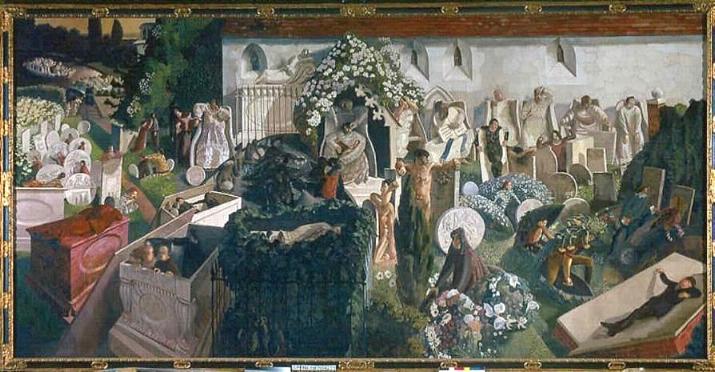
The idea of resurrection and other biblicaland Christian themes were sometimes the subject of Spencer’s paintings, in which he would transform the subjects of biblical stories into characters residing in his beloved Cookham, a small village in Berkshire. One example is his depiction of St. Francis, shown here to the left. Perhaps his best known work and one that  many consider one of the greatest British paintings ever is his painting of the resurrection of Cookham, shown at the bottom of this page. 

 I realize that the size of these photos doesn’t do justice to these paintings.  I had put off showing his work on the blog for this reason  but hopefully it will serve as an entrypoint to those who might want to investigate further his paintings or his interesting life which served as the basis for the play Stanley, a Tony nominee in 1997.  But even without the biographical material I’m sure you’ll find something in his work that stops you in some way.  I know it always stops me in my tracks.

Read Full Post »

Well, the opening is over and the show continues to hang at the West End Gallery.  Good opening.  Talked to a lot of really nice people, many new to me.  Many thanks to everyone who came out.   You made the evening complete and  I could not be more grateful.

That said, I was sure glad when the night was over.  There comes a point near the end of an opening, especially in the aftermath of constantly promoting it by writing about it here,  where I am really tired of talking about me and can’t wait for that moment until I don’t have to say anything to anyone. 

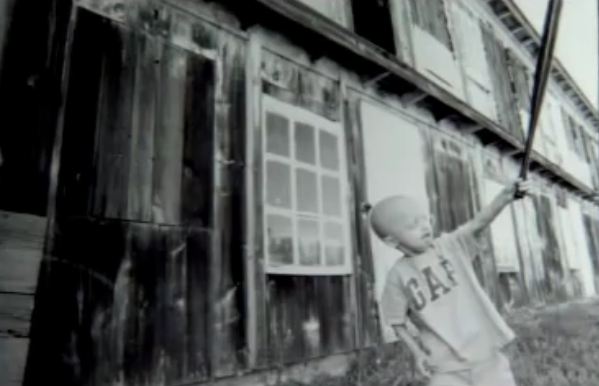
So later that night, we came home and decided to quietly watch that night’s Jeopardy,  a show I have watched intently since I was a child when Art Fleming was the host in the 60’s. Before it came on, I caught the end of the ABC Evening News and there was a story about their Person of the Week.  It was a young boy, Josiah Viera, from central Pennyslvania who suffers from Progeria, an exremely rare (something like only 54 cases in the world) disorder where the child begins prematurely aging, most having life expectancies of between 8 and 13 years.  Josiah, now 7 years old, has the tiny body of a 70 year old.  He is 27 inches tall and weighs 15 pounds.

But Josiah doesn’t dwell on the hardships of his condition.  Instead he concentrates on his passion, that thing that brings him sheer joy: baseball.  He lives for the game, wanting to play it from the minute he wakes until the end of each day.  He approached a coach at the local t-ball league in Hegins, PA and told him that he wanted to play in the games.  They feared he might not survive more than a single game and indeed, after his first game, Josiah suffered a series of mini strokes and was hospitalized.  But he recovered quickly and his desire for the game was so strong that he was back after three weeks.  The news of this little boy and the joy with which he played the game captured the hearts of the local folks and by the last game there were several hundred fans ( not your usual t-ball crowd!) all cheering him on and chanting his name.  And as he stands on the bag at first base, which seems like a table under his small body, Josiah smile glows with the sheer and absolute joy of being safe.

Absolute joy.  How many of us allow ourselves to feel that?  Josiah’s time here is limited, as it is for all of us.  Yet his life is not sadder for that knowledge.  Instead he has somehow chosen to find joy in those few days, rejoicing in the moment instead of fearing the future or focusing on the  life that might have been under different circumstances, things which too many of us allow to take over our lives.

Life is now.  His pure joy is a lesson for us all.  Life’s too short to not revel in those things that make us happy. 

What is your joy and if it’s not the biggest part of your life, why is that so? 

Here’s the longer version of the story from ESPN on which the ABC story is based.  It’s a beautifully done report.  Have a great Sunday and again, thank you for everyone who came out Friday night– you brought me a little of that joy that I speak of.

Read Full Post »

I look at the work of a lot of artists and usually see something I can relate to in much of it.  It might be the way a color sings or the way the painting is put together or in the expressiveness of a line.  Or just in simple emotion.  But very seldom do I stumble upon the work of an artist who I immediately feel as though I am sharing the same perspective.

Such is the case with Oscar Bluemner.

I came across his work a few years back.  I saw an ad for a piece of his in an art mag and was captivated.  There was something very familiar to me in it which made me want to know more.  But I could find little about Bluemner.  This was strange because he was in the right circles where one would think he would get some attention even if only by association.  The German-born painter, who was born in 1867 and moved to the US in 1893, was part of the Modernist painters group of the early 20th century represented by Alfred Stieglitz , famed photographer/gallerist and husband of Georgia O’Keefe.   His work hung in solo shows at Stieglitz’s famed NYC gallery and in the fabled Armory show of 1913.  You would think there would be no shortage of material on him or that his name would raise the image of some piece of his work.

But Oscar Bluemner had a knack for failing.  He was trained as an architect and designed the Bronx Borough Courthouse.  However, he was not paid for his services and the seven year court battle that ensued drove him away from  architecture and into the world of art,  where his paintings never garnered the attention or lasting reputation of his contemporaries.  He sold little and lived in abject poverty, which is said to have attributed to his wife’s early death and ultimately to his suicide in 1938.

But there is something in his work that I immediately identify with when I see it.  It’s as though I am seeing his subjects in exactly the same way as he did and would be making the same decision he made when he was paainting them.  His trees feel like my trees is the way they expressively curve and his colors are bold and bright.  His building are often windowless with a feeling of anonymity.  His suns and moons are solid presences in the sky, the focal points of many of his pieces.   In this piece to the right, Death,  he uses the alternating abnds of color to denote rows in the field as I often do and has his twisted tree rising from a small knoll in the forefront of the picture. 

I find myself saying to myself that I could very easily have painted these same pictures.  It’s odd because it’s not a feeling that I’ve experienced before even with the artists whose work I think has most influenced me and with which I feel a real connection.  And it feels even odder because I didn’t become aware of Bluemner’s work until long after I had established my own vocabulary of imagery. 

There are finally a few things out there online about Oscar Bluemener.  You can see more of his images now than you could even a few years back.  The Whitney in NYC had a retrospective of his work in 2005 (here’s a review) and that seemed to raise awareness of his work.  So maybe a few more people, a new generation, will finally see what I see in Bluemer’s work.

Read Full Post »

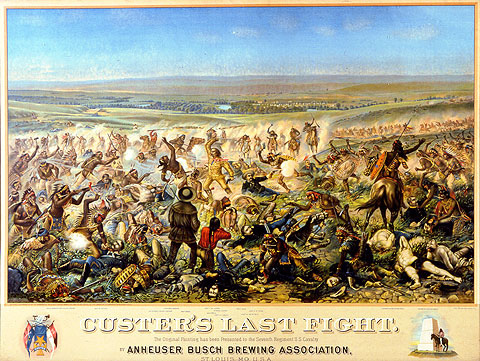
It was 135 years ago on this date, June 25, 1876, that the famous Battle of the Little Big Horn took place on the plains of eastern Montana, a battle in which the forces of General George Armstrong Custer’s 7th Calvary were overwhelmed by Native American fighters who had formed a large alliance from several tribes to battle the US troops.  268 troops were killed including Custer and several of his kinsman.  Through the years it has come to be known as Custer’s Last Stand and it’s historical perspective, along with the view of Custer himself,  has always been changing and controversial. 

In the years following the battle, there was a great psuh to portray Custer as a glorious hero.  His wife wrote a glowing book and extensively toured for years, speaking to civic organizations.  I came across a newsclipping from a newspaper in the Adirondacks from the 1890’s, nearly 20 years after the battle,  that spoke of such an engagement. 

His legend was also enhanced by a bit of advertising art from Anheuser Busch who issued a print heroically depicting the battle  in a way that most historians agree is extemely erroneous.  The print hung in saloons all through the states for decades and just added to the mythic quality of the man and the battle.  

Hollywood weighed in as well.  The portrayal of Custer by Errol Flynn in They Died With Their Boots On was one of a noble hero with hardly a flaw.  A bit too perfect.  Years later, the view of our historic treatment of Native Americans was under scrutiny and the view of Custer had changed.  Iin Little Big Man, Richard Mulligan as Custer (shown above) was the absolute antithesis of Flynn’s Custer.  His Custer was a comic caricature that took all of of the man’s known quirks to the extreme, showing him as fool.  Equally as inaccurate as Flynn’s shining hero.  The real man is no doubt somewhere in the middle, neither hero nor fool. 

There is a lot that could be said about Custer, the Battle of the Little Big Horn, our shameful treatment of the native Americans and how we view all of it at any given moment.  There is a ton of available information out there, too much to go into on this quiet Saturday morning.  So for now, I’m going to try to think how it must have been on this date, 135 years ago.   


Read Full Post »

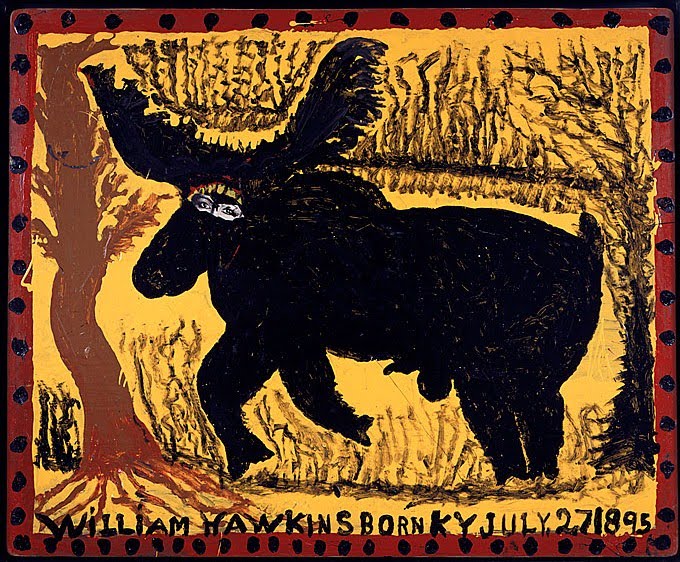
I really like self taught artists. I identify with these people who are usually living lives far removed from the world of art but who feel a compulsion to express something within them and create.  There’s something very pure in this work that transcends the lack of sophisticated technique and extensive artistic education.  In fact, it’s this very absence of these things that gives the work its purity.  It is a raw and often powerful synthesis of what these artists observe– something that can’t be taught.

One such powerful artist was William Hawkins who was born in Kentucky in 1895 amd died in 1990, in the Columbus,  Ohio area where he lived most of his life.  Most of his paintings are recognizable by his name and birthdate and birthplace emblazoned across the bottom.  But more than that,  his works were noted because they were diverse and always interesting, with their bold strokes and strong imagery.  The more pieces of his I see, the more I really see his strength as a painter and as observer of his and the greater world.

The Foundation for Self-Taught American Artists, one of my favorite sites and one that I’ve mentioned here  before, has produced a short film, which can be seen at the bottom of this post, that shows Hawkins at work in the late 1980’s.  It gives an interesting insight to the works and his process.  You can find more about Hawkins at their site and at a number of other sites.  Take some time and look at the images.  Find the rhythm in the slashing stokes and get to what Hawkins was seeing as he painted.  You’ll begin to appreciate that purity of which I spoke.

Read Full Post »

Everyone has his own specific vocation or mission in life; everyone must carry out a concrete assignment that demands fulfillment. Therein he cannot be replaced, nor can his life be repeated, thus, everyone’s task is unique as his specific opportunity.

——Viktor Frankl

**********************

The words of Viktor Frankl, the WW II concentration camp survivor who went on to greater fame as a psychotherapist and author, seemed to ring true for this square painting after I finished it.  I saw the Red Tree here as one that finally saw its uniqueness in the world, sensing in the moment that with this individuality there came a mission that must be carried out.

A reason for being.

I think that’s something we have all desired in our lives.  I know it was something I have longed for throughout my life and often found lacking at earlier stages.  I remember reading Frankl’s book, Man’s Search For Meaning, at a point when I felt adrift in the world.  I read how the inmates of the concentration camp who survived often had  a reason that they consciously grasped in order to continue their struggle to live.  It could be something as simple as seeing the ones they loved again or finishing a task they had set for themself. Anything to give them a sense of future.  Those who lost their faith in a future lost their will to live and usually perished.

 At the time when I read this, I understood the words but didn’t fully comprehend the concept.  I felt little meaning in my life and didn’t see one near at hand.  It wasn’t until years later when I finally found what I do now that I began to understand Frankl’s words.

We are all unique beings.  We all have unique missions.  The trick is in recognizing our individuality and trusting that it will carry us forward into a future.

I’ve kept this short.  There are many things that I could say here but the idea of finding one’s mission, ones meaning, is the thought that I see in this piece.  This paintings is titled The Moment’s Mission and is 11″ by 11″ on paper.  It is part of the Principle Gallery show that opens Friday.

Read Full Post »

A newer painting, this one an image of about 18″ by 26″ on paper.  The composition is intentionally simple in that  this piece is obviously very much centered on its color and texture.  The stringlike twirls of its texture create a real feel of motion and energy underneath the image, the hint of the hidden forces of nature  that exist just beyond our ability to recognize or comprehend them.  I don’t know if I would call these  purely physical forces or if they somehow become a spiritual force as well.  For this painting, let’s assume that they are both.

I see the Red Tree here as being enmeshed in both the visible world and in the world of these hidden forces.  While trying to find a way of describing this energy, these hidden forces of life, I came across the writings of Sri Aurobindo, anIndian philosopher/yogi who was very influential in the the first part of the last century.  Some of his writings describe the spiritual evolution of man into what he called the Supramental Being.  Here is how it is described in Wikipedia:

Sri Aurobindo’s vision of the future includes the appearance of what may be called a new species, the supramental being, a divine being which would be as different and superior to present humanity as humanity is to the animal. It would have a consciousness different in kind than the mind of the human, a different status and quality and functioning. Even the physical form of this being would be different, more luminous and flexible and adaptable, entirely conscious and harmonious. Between this supramental being and humanity, there would be transitional beings, who would be human in birth and form, but whose consciousness would approach that of the supramental being. These transitional beings would appear prior to that of the full supramental being, and would constitute an intermediate stage in the Earth’s evolution, through which the soul would pass in its growth towards its divine manifestation as the supramental being in the earth nature.

It is an interesting concept and one that I feel fits the imagery of this painting.  However,  I did think about how the concept was similar in nature to Nietzsche’s Superman  or Ubermensch  and the use of that idea by the Nazis,  how it could easily be diverted from its original meaning and twisted to rationalize behaviors far from the true nature of the concept.  It’s unfortunate that many ideas that are concerned  with the betterment of all people are often perversely used to divide and destroy people.  Here, I am thinking of this concept in the purest sense, of the elevation of the individual to a higher state of being, aware of and in harmony with all the forces of this world.

Or it’s just a tree blown by the wind…

Read Full Post »

« Newer Posts - Older Posts »