Feeds:
Posts
Comments

Archive for the ‘Influences’ Category

Helen Frankenthaler- Savage Breeze


There are no rules. That is how art is born, how breakthroughs happen. Go against the rules or ignore the rules. That is what invention is about.

–Helen Frankenthaler

************************

I’m using this quote from Helen Frankenthaler, the famed Abstract Expressionist, as a sort of follow-up or addenda to yesterday’s post about change.  I remember reading about Frankenthaler when I was first beginning to really paint with purpose.  In an article that I read but can’t locate now, she spoke of how she came to her trademark stain paintings where very thinned oil paint is applied to unprimed canvas.  She said it was almost by accident that she first experienced the absorbing of the paint by the raw cotton canvas and how that it caused a reaction, a breakthrough, in her thinking about how she wanted to express herself within her work. 

She felt that all artistic breakthroughs were the result of a change in the way one saw and used their materials.  It could entail changing the type of material used or using them in a more unconventional manner, as her above quote stating there are no rules infers.

This immediately clicked with me at the time I read it.  I had been trying to shape my way of thinking to fit the materials I was using at the time.  Unsuccessfully.  What I needed to do was change the materials to fit the way I was thinking.  Allow my thought process more free rein and not cater to the restraints of materials.

That may sound kind of abstract but it allowed me to start working with my paints and grounds in a much different way, forming my own process that worked well for my way of thinking and has become entrenched in my thought process.  Even though it may be outside more traditional forms of using these same materials,this process has over time become as rigid in my use as the techniques used by the most steadfast adherent of the most traditional school of painting.  This is sort of what I was referring to when I mentioned the end of the cycle, as far as art is concerned.  You reach a certain point, a mastery of your materials, where there are few accidents, few surprises in the materials’ reactions and, as a result, fewer surprises in your own reactions. 

For most, this is the goal.  But I want that surprise, that not knowing exactly how the materials will react and that need to solve the problem presented by the need to express with the limitations of the materials used.  So I try to continually tweak, create a little tension in how the materials react to my use of them, to create a sense of surprise.  Breakthrough.

And that’s where I feel I am at the end of the cycle mentioned in yesterday’s post.

Read Full Post »

I’m not going to go all sentimental about my dad on this Father’s Day.  It’s not either of our styles.

But I did want to show this picture of him from back in 1963 or 1964.  That’s my brother, Charlie ( Chuckie back then), in the background.  When I think of images of my father this one is always first in line in my head.  It was a Sunday morning ( my memory says it was an Easter but I can’t be sure) and we were living in an old farmhouse on Wilawanna Road, outside Elmira, that played a very large part in my formative years.  We had a large chunk of yard to one side of the house that became a ballfield, a place where many of the kids on our road came to play baseball regularly and where Dad would often pitch to us or hit soaring fungoes that we would run under, pretending to be Willie Mays or Mickey Mantle.  Dad is standing near home plate in this photo.

I love this photo.  It show my father at about 30 or so years of age, as strong and powerful as I would ever know him.  I was four or five years old and he was larger than life to me then, could do no wrong.  My protector and my boon companion.  This view of him sums that all up.

  The pose has a bit of the pride and arrogance of youth in it, still brimming with the what-if’s and what-can-be’s of potential.  It’s not something you’re used to seeing in your parents and witnessing it is like seeing a secret glimpse of them, a side you know must have been there but remains hidden from you in your day to day life with your parents.  Maybe that’s why I like this picture so much.  It seems like a marking point between his youth and ours, his kids. 

I don’t know.  Like many personal things, it’s hard to explain.  All I know is that when I see my Dad today or think about him, the image of this photo is never far from my mind.

happy father’s day….

Read Full Post »

Diego Rivera's Mural at the City College of San Francisco

There are pieces, paintings, out there that I would love to see in person and then there are some I would rather see from a distance, if only to avoid feeling utterly humbled in my own small talent by their beauty and grandeur.  The great Mexican muralist and painter Diego Rivera created such a work.

It is his Pan American Unity mural that resides at the Diego Rivera Theatre at the City College of San Francisco.  Painted in 1939/40, it is a massive true fresco that measures about 22 feet tall by 73 feet long.  Because of time overruns in the painting of such an epic piece, much of  it was painted as a public display during the Pacific Exposition of 1940.  Actually, after its completion it was packed away for over twenty years, unseen, as World War II intervened then the Cold War.  There was some controversy in the 1950’s over Rivera’s dalliance through the earlier parts of the century with the Communist Party in Mexico and and at that point, anything red was dead in the eyes of those in authority.  So, a masterpiece sat and sat like a dormant volcano, waiting to burst into open air once more.  It finally did in 1961, four years after Rivera’s death.  There is a piece of silent color film from the exposition that shows Rivera at work as well as his assistants at various tasks.  You can see it by clicking here.

I have seen other Rivera works and never fail to feel humbled by his great talent as well as his larger than life persona.  The Pan American Unity mural seems to sum up Rivera in one giant sweep, a piece so dense with imagery that one could spend months examining it and still find new details of beauty and color.  It is bold and big, like the man.  Epic.

My ego hopes I never see it…

Read Full Post »

We who lived in concentration camps can remember the men who walked throughout the huts comforting others, giving away their last piece of bread. They may have been few in number, but they offer sufficient proof that everything can be taken away from a man but one thing: the last of the human freedoms — to choose one’s attitude in any given set of circumstances, to choose one’s own way.

———-Viktor Frankl

************

I don’t know why this came to mind today but it did.  Viktor Frankl was an Auschwitz survivor who, after the war, created logotherapy, one of the important schools of psychotherapy alongside those of Freud, Adler and Jung.  It was a therapy based on finding meaning in one’s life, a reason to struggle onward.  In his best known book, Man’s Search For Meaning, he recounts his time in the concentration camp and how he and others who survived  seemed to have something in common– the discovery of a purpose and meaning in living.  It might be love. It might  be the will and drive to create.  Just something to set on their horizon to pull them ahead despite the horror around them.

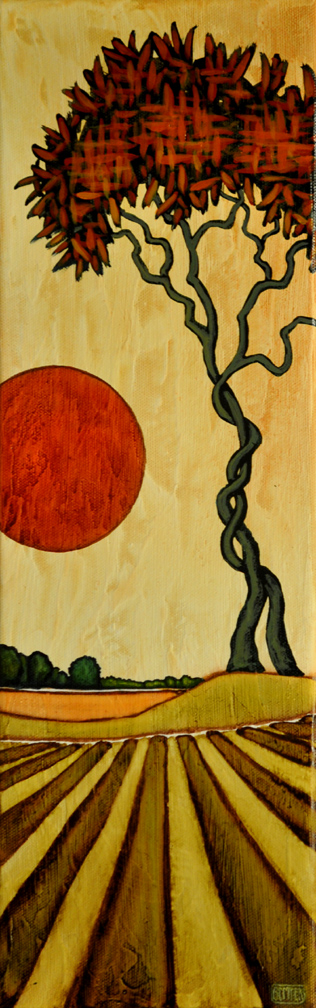
Maybe it was this painting, Lifeblood,  that brought back Frankl for me.  I had come across his work a number of years ago and and his words and example have helped me through some desperate, foundering times of my own.  There is a certain power in knowing that we all are fated to suffering of some sort, just by the sheer nature of existence.  There will be pain, there will be death.  No one is exempt from the distresses of  life.  But these can be endured through the knowledge that we have the choice in how we react to such events, how we perceive the deprivations of our lives.  We can choose to wallow, to give in,  or we can forge ahead.

Maybe that’s how I see this painting, as a path through the pains of living, symbolized by the blood red of the ground.  All the leaves, everything it had,  have been stripped from the tree yet it still stands.  It reaches for the light above, seeks a meaning for its suffering. 

I didn’t see it that way when I first painted this.  It was simply color and form.  Simplicity and harmony.  But sometimes there’s an associative power to a piece that gnaws at you, begs you to look deeper and find what it’s trying to say.  And maybe the ideas of Viktor Frankl hide in this piece for me…

Read Full Post »

Setting Time Aside

As the days wind down before I head to Alexandria for Friday’s opening, I’m still pretty busy in the studio.  I’m in the midst of completing several pieces for another show later in the year as well as working on several projects unrelated to shows, including minor repairs on an older painting of mine that was damaged in a fall at its owner’s home.  Another is a request for a painting from a couple marking their 10th anniversary.

I often get requests for commissioned work but usually am not excited by the prospect of being dictated to in the creation of  my work, actually turning down many that get too specific in their requirements.  I want my paintings to reflect my thought process and emotion as well as my craft.  As a result, I have an informal set of rules that let me have free rein in the creation of the work so that the painting is allowed to form in an organic way.  Not forced, which often takes away the vitality of many pieces, in my opinion.

But this particular request is unlike many others that I receive.  They want this piece to relate the story of the classic myth of Baucis and Philemon, which is the tale of a poor but happy couple who are unknowingly visited by Zeus and Hermes disguised as dusty travelers.  Beggars, really.  The two gods had went door to door among their neighbors seeking hospitality and were rebuffed in every attempt, often with harsh words.  Zeus became angry as door after door was slammed in his face.  Finally, they came to the door of  the shack of Baucis and Philemon, the poorest looking home they had yet approached. 

 Upon knocking, they were greeted warmly by an elderly couple  who welcomed them in to their simple but cleanhome and treated them with what little they had in the way of food and drink.  They were gracious and hospitable, seeking to give comfort to the strangers.  As the night wore on, the couple, who had been serving their simple wine to the travelers from a pitcher, noticed that the pitcher stayed full even after many pours.  They began to suspect that these were not mere beggars but were, in fact, gods.

They apologized to the gods for not having much to put before them then offered to catch their prized goose, which was really a pet, and cook it for them.  The old couple chased the goose around the shack until finally the frightened creature found sanctuary on the laps of the gods.  Stroking the now safe goose, Zeus then informed them of their identities and, after complimenting on their hospitality and of the mean-spiritedness of their neighbors,  told them to follow them.  They climbed upon a rise and Zeus told them to look back.  Where once their town had stood was nothing but water,  from a deluge that had washed away everything, including all who had insulted Zeus.  From where their poor home had been, a majestic golden-roofed  temple with sparkling marble pillars rose from the receding waters.

Zeus told the couple that this was their new home and asked what wish he could grant them.  They asked that they be made priests, guardians of this temple and that they should always remain together until the ends of their lives.  Seeing their obvious love for each other, Zeus readily agreed.  The couple lived for many more years together, reaching a prodigious age.  One day they stood together and all the past moments from their life and love together flooded over them.  Baucis saw leaves and limbs sprouting from Philemon and realized that the same thing was happening to her. On the plain outside the temple, they transformed into two trees, an oak and a linden, that grew from the same trunk, their limbs intertwined, eternally together.

That’s a simple re-telling of the tale but I think you can see why this couple might want a symbol of this story to mark their time together…

Read Full Post »

Peers- GC Myers 2003

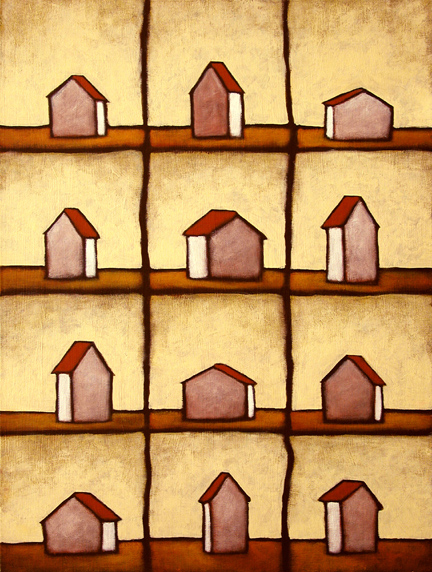
I’m in the last days of painting before I start final preparations such as framing and such for my upcoming show.  I’m currently putting the final touches on a piece that is a multiple similar in form to the one shown here, Peers from back in 2003.   The piece I’m working on consists of 3 rows of 3 red trees on a 30″ by 30″ canvas.  I’ve used multiple images a number of times over the years, although I often go years between.  There is something almost musical, almost choral, in the repetition of form.

I only mention this today because when I came into the studio I put on an album (CD actually but I still call them albums) of work from Arvo Part.  One of the first pieces to play was Cantus in Memoriam of Benjamin Britten.  It was a mesmerizing tonal piece and as it played, I looked at the title and realized I didn’t know what was meant by the cantus in the title.

Looking it up brought me to the term cantus firmus which is described as a sort of polyphonic composition, meaning it is comprised of multiple interwoven and, often, the same melodies.  A Gregorian chant is an example of one type of polyphony.  The voices, or melodies, are repeated,  one over the other, some at different tones and varying lengths.  I don’t know much about music but as I read I began to equate this meshing of voices and melodies in a cantus firmus with what I was trying to achieve with the multiple images in the painting I was working on.  Each image is basically the same but because of the way they are positioned and come together as a whole, they become more than the product of their parts.

At least, that’s my take on it. 

Anyway, I found a name for the piece I am finishing.  Cantus Firmus.

Here’s the composition from Arvo Part:

+

Read Full Post »

I’m not sure if Strange Affair is going to be the title of this piece.  I’ve had this painting, an 8″ by 18″  image on paper, done for several weeks now and I’ve been waiting for a title to come.  Something that speaks of it’s starkness of detail and stillness.

Then I heard a version of a Richard Thompson song, Strange Affair, sung by June Tabor accompanied by Martin Simpson on the guitar, and this piece came to mind.  It was as though the character in the painting might very well be playing this very song.  Really evocative.

You be the judge…

Read Full Post »

I Am Not Alone

The night, it is deserted
from the mountains to the sea.
But I, the one who rocks you,
I am not alone!

The sky, it is deserted
for the moon falls to the sea.
But I, the one who holds you,
I am not alone !

The world, it is deserted.
All flesh is sad you see.
But I, the one who hugs you,
I am not alone!

     –Gabriela Mistral

========================================

Another newer piece.  This smaller painting, a little over 5″ by 10″ on paper, is painted in the style of my earlier work.  More subtle. More restrained.  Simpler compositions and more space creating a greater coolness and airiness. 

To me, the feeling of solitude.

I came across this poem by the great Chilean poetess and Nobel Prize winner, Gabriela Mistral,  and felt it fit this piece, and many others of mine, very well.  The sense of being alone yet not lonely is an important element in the way I look at my work and one that I sometimes struggle with for fear that it may alienate some who see being alone as only loneliness and not solitude. An important distinction and one that is often misunderstood. 

But we who relish our solitary time understand.

Read Full Post »

Arthur Wesley DowI’ve been going back and forth over the last several weeks, painting in two different methods as I prepare for my two summer shows.  One is additive, where I am building up layers of paint, and the other deductive, where I am actually taking paint from the surface.  I am equally at home in either style but I have focused for the last few weeks on the deductive style, a reversion to the way I first painted.  In doing so, I have been reminded of the work of Arthur Wesley Dow, the American artist and educator from the early part of the 20th century.  Dow was a huge influence Arts & Craft aesthetic movement and his teachings combined Eastern and Western principles of art that have influenced generations of artists. 

I had never really heard of Dow until years after I had started painting and had already developed my style.  But seeing his work, his paintings and, in particular, his woodblock prints, struck a chord of familiarity with me.  I immediately sought out his classic text, Composition.  In it, he laid out the principles of simplifying form and arranging the pictural elements in a harmonious fashion.  He taught the Eastern concept of Notan, meaning dark light, which stresses the relationships between the two in composing a picture.

I was already doing many of the things he laid out in his treatise, having come to them by trial and error.  But it was thrilling to see the concepts that were central to my own work laid out in black and white.  His own compositions were spare yet not empty of feeling.  The way the simple forms played off one another  and the interplay of dark and light created feeling and mood.

Seeing them again recently, made me want to simplify my work again, to work in my earlier style to create emotion with pared down elements and paying more attention to subtlety of color and line.  And that is where I stand at the moment.  Thanks, Mr. Dow…

Anyone interested in browsing Dow’s classic Composition can read or download it free from Google books by following this link.

Read Full Post »

I often get comments from people asking about the Eastern, particularly Japanese, influence in my work.  While it has never been intentional, I have always been drawn to the prints of the Japanese masters Hiroshige and Hokusai and their influence inevitably finds its way into my own work.

I find the rhythm and structure of Hokusai’s wave prints very appealing.  There is a great combination of quietude and motion in the prints, brought to great effect with the use of gorgeous colors and impeccable design.

Along with this dichotomy of quiet and movement, there is a omnipresent sense of the immense force of nature over man.  Hokusai often has Mt. Fuji in the distance behind the curls of his powerful waves, reinforcing the power and sanctity of nature.  The finger-like  quality of the edges of the breaking waves seem like the hand of mother nature reaching out to slap at the reaching hands of her children, the boatmen.  Again, reinforcing the dominance of nature over man.

There is a lot more I could say about Hokusai’s work but so much of my appreciation for it is almost indefinable.  The work allows me to enter and translate it easily and thrill in the beauty of the lines and hues of the picture plane without determining why I am drawn to it.  This unquantifiable ease of translation may be the element of Hokusai’s work that I desire to see in my own work.

Great stuff…

Read Full Post »

« Newer Posts - Older Posts »