Feeds:
Posts
Comments

Archive for the ‘Influences’ Category

The Challenge Ahead


      From the very beginning almost I was deeply aware that there is no goal.  I never hope to embrace the whole, but merely to give in each separate fragment, each work, the feeling of the whole as I go on, because  I am digging deeper  and deeper into life, digging deeper and deeper into past and future.  With the endless burrowing a certitude develops which is greater than faith or belief.  I become more and more indifferent to my fate, as a writer, and more and more certain of my destiny as man.

      – Henry Miller, Reflections on Writing


This is a fragment from a book of essays, The Wisdom of the Heart, by Henry Miller, the great and controversial author.  When I was young his books such as Tropic of Cancer and Tropic of Capricorn were still being characterized as “smut” and many libraries didn’t have them on their shelves for fear the moral police would swoop in and raise a fuss.  Probably many only know the existence and influence of his books from their use in a memorable Seinfeld episode, the one with Bookman the library cop whose hard-boiled dialogue still makes me hoot.  

For me, I wasn’t so much attracted to his books by the raciness of the stories but rather by his way of speaking through his words and expressing views that I found at once to be compatible with my own.  He observed and said the things that I  wished I could say with a voice and power I wished I possessed.  I can pick up one of his books and open to a page anywhere in the book and read and be fascinated without knowing the context of what I’m reading, just from the sheer strength of his writing’s voice.

I see a lot of things in this particular essay that translate as well for painting or any other form of creation.  It opens:

Writing, like life itself, is a voyage of discovery. The adventure is a metaphysical one: it is a way of approaching life indirectly, of acquiring a total rather than a partial view of the universe. The writer lives between the upper and lower worlds: he takes the path in order to eventually become that path himself.

Substituting artist for writer, I was immediately pulled in.  The path he refers to is the path I often refer to in my paintings, the path we all walk and struggle along on, trying to find the middle way between these upper and lower worlds.  

It’s a good essay and one I recommend for anyone who creates in any form and struggles with the meaning of their work beyond its surface.  For anyone seeking that path…

_________________________________________________________


Name This Painting!Contest Reminder!

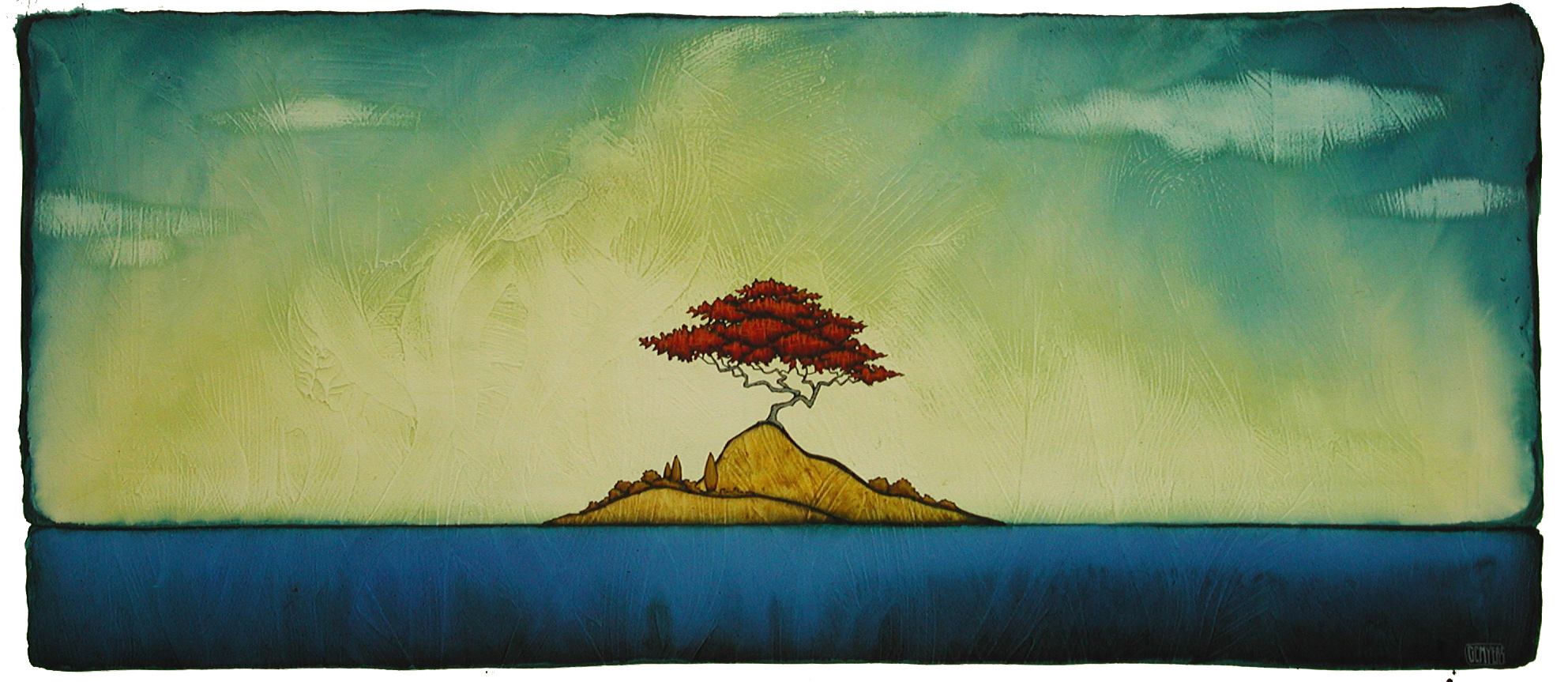
I’m asking for your help in naming this painting and am offering a prize (it’s better than you think though it doesn’t involve air travel or posh resorts) for the title that I deem fitting for the piece.

So put on your thinking caps and let me know your title for this painting.  Even if it’s not chosen as the final name, your title will be included on the painting’s reverse side for all of eternity.  Well, for an extended period of time.  I’m just not so sure about eternity.

So, submit your title by simply commenting or email me at  info@gcmyers.com

I look forward to your titles.

Read Full Post »

Drought Stricken Area 1934I wrote several weeks back about coming across artists whose work is so striking but whose names never become well known, at least on a national or international level.  I originally wrote about Paul Sample, an American Regionalist of the early part of the 20th century and my admiration for his work.

The Crucified LandRecently, I came across a name in Western Perspectives, the blog from Lovett’s Gallery in Tulsa, Oklahoma.  They mentioned a show appearing the Alexandre Hogue Gallery at the University of Tulsa.  I didn’t know the name so I quickly googled it and was surprised and delighted at the results.

Alexandre Hogue was another American Regionalist painter from the 1930’s who eventually ended up as the head of the art department at the U. of Tulsa.  He died in 1994.

Dust BowlLike Sample, I immediately connected with Hogue’s color palette and use of deep, saturated tones.  His landscapes of Dust Bowl-era middle America had a sense of message that was strong and served up in images that were powerful while still being attractive.  I have never seen Hogue’s work in person so I can’t talk about his surfaces or the painterly quality of the work but his work is, as I said, very striking in print and online.  There’s something gratifying about finding the work of a Hogue or a Sample, painters who will never be the flavor of the month but have distinct and powerful voices in their painting.

Good stuff…

Mother Earth Laid Bare

Read Full Post »

NC Wyeth The GiantIn an earlier post I talked about the great American painter Andrew Wyeth on the day after he died.  His father was NC Wyeth who was the preeminent illustrator of the early 20th century, illustrating some of the great books of the time.

Throughout his life, he wanted to be known not as an illustrator but as an easel painter, a fine artist.  There seemed to be this fine distinction that because an illustrator brought the scenes and ideas of others’ stories to life that they were somehow below the work of those who painted solely their own ideas.  I never understood that concept because it was still Wyeth who composed the paintings and created the colors and brushstrokes that distinguished the work.  Wasn’t this very much the same as many Renaissance artists who painted many of their great works for the Church?  Are they not considered fine artists?

NC Wyeth- Rip Van WinkleI’ve always been attracted to the work of NC Wyeth having seen it innumerable times in print.  There was a real dynamic quality, punch, in his paintings.  However, it wasn’t until I saw his work in person that I truly appreciated how beautiful his work truly was.

He treated many of his illustrations as fine paintings, with glorious paint appplication that created beautiful surfaces within the painting.  His colors were complex, hardly ever a pure single color.  His blues often had glazes of red, his whites tinged with yellows.  All of his colors had an  earthy base that gave them a dark edge and weight. His compositions were bold and inventive, highly contrasting and dramatic to best illustrate many of the adventure stories on which he worked.  In person, many of these paintings are even more stunning than on the printed page.

NC Wyeth Last of the MohicansHis non-illustrative work was much more mundane, less dramatic but well executed.  His real spark seemed to be from the stories he was bringing to life.  The Arthurian legends, the Leatherstocking tales of Cooper, the pirates of Robert Louis Stevenson–  all seemed fresh and new in his paintings.  Unlike many artists, I think being freed from having to create a narrative of his own actually gave him the opportunity to fully exploit all the knowledge of technique and composition he held.  As though having the decision of what to paint taken from his hands allowed that energy that would be expended to be used on making the painting stronger.  Whatever the case, whether you choose to call it fine art or illustration, the resulting work was memorable and deserves a nod.  It continues to inspire to this very day.

NC Wyeth Blind PewNC Wyeth

Read Full Post »

Soul of IndependenceIt’s Easter Sunday.  

While I wasn’t brought up with any religion in my life and don’t consider myself religious in any traditional, organized sense of the word, I am still respectful of the day and the gravity associated with it.

So on this holy day, I wanted to say something fitting in today’s post but it’s one of those situations where the will doesn’t match the task.  Maybe I’m tired.  Maybe I just don’t have a damn thing to say.

I don’t know.

Just don’t ask me questions…

I guess all I have to share today is the painting above, a personal favorite called Soul of Independence and a song that somewhat goes with it.  It’s Dont’ Ask Me Questions from Graham Parker about 30 years back.  It’s a song that has stuck in my head for all these years and whose chorus always has me thinking.  This is not a great video but please give a listen…

Read Full Post »

Babe RuthI recently picked up a book titled Baseball’s Golden Age: The Photographs of Charles Conlon.  It is, as it says, a book of photos of baseball players from the first part of the 20th century.  The photos are all black and white and give the players a grim, rough edge.  Not that they needed the help.

From the time I was a kid I was always interested in baseball from the turn of the century.  I read all sorts of books on my heroes and we had an old souvenir-like program from the 40’s that had many of these same photos with short stories and stats of many of these players.  I spent hours and hours looking at these faces and names until they took on a talisman-like quality in my mind.  Guys like Nap LaJoie, Rabbit Maranville, Wee Willie  Keeler, Cy Young and on and on.  In reality, many of these guys probably wouldn’t shine in today’s game but in my mind they were magic.Ty Cobb

Of course, there was a hierarchy.  Shown above, the Bambino, Babe Ruth, was the king.  An actual Sultan of Swat accompanied by his prince, the steady Iron Horse, Lou Gehrig.  Then there was the nasty tempered Ty Cobb, the Georgia Peach, shown here in one of the most famous of baseball photos of its time.  Renowned for sharpening his spikes and using them on waiting fielders as he stole numerous bases, Cobb was always bitter over Ruth’s dominance of the spotlight.

These players always really stuck out in my mind because of the images and stories I encountered as a kid.  They were brawny and raw looking.  They drank hard.  They fought.  They had a hardened mythic look in their gray wool uniforms.  They didn’t look like the players of my youth.  In the 70’s baseball started to be played in awful multi-purpose stadiums with hard artificial turf surfaces, vast cold edifices that sapped all of the organic quality from the game.  The uniforms were evolving as well.  The 70’s brought these stretchy polyester space suits that only added to the artificial feel of the stadiums.  I always think of Willie Stargell, a large first baseman for the Pirates with a big personality who would’ve fit in well with my old-timers) in this god-awful form-fitting spacesuit.  He looked ridiculous.

Walter Johnson The Big TrainIt was easy at that time to drift away from the game that had provided so much magic when I was young.  I stayed away for almost twenty years, barely checking the races or stats.  I have a huge hole in my knowledge of the game from the 80’s and early 90’s.  The return of smaller stadiums built to fit baseball saw a rebirth but it was the Yankees that brought me back.  I had grown up despising the Yanks ( the voice of their announcer Phil Rizzuto was like fingernails on a chalkboard to me) but this team in the 90’s was a throwback.  They had grit.  They fought. They made plays that became mythic.  They made me feel like I was 9 years old again, reading the wonderful hyperbole of the old sportswriters as they made mighty pronouncements about the exploits of the Bambino.  Baseball was magic again.

So leafing through this book rekindled many memories.  With that I leave you with a short piece of film that simply shows the great Big Train,  Walter Johnson, throwing. I saw a part of this on Ken Burns’ wonderful documentary series on the game and was mesmerized by his extraordinarily long arms and the whipping action his arms.  There is a kind of poetic beauty in the motion.

Maybe that’s the poetry of baseball that people talk of…

Read Full Post »

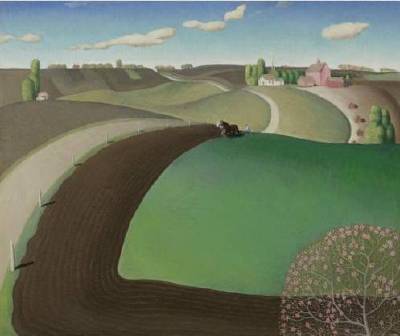
Near Sundown Grant WoodIn an earlier post I spoke briefly of my admiration of Grant Wood, primarily for the rhythm of his landscapes.  The piece shown to the right, Near Sundown, was a huge influence on my earliest landscapes for this rhythm.  The way the hills rolled and the treeline rode them fit perfectly with the way I saw things.Spring Plowing 1929

I failed to mention how much I loved his use of color, the way his shapes had a darkness that gave their color a richness that really appealed to my eye.  This color coupled with the way his landscapes moved in such a organic, human manner made me see that one could interpret the landscape in new ways.  He took what might be considered a mundane Iowa landscape and made it seem alive and moving.  It gave me hope and something to aspire for in my own landscapes.

American GothicMost people, of course, know Wood primarily for American Gothic, shown here.  It is perhaps the most recognizable American painting of the 20th century, widely referenced, and often parodied, in popular culture.  I really admire the way the piece is put together, the way the figures come together with the house to form a classic triangular composition.  I also like the color blocking with the darkness of the clothing making a base that holds up the lighter colors.

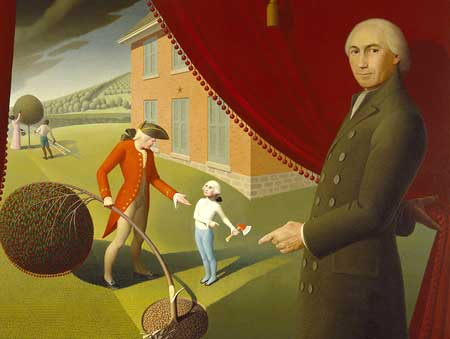
A lot of people see this as being a humorous piece, somewhat ironic.  I don’t know but given Wood’s use of humor in other pieces, this may be true.  A good example of his humor is Parson Weems’ Fable, below, which illustrates the famous tale of a youthful George Washington chopping down the cherry tree.  The Mini-Me Washington always makes me laugh.

For all of this, thanks, Mr. Wood…Parson Weems' Fable

Read Full Post »


Robert Smithson Spiral JettyProgress has not followed a straight ascending line, but a spiral
with rhythms of progress and retrogression, of evolution and dissolution.

– Johann Wolfgang von Goethe

I was looking at a book catalog yesterday, just browsing for something new and I spotted a book on the works of Robert Smithson, who is best known for his monumental earthworks.  The most famous is shown here, the Spiral Jetty, which juts out into the Great Salt Lake in Utah.  I’ve always been somewhat fascinated by earth-moving on a large scale and have always  admired Smithson’s work.  

The reason I mention this now is that I found myself thinking smaller lately, painting smaller paintings for a smaller economy.  Part of this was a conscious decision but part was the result of just becoming a little more wary with all the turmoil in the world.  There has been a period of introversion marked by a noticeable withdrawal from thinking boldly.  Seeing this reminded me of the need to think big.  

I realized I had become a bit fearful of pushing myself, perhaps afraid of exposing my limitations.  I had lost a little faith in my own abilities, including the ability to adapt to new challenges.

I was being safe.  It was the retrogression that Goethe talks of in the quote above.  I was in the spiral.

This all flashed in my head within a few seconds of seeing the spiral jetty.  Funny how a single image can trigger a stream of thought with so many branches off of it.

I had forgotten that I had to trust myself and throw the fear of failure aside, that thinking bold almost always summons up the best in many people.  Once you say that you don’t give a damn what anyone says, that if you fail so be it, the road opens up before you and your mind finds a way to get you on it.

So I have to remember to think big.

To look past the horizon.  Just freaking do it.

Then progress will come…


Read Full Post »

Paul CezanneThere is an exhibit at the Philadelphia Art Museum that features about 60 works from Paul Cezanne as well as works of about 17 artists that were directly influenced by Cezanne.  There is work from masters such as Picasso, Matisse, and Max Beckmann as well as modern painters like Ellsworth Kelly and Brice Marden,  all influenced in some form by his work.Cezanne Mont Sainte Victoire

Some take something from his use of color or his compositional forms.  Others takes from his brushwork and application of paint.  The interesting thing is how each translates what they see in Cezanne’s work and puts that into their own work, which at first glance has absolutely no connection with Cezanne.  For me, seeing how another artist assimilates his influences into his work actually draws me closer to their work.  It gives a little insight into a part of their mind that I may not see in their work normally.  It basically creates a common bond that helps me be better appreciate the evolution of their work.

cezanne-estaque My attraction to Cezanne’s work comes in a couple of different forms.  First, there is an underlying warmth in his colors that really hits for me and always makes me comfortable when looking at his work.  There is an inviting quality in his color.  Secondly, I always admired his repeated use of certain subjects such as Mont Sainte Victoire (above) which he painted about a hundred times.  You can see that this was not mere repetition, each piece having a unique quality and freshness.

Actually, freshness is a word that comes to mind when I think of Cezanne and the allure of his work.  Most feel in the present.  Most have a most modern feel.  I get the sense when looking at one that it could have been created today and has bonds to our times.  That is one of those indefinable qualities that artists seek for their own work and can sometimes see in the work of others.  I suppose that is why artists borrow from other artist- to attain that sense of timelessness for their own work. 

At least that’s what I seek in the work of others.Cezanne

Read Full Post »

Wayne Thiebaud

thiebaud-fields-and-furrows-1aOne of my favorite contemporary painters is Wayne Thiebaud, a West Coast based painter known primarily for his paintings of confections, often in multiples.  Things like cakes, pies, suckers, sundaes and so on.  Those are the type of paintings that are his signature work and that first introduced me to his work but, while I liked that work, it was his landscapes that made me a fan. 

His landscapes are often from an aerial perspective which gives them an abstract quality especially given his use of clean, bright colors.  I think it is his use of color that most draws me.  In print, you can’t see the texture of his work which is characterized by  heavy, beautifully applied strokes.   That is what stands out most in mind from seeing his work in person.  A beautiful tactile look.  I wanted to run my fingers over it.


thiebaud-fields-and-furrows-11
thiebaud_big-suckers1thiebaud-fields-and-furrows


thiebaud_cakes1

Read Full Post »

Marvin the Martian and DaffyI have often cited artists who have been influences on my work , people who are often giants in the world of art and sometimes lesser known but equally talented artists.  Sometimes you overlook the obvious.

What's Opera DocLast night, TCM honored the great cartoonist Chuck Jones by showing a documentary and some of his landmark cartoons starring Bugs Bunny, Elmer Fudd and Daffy Duck.  He also did the Roadrunner/ Wile E. Coyote cartoons as well as the seminal holiday favorite, How the Grinch Stole Christmas.  His work was and is a vivid part of an incredible number of people’s childhoods.  His What’s Opera Doc? with Bugs and Elmer in a Wagnerian setting with a tragic ending is classic and might be the only exposure to higher culture that many viewers may get.chuck_jones-opera-set

For me, I was always so drawn to the color quality that Jones had in his cartoons as well as the way he interpreted the landscape with a form of artistic shorthand that cut out extraneous detail yet never took away from the feeling of place, unlike some of the lower quality cartoons from Hanna-Barbera in the early 60’s.  Don’t get me wrong.  I loved those cartoons as well but even as a kid I was really distracted by the poor quality of the landscapes that scrolled continuously behind their characters.  With Chuck Jones, it always felt fresh and real, as though there was thought given to every detail in every frame.  Who else could put imagery like this set from  What’s Opera Doc? before the eyes of impressionable children?  Probably only the artists from Disney can match Jones’ work at Warner Brothers, but that’s another post.

His work also treated you, as a kid, like you had intelligence.  They were smart.  Clever and nuanced.  They never talked down to you.

For a kid this was potent stuff.  Scratch that- it’s just potent stuff. Period.

Read Full Post »

« Newer Posts - Older Posts »