Feeds:
Posts
Comments

Archive for the ‘Influences’ Category

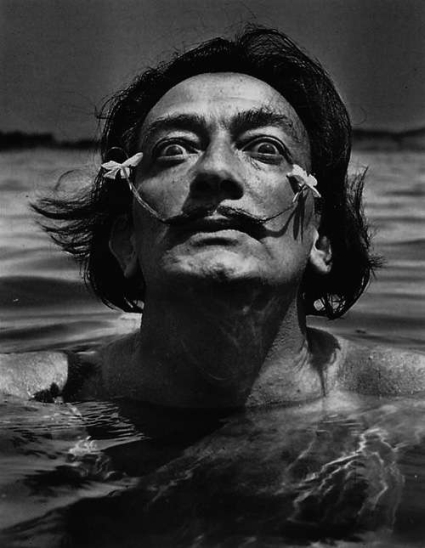
Salvador DaliAt the opening for my show at the Haen Gallery in Asheville, a young woman approached me, telling me first that  she had a piece of mine and she loved the work.  We talked for a bit then she came out with the inevitable.

“You’re not what I had expected.  I thought you might be wearing a beret or a cape or something like that.”

I get that a lot.

People expect something much different than I appear to be.  More flamboyant, I guess.  Maybe more boorish.  Maybe like this guy, Salvador Dali, who exemplified that stereotype of the crazy artist.  But they’re faced with me-  a thick-waisted, middle-aged guy with a sloppy gray beard.  I used to kid with the folks at the Principle Gallery that I would show up at a show one day in a Dali-like manner, swooping in to hold court in my flowing black cape, waving my arms about in dramatic flourishes.  Maybe wearing a monocle?  I sometimes wonder if people would look at my work differently if I donned a cape and had a long waxed mustache.  Would they find different attributes in the paintings?  Would they find a different meaning in each piece?

I don’t know.  I hope not.  But I do know there is an illusion behind each person’s impression of a piece of art, that it is a delicate web that supports how they value a piece and that can be affected by my words or actions or even appearance.  That is one of the reasons I’m a little reticent to do this blog.  I could write something off the cuff, something that I might soon realize was a product of flawed logic, and  quickly destroy someone’s whole interpretation of my work.  

PopeyePerhaps that is not giving the work enough credit for its own strength and life.  Perhaps this is the flawed logic I mentioned.  Whatever the case, it’s something I bear in mind.  But for the time being, I will keep the cape in storage  and stick with the credo of my childhood hero, Popeye: “I yam what I yam.”

And that’s all that I am…
Read Full Post »

Kandinsky Was Here

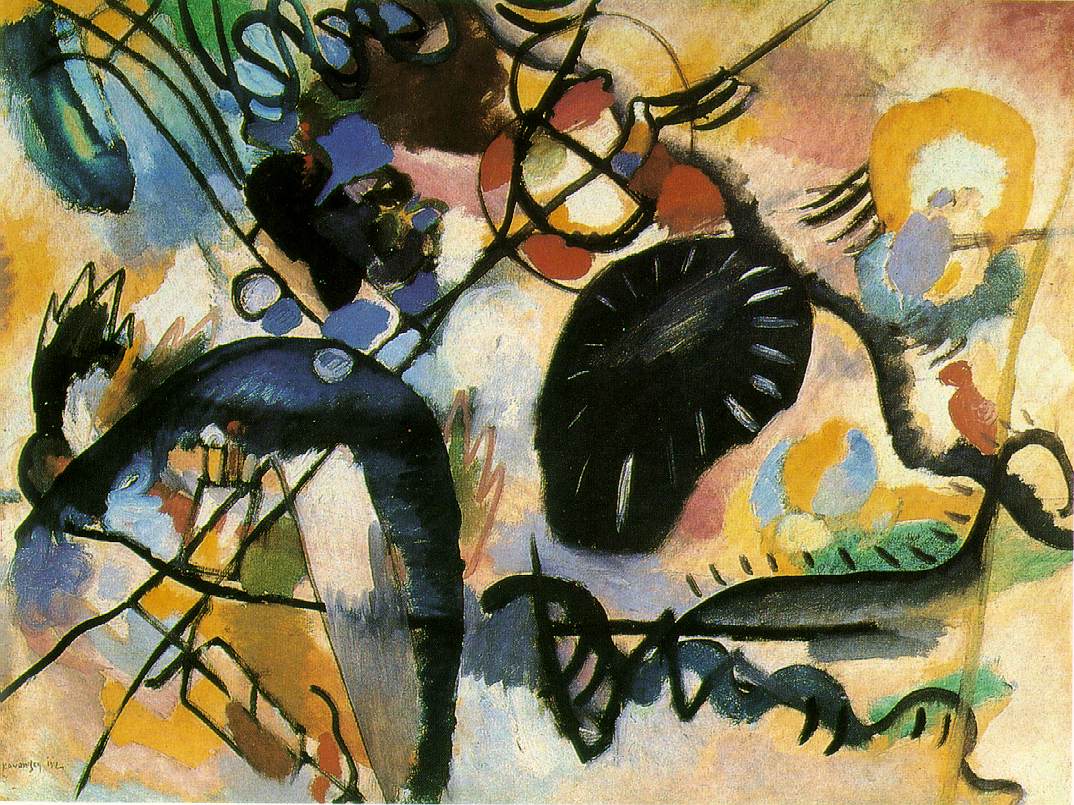
Kandinsky- Black Spot I


In the final analysis, every serious work is tranquil….Every serious work resembles in poise the quiet phrase, ” I am here.”  Like or dislike for the work evaporates; but the sound of that phrase is eternal.

         – Wassily Kandinsky


The above quote is from Wassily Kandinsky and concisely captures what might be the primary motive for my work.  I think, for me, it was a matter of finding that thing, that outlet that gave me voice, that allowed me to honestly feel as though I had a place in this world.  That I had worth.  That I had thoughts deserving to be heard.  That I was, indeed, here.

That need to validate existence is still the primary driver behind my work.  It is that search for adequacy that gives my work its expression and differentiates it from others.  I’ve never said this before but I think that is what many people who respond to my work see in the paintings- their own need to be heard.  They see themselves as part of the work and they are saying, “I am here.”

Hmmm….

Read Full Post »

Conviction

With All ConvictionMore advice for young painters:

Be bold.  Have conviction.

I have taken one art class in my life, a basic drawing course at a time when I thought I wanted to be an architect and was trying to figure out how to put together a portfolio to show for admission.  The class was a disaster.  It was an evening course and the instructor did not want to be there, often ending class early so he could hit his favorite watering hole.  He barely instructed, barely mumbled anything worth hearing.  I was really put off by the whole thing and it was 14 or 15 years before I really came back to art and stuck with it.

But there is one moment of redemption from that class.  It was a bit of advice he offered.  

Use bold lines.  He wanted to see confidence in the lines, even if they weren’t absolutely perfect

To this day, that advice rings in my head.  When I look at other artists’ work that is the first thing I notice.  How much did this person care about this piece and what they were trying to say with it?  I would rather see something done by a lesser talent with great conviction in what they’re trying to express than a more talented individual trying to convey something in which they have no interest.

To put it musically, I’d rather see a garage band thrash out three chords and mean it.  

So however you choose to express yourself, have conviction.  Mean it.

Read Full Post »

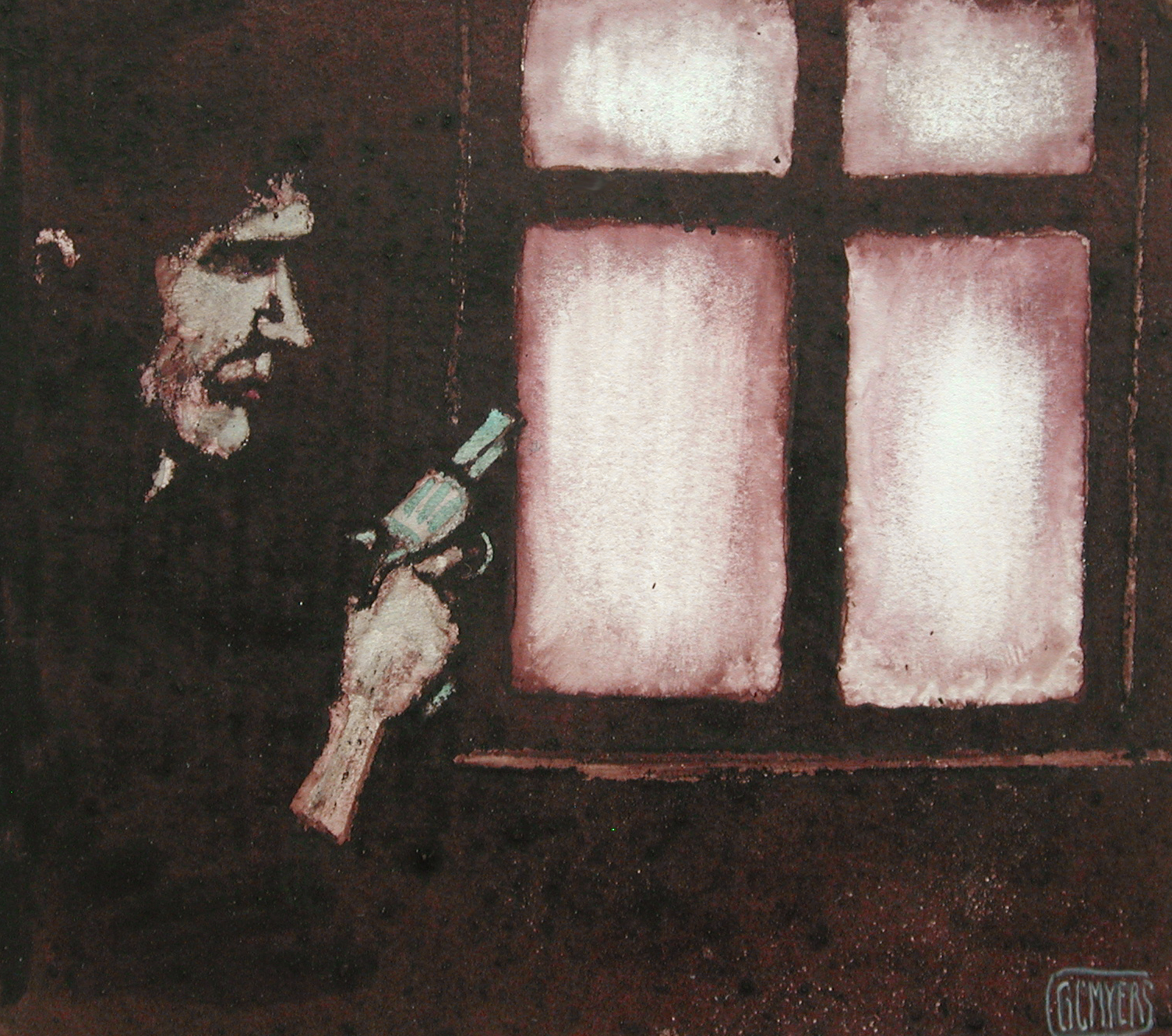
The FearA few days back I talked briefly about a series of pieces from 2006 called Outlaws, small and dark figurative paintings of individuals sometimes looking out windows, sometimes holding handguns.  They were a departure and some followers of my work were a bit put off.  Some were fearful of the figures, seeing them as menacing.  Most saw the fear in these characters, their past haunting them.

There was an observation I made concerning people’s reactions.  Those who were disturbed by the images saw the central figure as an intruder peering in through the window.  Those who were more empathetic with these figures saw them looking out the window.  They saw that these characters were the fearful ones.

These pieces were inspired by some silent films I was watching at the time.  These films from around 1918-1927 were made in the aftermath of the first World War, a time when expressionism emerged.  Many of these films were dark and gritty, filled with raw emotion and violence.  When two figures fought, it was not the clean, one-punch knockouts of later films.  They grappled, clawing at one another in a horrible realism.  One that stands out is  Sunrise  from the great F.W. Murnau, probably best known for his vampire classic,  Nosferatu.  It is the story of a married farmer seduced by a city woman who conspires to kill his wife and go to the city.  It’s a great story that is dark and full of wonderful imagery.  There is a train ride into the city that is a great piece of film.  Though most people think that Wings won the first Oscar for best picure, Sunrise won the award that year as Most Unique and Artistic Production, a short lived award that basically  split the Best Movie award into two parts.  It was great then and is still quite moving.Confession

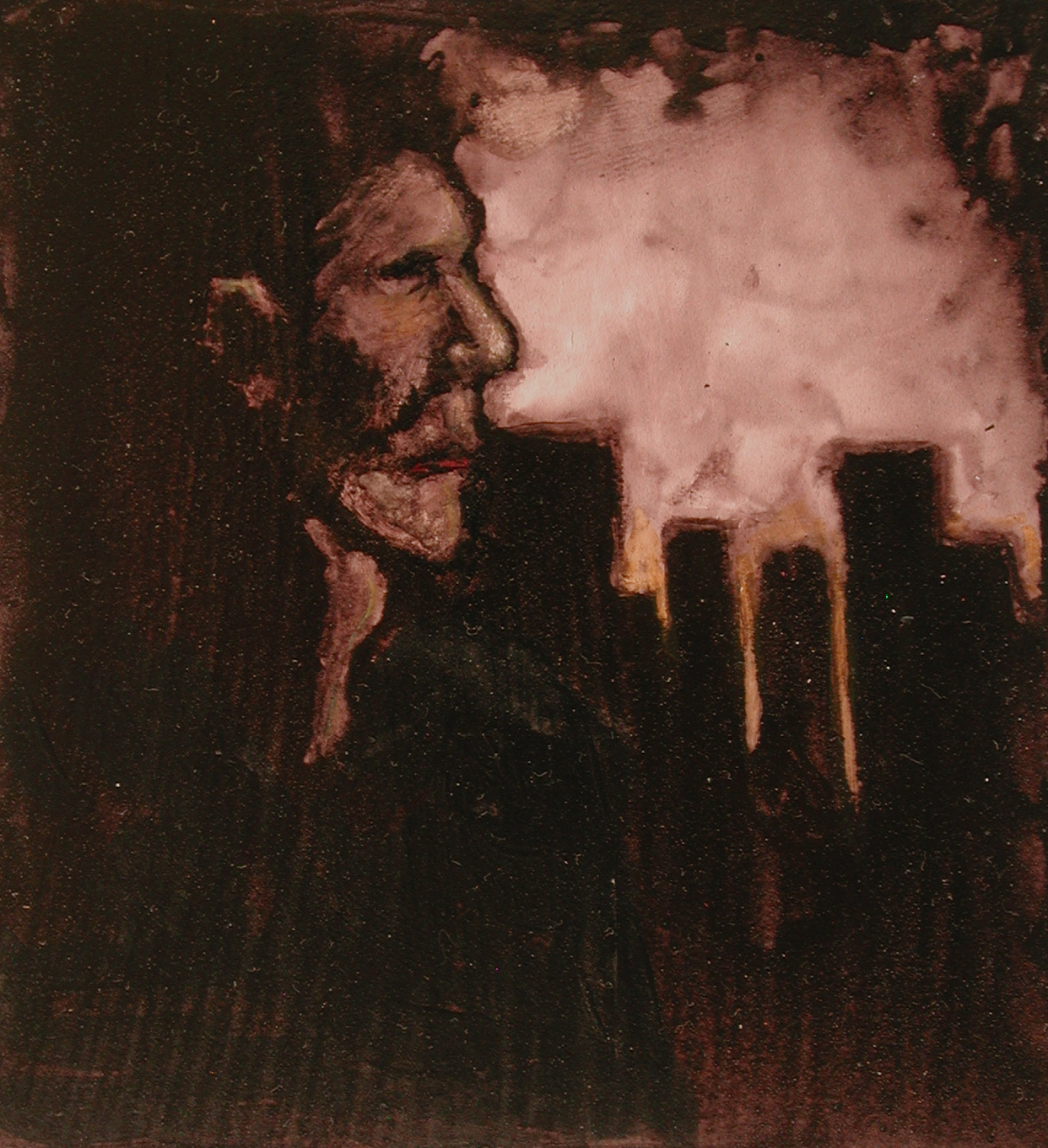
Also, around that time I saw a group of Goya’s small pieces at the Frick in NYC.  They were done by covering  ivory palates with carbon and dripping water on to the surface then manipulating the puddle until an image emerges.  I was taken by them, mainly because I fully understood the technique.  It was how I had taught myself to paint.  I saw it as an opportunity to express the faces and figures that have inhabited my mind for decades.

I only do a few of these a year now and the handful I have in the studio are what I consider personal treasures that still provoke thought from me, time and time again.Night and the City

Read Full Post »

The ServantThis is a little exercise that I did when I was first painting and still working as a waiter at a Perkins restaurant.  I call it The Servant and it sort of sums up my time as a waiter, except for the fact that  I never wore tails when serving pancakes.  It was a great learning experience however.  I think everyone should wait tables for a while.  Teaches humility.  

I remember going to some openings and being praised for the work.  “Oh, this is so wonderful” this and  “You’re doing great stuff” that to the point my head barely fit in my car to drive home.  Then the next morning I was pouring coffee for a factory worker or a trucker and I would realize that for most people my so-called triumph was an absolute nothing.  Didn’t matter and never would.  

My head returned quickly to its normal size and would resume my duties as a server, all the time whistling and humming tunes in my head to pass the time.  Here’s one from Lyle Lovett that was a favorite back then and still is.

Read Full Post »

Rilke

HarlequinA few lines forwarded to me from my sister from the poet Rilke:

Make your ego porous.  Will is of little importance, fame is nothing. 

Openness, patience, receptivity, solitude is everything

                 – Rainier Maria Rilke


Read Full Post »

Studio In the WoodsI’m showing the picture to the right to illustrate a bit of advice I often give when speaking with students or aspiring painters.  This is my first studio which is located up a slight hill behind our home, nestled in among a mixed forest of hardwoods and white pine.  This photo was from last February.  It was a fine little space although it lacked certain amenities such as running water, bathrooms and truly sufficient heat.  However, it served me very well for about a decade.

The advice that I give to aspiring artists is this:  Learn to be alone.  

The time spent in solitude  may be the greatest challenge that many artists face.  I have talked to many over the years and it is a common concern.  Some never fully commit to their art for just this reason.  To be alone with your own thoughts without the feedback or interaction of others can be scary especially for those used to being immersed in people and conversation.

I like to think that I have been prepared for this aspect of this career since I was a child.  For much of my youth we lived  in the country,  in houses that were isolated from neighbors.  I had a sister and brother, 7 and 8 years my senior,  and they were often my companions at times but  as they came into their middle teens I spent more and more time alone.  This is not a complaint.  Actually, it was kind of idyllic.  I lived a fairly independent life as a kid, coming and going as I pleased.  I explored the hills and woods around us, going down old trails to the railroad and cove that ran along side the Chemung River.  I studied the headstones at an old cemetery tucked in the edge of the woods overlooking what was then a thick glen, filled with the family who resided at a late 1700’s homesite that had stood across the road from our home.  All that remained was a stacked stone chimney which served as a great prop for playing cowboy.  

In the woods there were immense downed trees that served as magnificent pirate ships.  There were large hemlocks with thick horizontal branches that were practically ladders, easy to climb and sit above the forest floor to watch and dream.  

My life would be very different without this time alone.  Sure, maybe I’d be a bit more sociable and comfortable with groups of people, something which is sometimes a hindrance.  But it prepared me for the time I spend alone and allowed me to create my own world that I occupied then and now.  The same world that appears in my work.  That is my work. 

This is only a short post on a subject I could drone on about for pages and pages.  But, to aspiring artists, I say learn to love your time alone and realize what a luxury and an asset it can be.  Your work will grow from your time alone.

Read Full Post »

HarlequinIt’s Saturday morning and it’s time for something different.
This is a video from 1966 by the Vogues performing (well, kind of) on the TV show Hullabaloo.  It was an interesting time in popular music.  It was at the cusp, before the explosion of pyschedelia, before Woodstock, before the anger of the late 60’s.  The British Invasion was still in full swing and the Beatles were working on Sgt. Pepper’s Lonely Hearts Club Band , the album which would spark  the coming change.

But here are the Vogues, sporting the clean cut look of the early 60’s and  matching cardigan sweaters.  This is really a pretty good video for the time.  Maybe it’s because it’s such a great song.  Anyway this is Five O’Clock World

Read Full Post »

Quiet Rising

It seems a little odd to sit down and write something about why you like your own work.  I know a lot of artists find it difficult and maybe even a little distasteful.  For me, it’s about trying to find that part of a painting that reaches out to people, the part that is communicating.  I am the first person to see the work so in order for the piece to be able to speak to others it must first speak to me.  It must excite me on some level.  That excitement is a very big part of my process and carries me through a lot of long days alone in my studio.  So when I write or speak about my own work it’s so that I might understand better why the painting works.

That being said, this is a painting titled Quiet Rising which I’m showing  because I like this piece on many different levels.  On an emotional level I find this piece very calm, very quiet.  There is a nice harmony in the way the colors and forms fit together, again in a way that I find very calming.  For me, that appearance of placid calm seems to be an important aspect in my own evaluation of my work.

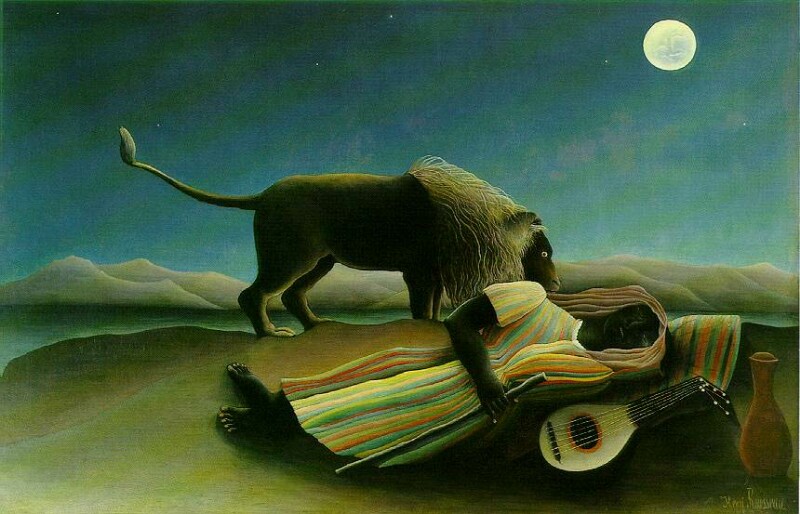
The path in the foreground has a curve that I find very intriguing.  I can’t put my finger on the reason but it reminds me of an element from Henri Rousseau painting.  Maybe it’s the movement of the path or the quality of the blue in the sky– I can’t be sure.  A lot of the feelings I get from a piece are not quite fully realized thoughts.  More like snippets or a tiny bit of a memory that comes to you without the whole episode, leaving you unsure if there even was a real memory there to begin with.

Whatever the case, this painting works for me and is worth sharing.  It’s being shown at the West End Gallery in Corning, NY.

Read Full Post »

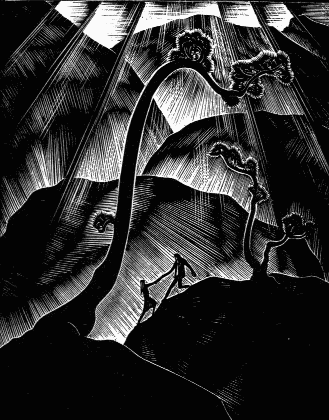
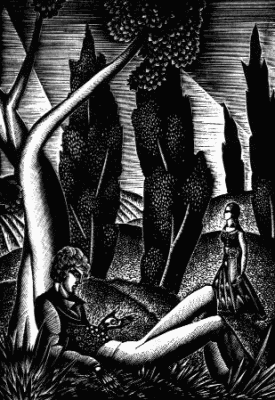
Lynd Ward/ Madman's DrumThis is from the wordless graphic novel, Madman’s Drum, from the mind of the talented Lynd Ward, done in 1930.  It is a self-described novel in woodcuts but to me has the feel of the truly great silent films from the years prior to its publication.  When I came across his work 13 or 14 years ago I was blown away by the feel, by the dynamic compositions and by the rawness of the storylines.  Each frame was put together so beautifully.  I am at a loss for words to describe how his images spoke to me, how his handling of light and dark told more than words.  

His first and perhaps more famous graphic novel  was Gods’ Man, published in 1929.  This was actually the first Ward work that I saw.  I have a newer edition from Dover that is very nice, very sharp, but the first book of his I saw was an older edition in the library from the 1930’s.  It was a bit yellowed and the paper slightly rough, the spine rubbed and worn.  It all contributed to the overall feel of the work.  It felt like I was finding a certain truth, something that was tucked away, a spirit voice waiting to be heard.Lynd Ward / Gods' Man

The boldness of the lines and the way the shapes and forms filled the picture frame boggled my mind.  It was so cinematic, so stylized.  Detail was stripped away but each frame lost no emotional impact.

It was everything I wanted in my work.  But I knew that could not be.  He is a true individual and his work is his and his alone.  I didn’t want to emulate.  I wanted to absorb the feel and use that feel to create something that was my own.  It showed me the possibility.

Great stuff…

Read Full Post »

« Newer Posts - Older Posts »