Feeds:
Posts
Comments

Archive for the ‘Motivation’ Category

Since I have much to do this morning, I am running this post from back in 2013 that concerns a few early pieces. I came across one of these pieces, Doug’s First Day on the Job, early this morning and, while it made me chuckle, it reminded me of current events. Thought this post was worth looking at again.

*******************

GC Myers Early Interior sm“Can you remember who you were, before the world told you who you should be?”

Charles Bukowski, Post Office

***************

I have often shown early work here, stuff from when I was still trying to find a path forward. Most of it is from before I ever thought  that showing my work in public was a possibility. As I have pointed out, I still revisit this early work on a regular basis in an effort to stay connected with that time in which the need to create was the only motivation needed. There’s also an element of backtracking in this as well, trying to put together how this work somehow led to what I do now.

Sometimes it is hard to see the connections as the work is so singular and never followed up on, then or now. I think those are the pieces from that time that intrigue me the most, making me wonder how my journey forward from that time would have been different had I chosen and stayed on that path.

For example, here are three pieces from around the same time, all painted within a month or so of each other back in 1994. None really lead directly forward to the current time but I really always enjoy seeing these three pieces, wondering what my motivation was at the time. The first , shown above, is an interior scene that just formed on the paper. I had no idea what was going to be there, outside of the checkered tablecloth. I remember that the cross on the wall was a last minute addition, one that changed the whole feel of the piece. I can understand why I didn’t follow this path but it still makes me wonder.

GC Myers Still Life smThe next was this still life, here on the left. I remember this piece well, having ambivalent feelings about it as a whole. I liked the clear graphic look of it but it was almost too clean, too sharp. It had really good eye appeal but it seemed all surface to me. I see things from this piece that I did bring forward, such as some of the clearness of the colors which I like in some instances. The thing that always strikes me is that I see a face in profile, looking to the right. Faces subconsciously built into the composition are something I often look for in my work, feeling a curious satisfaction when I find them. I wish I knew why. Maybe that’s what draws me back to these early pieces.
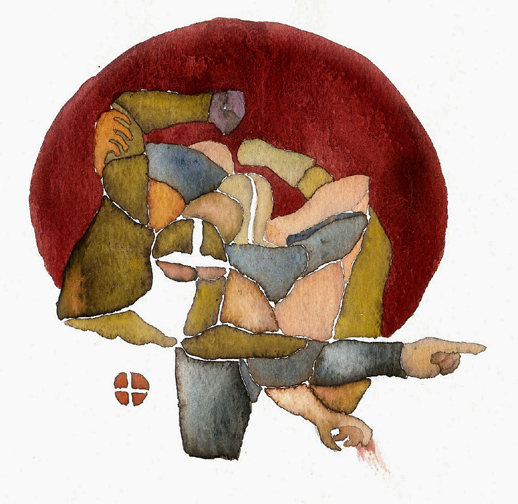
GC Myers- Doug's First day on the Job smThe last was one that had a title, Doug’s First Day on the Job.  I remember this as a piece that I viewed as an exercise even as I started, experimenting with forms and color. The resulting scrum of arms and fists with the strange authoritarian figure in the foreground, hooded and  pointing ominously out of frame reminded me of the chaos and confusion of  a kid’s first day on a new job. A strange environment with new procedures to learn and strange new people who struggle with each other and boss the new guy around. I knew even as I painted this that this was not my path but I enjoyed this piece anyway. It had a cleansing effect and was a wonderful lesson in color and form .

Plus it made me chuckle.

I don’t know that there is any great connection between these pieces or to my future and current work. I always wonder though at how these disparate  pieces formed in such a short time, wondering if I have that same burst of energy within me still. Maybe that is the reason for this backtracking, looking for that energy source, that fount of inspiration.

I don’t know…

Read Full Post »

*********************

The writer operates at a peculiar crossroads where time and place and eternity somehow meet. His problem is to find that location.

–Flannery O’Connor

**********************

I think you could probably substitute artist in for writer in the words above from author Flannery O’Connor (1925-1964) without changing the gist of the thought too much. All art, and literature certainly falls into that category, is about transforming the now of the creation– the time and place— into something beyond that moment, into something timeless–the eternity to which O’Connor refers.

Finding that intersection where those two things come together is, as she points out, not such as easy thing to accomplish. And almost every instance the artist will never know if they have come to those crossroads that moves their work into the realm of the eternal.

I guess the finding is immaterial without the seeking. And seeking without any assurance of finding something that will ever reveal itself to you is an act of faith, a belief that there something eternal worth seeking.

I don’t know what else to call it. You keep trying. You think it is near sometimes but when you finally come to it, you’re not sure enough of what you’re experiencing to stop seeking.

Does one ever know when they have come to that crossroads?

That being said, here’s this week’s Sunday morning music from a longtime favorite of mine, Tracy Chapman. I think her body of work sometimes get overlooked in the deluge of the new but every time I come back to her, I wonder how I have let her slip out of mind. Here’s a song that fits the subject here, Crossroads, to accompany the painting at the top, Beyond the Crossroads, from back in 2004.

Have a good Sunday, okay?


Read Full Post »

*****************

Artists who live and work with spiritual values cannot and should not remain indifferent to a conflict in which the highest values of humanity and civilization are at stake.

–Pablo Picasso

******************

I always worry about alienating people who come to this blog to read about art and are greeted with my opinions and beliefs on the world. But reading the words above from Pablo Picasso this morning reminds me that my art is a product of all that I am and all that I witness in this world. I like to think that the work is about the human spirit and emotion. As such, I can’t remain indifferent or ignore those things that set off my emotional alarms nor those that eat away at what I see as the collective human spirit that we all share.

Thinking this made me look for another blog entry that I wrote just a couple of years back that featured some other words from Picasso as well the painting above, his masterpiece Guernica.

Here it is:

***************

Art is a lie that makes us realize the truth.

Pablo Picasso

****************

Many of my favorite artists worked and produced their greatest works in times where the world was under great stress. Two World Wars only decades apart and– in the case of Picasso– the Spanish Civil War in between. Here, we had the Great Depression. Times of social transformation and spiritual upheaval. Even when the work didn’t overtly deal with the events of the day, much of the work reflected on the collective consciousness of that time.

I think that is so because art is, just as Picasso so succinctly states, a lie that makes us realize the truth.

Artists fabricate, often creating work that is on its surface pure fantasy with little relation to the world as others might observe it. But their fabrication is made up from everything that impacts them– their knowledge, their observations, their opinions and emotions. Artists take in the world and create something that seems like a pure fabrication.

A lie.

But what seems the lie often proves to be built of ultimate truths, just constructed in a manner that allows others to see this truth clearly.

I don’t know that we artists always succeed. I certainly don’t feel that I do as often as I would  like. But when a piece succeeds and shows us something far beyond what its surface represents, it is a true revelation.

Believing that, so long as we feel deeply and continue to create our lies, we will at some point reveal a truth.

Got to get to work now…

Read Full Post »

Peter Doig- Swamped 1990

********************

I sometimes wish I had never had to sell a painting. Every painting you make represents the time it was made and how you were feeling and what your influences were… You are never going to feel that way again, so you can never repeat it…

–Peter Doig 

*******************

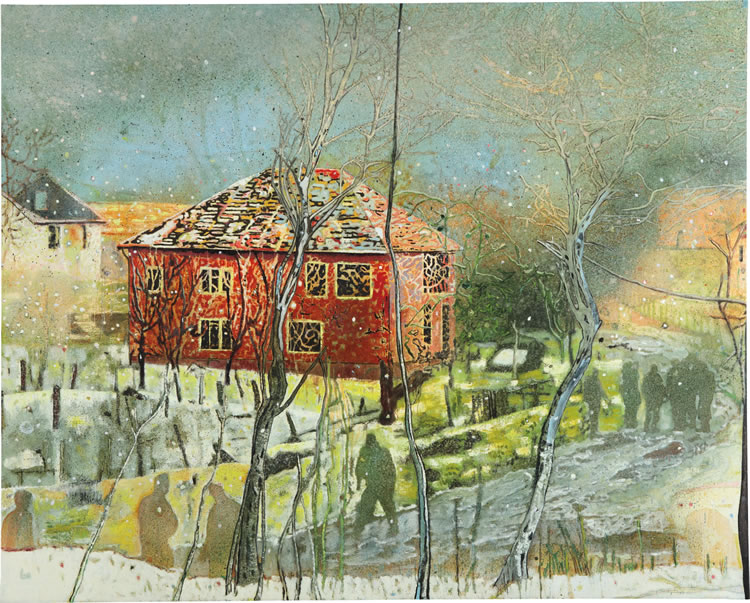
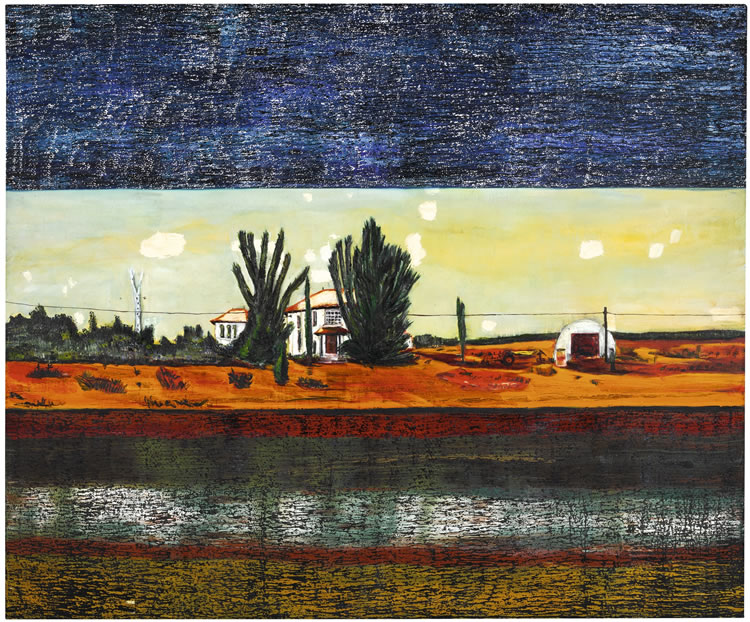
I shouldn’t make such a blanket statement but I doubt that most of you out there know the name of the contemporary artist Peter Doig. I know that I wasn’t fully aware of him until a decade or so back and even then only on a passing basis where I would stop and examine his work when I would come across it in an article. The piece at the top always made me stop and look a bit closer.

But the fact of the matter is that the Scottish born Doig (b. 1959) is perhaps the most sought after living artist working today with works selling for the tens of millions at auction. Of the 9 paintings shown here, only one sold for less than $10 million at auction. The most expensive sold for over $ 28 million. I won’t tell you which is which. There were many others on the auction sites that sold for between 1 and 4 million that I didn’t include.

These prices always open up a debate with lots of questions on the relative value of artwork. What makes a work worth $28 million? Does the auction value of the work determine its importance or does its importance determine its value? Is the working and thinking process of this artist that much different than that of an artist that sells for tremendously less?

You might think from the direction this seems to be heading that I am decrying Doig’s work selling for what I believe are ludicrous sums. I am not. I very much like and admire his work. I can see those elements in it that make it distinct. It is good and great work and might very well be among the most important work from this time. If his work can bring in that kind of money, I applaud him.

I am, if anything, criticizing myself for not having the ability– or knowledge or audacity– to command such prices. I know that the price of a piece of art sometimes determines how serious collectors view it and that a great piece can be overlooked simply because it is too inexpensive, at least by the standards of collectors.

That has happened to me at times.

In some galleries, my works sits at the top end of their market and in others, in the middle or near the bottom of their price ranges. While I am satisfied with that, I firmly believe that my work is greatly undervalued across the board, that it should be demanding much higher prices.

Now, that sounds like confidence, doesn’t it? Maybe even overconfidence?

Actually, it is the opposite of that. It is a lack of confidence and a bit of fear that keeps the prices of my work in the range where they are and have been. While I have the belief in the relative value of my work, I just don’t have the guts to make that jump.

I have been poor in my life and it wasn’t that long ago that I was dead broke and I think that tempers my ambitions, as far as pricing my work is concerned. I like to have my work sell and make a living from it. I take pride in being able to live off of the product of my own thoughts and imagination. And I find a sense of security in being able to provide what I consider high quality work at prices that make it obtainable for more people than if it were in a much higher range– it’s undervaluation generally means that the work will sell eventually.

Maybe I am too comfortable and seeing Mr. Doig’s prices just nudges me a bit, telling me to be less comfortable, to be more proactive.

I don’t know. Just thinking out loud this morning. I wrote this because much of what I have read about and from Doig jibes with my own experiences, including the quote at the top. For all the talk about prices, every real piece of art represents a certain time and place for that artist, one that is distinct and not repeatable. I know that I will sometimes look at a piece and remember the days I spent in front of it while painting it. That time, that thought process is burned into my psyche and will never happen again in the same way.

Anyway, lets’s push aside thoughts of money for now and just look at the paintings of Peter Doig a bit more.

Peter Doig- Rosedale 1991

Peter Doig– Red House 1995

Peter Doig– Island Painting 2000/01

Peter Doig– Grasshopper 1990

Peter Doig — Daytime Astronomy 1998/99

Peter Doig– Charley’s Space 1990

Peter Doig– Forestia 1996

Peter Doig– Almost Grown 2000


Read Full Post »

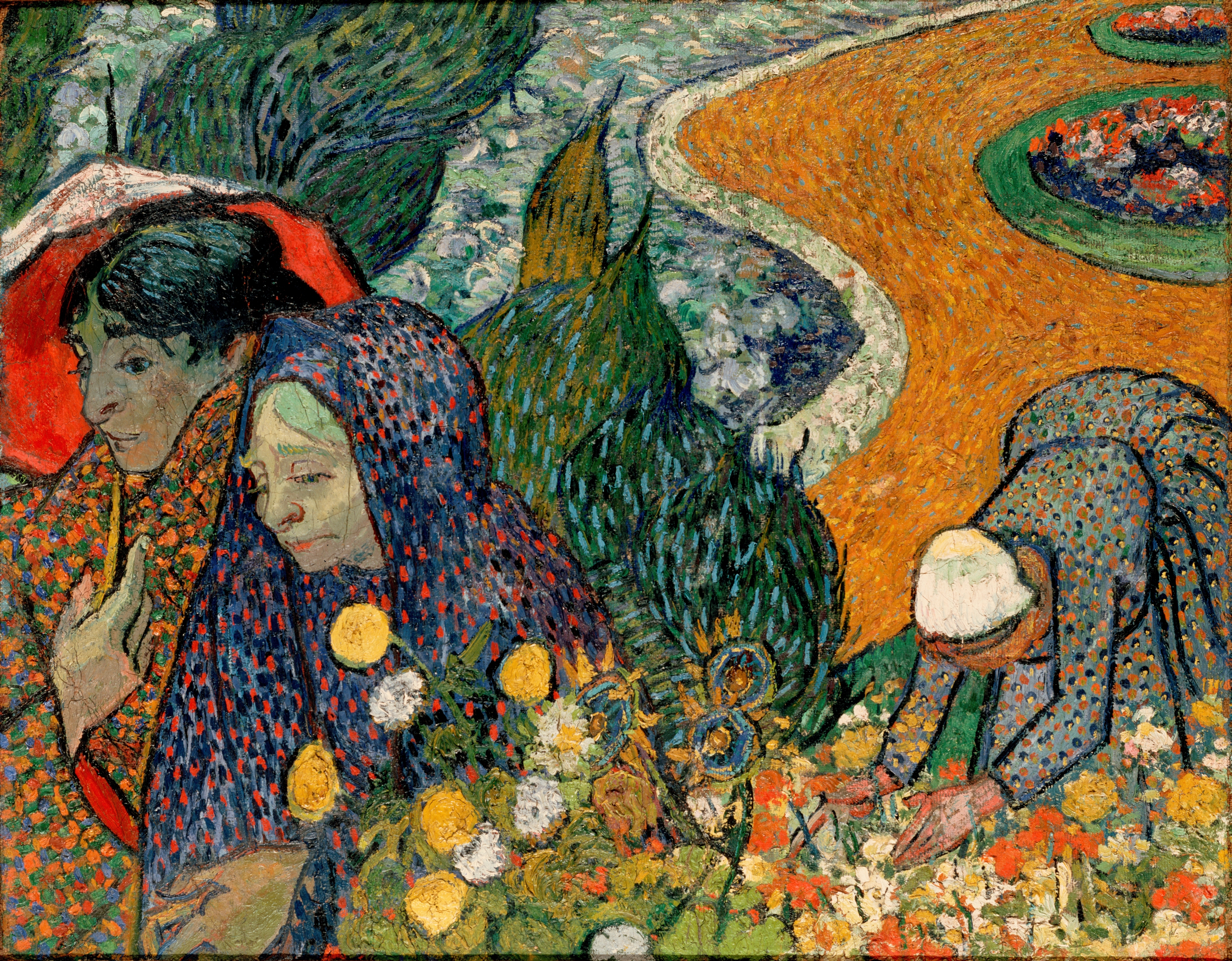
Vincent Van Gogh- Memory of the Garden at Etten 1888

*******************

My aim in life is to make pictures and drawings, as many and as well as I can; then, at the end of my life… looking back with love and tender regret, and thinking, ‘Oh, the pictures I might have made!’ But this does not exclude making what is possible…

–Vincent Van Gogh

*******************

Love this painting from Vincent Van Gogh with its wonderful color and the abstraction of the forms that comes from eliminating the horizon line. It was a piece that came to mind when I ran across this passage from Van Gogh. The words reminded me of something else, a thought that has been on my mind in recent times.

I was asked at my Gallery Talk at the Principle Gallery this past September if I ever had thoughts of retiring from my painting career. I think I made a bit of a joke about it, saying that I would no doubt die working away at a painting.

And that’s most likely true. I couldn’t imagine ever saying I am done as a painter.

It goes back to Van Gogh’s words above. I still see my artistic future brighter than my past, still envision important projects and better works to come. I still see my best work as being in the future, not dwelling in the distant past.

I can’t imagine that feeling ever changing. I can see myself on the day of my death, if I am capable of taking a moment to reflect on that day, will have that same regret that Van Gogh expressed: Oh, the pictures I might have made!

That being said, I must get to work. I am not retired yet and there are pictures to be made. The future is calling.

Read Full Post »

GC Myers- Listening to the Muse

**************************

I thought I would rerun the blog entry below that first ran in January of 2015. It might be the only piece of advice I truly feel comfortable in giving to aspiring artists in any discipline. Plus, it can be applied to everyone in their lives even if they aren’t engaged in creative endeavors because, at its base, it’s not just about making things, as much as it might seem at first glance. It’s about an attitude of being proactive in altering the world around us in what we see as being a positive manner. It’s about seeing something that doesn’t fully satisfy you and taking action to change that.

Moreover, at its root, it is about determining the person we want to be and moving consciously towards that goal.

Take a look and decide for yourself:


I spent quite a bit of time this morning looking at the image of the painting above, Listening to the Muse. It’s part of my show at the Kada Gallery [That show opened in December of 2014] which is in it’s last weekend there. This painting really captivates me on a personal level and reminds me of  a thought that once drove me forward as a younger painter. It’s a thought that I often pass along as a bit of advice to aspiring artists:

Paint the paintings you want to see.

Sounds too simple to be of any help, doesn’t it? But that simplicity is the beauty and strength of it.

For me, I wasn’t seeing the paintings out there that satisfied an inner desire I had to see certain deep colors that were being used in a manner that was both abstract and representative. If I had seen something that fulfilled these desires, I most likely would not have went ahead as a painter. I wouldn’t have felt the need to keep pushing.

It was this simple thought that marked the change in my evolution as a painter. Before it, I was still trying to paint the paintings that I was seeing in the outer world, attempting to emulate those pieces and styles that already existed as created by other artists. But it was unsatisfying, still echoing the work of others, forever judged in comparison to these others.

But after the realization that I should simply paint what I wanted to see, my work changed and I went from a bondage to that which existed to the freedom of what could be found in creating something new. For me, that meant finding certain colors such as the deep reds and oranges tinged with dark edges that mark this piece. It meant trying to simplify the forms of world I was portraying so that the colors and shapes collectively took on the same meditative quality that I was seeing in each of them.

In my case this seems to be the advice I needed. But I think it’s advice that works for nearly anything you might attempt.

Paint the paintings you want to see.

Write the book you want to read. [Toni Morrison said this very thing at one point]

Play the music you want to hear. Make the film you want to see. Cook the food you want to eat. Make the clothes you want to wear.

Make the world in which you want to live.

Simple.

Now go do it.

Read Full Post »

All Is Quiet

*****************

All is quiet on New Year’s Day
A world in white gets underway
I want to be with you
Be with you, night and day
Nothing changes on New Year’s Day
On New Year’s Day

U2, New Year’s Day

****************

Found myself beginning the new year this morning walking to the studio through the woods in the dark before 6 AM.

Like the song says: Nothing changes on New Year’s Day.

I always think of this song on New Year’s morning because there is always a preternatural quiet on these mornings.

Today was no different.

It’s an absolute stillness free of all noise. Even the deer whose eyes glow green in the light of my headlamp as I scan the forest, make no sound. They are motionless and when they finally move there is no snort of alarm, no crunch of leaves, no breaking of branches.

Just a stealthy movement of shadows against an empty void of blackness. It makes me stop for a moment just to listen, trying to absorb as much of that quietude as I can with the hope that I can recall this glorious absence of sound when I need it at some point later.

It makes me think of the old Elvis song If Every Day Was Like Christmas with its lyrics that ask: why can’t every day be like Christmas? I think a more appropriate question would be why can’t every day be like New Year’s Day?

The pressure of the holidays is past. No concerns about gift giving. It’s a fresh start, with the old and worn last year fading into the grainy grayness of the past and the new year stepping in, all shiny bright and full of potential. Even the most pessimistic and jaded of us most likely feels at least small glimmers of hope on this day.

And why not? It’s a clean slate, a tabula rasa, on which anything can written. It is a time, a moment, that assures us that there are no limits on what we can do in the coming year and the coming decade.

Of course, the pragmatic part of me knows that it is just as the song says: Nothing changes on New Year’s Day. 

But this morning, at least for a while, I will try to hang on to the belief that there is change coming in this shiny new year. For the better, I hope.

Here’s the song New Year’s Day from U2 from way back in 1983. Time flies so enjoy this quiet morning.

Happy New Year.

Read Full Post »

Put this one in the Even the great ones screw up every once in a while file.

This is a painting from Norman Rockwell titled People Reading Stock Exchange, a piece done in 1930 for one of his many Saturday Evening Post covers. There appears to be nothing unique about it at first glance, just a group of folks hunched around a wall chart that they all  find completely absorbing. They all seem perfectly normal until you take a closer look and notice that the young man in the red shirt seems different. You look a bit closer, maybe squint a little until you realize you don’t need to do that to see his abnormality.

Yes, he has three legs.

This strange young fellow apparently went unnoticed for a while and Rockwell himself didn’t recognize it until it was pointed out years later. It proved to be a embarrassing episode for him, especially given his reputation for capturing detail and realism in his work.

Some people have tried to explain it away as some sort of subconscious phallic representation which seems like a stretch to me. I think it was merely an oversight although an unusual one. As a casual viewer, it it something that is easy to overlook but I am more surprised that in the process of adding the finishing touches that it simply didn’t register for him that he was creating a most unusual young man.

As an artist, it’s reassuring, even comforting, to see someone so meticulous in his process make such an error.

Most artists have at least a handful of such things in their background, pieces with shadows that make no sense in nature or arms or necks that are much too long for any living human. Most go unnoticed. The unfortunate thing is that once they are identified, they become the focal point of that painting forever– something once seen that cannot be unseen.

I know that I have several paintings with mistakes, with departures from the laws of physics and other realities. These are pieces that, without these flaws being pointed out, are strong and full works. Few people, if any, notice these flaws but for me they are sometimes the first things my eyes rest upon in the picture. But they don’t bother me as I imagine this bothered Rockwell.

I see them as symbols of our humanity, our inherent flawed nature. We don’t need to point out our flaws. They’re there for all to see. We can only hope people accept us, three legs or two or one.

And the three-legged young man here is a refreshing reminder of Rockwell’s humanity.

************************

This post originally ran here back in 2013. It has proven to be one of the more popular posts through the years, often getting hundreds and sometimes thousands of views in a day. It is a favorite of mine, as well, simply for the reminder that we are imperfect beings. I certainly make no pretense of perfection in my own work. In fact, flaws are an inherent part of what I do. My signature, if you will.

Must be I subscribe to the words of Fred Astaire:

The higher up you go, the more mistakes you are allowed. Right at the top, if you make enough of them, it’s considered to be your style.”

Read Full Post »

With about a foot of snow already on the ground and more falling as I write, I spent my first few hours this morning shoveling and plowing but still felt that I should post something. I am running one of my favorite posts, one that I run every few years. 

GC Myers- Heliotrope sm***************************

“Patience and perseverance have a magical effect before which difficulties disappear and obstacles vanish.”

-John Quincy Adams

**********************

I don’t what made this pop into my head but I was thinking about a conversation from a few years back that I had with a friend who is also a painter. He has been a working artist for almost his entire adult life, fairly successful for much of that time. We both agree that we are extremely fortunate to have found the careers that we have, one that feels like a destination rather than a passageway to some other calling.

For me, I knew this was the career for me when I realized I no longer looked at the job listings in the classified section of the paper. For most of my life, I felt there was something else out there that would satisfy me but I didn’t know what it was or how to find it. Maybe it was as simple as finding the right job. Or so I thought.

When you don’t know where you’re going, any direction feels like it might be the right direction.

But during this particular conversation this friend asked, “What would you do if you suddenly couldn’t paint? What if you were suddenly blind?”

For him, it was unthinkable. His life of creation was totally visual, based on expressing every emotion in paint.

I thought about it for a second and said simply, “I’d do something else. I’d find a way.”

In that split-second I realized that while I loved painting and relished the idea that I could communicate completely in paint, painting was a mere device for self-expression. But it was not the only way to go. I knew then as I know now that the deprivation of something that has come to mean so much to me would, in itself, create a new need for expression that would somehow be satisfied. I have always marveled at the people who, when paralyzed or have lost use of their arms, paint with their toes or their mouth . Their drive to communicate overcame their obstacles. Mine would as well.

If blinded, I could or do something with words, using them to create color and texture. Perhaps not at the same level as my painting but it might grow into something different given the circumstance. The need to communicate whatever I needed to communicate would create a pathway.

It was an epiphany in that moment. Just knowing that I had found painting gave me the belief that I could and would find a new form of expression if needed.

I did it once and I could do it again. And I found that greatly comforting.

Yes, I’d find a way…

Read Full Post »

********************************

The only quality that endures in art is a personal vision of the world. Methods are transient: personality is enduring.

–Edward Hopper

**********************************

Felt like a little Edward Hopper this morning and realized that, in all the years of doing this blog, I had never shown his most famous painting, Nighthawks, above. Can’t say why I had failed to display it. Maybe it just felt so obvious that it overshadowed other works from his career that also moved me. Regardless, it remains a defining painting, one that never fails to be striking.

His words just below the painting above are equally striking for me.

I often write about artists trying to find their voice. By that, I am talking about painting (or working in any other medium) in a manner that matches up with and captures the artist’s point of view, their thought process, and the many facets of their personality. Not every method or style jibes with every artist, allowing them full expression of the truth of their own personality.

And method alone only goes so far. Method is transient and without endurance, as Hopper points out, without personality.

How does this happen, this insertion of personality into one’s work?

I can’t really say. I guess it starts with having a point of view, an opinion, an emotion, a thought. I tell high school and college students that technique is important but it is even more vital to have a base of other knowledge to draw from. Art is not technique or method, it is expression of the self so have a fully realized self to express.

Don’t know if that’s right for everybody but, hey, it feels right for me.

Work on that and get back to me, okay?


Read Full Post »

« Newer Posts - Older Posts »