I only have time enough this morning to throw this song out for this week’s Sunday morning music. The song is At My Window Sad and Lonely with lyrics by Woody Guthrie. The band Wilco and singer Billy Bragg put music to these lyrics along with a number of other Guthrie songs in the Mermaid Avenue albums. The version below is an acoustic version from Wilco frontman Jeff Tweedy. Nice stuff.
The image to the right is from my Outlaws series from back in 2006. This piece is called Followed. It was chosen because I think this person might be sad and lonely.
In the inner place where true artists create there exists a pure child.
–Lawren Harris
**************
I was planning on throwing up a quick post with a video of some of the paintings from another favorite of mine this morning.
Quick. Easy. Done and I’m on my way to the rest of my day.
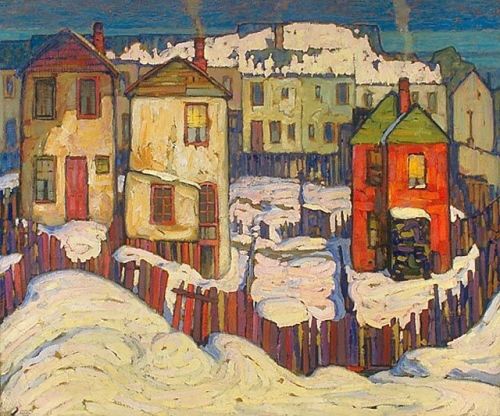
The problem is that once I start looking at the paintings of Lawren Harris time just evaporates for me. I find myself just staring at so many different pieces, taking in their colors, their harmonies, their stillnesses, and their sheer beauty, that time floats away. I find myself enthralled by his work maybe more than any artist I’ve encountered.
The video below is a group of his work set to a Barhms sonata. A few of the images are a bit fuzzy but it’s a pretty well done video and gives a good idea of the full range of Harris’ work. So while this post is short today be advised that it is one that might take up some of your time. It took a bunch of mine this morning!
We may never never meet again, on that bumpy road to love Still I’ll always, always keep the memory of
The way you hold your knife The way we danced until three The way you changed my life No, no they can’t take that away from me No, they can’t take that away from me
–George and Ira Gershwin, They Can’t Take That Away From Me, 1937
**************
I was looking at the new painting shown at the top, 10″ by 30″ on canvas, trying to determine what it was saying to me. For some reason, those lines from a favorite Gershwin song kept popping into my mind–We may never never meet again, on that bumpy road to love/Still I’ll always, always keep the memory of…
The more I thought about it, the more I liked the way the song tied to the image. I think I’ll keep it that way in my mind. You can’t take that away from me.
The song, You Can’t Take That Away From Me, was written by the Gershwins and first performed by Fred Astaire in the 1937 movie Shall We Dance. George Gershwin died two months after the film’s release. Since that time the song has become one of the great entries to the American songbook, performed by a seemingly endless list of jazz and pop singers. There are so many great versions of this song by some of the greatest vocalists of all time that it’s hard to pick one that might stand out for everybody.
For myself, I always come back to the Billie Holiday covers. She started performing the song in 1937 and I like those early performances but the one below from 1957 is a favorite, a great version with top notch players backing her.
Give a listen. And pay heed to those deep memories that no one can take away from you.
I need a break from the absurdity that is our government at the moment. I need something to hang my hat on that is based on the truth that is right in front of us. No alternate facts.
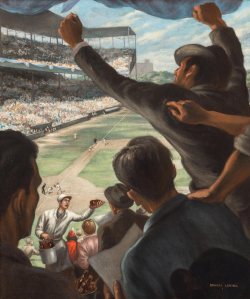
Baseball.
It’s Opening Day and a little sanity returns to the world. Remember that all of the craziness and angst of the past six months happened when there was no major league baseball being played. See what happens when you take away baseball?
It’s a simple and clear cut affair with nothing but the facts running the whole shebang . Three strikes and you’re out. The ball clears the fence and it’s a home run. The team with the most runs wins at the end of nine innings. And since they instituted video reviews of tight plays the only time that opinion comes into play on the field is with the home plate umpire’s calls of balls and strikes.
And unlike certain politicians, it’s a game of humility and instant karma. Blowhards, big mouths and boasters get brought down on a daily basis. Remember that this a game where one of the greatest batters of all time, Ty Cobb, failed to get a hit at the plate about 65% of the time. Reggie Jackson might be Mr. October and in the Hall of Fame but he has more strikeouts than hits in his career.
Ultimately, you put up or you shut up in baseball.
And it’s back today and I feel my anxiety leveling off. My rhythms are righting.
Play ball!
I thought for this Sunday’s music I’d play a little song from Sister Wynona Carr, TheBall Game from 1952. Wynona Carr was a multiple threat, singing r & b, rock and roll, and gospel. She added the Sister to her name when she was in that gospel mode. She never achieved a real breakout in any of her genres and after contracting tuberculosis in the late 1950’s she sunk into obscurity. She died in 1976 in Cleveland at the age of 53.
A sad story but she left us with some good music including this song, which was included in the recent Jackie Robinson biopic, 42. Give a listen and watch a couple of innings. It’ll do you some good.
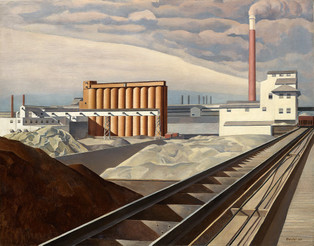
Since this is a busy morning, I was going to play a video of the paintings of a favorite artist of mine, Charles Sheeler. I thought I’d add a replay of a post from several years back that I wrote in case some of you were not familiar with his work. The video at the bottom features his work and Pamina’s Lament from the Mozart opera The Magic Flute.
I find it hard to believe that I haven’t mentioned the work of Charles Sheeler here, outside of a mention of his collaboration withPaul Strand on Manhatta, a landmark American art film from 1921. Sheeler (1883-1965) is one of my favorite artists who as a pioneer in photography and painting in the early decades of the 20th century is often called the father of Modernism. Oddly enough, I am particularly drawn to his industrial imagery which replaces almost all evidence of things natural in completely man-made factoryscapes. This might seem to be the antithesis of my own work, which often omits all evidence of human intervention in my landscapes.
Some of his most potent work came from an assignment where Henry Ford hired Sheeler to photograph his factories, wanting him to glorify them in an almost religious manner, as though they were cathedrals for the new age. As Ford had said at the time, “The man who builds a factory builds a temple. The man who works there, worships there.” Sheeler was impressed with the factory complexes and felt that, indeed, they represented a modern form of religious expression. His painted work from this time glorified the machine of industry in glowing forms and color.
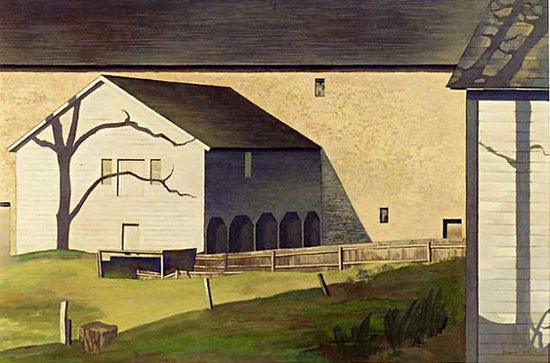
He saw the factory as a continuation of the American idea of work as religion, one that was rooted in the sense of reverence and importance of the barns and structures of the farms of the earlier pre-industrial age. He painted many scenes of farms and barns, abstracting the forms as he had with the factory scenes.
I don’t know that I completely agree with Sheeler on his idea of the factory as cathedral but I do have to admit to being awestruck in the presence of large factory structures. I remember working in the old A&P factory, a huge building with a roof that was somewhere around 35 acres in size. It was said to have the capability to produce enough product each day to feed everyone east of the Mississippi. It no longer exists. A large shopping center now stands in its place.
Some of the huge rooms in the building were amazing to stand in, as the machines hummed and throbbed while workers hustled about servicing their needs. I particularly remember the tea room which was a huge cavernous space with row after row of steampunk looking machines from what looked to be the 1920’s that bagged the tea then sewed it shut. I cleaned these machines for several weeks and, standing in the grand space in silence after most of the workers had gone and the machines turned off, felt that feeling of awe. I would sometime walk around from area to area, just taking it in. I didn’t necessarily adore it in the manner of a religious zealot but there was no denying the power in its magnitude and the power of the machine.
Maybe that’s why I’m drawn to Sheeler. Maybe its his use of form and color. I don’t know. I guess it doesn’t really matter. I just like his work. Period.
I finished this new painting a couple of weeks ago and it has been a piece that I’ve spent a lot of time looking at since its completion. It satisfies me on many different levels and simply raises a certain contentment within me. I guess that would be the textbook definition of what I am trying to do for myself with my work.
When I look at this piece, following the river upward where it converges with the sky with the sun at the center of it, I see a winged angel-like figure. This was not by design and it has become the focus of the painting for me. Perhaps this even adds to my engagement with this piece. That and the overall warmth of the colors and the pull towards the center created by the sky and sun.
There’s just a quality of attraction and completion in it for me that keeps me looking at it.
I was trying to name this piece while I was looking for a suitable bit of music for this Sunday morning selection. While I am not sure this will end up being the final title for this painting, I thought that the title from a somewhat obscure Bruce Springsteen song might fit.
The song is Lift Me Up and it was written in the late 90’s for a film, Limbo, from filmmaker John Sayles. The song is a quiet, almost pleading, song that features Bruce singing throughout in a falsetto that takes on a lovely and mesmerizing quality as the melody engulfs it.
I think it’s a nice fit for this painting, at least for this morning. I also threw in a companion song this morning. It’s a beautifully quiet version of If I Should Fall Behind that brings most of the other band members, including the late Clarence Clemons, forward to solo on the lyrics. Nice stuff. Have a good day…
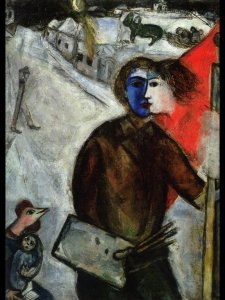
I’ve been very busy recently and haven’t had chance to write as fully as I would like. I’ve been doing this long enough that writing the blog has become habit and I feel a little guilty when I think I’m not attentive enough. But I have tried to alleviate some of my guilt by sharing some things that I do like. Like the video below of the work of Marc Chagall set to the music of Mozart’s Piano Concerto #23 Adagio.
I’ve always been a fan of Chagall’s work. It’s hard to not let myself get caught up in the world of Chagall’s paintings. It’s easy to happily absorb yet you’re never quite sure what it is that you’re taking in. Something magical and mystical there.
I was going to write something this morning about the craziness going on in the current administration. But after a while I began to think that there was no point in it. Those of you who see things as I do with me would nod in agreement.
And if you still believe there is a single bit of honesty, decency, empathy, or any other positive qualities residing at 1600 Pennsylvania Ave, then you most likely will never be swayed by my opinion. If you honestly believe that this person cares about anything but himself and the fortunes of a few friends and family members, then you and I reside on two different planets, my friend.
So, to spare myself the aggravation, I decide to focus on an old favorite who I’ve neglected in the last year or two, blues legend John Lee Hooker. I wrote the following here back in 2008 and didn’t include any of his music. I was new to this blog thing and didn’t even know how to embed a video at that point. So, here’s that post with the music.
Have a good day, if you can.
I remember coming across an old John Lee Hooker album at a used record shop on Market Street in Corning, NY in the 1970’s. It was a beaten piece of vinyl titled Folk Blues. I was just a kid and had no idea who John Lee Hooker was but the album cover had a certain gritty, real feel to it and besides, it was only a buck.
It was from the early 60’s, scratched and worn, and I remember the pops and crackles when I first put down the needle. Didn’t sound hopeful but when his guitar and rhythm section kicked in on songs like Bad Boy and Rock House Boogie ( both tracks from the early 1950’s) it was pure magic. It was simple, direct and raw. The guitar sound was like downed power lines arcing in a storm.
I was hooked by Hooker.
To the casual listener, Hooker’s music could seem repetitive and narrowly focused but to me that was the genius of it. His reexaminations of certain grooves revealed nuance and subtlety that could be easily lost in the distraction of an insanely hypnotic rhythm.
I view my work at times like Hooker’s music. There is sometimes repetition of form, of compositional elements but that is by design. Because I am working in a defined form it allows me to spend more creative effort on nuance– texture, color subtlety and quality of line. The result is a piece that fits easily into the body of my work but has its own feel, its own life. Its own groove.
For this Sunday morning music, it’s got to be Chuck.
The great Chuck Berry died yesterday at the age of 90. In the Pantheon of the gods of rock and roll, Chuck is without a doubt the true father of the genre, the wellspring that fed all others. His music is practically written in our DNA and permeates our culture. It is part and parcel of who we are.
You might think you can’t name a Chuck Berry song but I will bet that you know at least a dozen. In fact, one of his greatest hit albums is called The Great Twenty-Eight and almost every song on it is a rock and roll classic. When that sound comes out of the speaker it is instantly familiar and distinct. You may not have heard the song for forty years but you know the words and melody instinctively.
Oh, you know it.
Like many people, I have probably taken Chuck Berry for granted for many years now. But now that he’s gone I feel a definite sense of loss. Maybe it’s that we are in a period of time where we are struggling for a definition of who we really are as a people, where we seem poised at a juncture that will take us in two very different directions. He was that part of America that drew people here with his Everyman point of view and a sound that was forever young and vigorous.
So, like I said, this morning it’s got to be Chuck. I’ve been listening for about an hour and a half to Chuck and can’t even come close to choosing. I listen to one and go, “Oh, Yeah!” then I hear the next song and do it again. So I’m playing two that just feel good to me. One is Back in the USA and the second is Havana Moon, a quieter, moody song from Chuck that just clicks for me.
Have a good day and if the spirit hits you, as Chuck might say, let it rock.
Last week I shared a couple of videos of the paintings of Edward Hopper set to music. I thought that I’d do the same this week for the work of another of my favorites, the great American Regionalist painter Thomas Hart Benton.
I’ve always loved the rhythm and movement of the elements in Benton’s paintings, in even his most remote landscapes. They seem to be filled with potential energy and the landscape becomes a living, breathing figurative element in his work. That is a trait that I try to emulate in my own work.
This video features his paintings set to the music of late American composer Walter Piston‘s Symphony #6, Movement #4as performed by the St. Louis Symphony Orchestra as directed by Leonard Slatkin. It has that sound of youth, motion, and energy that is often associated with America in the late 19th/early 20th century. Plus it has Benton’s work.
 I only have time enough this morning to throw this song out for this week’s Sunday morning music. The song is At My Window Sad and Lonely with lyrics by Woody Guthrie. The band Wilco and singer Billy Bragg put music to these lyrics along with a number of other Guthrie songs in the Mermaid Avenue albums. The version below is an acoustic version from Wilco frontman Jeff Tweedy. Nice stuff.
 In the inner place where true artists create there exists a pure child.
 I was planning on throwing up a quick post with a video of some of the paintings from another favorite of mine this morning.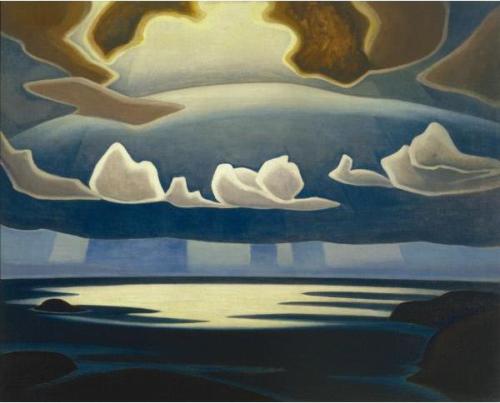

 We may never never meet again, on that bumpy road to love
 Ah, sweet relief!
 It’s a simple and clear cut affair with nothing but the facts running the whole shebang . Three strikes and you’re out. The ball clears the fence and it’s a home run. The team with the most runs wins at the end of nine innings. And since they instituted video reviews of tight plays the only time that opinion comes into play on the field is with the home plate umpire’s calls of balls and strikes.

 I finished this new painting a couple of weeks ago and it has been a piece that I’ve spent a lot of time looking at since its completion. It satisfies me on many different levels and simply raises a certain contentment within me. I guess that would be the textbook definition of what I am trying to do for myself with my work.
 I’ve been very busy recently and haven’t had chance to write as fully as I would like. I’ve been doing this long enough that writing the blog has become habit and I feel a little guilty when I think I’m not attentive enough. But I have tried to alleviate some of my guilt by sharing some things that I do like. Like the video below of the work of Marc Chagall set to the music of Mozart’s Piano Concerto #23 Adagio.
 For this Sunday morning music, it’s got to be Chuck.
 Last week I shared a couple of videos of the paintings of Edward Hopper set to music. I thought that I’d do the same this week for the work of another of my favorites, the great American Regionalist painter Thomas Hart Benton.
 Redtree Times