Really busy this morning as I try to wrap up everything for my Truth and Belief show that opens June 2 at the Principle Gallery. As it always is at this point, a week from delivering the show, there is still a lot to do including what seems like a million little, nit-picky details, those small touches that I find make a big difference.
So this morning I am just throwing out a lovely short video of the paintings of pointillist painter Georges Seurat set to the music of Vivaldi. Both always strike me as rock solid so I figure that you can’t go wrong either way. It’s a good and relaxing way to kick off an overly active Saturday.
So take just a few minutes and relax in the relaxing colors of Seurat and music of Vivaldi.
Well, it’s Mother’s Day. I am not going to wax sentimental here today except to say that I will think of my Mom today, just like I have nearly every day since she passed away nearly 22 years ago. I miss her in so many ways.
The painting at the top is called Days Like This and is a little 6″ by 12″ canvas that will be in my Principle Galleryshow in June. The hanging Red Chair here represents, as it often does for me, a deceased ancestor. Maybe my Mom on this day.
The title is taken from the Van Morrison song of the same name that fits right in with the day and is my selection for this week’s Sunday morning music. Instead of the warnings of bad days and lost loves ahead that The Shirelles offered in the early 60’s hit Mama Said, Morrison’s mother in his song let him know that there would be good days ahead as well.
Hope you have a good day. Be nice to your Mom and if she’s no longer around, remember some good times with her.
Today and the next several days ahead are busy for me as I do prep work for the June 2 opening of my solo show at the Principle Gallery. Even though it’s really hectic it’s not a disorienting kind of chaos. I’ve done this so many times that I understand the rhythm and timing that is required for these preparations.
That knowledge takes care of some of the anxiety but certainly not all of it. Every show has a level of trepidation as you worry about how it will be received. That particular anxiety will never go away and is actually, at least for me, kind of reassuring. I tend to think that when I stop feeling that tension before a show I will have become complacent.
So, I am currently busy, anxious and worried. In other words, things are going about as good as can be expected.
I thought I’d share a nice video I found of the work of Van Gogh set to Don McLean‘s lovely ode to the artist, Vincent. It’s a very pleasant combination for a bustling Monday morning and definitely eases the nerves.
Sunday morning and I just want to hear some music, something that will make me think, maybe move me a bit. I didn’t know what I was really looking for when I came across this John Prine song from his 2005 album, Fair and Square. Even though I say it’s his song it was actually written by songwriter R. B. Morris. John Prine just sang it in that way he has that can either make you laugh or cry depending on the song.
This is one that doesn’t make you laugh. It might not make you cry but it will make you think a little bit and no doubt recognize yourself or someone you know in the lyrics of the song. The first verse dragged me in. Here’s That’s How Every Empire Falls. The lyrics are below.
Have yourself a good Sunday.
Caught a train from Alexandria Just a broken man in flight Running scared with his devils Saying prayers all through the night Oh but mercy can’t find him Not in the shadows where he calls Forsaking all his better angels That’s how every empire falls
The bells ring out on Sunday morning Like echoes from another time All our innocence and yearning and sense of wonder left behind Oh gentle hearts remember What was that story? Is it lost? For when religion loses vision That’s how every empire falls.
He toasts his wife and all his family The providence he brought to bear They raise their glasses in his honor Although this union they don’t share A man who lives among them Was still a stranger to them all For when the heart is never open That’s how every empire falls
Padlock the door and board the windows Put the people in the street “It’s just my job,” he says “I’m sorry.” And draws a check, goes home to eat But at night he tells his woman “I know I hide behind the laws.” She says, “You’re only taking orders.” That’s how every empire falls.
A bitter wind blows through the country A hard rain falls on the sea If terror comes without a warning There must be something we don’t see What fire begets this fire? Like torches thrown into the straw If no one asks, then no one answers That’s how every empire falls.
I thought I’d replay this post from back in 2011 about a little piece that is one of my personal favorites.
I came across this little piece that I had painted long ago, before I ever showed my work to anyone. It’s a tiny little thing, barely 2″ by 3″ in size, but it’s a painting that I consider one of my favorites. It’s not because of anything in the painting itself, although I do like the way it works visually with its simple forms and tones. Actually, it’s because I see an entire narrative in this piece and it always comes back as soon as I see it, even after many years.
I call this Guenther Hears the Boogaloo Softly. The story I see here is a German soldier on patrol in the second World War, in a wintry forest, perhaps in the Ardennes during the Battle of the Bulge. He is separated from his group and as he is alone in the forest he suddenly hears a sound from deep in the woods, echoing softly through the frozen trees. It is a piano and it is like nothing he has heard before. It has a loping bassline that churns and pops and over it is a tap dance of notes that bounce and roll on the rhythm. It’s American boogie woogie. Somewhere unseen in the forest a piano is rolling out that boogie woogie beat.
Guenther is transfixed and holds his breath to better hear the music that enchants him. A siren’s song. He loses all thought of his mission and his duty. He is engrossed by the music.
I don’t go any further with this scenario in my mind. There are obvious directions the story could take. Guenther might allow the music to transfix him to the point he doesn’t hear the American patrol coming upon him. Or he might throw down his weapon and flee. But most likely, he would return to his patrol and if he were lucky enough to survive the war, the memory of that music would haunt him for years, sending him on a search to recapture the sound of that moment in the forest.
I see it simply as a being about the transformative power of music and art, about how they unify humans despite our differences. When we hear or see something, we don’t do so as a German or an American, as a democrat or a republican, as a Christian or a Muslim. We react as a human to our individual perceptions. Sometimes we cannot shake these other labels we carry with us but there are moments when our reaction is pure. Which is what I see in this little bit of paint and paper, in Guenther’s reaction to the piano.
Such a little bit of paint yet such a lot to say…
Afternote: There is a certain irony that the boogie woogie sound is largely kept alive by Europeans now with people such as Axel Zwingenberger and Silvan Zingg, a pianist known as the Ambassador of Boogie Woogie who hosts a boogie woogie festival in his native Switzerland each year. But here’s a little taste of boogie woogie from the late pianist Dorothy Donegan (1922-1998) as she performs Hallelujah Boogie Woogie. In her 70’s, she’s having a good time and putting on a real show.
“Can anything be imagined so ridiculous, that this miserable and wretched creature [man], who is not so much as master of himself, but subject to the injuries of all things, should call himself master and emperor of the world, of which he has not power to know the least part, much less to command the whole?”
Dominium is the title of this new painting, a 24″ by 24″ canvas that is part of my annual solo exhibit at the Principle Galleryin Alexandria, VA. The show opens June 2.
I’ve spent a considerable amount of time looking at this painting in the last several weeks and have found that it is an easy piece in which to withdraw. Even though there are paths coming into the picture, which normally denotes the presence of people, it is the absence of humans that is the message that I get from this piece.
We have no dominion over this world. It is the land that holds sovereignty for no matter how badly we abuse and squander the bounty that this world provides, it will no doubt persist in some living form well beyond the very short time our species will litter its surface. We are not the owners of the land or its creatures nor treat this planet as though we were. No, we should act only as caretakers and custodians of this world, for that is the only way we can extend our tenuous time in this bountiful place.
Maybe this is snapshot of a time beyond ours. Or maybe it is a hopeful example of how we should coexist with our environment.
I don’t know which. I do know that it makes me feel better to just stare at it for a while and that’s a good thing these days. It’s far too easy today to cynically believe that the hubris, stupidity and selfishness that is so prevalent in our species will prevail. All available evidence points in that direction.
But this piece gives me a bit of peace of mind and with that comes the possibility for hope. And that hope at least makes possible the opening of one’s mind which leads to the possibility of obtaining wisdom. And wisdom gives us a chance to use our limited knowledge and abilities to the greatest benefit, to possibly avert destroying our world.
Save the world. That’s a lot to ask of a simple painting. But maybe that is a major purpose of art– to save us from ourselves, to bring light to the darkness.
Okay, in that same vein, this week’s Sunday morning musical selection deals with the ecology. It’s the classic Mercy Mercy Me from Marvin Gaye. That’s two Sundays in a row for Marvin but it just felt so right.
Give a listen, have some hope and with that, a great day.
Several years back, I wrote here about the late Croatian painter Ivan Generalic (1914-1992). I don’t really know how his work is categorized. He mixed folk art, rural Eastern European village life and folklore, and allegory in a painting style that was richly colored and inviting. It was most often painted on glass which increased its vibrancy and glow. It had a certain charm that reminded me of the jungle paintings of Henri Rousseau.
I thought I’d share a video this morning that features his work set to music, “Raindrops Prelude” by Grupo Pedagógico Infantil. It’s a nice and interesting watch. I urge you to take a few minutes and give it a look and a listen.
Another Sunday morning and I am ready for a little music. I was looking at some of the Nocturnepaintings of James McNeill Whistler that I so much admire, like the one shown above from 1877, and thought I’d use that as the theme for this week’s music.
There are a lot of songs that use night as a theme but I settled on the classic Night Life written by Willie Nelson back in the late 1950’s. It has been covered by a lot of folks over the years, some good and some not so much. But for me while Willie’s version remains the truest and best of the bunch, I am partial to this performance by the great Marvin Gaye. He inserts his own special feeling into the song and the night life he creates is indeed his life. Good stuff.
I’m not a religious person and wasn’t raised with any religion in my life. Growing up, Easter was just another excuse to gorge myself on candy and boiled eggs.
But the idea of resurrection that this day represents is a potent theme, one that resonates deeply with me. I am not talking about actual resurrection, the rising from the grave type of thing. But the idea of rebirth, of washing away the past and beginning anew has always struck a chord within me.
Maybe that’s why I am a morning person. Each day is a personal resurrection of sorts. There is a new start each day the sun comes up, a new chance to redeem yourself in some way. So, in a way, Easter is just part of a continuum of constant rebirth, one that transcends personal religion.
For this Sunday morning music I am choosing a song that concerns itself with a more literal form of resurrection. It is Ain’t No Grave (Gonna Hold This Body Down) which was written in 1934 by Claude Ely. He was twelve years old at the time and was stricken with tuberculosis. His family is said to have prayed for his health to return and in response, he spontaneously performed this song.
I can’t attest to that part of the story but it is a pretty well known gospel standard now. This version is from the great Odetta.
The newer painting above is a small 8″ by 8″ panel that I call Resurrection. It feels very Easter-y to me.
I have been enjoying the films I’ve been sharing lately featuring the work of some of my favorite artists. It sometimes gives me a wider view of their body of work, giving me glimpse at lesser known pieces alongside their greatest hits while listening to music that often fits the tone of the work.
Today’s pick was an easy one for me. It’s a lovely compilation of the work of Andrew Wyeth set to the gorgeous guitar of John Williams‘ version of British composer Stanley Myers’ Cavatina. You might recognize the song from its prominent place in the film The Deer Hunter.
Andrew Wyeth would have been 100 years old in 2017 and to mark the occasion, the Fenimore Museum in Cooperstown has an exhibit opening in May that celebrates the life and work of Wyeth. It is curated by his granddaughter, Victoria Wyeth, and includes many items from his personal collection. It is on my to do list.
Anyway, enjoy this beautiful group of paintings and the music that accompanies it. I am off to work, happier for having watched this short film this morning.
 Really busy this morning as I try to wrap up everything for my Truth and Belief show that opens June 2 at the Principle Gallery. As it always is at this point, a week from delivering the show, there is still
  a lot to do including what seems like a million little, nit-picky details, those small touches that I find make a big difference.
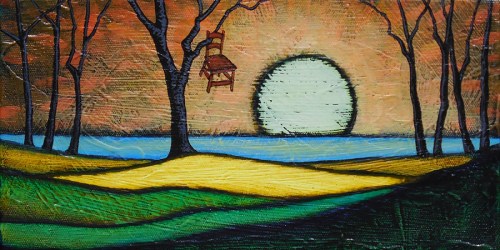 Well, it’s Mother’s Day. I am not going to wax sentimental here today except to say that I will think of my Mom today, just like I have nearly every day since she passed away nearly 22 years ago. I miss her in so many ways.
 Today and the next several days ahead are busy for me as I do prep work for the June 2 opening of my solo show at the Principle Gallery. Even though it’s really hectic it’s not a disorienting kind of chaos. I’ve done this so many times that I understand the rhythm and timing that is required for these preparations.

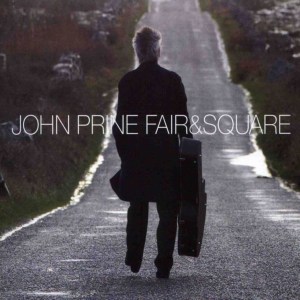 Sunday morning and I just want to hear some music, something that will make me think, maybe move me a bit. I didn’t know what I was really looking for when I came across this John Prine song from his 2005 album, Fair and Square. Even though I say it’s his song it was actually written by songwriter R. B. Morris. John Prine just sang it in that way he has that can either make you laugh or cry depending on the song.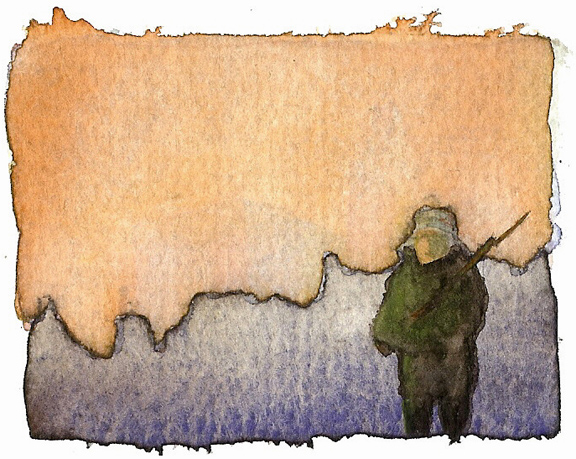
 “Can anything be imagined so ridiculous, that this miserable and wretched creature [man], who is not so much as master of himself, but subject to the injuries of all things, should call himself master and emperor of the world, of which he has not power to know the least part, much less to command the whole?”
  Several years back, I wrote here about the late Croatian painter Ivan Generalic (1914-1992). I don’t really know how his work is categorized. He mixed folk art, rural Eastern European village life and folklore, and allegory in a painting style that was richly colored and inviting. It was most often painted on glass which increased its vibrancy and glow. It had a certain charm that reminded me of the jungle paintings of Henri Rousseau.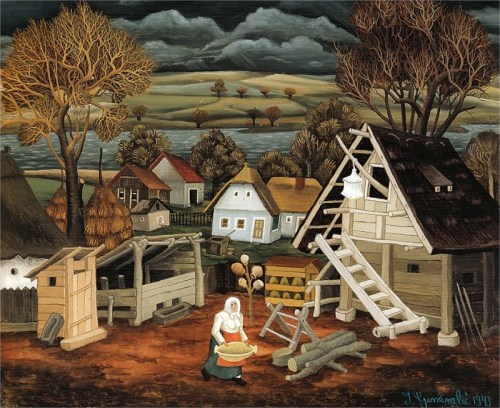
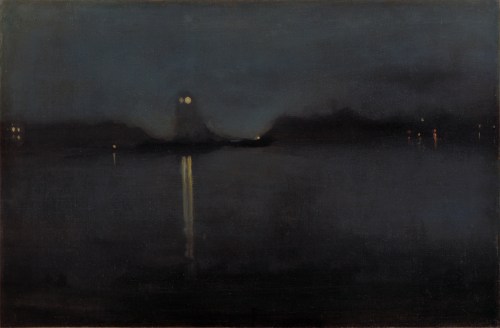 Another Sunday morning and I am ready for a little music. I was looking at some of the Nocturne paintings of James McNeill Whistler that I so much admire, like the one shown above from 1877, and thought I’d use that as the theme for this week’s music.
 I’m not a religious person and wasn’t raised with any religion in my life. Growing up, Easter was just another excuse to gorge myself on candy and boiled eggs.
 I have been enjoying the films I’ve been sharing lately featuring the work of some of my favorite artists. It sometimes gives me a wider view of their body of work, giving me glimpse at lesser known pieces alongside their greatest hits while listening to music that often fits the tone of the work.
 Today’s pick was an easy one for me. It’s a lovely compilation of the work of Andrew Wyeth set to the gorgeous guitar of John Williams‘ version of British composer Stanley Myers’ Cavatina. You might recognize the song from its prominent place in the film The Deer Hunter.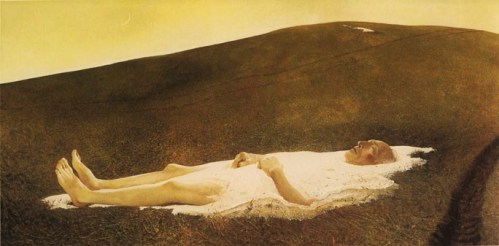
 Redtree Times