Feeds:
Posts
Comments

Archive for the ‘Music’ Category

Texas


Austin Texas February 2021


There could be only one result . . . If men insisted on being free from the burden of a life that was self-dependent and also responsible for the common good, they would cease to be free at all. Responsibility was the price every man must pay for freedom. It was to be had on no other terms.

Edith Hamilton, The Echo of Greece [1957]


I was looking for a song to play for this week’s Sunday Morning Music and I stumbled across a Chris Rea song from the 1980’s, from an album of his that I listened to quite often back in the day. I searched the blog’s archives to make sure I hadn’t played it before or too recently.

I found that the last time I used a Chris Rea song here was last April. It was the title song, The Road to Hell, and it was used in a blog post about how people were using the word freedom in those early days of the pandemic as an excuse for refusing to accept any responsibility or accountability to their fellow citizens. For example, their right to get their hair cut–or wear a mask, god forbid!– was greater than any responsibility they held for the safety and welfare of those folks that they came in touch with.

In that post I employed some quotes from the late Classicist scholar/mythologist Edith Hamilton that described the lack of responsibility and accountability that marked the downfall of the Athenian empire. There was the quote at the top along with this:

When the freedom they wished for most was freedom from responsibility, then Athens ceased to be free and was never free again.

Her words really struck me last April in that it was the same shirking of duty and responsibility that we have been experiencing here in recent times, a trend that really stood out during our time of greatest need. People wanted to say they were free but only with the implication that it meant that they were free from all, responsibility, accountability, empathy, or conscience. 

That might be some sort of libertarian wet dream but that ain’t freedom, folks. At least, not for a country as wide and as varied as we are.

I’ve said it before: Freedom ain’t free.

Reading this blog post from last year reminded me of the situation that has been taking place in Texas. Now, I don’t claim to know all the intricacies of Texas power ( or political power) system so I can’t really make any informed commentary but it sure seems like what took place in recent times there pretty much lined up with Edith Hamilton’s words.

Put plainly, people entrusted to provide necessary services grabbed all the cash they could while doing as little as possible to maintain or improve the system or to accept any sort of personal responsibility for the citizenry they served.

The privatized power system was a cash cow that was there to be milked until it fell over and died. Then they thought they could simply walk away, buckets of cash in hand.

That’s how it looks to me but like I said, I don’t jack about what really goes on down there. But privatizing something so important as the power system without having a mechanism for accountability seems like a recipe for disaster. And this disaster, while labeled as a natural disaster, was more of a man-made disaster, one of great negligence.

I don’t think this is the same sort of freedom that Texans think they were told that this would provide.

End of commentary. Well, close to the end.

Anyway, this post reminded me of another Chris Rea from that same album, a song called Texas. It’s about a guy in, I Believe, Ireland who dreams of Texas, fantasizing about its size and wide open spaces. He sees it as a place of escape. A place where a man can be free. 

Hopefully, his idea of being free is not the same sort of freedom that we’re seeing come to fore at the present. 

Anyway, here’s the song Texas set to a wonderful slideshow of the natural beauty and wonders that make Texas an exceptional place. That exceptional is code for one of my Texas friends. He’ll get it. 

To my friends in Texas, glad to see the cold weather moving past you now. Now comes the hard work of cleaning up and restoring some sense of normalcy. Let’s work on our empathy and our responsibility to those around us so that we can all weather the next storm.

 After all, freedom ain’t free, my friends. Have a good day.


Read Full Post »


I’m helplessly and permanently a Red Sox fan. It was like first love…You never forget. It’s special. It’s the first time I saw a ballpark. I’d thought nothing would ever replace cricket. Wow! Fenway Park at 7 o’clock in the evening. Oh, just, magic beyond magic: never got over that.

― Simon Schama


Maybe it takes the words of an esteemed British historian like Simon Schama to best describe the grand attraction of a ballpark when first seen in the waning light of the day, with the lights making the green grass and bright white chalk lines of the field pop into your eyes. I remember that feeling at Shea Stadium in the late 60’s, going up the darkened ramp from the concourse to the stands, emerging into a burst of deep colors and lights along with the buzz of the crowd increasing with each step forward.

It was magic beyond magic.

Baseball is back this week, with Spring Training beginning. For me, baseball is the canary in the coalmine. It felt odd and out of place last year with a raging pandemic and the country ripped apart by culture wars and the political apocalypse of an election that felt as existential as any we have had in recent times. Baseball was still there in a weird bubble that took away much of what made it important as a cultural touchstone.

It felt sporadic and detached.

Like most of us.

But it is coming back, as it always has each February, and with it comes the hope that we are nearing a point where we can sometime soon return to a form of normalcy. Where kids can experience that burst of color and light for themselves, can root loudly for slick fielding infielders and hard hitting sluggers. Where old farts like me can revel in the cyclical nature and routine of the game along with its esoteric details, its poetry, and its history. That

Author Michael Chabon, in his book Summerland, put words to my own feelings the game and how it echoes and rhymes with day to day life:

 The first and last duty of the lover of the game of baseball,” Peavine’s book began, “whether in the stands or on the field, is the same as that of the lover of life itself: to pay attention to it.

I have had trouble immersing myself in spectator sports this past year with all that is happening. But the start of Spring Training offers renewed hope. And that hope is a big part of the game. While personal glory and team victory are the goal, baseball is a game about how one copes with failure. It is a game of humility. The greatest players of all time failed more than they succeeded and most players go through their careers without winning the World Series. 

The hope is that if you give it your best effort, this pitch might be the big pitch or this catch will be the big catch. This hit might be the big hit.

This year might be the year.

It is a grand metaphor for the hardship and grace of life that repeats itself 162 times a year. Like life, it offers us everything if only we pay attention.

Pay attention and have a good day.

Here’s a favorite baseball tune from Mabel Scott to kick off the season:


Read Full Post »


“Everyone must leave something behind when he dies, my grandfather said. A child or a book or a painting or a house or a wall built or a pair of shoes made. Or a garden planted. Something your hand touched some way so your soul has somewhere to go when you die, and when people look at that tree or that flower you planted, you’re there.

It doesn’t matter what you do, he said, so long as you change something from the way it was before you touched it into something that’s like you after you take your hands away. The difference between the man who just cuts lawns and a real gardener is in the touching, he said. The lawn-cutter might just as well not have been there at all; the gardener will be there a lifetime.”

― Ray Bradbury, Fahrenheit 451


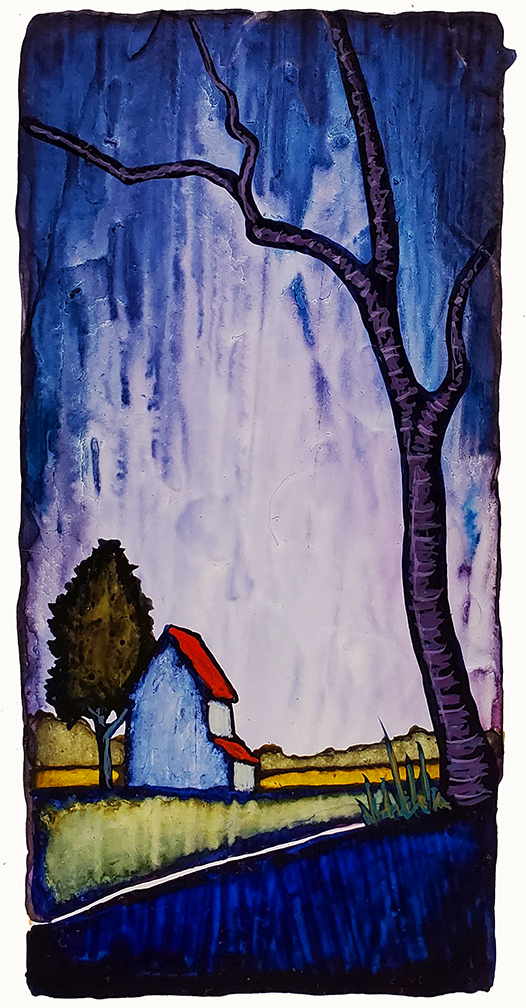
I recently finished this small piece shown above, a little guy that’s only 2″ by 4″ on paper. I wasn’t — and am not yet– exactly sure what meaning it holds for me, what message, if any, it carries. It certainly felt like it had something to offer.

It might be small but it seemed like it was speaking with a much larger voice. I was mulling this over this morning when I heard a new song, Calling Me Home, from one of my big favorites, Rhiannon Giddens. It’s from a new album coming out in April. There’s a line in the song that immediately struck me:

Remember my stories, remember my songs/ I leave them on earth, sweet traces of gold

It made me think of that existential question: What is it we leave behind?

That immediately brought to mind a favorite excerpt, shown at the top, from Ray Bradbury in his sci-fi/ dystopian classic Fahrenheit 451. It’s those things to which we devote or full effort, our mind and time, that have lasting effect. Often, things that are done with no real expectation of anyone recognizing your thought or effort in doing them.

It makes me think of my pond. I can see its top now in the winter since the leaves have fallen from the trees. I built it back in the summer of 1998 during a week spent pounding the hard pan soil beneath the clay of my property on a rented Cat D9 dozer. I am not sure my brain has come to rest yet from that beating. But the thrill of seeing it fill in the rains later that summer and fall along with the many life forms that soon made it their home were as satisfying as anything I have painted. I often look at it and think that it will be here long after I am gone, supporting lives of creatures that will have no knowledge of my efforts.  

And that pleases me greatly. Even as much as any legacy my work here in the studio, if any, will have.

I think I will call this little painting Calling Me Home. Not sure it’s absolutely the title others will see but if fits for me this morning.

Here’s the song from Ms. Giddens. have a good day, 


Read Full Post »


If you only had brain in your head you would be as good as man as any of them, and a better man than some of them. Brains are the only things worth having in this world, no matter whether one is a crow or a man. 

― L. Frank Baum, The Wizard of Oz


Watched the end of the impeachment trial yesterday. Sad day for this country and for every American as the former president* was acquitted.

Acquitted but not exonerated in any way.

It was actually more of an embarrassing day for republican voters who see themselves as being American first then republican. I believe there are a few still remaining out there. These folks witnessed and understood the criminality– which their party leader readily admitted was present in the words and actions of the president– that put our democracy in peril, knew that it went against everything that our country once claimed as virtues.  But they saw the majority of their craven senators say that it didn’t matter, that their partisanship and short term self-interest was more important than doing what was right for the future of our nation.

These senators seem intent on following the road to disgrace to its bitter end.

Their votes to acquit made this political in a proceeding that, at its heart, was not apolitical. It was necessary and for the majority party to have not went down this path would have been betraying their sworn oaths to the Constitution and to the future generations of this country. The House Managers laid out a compelling and convincing evidentiary argument that won the day.

57-43 is a victory in a way. It was an acquittal but, as I said, not an exoneration. No innocence was implied or proven. The majority of the country recognizes and approves of the guilt attached to this vote. I say majority because the 57 senators who voted to convict represent 76.7 MILLION MORE Americans than the 43 dissenting senators.

The people know. 

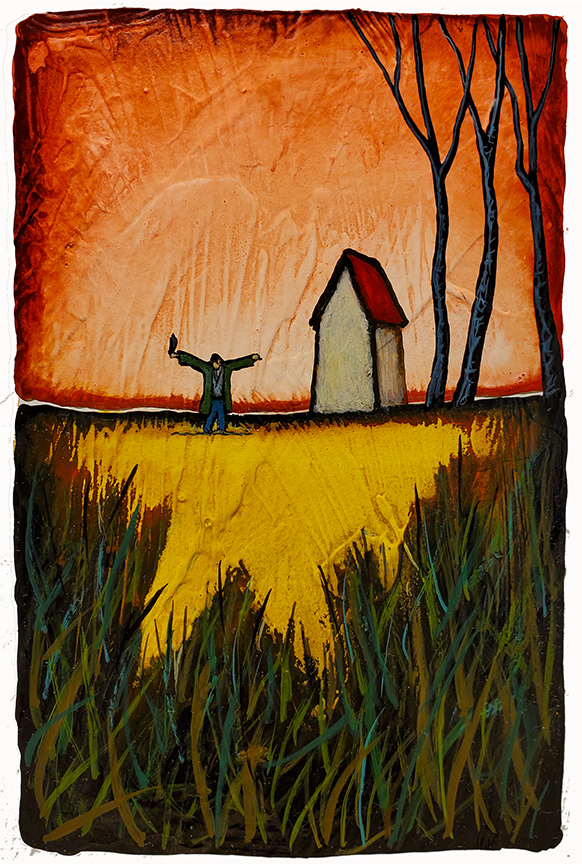
Let’s move on now to the Sunday morning music for this week. I was working on the small painting at the top the page yesterday while listening to the impeachment proceedings. I don’t know what made the idea of a person standing in the field as scarecrow come to mind but it appeared around the time the voting was taking place. I can’t quite put my finger on the feeling I get from it or its origin but it seemed to fit the moment.

Maybe it cam from the quote at the top from L. Frank Baum’s Wizard of Oz? If they only had a brain…

The piece itself reminded me of the old John Cougar Mellencamp song, Rain on the Scarecrow, from 1985. He started his career with the cheesy stage name of Johnny Cougar before attaching his actual Mellencamp last name and eventually getting rid of the Cougar altogether.

In 1985, he was still John Cougar Mellencamp. He had a great trio of albums in the late 1980’s starting with this album, Scarecrow, followed by The Lonesome Jubilee and Big Daddy. They were all strong. complete albums. This song has been a favorite from when I first heard it back then. I also want to note that John Mellencamp is a talented painter as well.

But here’s Rain on the Scarecrow to go along with the new piece at the top which is simply called Scarecrow.

Be careful out there and have a good day.


Read Full Post »


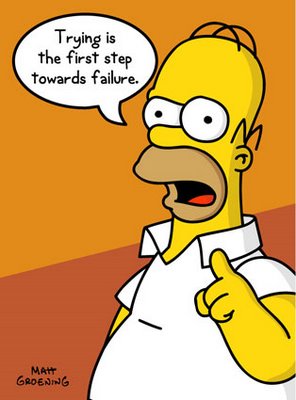
If at first you don’t succeed, try, try again. Then quit. There’s no point in being a damn fool about it.

-W.C. Fields


I wanted to play another song, I Don’t Mind Failing, from the late folksinger Malvina Reynolds and thought a replay of this post from a decade ago would fit well with it. Not much has changed in these past ten years from the standpoint of failure. The post below, from 2011, was titled Failure, of course


In response to yesterday’s post concerning a very large blank canvas that is waiting patiently for me, I received several very interesting questions from my friend, Tom Seltz, concerning the role that failure and the fear of failure plays in my work. He posed a number of great questions, some pragmatic and some esoteric, that I’ll try to address.

On the pragmatic side, he asked if there is a financial risk when I take on large projects like the  4 1/2′ by 7′ canvas of which I wrote. Actually, it’s not something I think about much because every piece, even the smallest, has a certain cost in producing it that, after these many years, I don’t stop to consider. But a project such as this is costlier as a larger canvas is more expensive right from the beginning simply due to the sheer size of it. The canvas is heavier and more expensive and more of it is used. I use a lot more gesso and paint. The framing is much more expensive and the logistics of shipping and transporting become more involved and costly. It’s larger size and price means the audience of potential buyers is much more limited which means more time trucking it around or storing it.

And while these cost of materials and handling are the larger cost, the biggest financial risk comes in the time spent on such a project. It takes longer to prepare such a large canvas, longer to paint and, if it works out, longer to finish and frame. This is time not spent on other projects. Wasted time is by far the biggest risk in facing such a project and that is something I have to take into consideration before embarking on large projects.

He also asked whether I can reuse the materials if I don’t like what I’ve painted. Sure, for the most part.  Especially canvasses. Actually, the piece shown here on the right was once such a piece. There’s a failure lingering still beneath its present surface.

I had a concept in my head that floated around for months and I finally started putting it down on this 30″ square canvas. I spent probably a day and a half worth of time and got quite far into it before I realized that it was a flawed concept, that I was down a path that was way off the route I had envisioned. It was dull and lifeless, even at an early stage.

It was crap and I knew that there was no hope for it. I immediately painted it over, mainly to keep me from wasting even more time by trying to resuscitate it, and the piece shown here emerged, happily for me.

Tom also asked if I ever “crashed and burned” on a piece or if the worst sort of failure was that a piece was simply mediocre. Well, I guess the last few paragraphs say a bit about the “crashed and burned” aspect, although that is a rarer event than one might suspect. The beauty of painting is that it’s results are always subjective. There is almost never total failure.

It’s not like sky-diving and if your parachute doesn’t open you die. At least, that hasn’t been my experience thus far. I’m still here.

Mediocrity is a different story. That is the one thing I probably fear most for my work and would consider a piece a failure if I judged it to be mediocre. I have any  number of examples I could show you in the nooks and crannies of my studio but I won’t. Even flawed and mediocre, these pieces have a purpose for me and some have remaining promise. The purpose is in the lessons learned from painting them. I usually glean some information from  each painting, even something tiny but useful for the future. Each is a rehearsal in a way. But most times, the mediocre pieces teach me what I don’t want to repeat in the future. A wrong line or form here. A flatness of color there. Just simple dullness everywhere.

But, being art, there are few total failures, and many of these somewhat mediocre pieces sit unfinished because there are still stirs of promise in them.  I can’t tell you how many times I’ve come to what I felt was a dead end for a painting, feeling that it was dull and lifeless, and set it aside. Months and months might pass and one day I might pick it up and suddenly see something new in it. A new way to move in it that brings it new life. These paintings often bring the greatest satisfaction when they leave the gallery with a new owner.

Sometimes failure is simply a momentary perception that requires a new perspective.

Sometimes you need to fail in order to succeed later.

Okay, that’s it for now. I’m sure I have more to say about failure but it will have to wait until a later date. I’ve got work waiting for me that doesn’t know the meaning of the word failure and I don’t want to take the risk that it might learn it.

Tom, thanks again for the great questions.  I’m always eager for good questions so keep it up!


Now here’s I Don’t Mind Failing from Malvina Reynolds. It’s from around 1965 and was written after hearing a sermon called The Fine Art of Failing. Lot of great lines in this one:

I don’t mind failing in this world,
Somebody else’s definition
Isn’t going to measure my soul’s condition,
I don’t mind failing in this world.

Give a listen and if you fail today, don’t worry about it. You’re in good company.


Read Full Post »


To live on a day-to-day basis is insufficient for human beings; we need to transcend, transport, escape; we need meaning, understanding, and explanation; we need to see over-all patterns in our lives. We need hope, the sense of a future. And we need freedom (or, at least, the illusion of freedom) to get beyond ourselves, whether with telescopes and microscopes and our ever-burgeoning technology, or in states of mind that allow us to travel to other worlds, to rise above our immediate surroundings.

We may seek, too, a relaxing of inhibitions that makes it easier to bond with each other, or transports that make our consciousness of time and mortality easier to bear. We seek a holiday from our inner and outer restrictions, a more intense sense of the here and now, the beauty and value of the world we live in.

― Oliver Sacks. New Yorker article 2012


I was thinking this morning about how I would describe the painting at the top, Steady As She Goes. It is included in the Little Gems show at the West End Gallery which opens today. 

At first, I was thinking about sailing but I really don’t much about that subject. I can try to imagine the thrill of the open water, the feeling of untiy with the natural world, but I’m pretty sure it’s not the same as the real experience.

I began to wonder what was the underlying appeal of sailing, of open water. All that came to me was the word escape.

That made sense. You’re free from the ties that bind out there, subject, of course, to the whims of Mother Nature. We can never free ourselves from her her apron strings.

Yes, escape. And that representation of escape might be the appeal of these boat paintings even for us non-sailors. 

I searched for  a few words from others to describe that and came across the excerpt from a 2012 article in the New Yorker from the late Oliver Sacks, who wrote about how we need some form of escape from the day-to-day, an outlet where we are free from the restrictions set upon us by others. 

I was torn between the Sacks excerpt and these words from the great Graham Greene:

Writing is a form of therapy; sometimes I wonder how all those who do not write, compose, or paint can manage to escape the madness, melancholia, the panic and fear which is inherent in a human situation.

It seemed a little more pointed at creative types but made great sense to me. My work certainly does provide me with an escape route from the stresses and pains of the real world. 

I wasn’t sure which quote to use but, in the end, I guess I opted for using both.  After all, this is my blog and I can do what I want. I make the rules.

Maybe this is, in itself, a form of escape?

Maybe I should take up sailing. Since it’s about 8° this morning, that seems unlikely anytime soon. So, let’s listen to a favorite song from Lyle Lovett. It’s If I Had a Boat from his epic 1988 album Pontiac. I listened to this album over and over back then and it was a means of escape at times. It still holds up beautifully to this day.

Hope you find your own escape route and have a good day.


Read Full Post »


“I have an idea that some men are born out of their due place. Accident has cast them amid certain surroundings, but they have always a nostalgia for a home they know not. They are strangers in their birthplace, and the leafy lanes they have known from childhood or the populous streets in which they have played, remain but a place of passage. They may spend their whole lives aliens among their kindred and remain aloof among the only scenes they have ever known. Perhaps it is this sense of strangeness that sends men far and wide in the search for something permanent, to which they may attach themselves. Perhaps some deep-rooted atavism urges the wanderer back to lands which his ancestors left in the dim beginnings of history.”

W. Somerset Maugham, The Moon and Sixpence


Short one today for this Sunday morning. The painting above is a little guy, a new 2″ by 4″ piece called What Was, headed to the West End Gallery for the Little Gems show. It’s one of those pieces that speak to me of the search for home, a theme that has been pretty prevalent in my work over the years.

I very much identify with the excerpt above from Somerset Maugham’s The Moon and Sixpence whose story incorporates the search for home by Paul Gauguin, which eventually took him to Tahiti. I have always felt a bit out of place, even in this place where I have lived all my life.

Yet, I don’t know what place or situation might ever make me feel truly at home. Maybe that’s the purpose of my work, at least for me personally. To formulate an idea of what home might be.

I don’t really know. But I know that it has a strong pull.

Let’s leave it at that. For this Sunday, on the theme of home, I am returning to an old Staple Singers song from the late 1950’s. I played Uncloudy Day on this blog recently and this song, I’m Coming Home, is very much in that same vein. It’s from the same timeframe and has that same sort of sharp underlying guitar line from Pops and powerful vocals from a very young Mavis Staples. Great song to kick off a cold Sunday morning.

Have a good day.


Read Full Post »

“Memory and Return”- At the West End Gallery


It was odd getting up this morning and not staggering out the door to climb on my tractor to plow. It was almost becoming habit. Not having to do so felt liberating and it was nice to relax as I walked over to the studio under a still hanging half-moon that made the icy surface of the deep snow sparkle.

It was nice image. It made me wonder if these sort of images linger in our subconscious, becoming enmeshed and part of who we are.

They say that your life flashes in an instant in your mind’s eye just before you die. Would these be one of those images that would flash before my eyes when my time comes? Would they be random moments that didn’t even register in our conscious mind, hidden clues to who we are that lay deep in our brains waiting for the final moment to reveal themselves?

Or would they be those moments and faces and places that we do remember consciously, that we have already placed in our memory as being important?

I find myself often wondering about what sort of imagery, if any, would be there. Sometimes I will stop in the woods on those seemingly perfect days when the temperatures are pleasant and the sky peeking through the trees is that rich color of placid blue. Looking up, I will think to myself that if this were the last image in the final flash of my life, I would be okay with that.

And if not, it’s a perfect moment of calm in the present moment. Win-win as they say.

I guess I won’t know the answer to my questions until that last moment so I most likely won’t be able to write about them here. I just hope I am satisfied with what I am shown.

It would be awful if I were to end up like the Albert Brooks character in his film Defending Your Life who has to make the case after his death, using flashbacks to vital points in his life, that his time on Earth was well spent and that he was worthy to move on to the next world. His flashbacks focused, to great comedic effect, on his many fears and his weaknesses. 

I was hoping for something a little more zen, perhaps even answers to what the meaning might be for this particular life on this strange spinning planet.

But you get what you get, I suppose. We most likely have to do our own editing now, while we have the opportunity, if we want to be pleased when that flash comes before our eyes. 

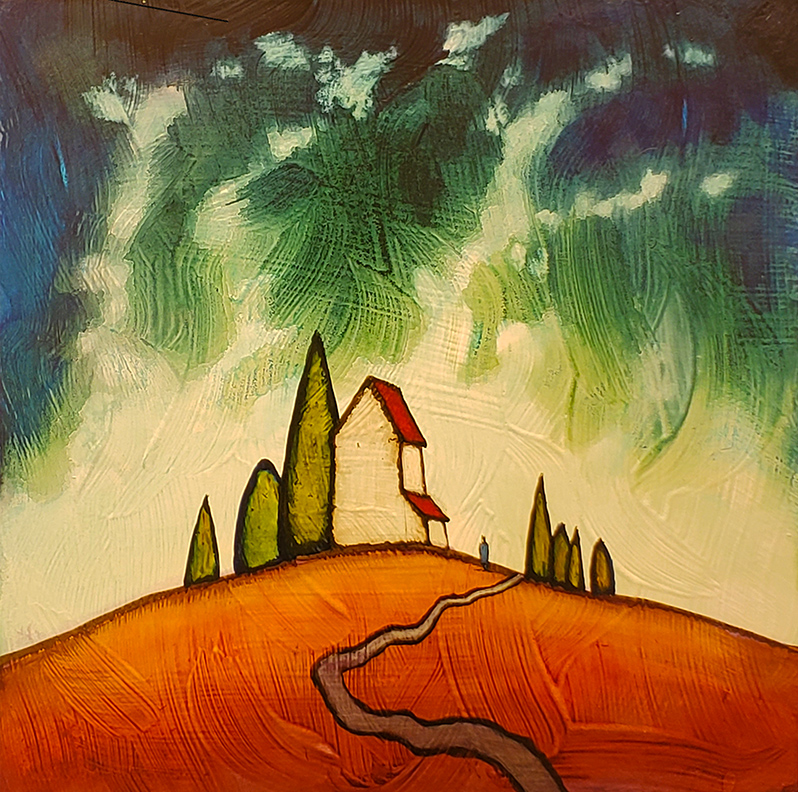
That brings me to the painting at the top, an 8″ by 8″ piece called Memory and Return that is part of the West End Gallery’s annual Little Gems show of new small work, that opens next Friday, February 12. This piece has that feel of an image that might flash in my mind during that final slideshow of my life.

I don’t exactly know why.

While I am hoping the rest of the film will reveal the answer, I am mainly hoping I don’t see this film for some time to come. 

Here’s a lovely rendition of a favorite song that continues this theme. The song is In My Life from the Beatles and this version is from Diana Krall.

Give a listen, then go work on your own film and have a good day.


Read Full Post »

“Private Space”- Available at the Principle Gallery, VA


Oh, they tell me of a home where my friends have gone
Oh, they tell me of that land far away
Where the tree of life in eternal bloom
Sheds its fragrance through the unclouded day

Uncloudy Day, Josiah K. Alwood 


Still on a semi-hiatus here on the blog but wanted to continue playing my Sunday Morning musical selection. This week I am going way back with a gospel tune called Uncloudy Day, written by Josiah K. Alwood in 1879. We’re not going back quite that far for this week’s pick but it’s still pretty old, taking us back to 1956 when The Staple Singers first recorded what is probably the definitive version of this song. 

This is a powerfully performed song, with the droning bite of the undertone from the electric guitar of Pops Staples and an emotional vocal lead from Mavis Staples. It’s hard to believe but Mavis was only 16 years old when she recorded this.

It’s reported that this song was a huge influence on a young Bob Dylan. His appreciation didn’t stop at the song as he pursued and proposed to Mavis Staples in the early 1960’s. She turned him down but they have maintained a close friendship and working relationship to this day, recording and touring together periodically over the many decades that followed.

Anyway, it’s a song that always stops me in my tracks and I think anything that makes you stop to listen is a good song to kick off a Sunday. 

Be careful out there and have a good day.


Read Full Post »

9913217-fragments-sm


“All there is, is fragments, because a man, even the loneliest of the species, is divided among several persons, animals, worlds. To know a man more than slightly it would be necessary to gather him together from all those quarters, each last scrap of him, and this done after he is safely dead.”

Coleman Dowell, Island People


[Been running some older posts this week — and maybe next week, as well– as I attempt to recalibrate. Or better yet, as the post below says, gather the fragments and try to reassemble them in some workable form. This post features a favorite painting here in the studio as well as a favorite song.]


It’s been hard finding footing lately in the studio. It’s been hard to just get started on most days. There are plenty of factors that play in to this, some external and some internal, some that I can control and some I cannot. But the end result is the same: left feeling fragmented, broken into shards that don’t want to reassemble easily in the form of my work.

I am not worried however. This is not the first time I’ve felt so fragmented nor will it be the last. I know that I come apart at times and have to bide my time, just continuing to try to put myself back together so that I may uncover what I know is waiting there for me.

It’s there. It may seem an awfully long way away but I can see it and I know that while it may take time and much effort, I shall be together with it again.

The painting above is a piece that has been with me for a while now. One of the orphans that come home to reside for a bit.  I wrote about it last year when I thought I might change its name to Dimming of the Day but it still remains under its original title, Fragments, in my mind. And I suspect it will stay that way.

This painting is based very much on this feeling that I am experiencing at this moment and when this feeling emerges, I often think of this painting.  There is darkness and distance here. The space between the Red Chair and the house has a certain weight that makes me feel as though there is something more than physical distance at play here. The sky, a confetti-like blend of thousands of little fragments of brushstrokes that gave the painting its title originally, represents, for me at least in this piece, the world falling out of harmony.

Dark, distant and coming apart.

Yet despite that I find this painting very comforting. I think that goes back to what I said above, that I know this place well from past experience. I know how to navigate it and know that the distance is not so great nor the darkness too deep. And I know that the parts are still in place to come together again in the future if I simply exercise patience and don’t give in.

It’s funny how that works. I walk by this painting several times a day in the studio and it’s often without a thought as my mind is preoccupied with something else. But every so often I stop before it and suddenly all of these feelings flood back on me when I look closer. I’m glad it works that way, actually.

Here’s the song, Dimming of the Day, which made me think about renaming this painting. It’s from one of my favorites, Richard Thompson. This is a great acoustic version. Have a good day…


Read Full Post »

« Newer Posts - Older Posts »