I am always interested in seeing what the extreme magnification of an electron microscope reveals about our world. It’s fascinating to see how tiny matter is built, often having a beautiful architectural grace in their patterns and constructions. For example, this fellow to the left is a phytoplankton, a microscopic organism that lives in a watery environment, in both fresh and salt water. Basically, a form of algae that is at the base of the marine food web.
This particular phytoplankton is a coccolithophore, which denotes that it is covered in the calcium plates (called coccoliths) that you see on its surface. There are over 30 plates on each of these organisms and when they die these plates break free and, in great concentrations, form a deep and opaque turquoise bloom in the sea water.
These little guys hold an important position in the environment, one which I am still struggling to fully understand. There’s an article on NASA’s Earth Observatorysite that better describes their nature and place in the world. For me, I am simply intrigued by the shapes and patterns of this creature.
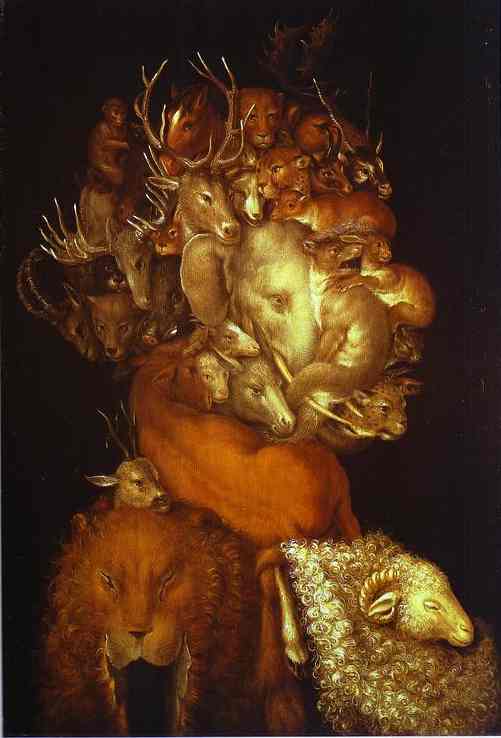
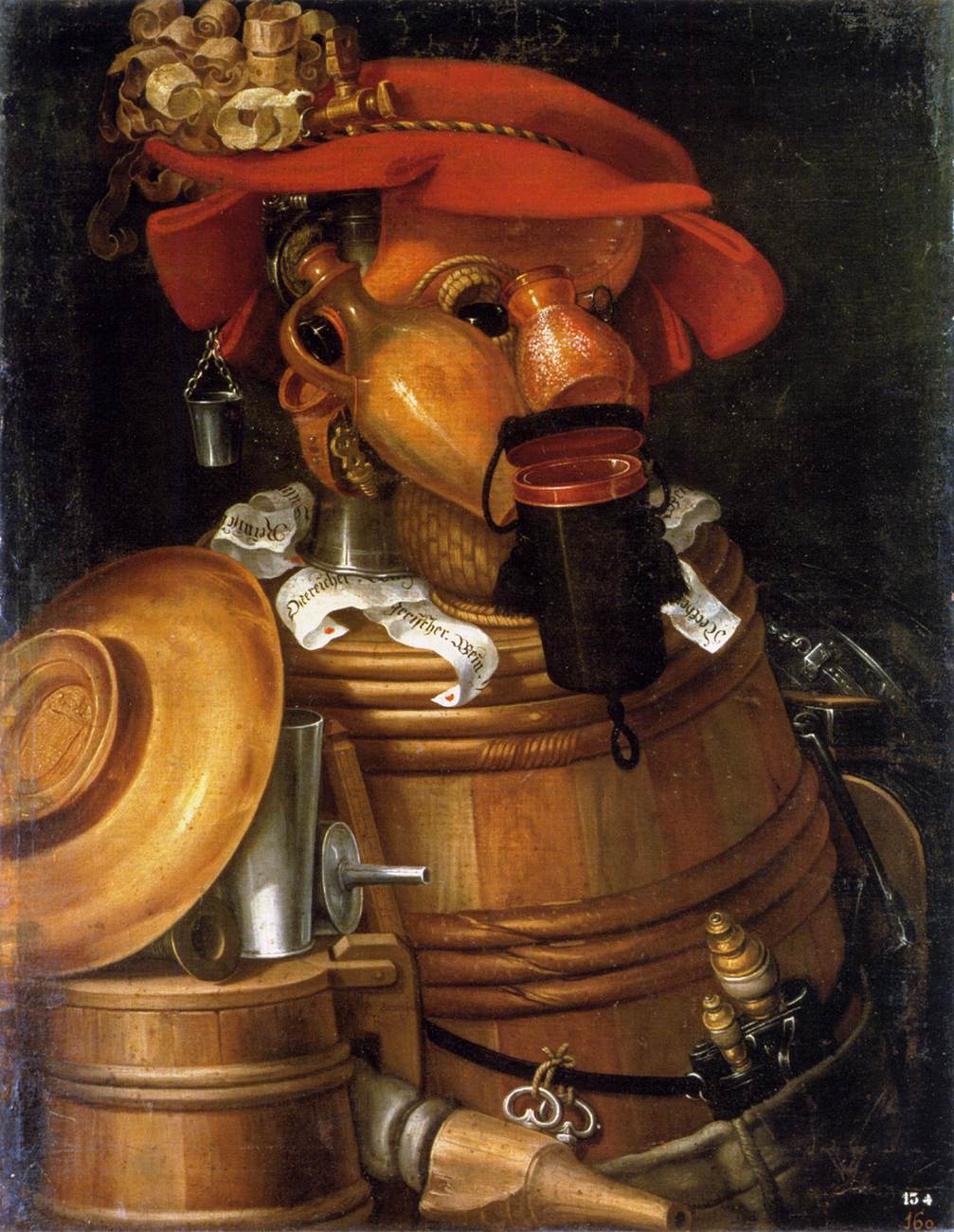
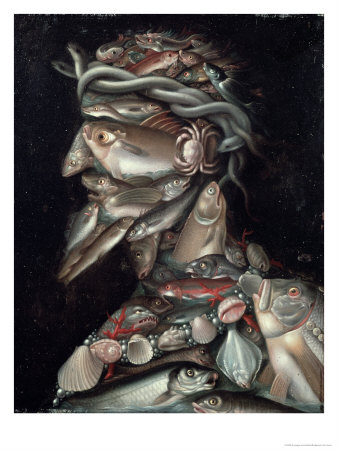
You don’t often think of work of art from an Italian Renaissance painter as being whimsical. Generally, they seem to focus on themes of religion and myth or on portraiture of wealthy patrons of the time, most beautifully painted. Then there is the work of Guiseppe Arcimboldo, who was born in Milan in 1527 and died there in 1593, although much of life was spent in the service of the Hapsburg courts of Vienna and Prague.
Arcimboldo was trained as stained glass designer and painter and initially worked in these fields in a traditional manner. Much of the work from this time has faded into oblivion, although there are examples of his windows and a fresco or two. However, it was his other work that gained him fame in his time and which has came through the ages as a constant source of fascination.
The other work was creating portraits, sometimes of his patrons such as the portrait at the top of Rudolf II , that are composed using all sorts of objects to create the figure and features of the subject. He used fruits, vegetables, birds, books, fish and many other objects in creating these unusual figures. The final result was always striking, colorful and whimsically imaginative. And sometimes grotesque, even a bit spooky– I’m thinking here of a series of pieces that Arcimboldo created portraying the Winter season as a person., such as this example on the right, painted in 1573.
Arcimboldo’s work always brings a smile to my face while also stirring my interest in how he must have worked at the time and how he was perceived in that era. I am sure he was both admired and disliked for his unique work. Whatever the case, the work remains a fascination. I am showing several example here but you can go a site– Guiseppe Arcimboldo: The Complete Works— that features a broader view of his work. Very interesting.
Yesterday I checked my blog with a search to see if I had ever written here before about that day’s subject, Long John Baldry. I found that I had only mentioned him once in a post from back in 2009. I read the older blog and it made me chuckle. It was titled You Can’t Judge a Book… from a song that Baldry had once covered and had to do with how our preconceptions are often wrong about people. It immediately brought to mind something that had happened over the weekend here at the studio.
My niece, Sarah, brought a friend and her husband to visit the studio from their NYC home. Sarah didn’t share much about her friend outside of saying that they danced together and that she was a filmmaker for one of the large big-name auction houses. I had no idea about what her husband did. That was the extent of my knowledge outside of knowing they had been married the year before in New Orleans. But they arrived and we had a wonderful visit. Both were charming and inquisitive, asking real questions and relating their own experiences in response to my answers. They made me feel comfortable in describing my work and process, not something that a lot of people can do easily. We visited for a couple of hours and they headed back to the city.
During our visit we learned a bit about the friend’s husband. I won’t use their names out of respect for their privacy. He was in the music business in some fashion. He was DJ and had spent a lot of time touring here and abroad. He also was working on soundtracking films. When I asked what sort of music he worked in, he said, in an almost apologetic way, that it was mainly rap and hip-hop. It struck me in a curious way. He went on to explain that it was the music of when and where he grew up, in the neighborhoods of NYC. Again, this was said in an apologetic manner.
I didn’t think much about until after they left and I decided to see if I could find out more about his music. He had a prodigious reputation in the rap genre, with over twenty years in the business as a DJ and producer for a pretty big name rapper. He ran his own newer record company and has released an album of his work only weeks before our meeting. I watched a couple of videos of his work and listened to several songs. I am not an authority on rap in any form but it was powerful stuff.
I was really impressed and thought back to his apologetic description of his work. I understood it then. He didn’t want to be judged and was trying to make it easy for me to not judge him. I mean, here I was, a middle-aged white guy with gray hair out in the country— not exactly a prime candidate for a hip-hop connoisseur. He had surely heard the venom directed toward his musical genre before from people who looked like me.
So, he judged me before I could judge him. I understood that. It’s what I would have done had I been in his place. My only regret is that it robbed me of an opportunity to ask the many questions that I formed in looking up his work after they had left the studio. It would have been fascinating to compare our creative processes, to see how he synthesized his influences. I got the impression from our talk that, though we worked in vastly different environments with disparate influences, we both working on a similar creative rhythm, expressing emotion within the framework of our own personal environments.
Well, the next time we will both know and won’t worry about judging one another. Here’s the original post from back in 2009:
I’ve just put the final details on a couple of paintings that will be part of my solo show at the Principle Gallery in Alexandria, VA. The show opens June 12th and I’m scheduled to deliver the work to the gallery a week before so I’m in the final stages of preparation. This is my tenth one-man show at the gallery and before that I did two shows as part of a group of painters from the Corning , NY area that was dubbed the Finger Lakes School.
I particularly remember one moment from the first show with that group. There was a pretty good crowd and several of us from the group mingled, answering questions and such. I had a small break in the conversation and I heard a female voice from behind ask her companion where we were from. Her friend answered that we were from the Finger Lakes region in New York. He said it was a pretty rural area with a lot of wineries and farms.
“Well, you know, they do look like farmers,” she replied.
I think I did a spit take. Over the years I often think back to that lady’s comment and sometimes laugh. Maybe we shouldn’t have all worn our overalls and straw hats that night. It just reminds me how people judge others by that initial glimpse and how often they end up being wrong. Actually, I’ve come to the conclusion that, in the end, I would prefer being mistaken for a farmer than an artist anyhow. Offhand, I can think of more positive attributes for the farmer. So, if you can make it to the opening look for the guy who looks like a farmer…
That brings me to a song, You Can’t Judge a Book, that was originally written by blues great Willie Dixon and made popular by Bo Diddley. My favorite version was from Long John Baldry, one of the pioneers of the British blues/rock movement in the early 60’s and a guy who had real panache, but I couldn’t find a version online. But while searching I came across an interesting jazzy version of the song from Ben Sidran. Give a listen and enjoy…
A while back, I went down to an old large pine tree that sits by the drive going into our place. A large lower limb had broken and was hanging to the ground and I took a pole saw down to cut it off. I started cutting and suddenly felt a burning sensation on the fingers of my right hand. In an instant, the same shooting stings were firing all over my left shoulder blade. What the hell?! My mind raced and at once I knew that I was being attacked by bees or wasps. Leaving the saw, I ran away from the tree, squealing as the offending insects kept stinging me, obviously trapped in my shirt.
I shed the shirt and, panting and grimacing from the many stings, headed back to see what had attacked me. From a distance , of course. I circled the tree and kneeling saw what I had missed when I first went to the tree. A large paper wasp nest.
Though I was in pain and wanted to retaliate in anger, there was no denying the beauty of the nest, a large egg shaped structure built from a combination of wood fiber and wasp saliva that is both strong and waterproof. The swirling texture of it was fascinating and the bottom of it jutted out slightly around the entrance where several wasps hovered, ready to protect the structure in an instant.
I left to tend to my stings, all fourteen of them, and to ponder what to do with the nest. We did a little research and, finding how beneficial the wasps are in the maintenance of the bug population, decided to simply avoid the nest and let them live out the season where they were. At the end of the year when the weather cooled, the wasps would pass away and the magnificent structure would be ripped apart by other creatures, blue jays and squirrels to name two, who would make use of the material for their own nests.
I periodically go down and check on the nest, wondering at the wasps’ ability to produce such magnificent architecture with their own bodily fluids as well as their innate understanding of the required engineering. Such a gorgeous organic structure. I also learned that they also produce a chemical that they spread around the branches that hold the nest in place that repels ants who might raid their nest to feed on the wasp eggs. Just amazing stuff.
We live in the midst of other worlds of wonder and often don’t get a chance or fail to take notice. While I would have preferred to have not been stung by the otherwise non-aggressive paper wasps, I am glad to have encountered them, glad to see how they survive and prosper in their little world of wonder.
I came across these images and this story on a site pointed out to me by my friend , Scott in Ohio, that features wonderful visual imagery, TwistedSifter. This particular story was about a couple in the Pampas region of Argentina who had been flying over Argentina in the early 1970’s when the wife noticed a farm that looked to her like a milking pail. The husband told her that they could do even better by making a large guitar, her favorite instrument, on their farm for all to see from above.
A few years later, the wife died unexpectedly from a cerebral aneurysm and the husband and their children set about creating that guitar in her memory. What they created is quite remarkable. It is about 2/3 of a mile in length, formed from over 7000 trees that they planted and nurtured. The outline of the body of the guitar and the star shape around the center are cypress trees and the area making up the fretboard are eucalyptus trees which give it a beautiful blue tint.
It’s a magnificent tribute, a grand piece of land art. I was struck by the satellite images that show the guitar from various altitudes. The middle one below, in particular, is my favorite, looking as though it would be a great painting or quilt with a simple guitar shape woven into its patchwork, with the varying colors laying out in front of it as though they represented the sound of the guitar’s music coming from it.
As though I have been searching for more ways to kill time, I have spent well over an hour already this morning just clicking on images on what might be my new favorite website, the Art Projectat the Google Cultural Institute. It’s a collection of great paintings and objects of art from around the world, all photographed in stunning detail that allows you to get closer, in many cases, than you could ever get at any museum. Some are photographed in a Gigapixel mode that allows you to be almost part of the surface.
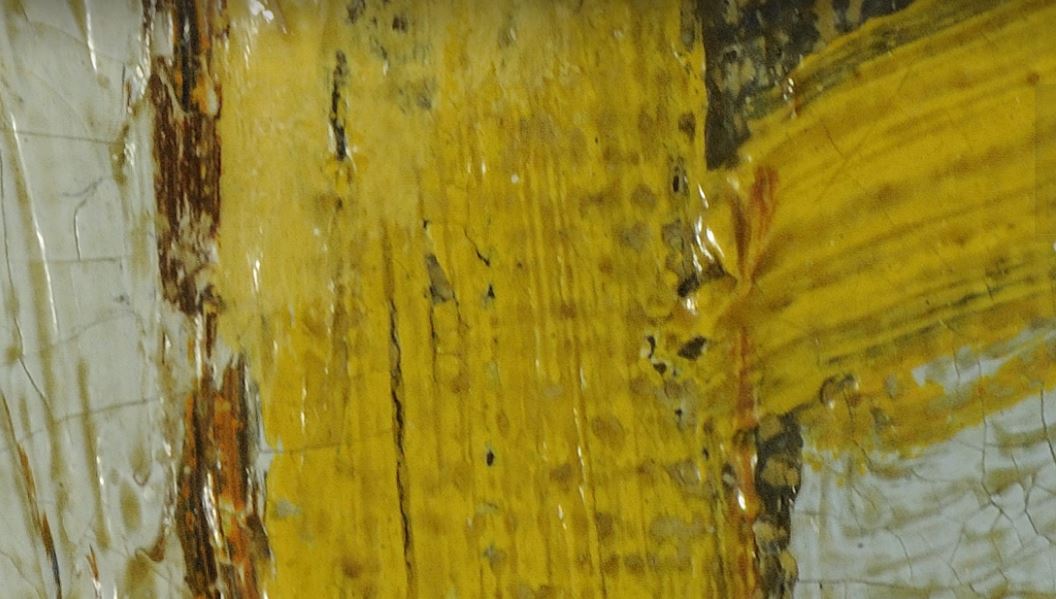
For example, one of the first images I came across was The Bedroom from Vincent Van Gogh, a favorite of mine shown here on the left in its entirety. Whenever I see a Van Gogh in person I always want to get as close as I can to see the fervid brushstrokes that give the pieces so much life and energy. I have been asked to step away from the paintings in the past but with this site can now zoom in to a level that my eyes (and security guards) would never allow in a museum.
The images here to the right and at the top are of one of the rungs of yellow chair’s back in the center of the painting. The top image is magnified to a high level but there is still another level beyond this to which it can be magnified. I can see the canvas under the strokes, the varnish’s darkened surface in the crevices and the craquelure (cracking) of the oil paints. I feel like I am seeing Van Gogh working on the painting, can see how his mind is forming the image on the canvas. It deepens the whole sensation of the painting for me.
What a great site! On a local level, this site features over 1000 items from our own Corning Museum of Glass. There are incredible views of glass objects from antiquity up to modern art pieces.
Well, I have just a little more time to spend this morning so I better get back to looking at some super details of great art. Check it out!
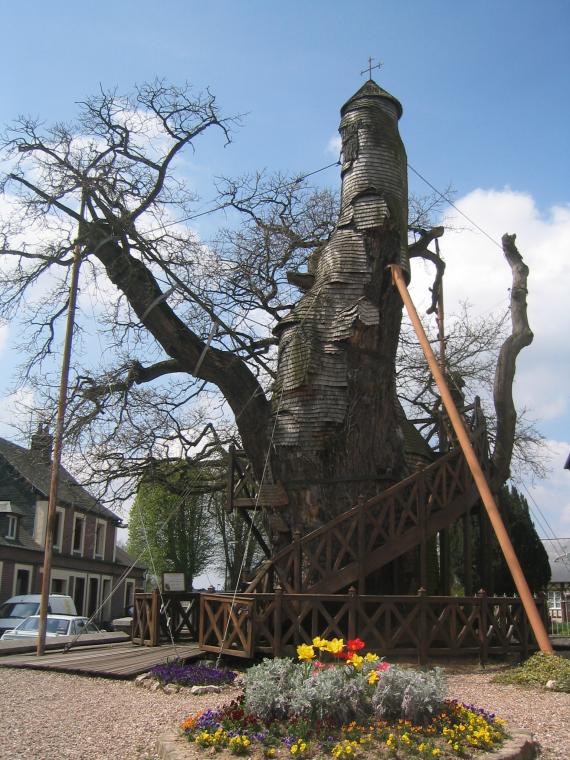
Maybe it comes from painting so many trees but I find myself with a number of books about trees. One of my favorites is a set from Thomas Pankenham containing Remarkable Trees of the World and Meetings with Remarkable Trees, containing pictures and descriptions of some truly beautiful and astounding ancient trees from around the globe. There are some magnificent specimens that choosing a favorite would be impossible. But one that always makes me stop as I leaf through is the Chapel Oak in Normandy, France.
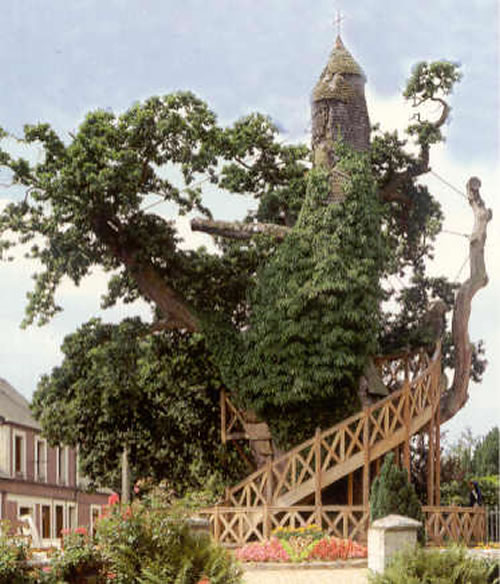
Legend has its age as being 1000 or 1200 years although scientists estimate it at about 800 years. It began its career of note in the the 17th century when lightning struck the already old and grand oak, sending a bolt down through its center that smoldered and burned until it had hollowed out a large cavity within the tree. The village priest determined that there was some divine intent in the lightning strike to this tree and built a chapel in the hollow of the tree along with a small room above it suited for a hermit.
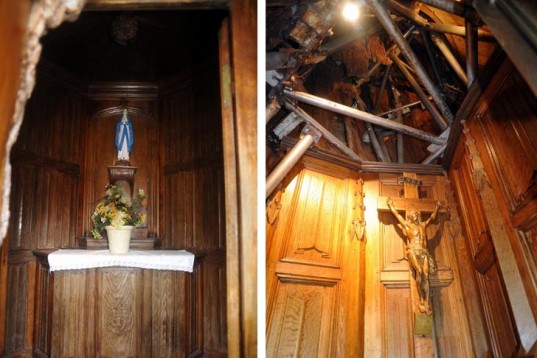
Perhaps the priest’s belief in the tree was deserved because, though badly wounded by the lightning and inner fire, the tree still leafed and maintained year after year until the present day. Of course, it has been lovingly nursed and reinforced through the ages. It has cables and straps and two steel supports that give it the look of a creature on two crutches. The large section of the trunk damaged by the lightning lost its bark ages ago and the tree’s caretakers covered the exposed wood with shingles and a spire roof, giving the look of a fairy tale castle. The inner chapel and the room above it have been renovated in recent years, refitted with paneling and mirrors to create more light with the dark hollow.
Of course, it is a place of great interest to tourists and pilgrims alike. I am always torn when I look at the pictures of this tree. Part of me is simply fascinated with the image and the way its caretakers have prolonged its existence. There seems to be a grand reverence in this. But another part of me wonders if the tree should be allowed to simply succumb in dignity to its natural ending without the assistance from humans. I suppose it comes down to how one views all trees and this particular tree. Perhaps, it’s continued life is proof that it desires to endure.
Whatever the case, it remains after enduring the many pages of history that have turned around it. Interesting…
I am on the road today, visiting my good friends at the Kada Gallery in Erie. One of the paintings that I am taking out to them has a distinct labyrinth-like pattern in it, a twisting maze that always captures my attention. I love the idea of it as an analogy for many of us for the journey through this life, seeking an unseen, and often unknown, goal. We travel ahead on a path that takes twists and turns and often we find ourselves feeling as though we are within reach of that central goal only to find that the next turn has taken us as far away as we can imagine. And vice versa, we often feel adrift and lost only to suddenly find that the goal is suddenly there before us.
There’s something very balancing in thinking of life in this way. You become wary of the highs and lows, knowing that one’s fortune can spin on a dime.
Here’s an interesting video showing the constructs of several different labyrinths, all accompanied by a chorus with a basso profundo that gives the whole thing some real weight. Enjoy and make a labyrinth for yourself!
There was an article in The New Republic magazine a few months back titled The Boys of Lancasterfrom writer Kent Russell. It is about the relationship between the game of baseball and the Amish community of Lancaster County, Pennsylvania. The article documents how the game, while forbidden to adults once they have been baptized ( the Amish are Anabaptists which means they practice voluntary baptism of members at an age when they can make their own decision to do so), is a big part of the Amish boys and young men’s lives, especially during the period of Rumspringa, that sanctioned time when Amish youth basically sow their wild oats before making the decision to stay with the Amish way of life and religion or leave and live the modern English life. During Rumspringa they often drive cars, drink alcohol, take drugs, have sex, listen to modern music, watch TV, talk on their cell phones and do just about anything else that any modern non-Amish youth might be doing.
This includes playing baseball.
There are fields and backstops scattered around the county and they play in leagues among themselves and against the English, the term used to describe all non-Amish. The author describes their play as being unschooled but having a purity and consistency in its form. It might not look as polished as kids who were in travel leagues and went to instructional camps but they could play. He describes them as not being too self-conscious and having a centered confidence without being cocksure, traits that by nature translate well to the game of baseball. While the game is one of thought, those who play best have an ability to not be self-conscious and make each move on the field with the certainty of result. Questioning your own ability and your movements make for poor play. The Amish boys seem to have this required self-certainty and an ability to be single-minded in their purpose.
The author makes a couple of points that apply outside of baseball. One was a saying from The Mental Game of Baseball,a book that is considered a must-read for big leaguers or wannabes, that goes If there is no future, there is no distraction. I immediately understood what it meant. Focus on the now, on this very instant. Block out what may happen in the future because it doesn’t really exist. Just like the past.
Existence is always in the present.
This works in baseball. The best players block out the past and all the failures or successes that came before. The future is not even thought of. Those players that do dwell in the past or future, fail in the present.
It made me think of how often I find myself living in pasts and thinking of futures, how often I fail to take in the precious now. I swing and miss, striking out because of this preoccupation with the past and future, both things out of my control. We may think we control our future but it is only the now that we can truly control.
Hmm. The zen of ball…
Whatever the case, if you’re a baseball fan or a fan of cultural anthropology, it’s an interesting read.
Put this one in the “Even the great ones screw up every once in a while” file. This is a painting from Norman Rockwell titled People Reading Stock Exchange for one of his many Saturday Evening Post covers. There appears to be nothing unique about it at first glance, just a group of folks hunched around a wall chart that they all find completely absorbing. They all seem perfectly normal until you take a closer look and notice that the young man in the red shirt seems different. You look a bit closer, maybe squint a little until you realize you don’t need to do that to see his abnormality. Yes, he has three legs. Rockwell apparently didn’t notice this until it was pointed out years later and it proved to be a embarrassing episode for him, especially given his reputation for capturing detail in his work.
Some people have tried to explain it away as some sort of subconscious phallic representation which seems like a stretch to me. I think it was merely an oversight although an unusual one. As a casual viewer, it it something that is easy to overlook but I am more amazed that in the process that it simply didn’t register for him that he was creating a most unusual young man. As an artist, it’s reassuring to see someone so meticulous make such an error.
Most artists have at least a handful of such things in their background, pieces with shadows that make no sense in nature or arms that are much too long for any living human. Most go unnoticed. The unfortunate thing is that once they are identified, they become the focal point of that painting forever– something once seen cannot be unseen.
I know that I have several paintings with such mistakes, pieces that, without these flaws being pointed out, are strong and full works. Few people, if any, notice these flaws but for me they are the first things my eyes rest upon in the picture. They don’t bother me as I am sure this bothered Rockwell. I see them as symbols of our humanity, our inherent flawed nature.
We don’t need to point out our flaws. They’re there for all to see. We can only hope people accept us, three legs or two or one. And the three-legged young man here is a refreshing reminder of Rockwell’s humanity.
 I am always interested in seeing what the extreme magnification of an electron microscope reveals about our world. It’s fascinating to see how tiny matter is built, often having a beautiful architectural grace in their patterns and constructions. For example, this fellow to the left is a phytoplankton, a microscopic organism that lives in a watery environment, in both fresh and salt water. Basically, a form of algae that is at the base of the marine food web.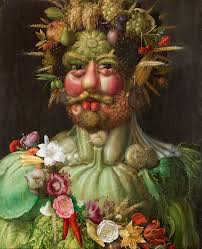









 Redtree Times