Feeds:
Posts
Comments

Archive for the ‘Neat Stuff’ Category

Commuter

Moscow Wild Dogs - The Sun UKOver the years I have been fortunate to observe many wild animals from the windows of my studio.  I am always amazed at the  intelligence and resourcefulness as well as the sense of community and family that they so often display.  Their ability to adapt to situations is remarkable, something which many humans  fail to do when faced with any sort of change.  I suppose that’s why I was not surprised when I read an account of the wild dogs of Moscow and how they have adapted to a changing world.

It seems there is a large group of these dogs which works during the day in the city center where scavenging for food is easier from tourists, office workers and city dwellers who frequent the street vendors there.  These dogs have even developed a method where they approach an unsuspecting street  diner from the rear and bark very loudly, often making the startled person drop their food.  With children, they change their tact, using a softer approach where they will rest their heads on the child’s knees and look dolefully at them as they eat.  It often yields a few tidbits.

At the end of the day these dogs move to the subway and head out to the suburbs, where it is safer for them at night than in the city center.  They board the appropriate trains, dashing through the doors at the last second, and know how long it takes to reach their destination.  They ride in the less crowded cars at the front and rear of the train and often  fall asleep, having  to be awakened by the barks of their companions to let them know that it is time to get off the train.

If you’ve had a pet, especially one that was extremely bright, then this probably doesn’t come as any sort of surprise.  I wish I could find one that would write my blog and do my taxes.
Read Full Post »

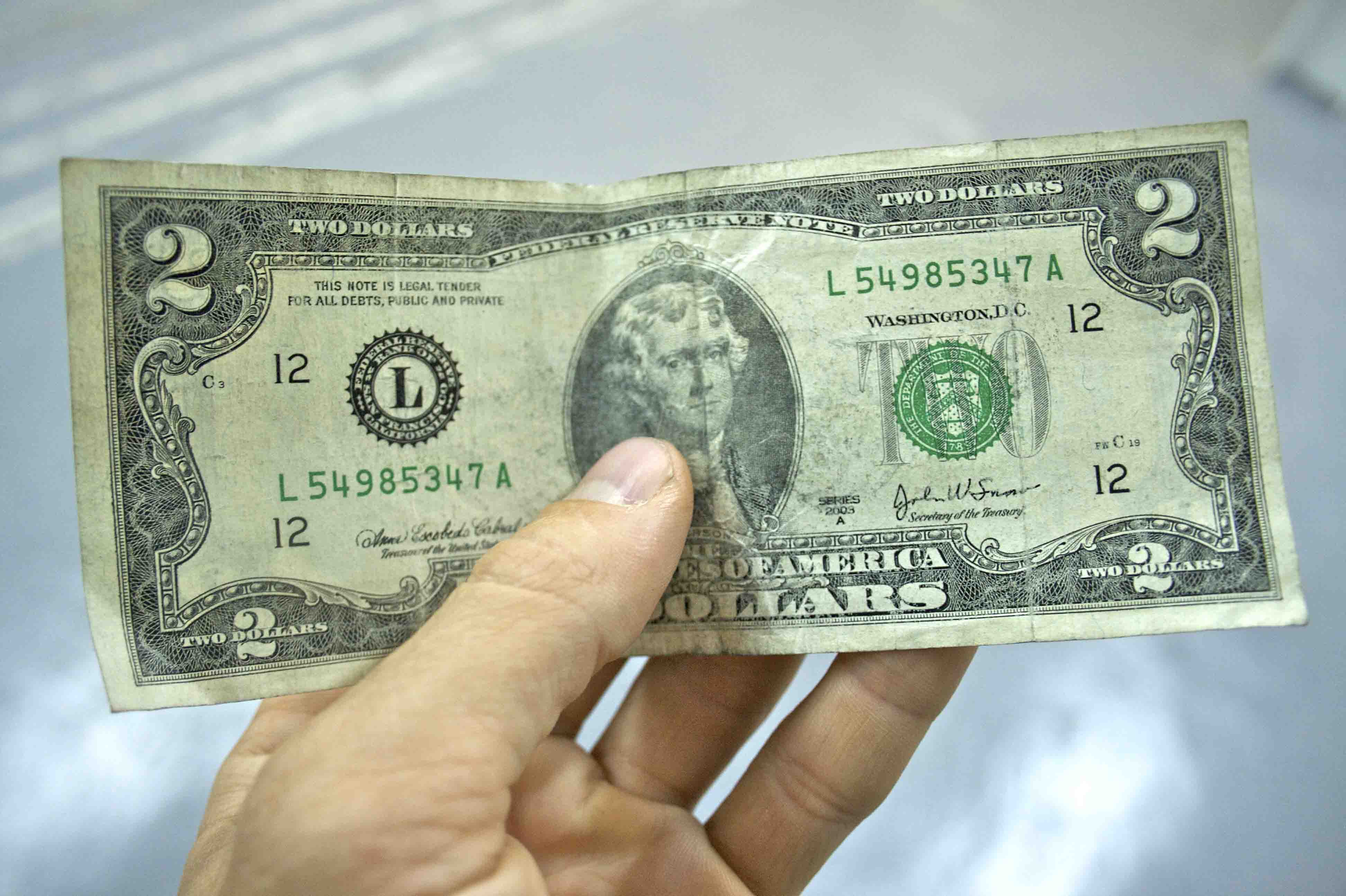
The $2 Road Trip FundA friend of mine sent me a story last week that he had come across that he thought would interest me.  It was a story that has been told on CNN and NPR but was not one that I heard.  It was about a young man from NYC named Dotan Negrin who travelled around the Northeast US and eastern Canada, playing piano as he went.  He started the trip in NYC with his van, a 450 pound Kimball piano, a few personal items, a$2 bill which was the only money he took, one gallon of gas in his van and Brando,  his constant canine companion.

The trip lasted 31 days and he covered 3600 miles, playing piano in 11 cities.  He earned money from donations as he played as well as from picking up a few gigs at a few places from owners who heard him on the street.  He came home with the $2 bill still in hand as well as over $2200 more.  It’s a great story, along with earlier trip across the entire US,  that you can read more about at his site Piano Across America.

The $2 Road Trip- Doltan and Brando at workIt’s just another great illustration of someone following their bliss, taking that thing that they most love to do and somehow finding a way to make it their livelihood.  Dotan loves playing piano yet struggled to find a way to earn a living doing it in the traditional manner.  So he made his own opportunity.  It’s a great lesson in thinking outside of the box, determination and not accepting what the eye initially beholds.  A lesson that many of us should take notice of

Too often we let others set our limits and determine our fates.  We all have an ability of some sort.  This is something that I have always believed– that we are all equally gifted and flawed.  It’s just a matter of determining what our own special ability is and finding a way to incorporate it into our life.  Dotan Negrin is doing just that.  On the back of his piano there is a map of the US along with a sign that says “You owe it to yourself to do something remarkable with your life.

It appears that his special ability is in playing music and inspiring people.

Here’s a great video that has him playing and talking about his trip across the country.  Lot of lessons in here, too.


Read Full Post »

Nadar_autoportrait_tournantWhile following the events of last week , both in Boston and in Texas, it seemed as though the media was constantly mentioning how many terrible things had happened during this week in the past.  The Oklahoma City bombing and the end of the siege at  the Waco compound of the Branch Davidians, to name a couple.  It sent me to  the computer to search for something more positive to mark this week of the year.  I came up with the first exhibition of the Impressionists in  1874.  It took place at the Paris studio of a photographer called  Nadar.  The story of this  photographer looked even more interesting  than the original story  of the Impressionists and set me off on a tangent.

Nadar Self Portrait 1909The Frenchman Nadar, who lived from 1820 -1910 and whose real name is Gaspard-Félix Tournachon, was a larger than life character who acted as a caricaturist, photographer, journalist and a pioneering balloonist.  That’s him above in a revolving self portrait that he did in 1865.  Of course, the automated spinning was a bit after his time but I’m not sure he didn’t see it coming.  He was always pushing for the advancement of  heavier-than-air flight, in the form of balloons at the time, and was a friend and associate of Jules Verne, who based his book Five Weeks in a Balloon as well as a character in his book  From the Earth to the Moon on Nadar.

Nadar Le Geant Gondola after flight and wreckHe was well known for his aerial photos of Paris taken from a tethered balloon.  In fact, he was the first person to take an aerial photo in 1858 although none of these survived until today.  The aerial shot below of Paris  is from 1867.  In 1863, he built a huge gas balloon, Le Geant (the giant),  the largest to date.  It had a huge two story gondola and had room for thirteen passengers as well as a lavatory and other amenities such as a darkroom and a lithograph press on which short reports would be printed and flung from the balloon.  After a failed first attempt, a flight that lasted more than 17 hours and covered 400 miles was made but unfortunately there was a mishap on landing.  The winds were high and the gondola was dragged along the ground for several miles, injuring  all aboard, some seriously.  But it never deterred the forward looking Nadar, who sent the balloon to England to be displayed at the Crystal Palace in hopes of raising funds for an future attempts.

Nadar Aerial View of Paris 1867

The ballooning aside, his portraits of the leading names of the time are really wonderful.  Artists such as Monet, Corot and Delacroix were all subjects as were many others from all other fields– the actress Sarah Bernhardt; the composers Rossini, Chopin and Liszt; writers Baudelaire and George Sand.  Perhaps most striking of his portraits is a shot of Victor Hugo as he lay dead in his bed,shown here at the bottom of this post.

It all amounts to a pretty big life, one that we know little of today except as a footnote to other events.  I’m glad I followed that tangent…

Nadar Death Portrait of Victor Hugo

Read Full Post »

jackie-robinson-1956_April 15 means a couple of things to some people.  Of course, there is the unpleasant connotation of it as being Tax Day, the due date for income tax filing here in the USA.  But for the baseball fan, it is a date that marks the first day a black player took the field as a major leaguer, when a special player ran out to play first base for the Brooklyn Dodgers back in 1947.   This young black man was athletically gifted, smart and tough-minded.

That player was of course Jackie Robinson.

Major League Baseball now honors him on this day every year, Jackie Robinson Day, with every player on every team putting aside their own uniform numbers to wear his number 42, which is now retired throughout baseball. Currently, only Mariano Rivera wears the number 42 on his back  and after he retires at the end of this season, no player will ever wear the 42 on their back again outside of this day each year.

Retiring a number is a sacred thing in baseball.  A player’s number has an almost mystical connection with the fans.  Growing up, everyone knew that Babe Ruth was 3,  Lou Gehrig 4, Mickey Mantle 7, Willie Mays 24, Hank Aaron 44 and on an on.  Whenever I see the number 45 all I see is my hero Bob Gibson on the mound. And everyone , even Mariano Rivera fans like myself, knows that the 42 belongs to Jackie Robinson.

There is also a new movie out that bears that number and it tells the story of Robinson’s initial turbulent year with the Dodgers.  I haven’t seen it so I can’t really comment other than to say that it is a story that every child should know.  It is a remarkable story of self restraint and strength in the face of institutionalized hatred, one that made possible the  broader changes that took place in our country in the civil rights movement in the decades after Robinson’s first day on that field in 1947.

From what I have read, the biggest complaint is that the movie doesn’t really give a full accounting of Robinson’s life. Jackie was a legendary collegiate athlete at UCLA, lettering in four sports– football, basketball, track and baseball.  He was the NCAA champion in the Long Jump and could have easily played professional football.  Of course, that was impossible because  the NFL was segregated at that time as well.

Nor does it detail his military career which is of interest mainly for Robinson being court martialed for refusing to sit in the back of an Army bus at Ft. Hood, Texas.   He was eventually acquitted of all charges by an all-white panel of officers  but it was an incident that foretold of his strength and willingness to enter the fight in taking on the segregated major leagues.

Nor does it address the health problems that led to his early death.  He suffered from diabetes and was nearly blind when he had a heart attack that ended his life at the age of 53.  It was much too early for this remarkable man’s story to end.

As I said, it’s a story that every child should know and celebrate.

Read Full Post »

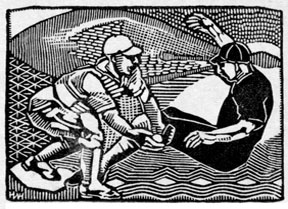
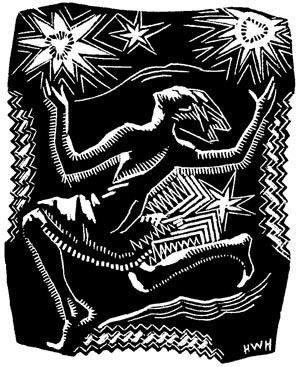
Baseball  Helen West HellerI was looking for woodcuts that had baseball in them and came across a couple that were by an artist with which I was not familiar, Helen West Heller.  I liked the design and look of the pieces that I had found, more modern and stylized than the others.  Unique.  I began to look up the artist, who lived from 1872 to 1955,  but found little.  No Wikipedia page and a few scant biographies that mainly listed her exhibits and the collections in which her work – both woodcuts and paintings-  was included.

Baseball2 Helen West HellerAnd it was a pretty impressive resume.  A retrospective at the Smithsonian.  Awards from the Library of Congress. Shows at the Brooklyn Museum and other galleries around the country.  Looking at the Metropolitan Museum website, I found that she had over 170 pieces in their permanent collection.  Why wasn’t there more on her?

HellerBut then I came across a site devoted to her life and work, The Extraordinary Life and Art of Helen West Heller.  It’s a rambling website full of references and writings devoted to Heller but even as Heller’s most ardent fan and champion, Dr. Ernest Harms, wrote in 1957, just two years after her death: “Helen West Heller has lived the life of a full blooded personality striving and fighting for an artistic ideal . . . Far too little is known even among artists about this amazing woman.”

The tragedy is that when she did die, she did so alone and as a pauper in  Bellevue in NYC.  Her body remained in the morgue there for over 10 days until Artists Equity arranged for burial in NJ.  There’s a lot more on her in the rambling site devoted to her, much of it quite interesting but never completely revealing.  She lived at a time when there was still room for mystery and mythology in one’s life.  Perhaps that mystery, as well as the personality of her work,  is what makes her  so intriguing to me.

Heller-HoovesBig


Read Full Post »

The Fairy Circles

African Fairy Circles-  Photo by N. JuergensA friend sent me this photo that was attached to an article from the NY Times from a few days ago, writing that it reminded her of me and my work.  It’s a high overhead view of a tree standing alone on a barren plain in southwestern Africa surrounded by small circles that dot the terrain, looking like tiny craters on the surface of the moon.  It’s a great image, simple and strong, and I am honored that she saw my work in it.

The article called the rings  growing around the tree fairy circles.  This, at first,  brought to mind the fairy circles that  we sometimes see around us that are  formed by mushrooms growing  along the forest floor in rings that are usually three or four feet in diameter.  They are called fairy, pixie or elf rings or circles.  The Gaelic legend behind the name says that these are these rings are the gateways to elfin kingdoms, places where the little creatures sometimes appear to sing and dance.  Pixie dance floors.  I don’t know about that but we have found some old beer cans in the woods.  But I don’t think these came from elves or pixies.  I just  think the previous owners of the forest around us were slobs.  But if some new cans show up I may have to rethink this whole thing.

The fairy circles shown in the photo are not formed from mushrooms  but are made a dense grass.  Their has been some controversy about how they are formed and the article states that the current and best theory, as  stated in the Times article, is that they are made by a particular type of sand termite that has engineered these rings to better capture the rare rainfall, allowing the soil inside the rings to remain relatively moist for a longer period of time compared to the arid conditions outside of them.

The article downplays the elfin kingdom theory altogether.   And they call themselves scientists…

Read Full Post »

historia-antiques.com head and brain model 1I came across an interesting site belonging to a California based antiques dealer, James Caswell Historia.  I was  looking at  his collection of ex-votos, which are basically notes  left in shrines or churches by believers who want to express their gratitude or thanks for what they believe are answered prayers.  Many are small paintings depicting their patron saints or a miracle being performed.  They have a number of these from Mexico that are quite striking, real colorful examples of folk art.  They should show up in a future post.  But it was this item from their Medical/Scientific section that caught my eye.

historia-antiques.com head and brain modelIt’s a model of the upper part of a human head with the brain, which is in sections which are removable, exposed.  It’s from Germany and was made in the 19th century.  Sells for $1450 if you’re interested.  But it was the image of this head as though it were emerging from a pool of water like some creepy, throbbing  brain monster that intrigued me.  All I could think of was Martin Sheen’s Captain Willard character from Apocalypse Now when he slowly emerges from the water as he nears Colonel Kurtz.  Perhaps the exposed brain was somehow symbolic of Willard’s transformational epiphany.

Or not.

But that aside, it’s a striking piece that has the feel of a piece of modern art .  Plus, it would make a great candy dish for your Easter treats.  Take a look at this site— it’s got a lot of great interesting items.

Read Full Post »

John Sloan Dust Storm Fifth AvenueI was going through a book of painting that focused on New York City and came across an image of the fabled Flatiron Building, its three sided structure which gives it the look of a ship’s prow making it one of the more iconic building in the city.  It has been photographed  and painted numerous times, enough so that there is probably a book of just Flatiron images floating around somewhere.  It’s a striking building and one that I always am intrigued by in images and in person.

But I hadn’t seen this painting by John Sloan, the American artist who was part of the Ashcan School that painted the reality of the urban experience in the early decades of the 20th century.  I am a fan of this loose-knit group of  painters that includes George Bellows, Edward Hopper and Robert Henri, among others.

The painting was titled Dust Storm, Fifth Avenue and was painted in 1906.  It was an image looking down Fifth Avenue to where the Flatiron’s prow stood proudly as a black cloud hovered above.  On the ground below, the people scurried about  in a panic as the wind blew up huge clouds of dust as it funneled down the canyons of the city.  There’s a tremendous amount of movement in the painting that gives it great impact.

It made me wonder how accurate the image was.  Were these dust storms a normal occurrence in old New York?  It turns out that the Flatiron was notorious for the winds that gathered around its base and buffeted the pedestrians who happened that way, taking hats and lifting women’s skirts, exposing their legs to leering young men who would gather on the corner of 23rd Street for just such a purpose. The police would regularly have to disperse the gawkers which is supposedly where  the term 23 Skidoo originated, it being the phrase they would shout to get the crowd moving.

It’s always interesting to see the story behind an interesting image like the one Sloan captured, to see the real history being portrayed.  It makes me appreciate this painting even more. Here’s a short film from 1903 that shows  the mischief that the wind played on the passing crowd.

Read Full Post »

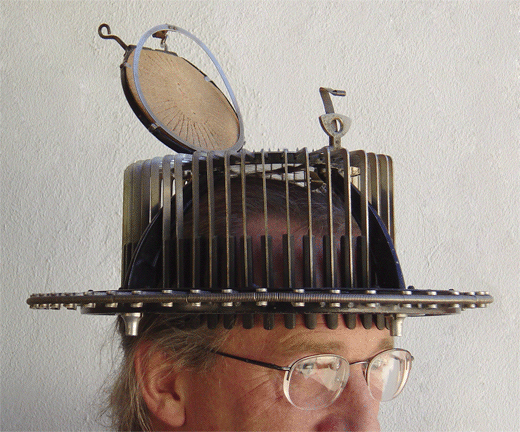
ConformateurAs I looked up from my painting the other day there was an old  movie, one that I can’t even recall at this moment.  On the screen there was a man, I think it was Tyrone Power, in a movie from the late 1930’s to 1940’s, wearing a hat of a sort on his head that caught my eye. It wasn’t really a hat but was worn like one, looking like some sort of Victorian device for either measuring the head for a hat or for torturing the wearer.

Or both.

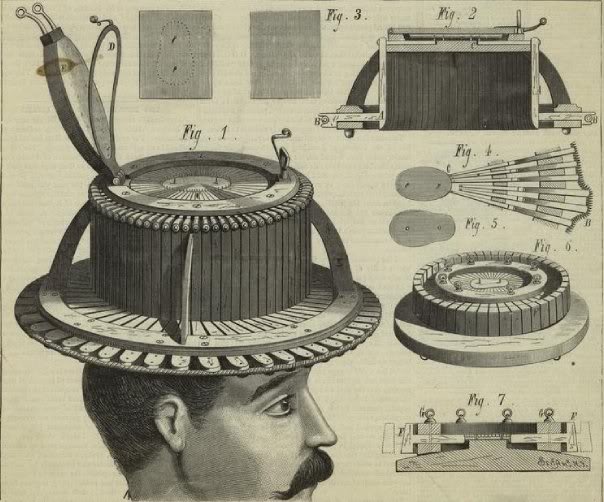
Conformateur_fittingIt really piqued my interest and I did a quick search and, lo and behold, there it was on my computer screen. It was called a comformateur and was a French device used by hat milliners to get exact measurements of the head so that they might make a hat fit perfectly. The slats or fingers that make up the side of the device all conformed to the head and as they moved in or out would push corresponding pins upward. These pins would puncture a sheet of paper placed in the top of this device, the perforations forming an image much like a connect-the-dots drawing, leaving an exact outline in miniature of the head. The hatmaker then has a permanent record of the shape of his client’s head.

These conformateurs date back to the 1820’s and are very collectible by hatmakers and by collectors of Victorian oddities.

I don’t know why this caught my eye or why I’m sharing this today. I guess I am interested in these types of inventions, these contraptions that obviously required a lot of effort to design and build. They show such ingenuity and complexity in their design, especially for purposes that seem so obscure in the present day.

Actually, I’m thinking it might just be cool to wear one around as my everyday hat.  Maybe at my next opening.  Would that make me a non-conformateur?


Conformateur-formillion

Read Full Post »

Locust Folding Bicycle Desined by Josef CadekI worked one summer many years ago as a janitor on the campus of Syracuse University. I worked in the men’s gymnasium that was attached to old Archbold Stadium, on the site where the Carrier Dome was erected a few years later. Cleaning the gyms was part of my duties there and it was interesting to watch some great athletes work out. But for me the more interesting aspect cam in the the lower level of the building where the Industrial Design department was located.

This was where the future was being designed by young, inquisitive minds who were always looking for new ways to streamline product designs for efficiency.  I worked in the lab where they created prototypes and, as they had adjourned for the summer, was able to spend a lot of time wandering around among the clay rooms and drawing boards,  gawking at the drawings and plans that had been left behind.  They were a messy bunch but it was fascinating to see how their minds perceived the function and design of  everyday items

It gave me a greater appreciation for the way products evolve.  We have a use for an item and generally start a first impression of how it should function, creating a product to fit that function.  But as time passes the function changes as does the technology and materials we employ in making these items and the design evolves.  I think this folding bicycle designed a few years ago by Czech designer Josef  Cadek is a great example.  Called the Locust, it is a lightweight bike that folds into an efficiently transportable unit.  The chain (actually a heavy belt) is fully encased so there is no oil to rub on your pant legs  and it features a circular frame into which the whole bike  folds.

I don’t know about how well this bike rides but the Dr. Seuss factor of its design sets it apart for me.  I could see the Whos in Whoville spinning around town on these contraptions.  Maybe a Dr. Seuss-like future is in store for us, after all.  There are worse things…

Read Full Post »

« Newer Posts - Older Posts »