Feeds:
Posts
Comments

Archive for the ‘Neat Stuff’ Category

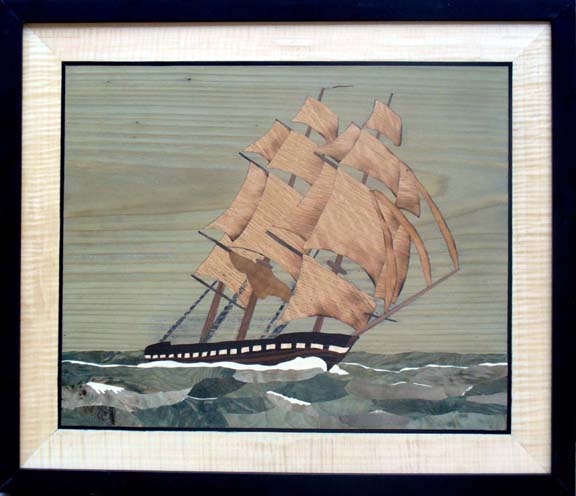
I came into the studio this morning and there was an interesting e-mail from Dave Higgins, a friend and one of my favorite artists whose work has been featured here on the blog  a number of times.  He said he visited a Corning senior center where they hold a weekly session to learn and practice the art of wood marquetry, which is creating pictures using thin veneers of woods as the medium instead of paint or pastel.  It requires precise cutting and placement of the wood as well as a keen eye for matching the tones and textures of the scene you are trying to replicate in wood.  It has been around since the 15th century and has reached some pretty spectacular heights.

Dave said that this group of mainly older women  meet every Friday to practice this art and that they use items snipped from the local newspaper as reference material for them to translate into wood.  To Dave’s surprise, it turns out that their favorite subject to copy is my work. 

He told them he knew me and said that they looked suddenly afraid as though they might be in trouble for plagiarizng my work.  He assured them that I would not be upset but would instead get a kick out of it.  He was  right.  I do get a kick out of this and am very honored as well  It’s a sort of affirmation that my work reaches the wide spectrum of people that I hope for it. 

 I had a similar experience a number of years ago when I was contacted by an arts therapist who worked with seniors.  She would take photocopies of  artists’ works and print them in grayscale for her seniors to color and said that my work was the most popular with her seniors.  She said they really responded strongly to the shapes and lines in my work as well as to the colors in the original images.  That was very gratifying.

I hope to someday drop in and see some of these landscapes in wood.  I hope these folks continue to find them inspiring for their own work.  The image at the top is from Bill G. at Colorado Marquetry.  The image below is his translation of the USS Constitution.
Read Full Post »

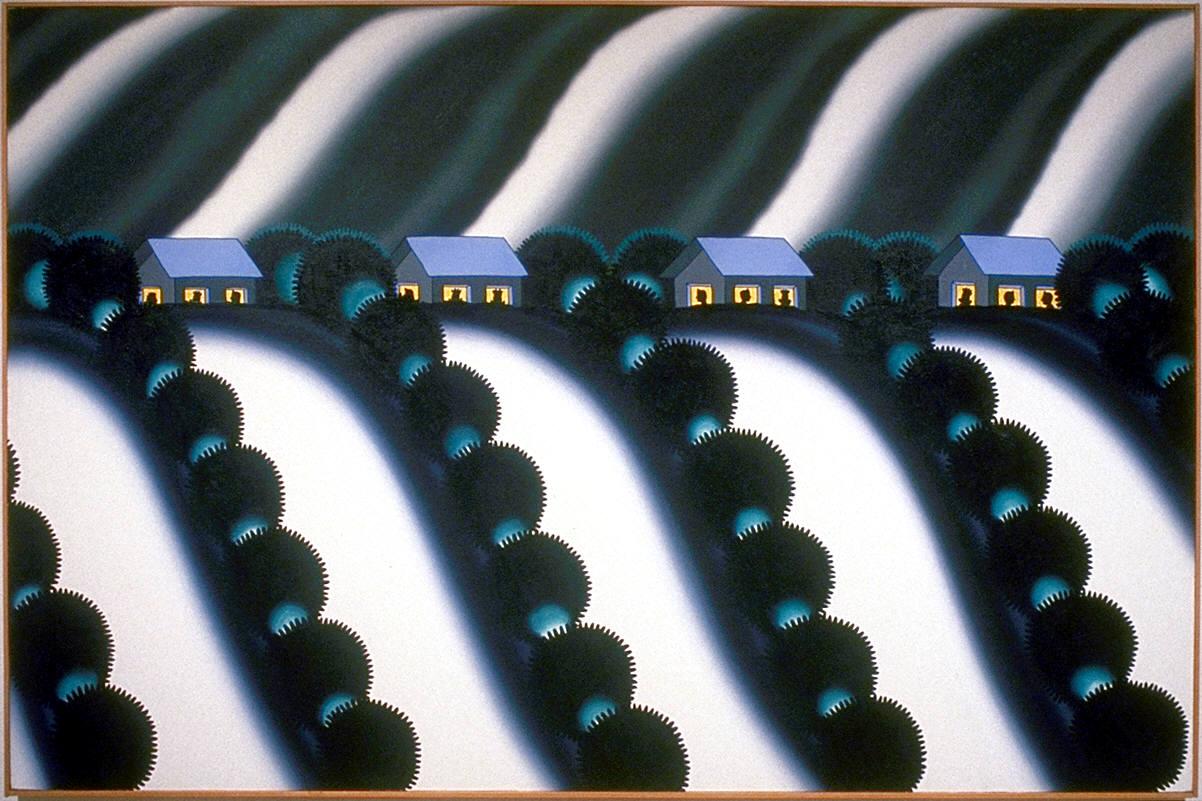
I was looking up something totally unrelated to his work when I stumbled across the paintings of Roger Brown, a painter who was one of the group of Chicago Imagists, an informal school of art in the late 1960’s that had it roots in comic book art, Surrealism and  Primitivism.  The work was highly individual and always bold in style and statement.  When I saw Brown’s images, I wondered how I had missed him before.  Strong work with big rhythmic patterns.  Just plain good stuff that turns my wheels.

Brown was born in Alabama in 1941 and came to Chicago in 1962 to study at the Art Institute of Chicago and remained a resident of the Windy City until his death in 1997 from liver disease at the age of 55.  I can’t give a lot of info here about his biography as I am still learning about his life and work myself.  I will let his images tell the story here .

Read Full Post »

Once again, I came across a painter from the past of which I knew absolutely nothing.  That is nothing new but when I first saw these paintings I was shocked he was unknown to not only me but to most other people as well.  Actually, his biography is pretty thin in content but the sheer power of his work makes up for it. 

 His name was Thomas Chambers and he was born in England in 1808, probably training there as a decorative painter for the theatres of London.  He popped up in the States, in New Orleans, in 1832, filing for American citizenship.  Over the next few decades he moved along the Atlantic Coast and New England working as a landscape and marine painter as well as a fancy painter, meaning that he also painted  objects such as mirrors and furniture in a decorative fashion.  After the death of his wife in 1866, he returned to England, where he died in 1869.  He never really prospered as an artist, just scraping by for most of his life.  He died in an English poorhouse.

All of that seemed impossible to believe when I first saw his work.  It was unlike anything I had seen from that era.  They felt like folk art but with a stylized sophistication that displayed a distinct and fresh voice.  They seemed so modern, feeling to me as though they were perhaps 75 years before their time.  The colors were powerful.  The forms were stylized and rhythmic, the skies often having wonderful whirls of clouds and light.  Looking at some of these landscapes, I could believe that they were influenced by some of my heroes such as Thomas Hart Benton and Grant Wood even though I know that this is impossible because of their age.  I wondered if some of the more modern painters had come across his work or if his work was merely a similar artistic evolution, just earlier, isolated in time.

It’s hard to believe that this work was practically unknown until around 1940 when a group of his paintings were found in upstate NY.  How something this dynamic and modern in feel could slide by unnoticed is a mystery.  The first major museum exhibit of Chambers’ paintings was only held in late 2009/early 2010 at the American Folk Art Museum in NYC. 

There’s a good article from the NY Times that offers a good overview of Chambers’ life as well as a review of this museum show that I found very interesting, particularly when the author, Roberta Smith, writes about the works included in this exhibition of other painters who were better known contemporaries of Chambers, such as Thomas Cole and William Matthew Prior.  She writes:  This exhibition includes landscapes by other artists, including Cole, Thomas Doughty and William Matthew Prior, but don’t be surprised if you pass them by. Chambers’s work may lack the historic pedigree and national symbolism, say, of Cole’s paintings, but on the wall, it’s no contest.

As I said, potent stuff.  I’m hoping to find out more about Chambers but for now I am basking in these rich images. 

Read Full Post »

I came home from my roadtrip last week and decided to take a few days off from the blog.  It was a pretty good trip, even with some iffy weather for travelling, that crossed some of the flat, open  farmlands of the midwest.  Heartland. On this trip,  I was especially encouraged by my visit to Watts Fine Art.  The gallery is located in Zionsville, a bedroom community just a bit north of Indianapolis.  The village is a lovely place having a compact and very inviting commecial district with brick-paved streets lined with shops, galleries and restaurants.  Just a charming and very comfortable place.

I was especially pleased with the gallery.  It is a great space and the owners, John and Shannon Watts, have assembled a very eclectic mix of  talented and very distinct artists from around the country.  As an artist, I am always concerned with how my work fits in with a gallery’s lineup of other artists, desiring a high level of quality as well as a variety of styles.  Even though I might feel confident about the strength of my own work, I realize that the overall strength of a gallery’s talent affects how those who come into the gallery view my work.  I always like to be hung near what I consider the best work in a gallery, believing that a gallery is remembered either by its best work or its weakest.  I prefer to be surrounded by the better work.

 I was really pleased with the group of artists at Watts Fine Art.  They came from many differing genres and all had very distinct styles and voices.  I immediately felt that my work would fit well within this group.  Although I liked almost of the work there, there were several that really stood out for me.  For example, they had a couple of beautiful pieces from Fatima Ronquillo , a self-taught artist now residing in Santa Fe,  that have the feel of the fine folk art portraits of the 19th century mixed with a sense of whimsy.  Beautiful surfaces.  Shown to the right  is her Lady With a Marvelous Pig, a painting that my eyes kept coming back to during my visit.

I also really liked the moods created by the paintings of Wendy Chidester, a Utah artist whose beautifully rendered still life pieces often evoke a sense of nostalgia.  Old typewriters, adding machines and vintage luggage populate her pieces and allow you to find something more beneath the surface appearance of these objects.  They also have beautiful surfaces.  Shown to the left is her Dalton on Brown.

There were several more artists who I could easily point out here but I think these examples will suffice for now.  Just really good stuff.  I am pleased and honored to be hanging alongside this group of artists, glad to be well represented in the heartland.

Read Full Post »

I thought I’d show something a bit different this Sunday.  I came across an interesting little video called Gulp which bills itself as the world’s largest stop-motion animation.  Plus it’s shot entirely on a Nokia N8 cellphone.  It’s a short film depicting a fisherman and a difefrent sort of day on the ocean.  It was produced on a beach in South Wales by Sumo Science, a branch of Aardman Animations, the folks responsible for the great Wallace and Gromit films.  They are masters of stop-motion and if you’re thinking of stop-motion in terms of it being like the Gumby and Pokey films of years ago, you’re in for a big surprise.

I watched this film and found it entertaining but it wasn’t until I watched the video showing how it was made that I was really impressed.  In that film, you get a sense of the scale as well as the immense work that went into making this little charmer.  I’ve included both below.  And if you aren’t impressed with the largest stop-motion shot entirely on a cellphone, they are also repsonsible for the worlds smallest stop-motion, Dot, also shot on a cellphone.  It is a sweet little film and I mean little.  I’ll throw that on here as well.  Have a great Sunday!

Read Full Post »

I was rummaging around in one of my favorite sites, Luminous Lint, looking for something that would somehow sum up the world of Kodak and Kodachrome film on this day when they file for bankruptcy, the end of an era.  As I flipped through the photos this image caught my eye.  There was a blaze of green that lit up the edge of it and flecked through the faded and vague image of a farmhouse giving it an otherworldly glow. It reminded me of the effect I wanted in much of my early work, of the image seeming to be somehow pulled from time and space, leaving it in a rough-edged cell.

Reading below it I discovered that the photographer was Levi L. Hill and that was taken in 1851 in Greene County in the Catskills of New York.  It also said that this may be one of the first color photos taken and that Hall came across the image accidentally and spent the last 15 years of his life trying to recapture the effect.

Levi Hill Portrait

Intriguing.  I decided I wanted to know more and came immediately across an article from the Catskill Mountain Foundation titled Levi L. Hill: Fool or Fake? by writer Carolyn Bennett.  The whole story is a bit more involved and even more interesting.  It seems that Hill began a Quixotic journey to discover color photography after a discussion with famed Hudson River painter Asher Durand who told him that if he could find a way to capture color with photography he would be far ahead of all of the painters of the time.  The public was crazy for photoimages and especially clamored for color.  The man who discovered a color process would gain renown and fortune. 

So Hill started an intensive search even though he had little training in chemistry or science, performing thousands of experiments.  The image above was one of the few, if limited, successes and that was merely by chance.  His grand quest ended with his death in 1865 at the age of 49.  To get a better sense of this little known bit of photo history I suggest reading the article from the Catskill Mountain Foundation mentioned above or an article from Smithsonian curator Michelle Anne Delaney that talks about Hill’s work and the museum efforts to determine if he was indeed a fraud or a genuine trailblazer.

Whatever the case, I still am intrigued by his image.

Read Full Post »

Last week, a friend forwarded me a link to an online article from the December 21st edition of a  Greensboro, NC newspaper,The Rhinoceros Times.  It was from a column called Uncle Orson Reviews Everything and in this particular column, Uncle Orson took on a variety of subjects including flash mobs, Andy Serkis ( the actor who portrayed Gollum in the Lord of the Rings films) and a book from Stephen GreenblattThe Swerve: How the World Became Modern.  He then went into a description of the shopping district of Alexandria, VA from a recent visit that included a visit to the Principle Gallery.  He writes:

I’ll confess that I spend my longest visit in Principle Gallery, which specializes in one of my favorite genres of art – hyper-realism and abstracted realism. My wife and I visited once before and fell in love with the art of GC Myers, a painter of symbolic landscapes with a bold earthtone palette.

A piece of his has stood now for years above the fireplace in our family room, where it is the focal point as you walk down the hall. It’s a place of honor – and we can’t bear to rotate any other piece in to replace it, even temporarily.

Myers makes it a point to keep his originals low-priced enough that regular people can afford them, though this means he must paint many of them! He’s a hard-working artist – but with a powerful vision, and art that rewards long contemplation.

He goes on to write about his admiration for the gallery and its many other extremely talented artist.  Needless to say, I was surprised and pleased at being the subject of his words, even the fact that he took notice of my desire to keep my work accessible to people of most income levels, a subject  I will talk in greater depth about in a later post.  I wondered who this Uncle Orson was and going back to the top of the page located a photo that I had missed earlier with the words By Orson Scott Card underneath. 

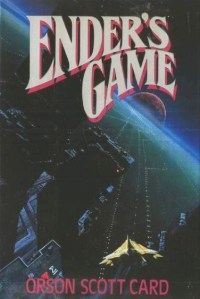
Orson Scott Card, it turns out, is an extraordinarily famous writer who has written over 60 books in several genres but is best known for his landmark science-fiction series that begins with Ender’s Game, a book that  won both the Hugo and Nebula Awards and came in third in a poll from NPR for the Top 100 Science-Fiction and Fantasy Books, with only Tolkien’s The Lord of the Rings snd Douglas Adam’s The Hitchhiker’s Guide to the Galaxy finishing above it.  Ender’s Game is currently in production for a long awaited film version,  to be released in 2013.

Now I must confess, I had no idea who Orson Scott Card was beforehand or the extent of his notoriety.  While I was an avid sci-fi and fantasy reader in my younger days, it was about the time that Ender’s Game came out that I lost track of the genres.  It wasn’t until I was at a family get-together a few days after Christmas that I realized how well known he was.  When I mentioned this Rhino Times article and said it was by the man who wrote Ender’s Game, my two nephews, both intheir 30’s now, were pretty excited as it had been a pretty big book in their lives.

 Even my sister, coming from the kitchen, asked, ” Orson Scott Card has one of your paintings? Well, my estimation of your work has just went up!”  It seems she had read it as well. 

As I have said here before, I am unaware of many things in this world.  So, Uncle Orson, excuse me for not knowing your work before this and thank you for your kind words in your article.  They are most appreciated and I am honored to have a painting in a place of honor in your home and hope it continues to give you enjoyment for many years to come.

And I will be reading Ender’s Game soon.

Read Full Post »

As we end this year, 2011, I thought I’d take a minute and show a few of the Saturday Evening Post covers from the first half of the 20th century that celebrate the new year, all created by  the great illustrator J.C Leyendecker

Leyendecker is credited with popularizing the notion of the New Year being embodied as a baby and for over thirty years his versatile babies hailed in the new year for the popular magazine, often in a timely fashion.  One hundred years ago, he had a baby suffragette marching across the cover and in times of war he had sword wielding doughboys and Nazi-fighting GIs.  The one thing they all had in common was Leyendecker beautiful style.

The German-born Leyendecker came to America as a child in 1882 and became one of the most successful and influential illustrators of his time.  He is perhaps best known for his Arrow Collar Man, a long-running series of ads that shaped how the American man of that time came to be viewed.  He also did so many of their covers that his name was  associated almost synonymously with the Saturday Evening Post, in much the same way the work of Norman Rockwell became after him.

I wonder how Leyendecker might have portrayed this new year’s baby?

Read Full Post »

Early Snow

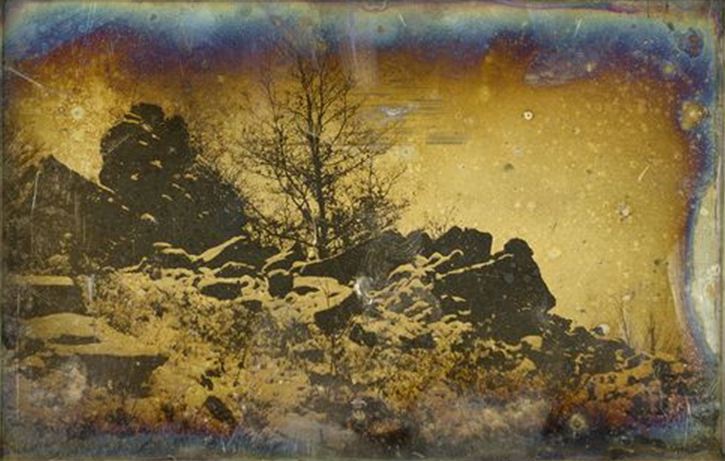
We’re winding down the last few days of December and we have yet to have any real snow in this part of New York  where I live and work.  I’ve rhapsodized here before about my particular affection for snow so it should come as no surprise that I am bit depressed by the lack of the white stuff at this point in the year.  That being the case I went looking for some online and came across this image on one of my favorite sites, Luminous Lint, which features a spectacular array of fine art photos from all eras.

This particular one is an 1841 daguerrotype from Frenchman Joseph-Philibert Girault de Prangey that may be the eraliest known photographic image of snow.  Photography was in its infancy then and nature photography had yet to blossom.  The daguerrotype, named after the man, Louis Jacques Mande Daguerre, who created the process which created these images, was the main form pf photography at the time.  It was a very dangerous process that involved the heating of mercury which created extremely toxic vapors.

According to the site, there may be other images of snow that predate this but today I’m considering this the first.  Besides I like the was the plate shows its spectrum of color at its edges and the image sort of emerges from it.  It really feels like a moment from a time long ago has been ripped from the continuum and placed on a slide for us to examine. 

And besides, it may be the only snow I see for the rest of this year.

Read Full Post »

The other night, I saw the end of the 1958 movie Auntie Mame, starring Rosalind Russell as the iconic title character.  The film was on TCM and at its end, host Robert Osborne came on and, as he normally does,  wraps up the film with an interesting bit of trivia about its stars or the folks who made it.  I really enjoy these stories as they usually give you some info that I didn’t know before that often adds a layer of understanding and interest to the film.

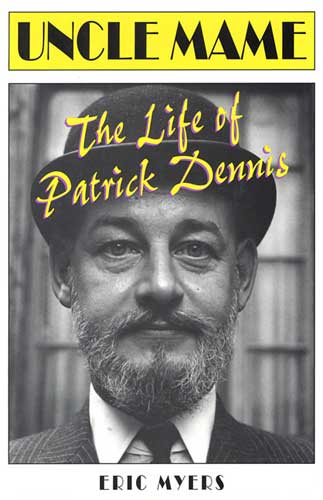
On this particular occasion,  Osborne spoke for a minute about the author, Patrick Dennis,  who wrote the book behind the film,  Auntie Mame: An Irreverent Escapade in 1955 Although I knew of the stageplay and film as well as the later musical versions, Mame, I knew nothing about the author.  Patrick Dennis was an unknown quantity to me.  It turns out that his story is a fascinating one that was documented in a book , Uncle Mame: The Life of Patrick Dennis , from author Eric Myers.

Patrick Dennis, whose real name was Edward Everett Tanner, was spectacularly famous as an author in the 1950’s, the toast of the NY publishing world.  He wrote 16 books, mainly comic novels and almost all bestsellers, which made him many, many millions of dollars.  Auntie Mame alone was on the NY Times Bestseller List for 112 weeks.  He was married with two children and seemed to be living the American Dream but that was a mere facade.  He lived another life as a gay man and also washed away all traces of who he really was with torrents of hard drink.  His fame steadily waned in the 1960’s as his books fell from fashion and his boozy, freewheeling lifestyle left him near broke.

His life entered a second (or third) act. 

He reverted to his original name and, knowing well the world of wealth,  became a butler.  He buttled for the family of McDonald’s founder, Ray Kroc, and a few others who had no idea that the bearded gentleman managing their home was the famous author responsible for Mame.  He worked anonymously.  After several years, he was diagnosed with pancreatic cancer which ended his life in 1975.  He was 55 years old.

While the play and film stand well enough on their own, the story of Patrick Dennis is a truly interesting  footnote to Auntie Mame.

Read Full Post »

« Newer Posts - Older Posts »