Feeds:
Posts
Comments

Archive for the ‘Neat Stuff’ Category

I wrote a week or two ago, after seeing the film Hugo, about the work of George Melies and how wildly inventive it was at the advent of modern cinema.  He used built sets and illusion to create  images that were like scenes torn from a dream. 

The same might be said for the work of Robert and Shana Parkeharrison, contemporary photographers who create magnificent metaphorical landscapes on elaborate painted sets then photograph them.  Old school.  There is no computer generation here.  In their best known series which is captured in a book of the same title from 2000, The Architect’s Brother, they create a monochromatic, sepia tinged world that is both filled with foreboding  and trepidation as well as sheer beauty.  Each image is poetic and thought provoking on some level. 

And powerful.

I’m sure I’m not giving as much detail about this couple and their work as you may desire.  I just wanted to pass along their imagery and let you do what you may with that.  Besides, if I write much more, that means I have less time for exploring these photos further.

Here’s a slideshow of the images from the Parkeharrisons’ book, The Architect’s Brother.


Edison's Light


Read Full Post »

Okay, I don’t mean to put a damper on anybody’s holidays or anything like that but I would be remiss if I didn’t mention that the world is scheduled to end one year from today, according to my Mayan sources and a whole bunch of cable channels.  In case you’ve been living in a cave or have been astute enough to ignore this hoopla, the Mayan calendar supposedly ends on that day and with it comes the end of the world as we know it.  All sorts of cataclysmic chaos is purportedly set to be unleashed on us on or about December 21, 2012. 

Magnetic pole shifts.  Tsunamis.  Meteor strikes.  Volcanos erupting.  Fireballs shooting out of giant Gila monsters.  Okay, maybe not that last one but this is  pretty much  a you-fill-in-the-blanks sort of imminent disaster.  I’m sure over the course of the next 365 days we will hear of many even more outrageous ways in which the world will surely be destroyed by the end of 2012.  The media, including, I’m sad to say,  the History Channel have been buidling this hysteria for years now and this year will be the payoff for their efforts.  Anything short of apocalypse will be anti-climactic.

I have to admit that there are days when I think they may be onto something, that the world is surely going to hell in a handbasket.  Maybe I even mutter, “C’mon, Comet!” under my breath once in a while.  But overall,  I think it’s all a load of crap and I find myself  hoping that that my belief is correct and that come December 22, 2012, I can get out of bed and have something new about which to complain.  That would be sweet.

So,  live each day over the next year as though it were your last.  Treasure those you love.  Take in the sunsets and sunrises.  Don’t worry about those things you can’t control.  Laugh a lot and cry a little.  Live well. 

It won’t be wasted effort because if the world does  end, you’ll have spent your last days well and if it doesn’t,  you’ll  truly appreciate what you have in this life. 

So don’t waste today.

Read Full Post »

It’s always a little disconcerting to come across someone, a performer or artist, that is well on their way to a brilliant career yet remains completely off your own radar. That’s how I felt the other day when I saw a segment on the CBS Sunday Morning show, where a reporter, Bill Flanagan,  was talking about music to give this holiday season.  He talked about the new box sets from the big names then he talked for a brief moment about a 21 year-old British singer/songwriter named Laura Marling who he said, “ Is not only wiser than her years – she’s wiser than MY years.”

He also said that older listeners would hear echoes of Joni Mitchell and Leonard Cohen and that young listeners would hear the voice of a new generation coming into its own.

Pretty high praise.  I decided I had better check out this person.

Wow.

I was knocked out.  There were tons of videos out there and going through several, I couldn’t find one that wasn’t verging on brilliant from this very young looking girl with a sad, detached blankness on her face.  You could hear traces of the artists he mentioned in the easy phrasing of her lovely voice which made it somewhat familiar but there was indeed something new in her synthesis of what she had absorbed in  her very young life.  Something well beyond her years.  It was all just wonderful, even the music from her earliest album released just days after she turned 18.  I couldn’t believe I hadn’t stumbled across a talent this big before now.

But thankfully, I have.  As I said, there is a great number of her  songs out there online and I have yet to find a clunker.  Here’s a newer song called Sophia.  I was captured by the line from its chorus–… I am wounded by dust… 

Read Full Post »

I was doing a little research on the painter Robert Gwathmey, the social realist painter whose work most often depicted the day to day life of  poor African-American culture of the American South.  I knew that his son, Charles, was a very famous architect but I didn’t know much about his wife, Rosalie.  She was a photographer who chronicled that same rural culture that was the subject of her husband’s paintings.  In fact, her photos were often the source material for his work.

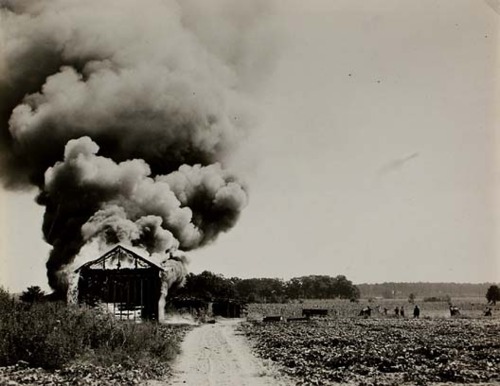
Digging deeper, I came across her photos and found them compelling.  There were poignant shots of families at work and at home, often in abject poverty.  Wonderful compositions of a barn on fire amid the wide flat fields, smoke billowing with an awful ominosity.  All very powerful stuff.

Reading some articles about her I came across a terrific article from 1994 and Erika Duncan in  the New York Times.  It was of an interview with Rosalie Gwathmey, who died in 2001 at the age of 92, focusing on her work as a photographer which, at the time of the article, was being rediscovered as the result of a solo show of her photos.  It turns out that she had been an earnest photographer. associated with some of the other great photogs of the time such as Dorothea Lange,  from around the mid 1930’s up until 1955 when she abruptly put down her camera, destroyed many of ner negatives and gave away her photos.

“I just quit,” was her description.

Reading the rest of the article, she also simply stopped painting at one point, despite having great promise, and she also abruptly ended a long career as a textile designer.  She simply stopped and claimed to have no regrets.

That really made me think.  Was this merely a facet of her personality or could this happen to anyone?   Could I one day suddenly decide that I no longer wanted to paint?  What was it that made her suddenly lose that need to express herself in a certain way?  It became a sort of scary thing to think about for me, as though it were some horrible affliction that lay in wait for me somewhere in the future.  Maybe never but maybe tomorrow.

I don’t know that there are actual answers here, only more questions.  But her quitting is as intriguing an aspect of her life as her wonderful work and makes me wonder how many others have simply walked away from what seems to be a great career.

Read Full Post »

Mr. Eddy

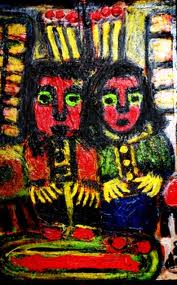
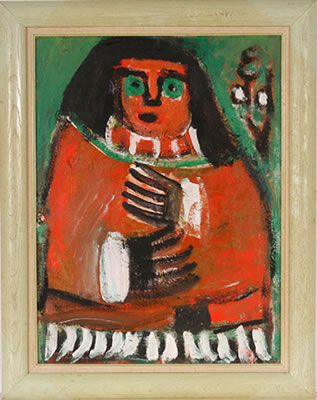
I came across another outsider folk artist whose work really hit with me.  It was from a gentleman by the name of Eddy Mumma who was born in Ohio in 1908 and lived the last part of his life in Gainesville, Florida.  It   Mr. Eddy, as he was known, started painting when he was in his early 60’s and continued in an obsessive fashion until his death at the age of 78 in 1986.  

Having lost both legs to diabetes, his daughter urged him to take some art classes just to get out of the house.  His instructor called his work sloppy.  This both caused him to quit the class and served as the ignition for an obsession that saw him paint hundreds of paintings in his distinctive manner, with heavy layers of paint of mainly figures with round eyes and and five straight fingers on each hand that created a design pattern of their own in his work.  He also painted both sides of his canvasses or boards, sometimes hanging framed pieces with the glassed side to the wall to better show the painting on the back. 

His work was never for sale although he did allow a local artist/teacher, Lennie Kesl, to purchase a number of pieces over the years in exchange for his friendship and assistance in obtaining supplies.  There is a nice recollection of Mr. Eddy from Kesl on the Southern Folk Art site that documents some of Mumma’s idiosyncracies as well as a short bio from Mumma’s daughter.  His work was obtained by a dealer from his family after his death.

There’s something very warm and inviting in the work of Eddy Mumma, something very familiar. In his better pieces, it is bold yet orderly and the repetition of forms that he uses create a running dialogue through his body of work that seems to speak, in a visual manner,  to unspoken parts of the psyches of others.  I often admire the work of obsessives like Mr. Eddy, identifying with that need to experience that  feeling of discovering something in each new piece.  Their work, while appealing to others, is created to satisfy some internal primal need for creation ans expression.  There’s something almost otherworldly in this for me and seeing their work often reinforces that feeling.

I definitely get that from the work of Mr. Eddy.  His work is inspiring to me as any great master and there are things I see in his work that make me want to get right to my brushes. 


Read Full Post »

This is a new painting called Path to Clarity, that made its way to the Principle Gallery in Alexandria yesterday.  It’s a 6″ square piece on paper and has a clarity in its color and tone that evoked the title for me.  I was looking at this piece and thought of an item that I came across lately, a test of the flexibility of the mind.  I’m sure this has been around for quite some time, probably for years in circles that cover areas of  psychological/cognitive testing.  When I first saw iit I thought it was just a foul-up in the code for the page I was reading , a seemingly random series of numbers and letters.  But seeing below that I was supposed to read it, I focused a bit and it came very easily.

Here’s the message:

7H15 M3554G3 53RV35 7O PR0V3 H0W 0UR M1ND5 C4N D0 4M4Z1NG 7H1NG5! 1MPR3551V3 7H1NG5! 1N 7H3 B3G1NN1NG 17 WA5 H4RD BU7 N0W, 0N 7H15 LIN3 Y0UR M1ND 1S R34D1NG 17 4U70M471C4LLY W17H 0U7 3V3N 7H1NK1NG 4B0U7 17, B3 PROUD! 0NLY C3R741N P30PL3 C4N R3AD 7H15. PL3453 F0RW4RD 1F U C4N R34D 7H15.

Translated:

This message serves to prove how our minds can do amazing things! Impressive things! In the beginning it was hard but now, on this line your mind is reading automatically without even thinking about it. Be proud! Only certain people can read this. Please forward if you can read this.

I don’t know if there is anything to be gained from this exercise for the general public,but  it made me think about painting and art and how it communicates in very much the same way as this exercise, giving bits of data and filling the blanks with new information that translates in the mind of the viewer.  I looked at this painting and it very much made sense in this context.  I’m sure most people can look at this piece and immediately know what it represents.  Their mind takes in the info and it makes sense and translates very easily.  Their mind probably doesn’t question the white emptiness of the path, the blues of the hills or the orange and reds of the field.  Their mind reads it as one might read the passage above.

What does this mean?  That I really can’t tell except that it only serves as a form of validation of this work’s power as form of communication  rather than something created for mere aesthetics.  Not that aesthetics don’t come into play.   Harmony of color and form play a large part in making the message more palatable.

Anyway, just thought it was interesting.  I guess that’s good enough.

Read Full Post »

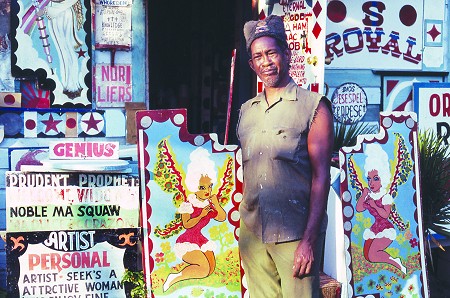
I’ve written here about a number of self-taught artists who create their work from some hidden inner core that demands expression.  Some have suffered through forms of mental illness en route to their creations but perhaps none show the depth of their illness so readily as Royal Robertson, shown here in front of his home before his death in 1997.


Robertson was born in 1936 in Louisiana and trained as a sign painter.  He married his wife Adell in 1955 and they produced 11 children in 19 years of  marriage  until Adell left Royal for another man , taking the 11 children with them.  Already in the midst of his paranoid schizophrenia, this departure sent him reeling into an angry pit of despair fueling a misogynistic rage that saw him create numerous pieces featuring Adell in various forms, mostly as a whore and sometimes in a very explicit manner.

Adell- Prophet Royal Robertson

There’s a lot more than can be written about Robertson’s life and illness– the visions and alien visitations he claimed, for example– but I want to just talk about his work a bit.  It’s a bit different from most self-taught or outsider artists that I have looked at in that it doesn’t settle into a recognizable self-vocabulary for him.  His work seems to dart all over the place in different styles and looks , never really finding that singular voice, probably a result of the unsettled nature of his mind.  It sometimes looks like comic books, sometimes like pastoral scenes that just happen to have alien crafts hovering through and sometimes just crude drawings of a naked Adell.  And sometimes it will coalesce into a piece that is quite graceful.  It’s difficult work of which  to get a grasp, to say that it easily attracts or repels me. 

One thing that did attract me was his practice of filling the backs of his work with the words of his prophecy.  It reminded me very much of a piece of paper that I have around here somewhere.  It was done by a man who used to come into the restaurant where I worked when I first began painting.  His name was Sam and he would come in and sit at a table for hours, drinking coffee and smoking cigarettes.  He was always disheveled and muttering, obviously possessing a disturbed mind.  He was eventually barred from the restaurant for yelling at the other patrons.

Royal Robertson- reverse side of drawing

But while he was there he often  would have a sheet of paper on which he would make lists in a beautifully graceful manner.  One day he left one and I made sure to grab it before it hit the trash.  It was a  wonderful piece of work.  It had lists of government officials, Hollywood starlets, PGA golfers and characaters from the Godfather movies.  He often called a young server, whose name was Mary, Tina Brazzi, saying that she was the daughter of Luca Brazzi, the character in the film who eventually slept with the fishes.  Mary was a little uneasy about being recognized as Tina.  But the sheet itself was beautiful, with lovely calligraphy and an order that belied Sam’s own mind.  It’s a piece that always brings me both joy and sadness when I see it, a reminder of how fine that line often is between beauty and madness, something to which the work of Royal Robertson also attests.


Read Full Post »

On my recent visit to the Fenimore Art Museum, there were many pieces that really hit with me but one that I keep coming back to in my mind is a folk art painting from Malcah Zeldis titled Homage to Hank Greenberg.  Greenberg, the large figure of the baseball player in the upper center of the painting, played for the Detroit Tigers in the 1930’s and 40’s and was a power-hitting superstar of that era.  Known as the Hebrew Hammer, not only was he the hero of Detroit fans but he was also a hero to Jewish fans throughout the nation.  Malcah, born in the Bronx but raised in Detroit, was a fan of Greenberg’s in both camps.  He was to her, as the painting shows, larger than life.

The painting has a wonderful glow to it in the museum gallery, a bit more warm and orange than this image, that makes it most appealing.  This warmth draws you in and allows you to take in all the smaller details that Malcah has painted into the beautifully laid-out scene,  such as  scene directly below Greenberg where the artist and her family are portrayed sitting around the radio, listening to the game. 

I also find appeal in this painting in that the work is so confident and sure handed in the way the paint is applied.  It creates a real sense of solidness in the whole piece, giving you the sense that the artist is totally committed to their vision and their message. 

In short, I think it’s just a damn fine painting. 

For more info, on Malcah Zeldis, who is one interesting person, I refer you to a blogpost from the  American Folk Art @ Cooperstown site and to an interesting article from earlier this year in the Downtown Express, the Newspaper of Lower Manhattan as they put it.  She has led a vibrant and interesting life and still creates wonderful work at the age of 80.  Here’s a video that shows her in her apartment talking about some of her paintings and other objects she has found.

Read Full Post »

Most people think of anything that falls on the eleventh day of the eleventh month as being a time to commemorate the brave men and women who have served in the Armed Forces.  That, obviously, is a wonderful tribute to their sacrifice and is a worthy use of this day.  But this year, there is an added element to the gravity of the day.

This day in this year, 11/11/11, Nigel Tufnel Day.  I believe this has something to do with some apocalytic countdown attached to the Mayan Calendar. 

Nigel Tufnel was, and is, the lead guitarist for the band Spinal Tap, the heavy metal rockers who were the subject of  the celebrated film mockumentary This is Spinal Tap from director Rob Reiner back in 1984.  As played by Christopher Guest, Tufnel is best remembered for the part of the film where he is showing his guitars to Reiner and explains why the dials on his amps all go to eleven rather than ten, the normal top number on most numeric dials.  It is a classic bit.

The film has become a classic, deemed “culturally, historically, or aesthetically significant” by the Library of Congress in 2002.  The film popularized the mockumentary style and Guest has made a great series of films based on this format of a traditional looking film dockumentary using a reperatory of actors and improvised (and often very funny) dialogue.  Best in Show, A Mighty Wind  and Waiting For Guffman are all exceptional examples.

So, today, at the clock strikes the eleventh minute of the eleventh hour of this eleventh day in the eleventh month in the eleventh year of this decade, I will first say a silent thank you to honor the service of all the troops, past and present.  Then I will plug my guitar into my amp and turn it up to eleven. 

I can’t embed the actual  that started the ball rolling for Nigel Tufnel Day but you can watch it on Youtube by clicking here.

Read Full Post »

Among  the many great and sad stories in folk art is that of Martin Ramirez, a man born in Mexico in 1895 who came to the United States as a young man to work on the railroads.  The work proved too demanding for the small man and he soon was in despair, losing the ability to speak at that time as well.  He was diagnosed as a catatonic schizophrenic in 1930 and lived the rest of his life in mental health institutions until his death in 1963. 

Years into his institutional life, Ramirez started creating drawings and collages from the everyday objects around him.  This is how his work is described on the Foundation for Self-Taught Artists website:

Exhibiting a kind of iconographic vocabulary, Ramírez’s lovely drawings limn deep, vertiginous spaces through rhythmic repetition, disorienting perspectival shifts, and stagy composition. A mythic presence suffuses the animal, human, landscape, and abstract aspects of the work, all hemmed in by vibratory channels and warrens. A master of line and compositional control, Ramírez used graphite, melted crayons, and found pigments on paper fragments glued together with saliva and oatmeal. He also included collaged elements drawn from magazines and books. Recurring motifs in the work include mounted and armed jinetes (horsemen)—Ramírez was fond of horses and an equestrian back in Mexico—Madonnas, trains and tunnels, cars, and landscapes. Vernacular Mexican and American cultural themes and visual tropes, both nostalgic and resolutely modern, combine in a body of sensuous, dream-like images.

Martin Ramirez and Tarmo Pasto

In the 1950’s, Ramirez’s work was discovered by visiting art psychologist Tarmo Pasto who asked that he be allowed to keep any drawing that Ramirez produced.  Apparently, many pieces had been discarded over time in order to keep the ward clean.  Pasto championed Ramirez’ work and made it possible for the world outside those sanitarium walls to see the creations of this man whose mind seemed to transcend his captive life.  In the years since his death, the works of Ramirez have become some of the most prized in all of folk art and have been the subject of several  exhibitions in major museums.

I have never seen these works in person but am struck, even seeing mere images of them, by the almost trance-like rhythm of the patterns and imagery in them.  There is a beautiful grace in them that is only enhanced in knowing the story of this man’s struggle through his life.  It’s as though Ramirez was creating in his work, portals of release for a captive soul, a new world in which his inner mind finally jibed with the outer world.  That is how I choose to view it  in that I find the work filled with an almost idyllic harmony. 

 Postcards from a better place?  Perhaps.  Whatever the case, it is a gift to us from a world we may never know.


Read Full Post »

« Newer Posts - Older Posts »