Feeds:
Posts
Comments

Archive for the ‘Opinion’ Category

I saw Judith Schulevitz on The Colbert Report last night promoting her book, The Sabbath World: Glimpses of a Different Order of Time, and it brought a lot of things to mind.  Her book, from what I take, examines the concept of our need for a sabbath and how we have lost the benefits of this day of stoppage as we have become more and more entrenched in a hectic 24/7 world.   Our concept of time has been altered by our change as a society.  We see time spent in activity of ant sort as more meaningful than any spent in stillness.

I am old enough to remember when the Blue Laws of the past were still in play in this part of the world and how most businesses were closed on Sunday.  It was hard to find a gas station open.  You couldn’t buy alcohol.  Almost all retail stores were closed.  Traffic was lighter and Sundays had a quieter tone in general, even for my family which was not religiously observant in any way.

I used to think, when reminiscing about those days, that this slower pace and quiet was nothing more than the fact  that I was a kid and lived on the more casual, relaxed kidtime.  No deadlines.  No schedules.  Just be a kid and let time flow naturally.  But as I remember more, it really seemed to be a quieter and calmer time for the adults as well.  There was something very comforting in knowing that everyone’s week had this common day when we would all reset and realign.  A common stopping point where we could all reflect on the week that was past and regroup for the coming week..

Of course, that could never happen now.  We are too invested as a culture of perpetual motion now and to try to put on the brakes would take a revolution of sorts.  But people like Judith Schulevitz and her family are trying to return to that feeling of reflection.  It’s a small step but if only a few families can regain that sense of of calming the hands of the ever spinning clock, then it’s a worthy effort.

Here’s an article Judith Schulevitz wrote for the NY Times, several years ago that is the seed for this book and more clearly defines what I’m struggling to say.  For example:

What was Creation’s climactic culmination? The act of stopping. Why should God have considered it so important to stop? Rabbi Elijah of Vilna put it this way: God stopped to show us that what we create becomes meaningful to us only once we stop creating it and start to think about why we did so. The implication is clear. We could let the world wind us up and set us to marching, like mechanical dolls that go and go until they fall over, because they don’t have a mechanism that allows them to pause. But that would make us less than human. We have to remember to stop because we have to stop to remember.

Take a look and this Easter Sunday, relax.  Reset the clock…
Read Full Post »

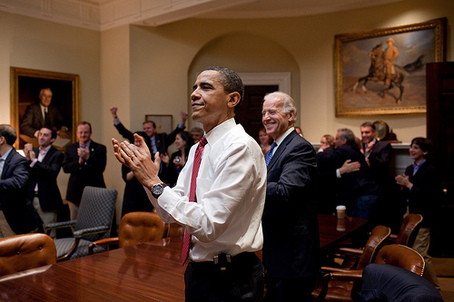
Last night was a historic one for America.  A healthcare reform bill was passed by Congress and awaits approval in the Senate before being signed into law by President Obama.

Is it perfect?  Certainly not.  It couldn’t be.  Passing legislation on a subject that affects such a large segment of our economy and all of our population could never approach perfection.  Some will say it’s not enough, that it doesn’t do enough.  Others will say it goes too far, is too intrusive. 

But it’s a true start, a real framework on which to build.  It is but a first step in a long process that needs to take place in order to bring substantive change to a system that has been devouring our economy for too long.  To do nothing and maintain the staus quo on healthcare as our government has been doing for too many decades was not a realistic option.  When you’re at risk of drowning there comes a point where you’re going to want to try to swim.

And we are in deep water.  Using the latest comprehensive figures, from 2007, the US spends over 2.2 trillion dollars, or $7400 for every person living here, for a system that doesn’t even include coverage for over 15% of its population.  The newer, not yet official, numbers are even higher, with healthcare costs growing much faster than the rate of inflation.

That means healthcare is eating about 16% or more of our GDP.  The average for other wealthy nations is 8-9% and that includes coverage for all their citizens in most cases.  And better overall healthcare, acording to most statistics.  We spend more and get less than any other nation in the world.  That puts us at a competitive disadvantage globally and  is unacceptable and unsustainable. 

Something had to be done and now it is officially underway with the imminent passage of this bill.  Let’s start building on this foundation.

**********************************************

A couple of good articles on the subject:  Ezra Klein in the Washington Post  and Paul Krugman in the New York Times.  Klein’s view is very similar to that of mine and Krugman’s examines the contrast between the tones of the two opposing sides of this struggle.

Read Full Post »

Today is  St. Patrick’s Day and I was going to write about the day and how it was my late mother’s birthday.   She would have been 78 today.  But today I’m interested in a story in the news as of late brought about by the recent publication of a book by Rebecca Skloot, The Immortal Life of Henrietta Lacks.

It tells the story of the amazing cells of Henrietta Lacks that survive to this day, almost 59 years after death.  You see, Henrietta was a poor African-American woman living in the Baltimore area in 1951.  She was 31 years old when she was diagnosed with cervical cancer and her treating physician took a sample of her cancer cells without her knowing, which was common at the time.  Later that year, Henrietta succumbed to the cancer and died.

In most cases, the life of a 31 year old poor black woman who died so long ago might only be remembered by a very small group of family and friends, and even then, only fleetingly.  But Henrietta’s name is very much alive today. 

Her name and her cells.

You see, the cells taken from other humans have been found to have  short lifespans outside the body,  usually days.  But not Henrietta’s.  Hers were unlike all others and continued to live.  And live and live and live. This was a boon for medical research.  Her cells , now called HeLa Cells, were used by Jonas Salk in developing the polio vaccine and in the years since have been part of almost all new vaccines and medical developments.  Her cells continue to grow and have become a factory of sorts as there are companies that mass produce her cells for use in medical research. 

 In fact, over 50 million metric tons of her cells have grown in those decades.  To put  that into perspective, that would be enough to fill the space of the Empire State Building– 15 times.

There’s more to the story.  Her immediate family was not aware until 1976  that her cells were stll alive and being produced for sale and were, in fact, a multi-billion dollar business.  They have never seen a penny and are ironically without health insurance and in need of  treatments that have been developed with Henrietta’s cells.

I don’t want to get into a rant over the ethics of big business and healthcare but it brings to light a question of what constitutes life and ownership of our own cells outside our body.  I don’t really know where I stand on the subject.  I would like to think that those cells are indeed a part of Henrietta Lacks and that her life continues in them.  It would be a lovely concept to think of her cells forming an immortality that extends beyond the memory of a small group of family.  That the spirit her family saw in her lives on.

Is it so?  I certainly don’t know.  It would be nice if her family could see even a token gesture from the companies that have been built on the legacy of her cells.  Then maybe her cells could live on in other ways as well.

Happy Birthday, Mom.

Read Full Post »

In a recent New York Times article, columnist Matt Bai wrote about the current outrage in the American public against the influence of lobbyists is our halls of government.  He makes a case that perhaps the lobbyists themselves are not wholly to blame for the power they now wield but the current state of affairs is a result of a system that has made most politicians view any critical decision as being a matter of them either choosing  what is truly right for their constituents and the country or choosing what best protects and serves their own position.  It comes down to a matter of self-preservation, looking out for themselves, over looking out for the people they represent and supposedly serve.

As a result, we are left with a government designed and built with good intentions for all but operated by the few for their own often selfish ends.

It brings to mind director Frank Capra‘s classic film,  Mr. Smith Goes to Washington.  Everyman Jimmy Stewart plays Jefferson Smith who is chosen by the governor of some vague western state to replace a recently deceased senator.  Smith is chosen for his wholesome image in the state, as head of the Boy Rangers,and for a naivete that those in power feel will allow him to be easily manipulated.  In Washington, Smith is faced with corruption and graft from special interests and is soon the target of these groups as they attempt to destroy him when he finds out what he is up against and tries to do what is right.

Sounds familiar.

The film is a very simplified, maybe overly naive,  object lesson for our democracy.  But beneath this layer of naivete there is the simple truth that our government is based on those in power doing what is just and right for the people and when this power is usurped, our voices are ignored and the power of our democracy is diminished.  We lose something essential to our character as a people.

What’s the answer?

I’m not sure.   Perhaps we should change our system in a way that very much limits a person’s term in office, maybe one four year term so that there is no pressure for running a campaign while they are in office.  Do away with career politicians.  Fund all campaigns with public funds and return to a true citizen government.

Could such a system do much worse than the way things are currently done?  Some will say that we would be losing our best minds by having term limits but does the current system really encourage our best minds to serve in government at this point?

As it is, I am without a congressman of any sort at the moment.  I am unfortunately part of the congressional district  ( the 29th New York) represented until last night by Eric Massa, who is bailing on his constituency because of a recurrence of cancer and a sexual harassment scandal.  I am disappointed.  In the sheer stupidity of his actions.  In his quick, unceremonious exit.  In his unwillingness to finish his term and fight for the people that chose to vote him into office.  He claims he was at odds with the Democratic party over his refusal to toe the party line on health care but instead of staying in the game and trying to work out solutions, his choice was to try to punish the party by leaving the citizens of his district without a voice in Congress for several months until a special election can be held.

He was obviously not our Mr. Smith.  I don’t think Mr. Smith would give up so easily on the people of this country.

***************************************************

Addenda: As I was finishing the end of this, there was a local news report on the TV about a local longtime mayor who was being urged to seek Massa’s abandoned seat.  In a statement the mayor said that the environment in Washington was toxic and that they needed honor and dignity.  For that reason, he would not run.  It struck me as a very funny line.

Read Full Post »

This Walking Man I from the late Swiss artist Alberto Giacometti.

A week or so back it became the most expensive piece of art ever sold at auction, selling for a cool $104.3 million.

I’ve always been intrigued by the life and work of Giacometti so I’m not going to rant about the relative merits of any work being truly worth such a sum of money.  If someone feels that it is worth that, then it is worth that.

However, there was an interesting editorial piece in Tuesday’s New York Times from Eduardo Porter that used the sale of this Giacometti as an example that the economic downturn is at an end.  At least for the type of person who can afford $104.3 million.

The fact that the super-rich are once again secure enough to parctice conspicuous consumption is a positive economic indicator especially when it comes to things such as works of art and other luxury items, which are considered Veblen goods. These are are items whose appeal grows as their prices rise.  Think Ferrari.  Louis Vuitton.

The Veblen Effect is an interesting one.  The idea that the same item becomes more desirable simply because it’s price is raised seems somewhat counterintuitive.  One would think that common sense would make such a thing a rare occurrence.  But we know better, don’t we?  Status seeking overrules all common sense.

I have seen the Veblen Effect at work.  I have a painter friend who, a number of years ago, had a painting sitting for a long time in his possession.  He felt it was a very good piece, one that was a great example of his body of work.  It was priced modestly and sat for months and months with no interest.  Frustrated one day, he more than doubled the price of this painting.

It sold within days.

Now this is certainly not on the level of the Giacometti’s Walking Man.  It’s just a little illustration of how we all can be affected by this drive to show our desired status in this world.  I’m not saying it’s wrong or right.  It’s part of who we are as a species and will probably never change.  The important thing is to determine who you really are as a person and be comfortable with that. 

Because who you truly are shows through even the most  or least  expensive coverings…

Read Full Post »

I guess I’m a little worried.

I tend to worry when I see problems that I have no answers to or have little control in their resolution. 

The latest moment of worry came with the resignation of Evan Bayh from his seat in Congress, citing the frustration of dealing with idealogues of both sides of the aisle and the gridlock resulting from their stubborn belief that theirs is the best and only way to move this country forward. 

It brought to mind a couple of things for me.  The first was an article several weeks ago that asked if we, as a country, had finally become ungovernable.  It cited the the increasing polarity of the two parties over the past two decades with a seemingly total aversion to common ground.  It spoke of the even greater influence of even bigger money lobbyists over the same time and the ever increasing use of stalling tactics, such as the filibuster, to delay the progress of anyof the nation’s business.  It also mentioned a political system that had become so cannibalistic in their personal attacks that it kept our the best people from seeking office, leaving the seats of governance open to those concerned with furthering personal agendas or worse, the agenda of an entity to which they are indebted.

Gone were the days of coming together to do what was needed to serve the country.  Instead it became you say yes, I must say no.  A culture that sees compromise as failure.

I was reminded of a conversation I had a number of years back at the Principle Gallery, in Alexandria just outside DC.  One of their clients and friends was there when I was delivering some work who was a longtime Washington insider, the assistant to a very well known political consultant/strategist.  You would know the name. 

His boss was a Democrat and this gentleman was a Republican.  I commented that this seemed a bit unusual and he said it wasn’t really that odd.  At least,he said,  it wasn’t in the Washington of the past.  He went on to say that he was sickened every day by the partisanship and the ugly tone of both sides, how personal attacks that would have seldom taken place before were now the norm.  He talked about how it was becoming more and more difficult to get anything done and how it was more about satisfying special interests than serving the people.

This was in the spring of 2001.

Things have not gone well in the time since.  We have a completely polarized Congress.  A Supreme Court that seems to put the rights of the corporation above the rights of the citizens, whose recent rulings may very well allow the shamelessly greedy bankers and brokers who sent us to the brink of ruin actually have more power and say in who is elected.  We are constantly bombarded by pundits from both sides who take glee in the failures of the other side which to me says they are taking joy in our failures as a nation.

And we, the great centrist portion of the nation are left with this– a nation served from the edges of both sides.  Nobody is well served this way and nobody is happy but for those who profit from the edges.

So, are we ungovernable?  Do we have any chance of moving forward together as one nation?

I don’t know. 

Like the heading above says, I am worried.  I, like most, feel as though I am powerless to affect change, that my voice is tiny before the great din of Washington and Big Money. 

I’m hoping an answer will appear…

Read Full Post »

This is Alexa Gonzalez.

She’s 12 years old and attends junior high school in Queens, NY.

She loves her friends, Abby and Faith.

Probably knows every show on the Disney Channel.

You probably wouldn’t guess that she’s a menace to society.  A threat to the very fabric of our civilization.

You see, this past week Alexa was arrested and taken from her school in handcuffs by police.

Drugs, you ask? Bullying?  One of those horrible videotaped girlfights?  Did she stab a teacher?

Worse.

She wrote on her desk.

Terrible things.

I love my friends Abby and Faith and worst of all, Lex was here 2/1/2010.

Then she punctuated the whole bit of obscenity with a lewd symbol– a smiley face.

Omigod!  Monster!

You know, when I heard this the first thing that came to mind is that I would be in prison today for almost anything I did  on a regular basis from the ages of 12 to 16.  Talking during class.  Running in the hallways.  Yelling during lunch.

Actually, I probably should have been in prison for some of the things I did that I won’t mention here but I’m trying to illustrate a point here.

Kids are still kids.  Kids will do goofy, rebellious things.  Our job is not to go insane, not to overreact.

I used to write little stories with illustrations on the tables of a study room a group of friends and I occupied during lunch hours at my school.  They were goofy tall tales of a character I called General Billy Bob Buckles. Not great stuff but they filled the time and satisfied a creative outlet.  Not obscene, although they were far more inflammatory than I love my friends.

But in the end, they were saying the same thing.  Like Lexa was here, I was saying I was here.  It’s that eternal need to be heard, especially when you’re a 12 year old child in a world where you often feel powerless and voiceless.

Now I knew at that time that if I had been caught by someone in authority  (particularly our principal who was very much irked by these stories and whose ire only served to make me want to write even more on the desks)  that I would have been in for trouble.  But the thought that I could have been hauled from the school in cuffs would have seemed ludicrous, beyond belief.  It would have seemed, even to a kid with limited life experience, to have been way out of scale for the crime, especially when so many far worse  crimes were occurring within walking distance.

It seems we have lost scale for we react to many things, this incident just being a highlight.  It feels as though we are teaching these children to be reactionary, to not step back and take measure with a calmer eye and common sense.

And where this lesson leads is far worse than a 12 year old girl writing I love my friends.

Read Full Post »

Yesterday, I received this photo in an e-mail from my friend, Bill Boland.  It’s a picture he snapped at 8 AM on Tuesday morning of the the steam whistle blowing for the last time at the south side location of the old Corning Glass Works plant in Corning, NY.  For over a hundred years, this whistle has bellowed out over this small city eight times a day, signaling the workers to the different times in the work day.  It was a sound that was part of the background of your life if you lived in any of the many factory towns throughout this country.

Corning has very much been a company town for the last century, and as Corning Glass Works grew so did the local workforce.  But the company, like any big company, evolved.  Corning Glass Works became Corning Inc and  they became part of the global community of high tech firms, opening plants and offices all over the world.

But with this change came the end of most of the local manufacturing, most of it moved to foreign shores.  Gone were many of the blue-collar jobs that supported the community for a century.  It’s a familiar story throughout the country.  The local company that anchors a community becomes larger and eventually finds greener pastures for their factories overseas or across borders, leaving behind a large portion of the locals to scramble  to find new jobs in this new global economy.

To be fair, Corning Inc  still dominates Corning  and has worked hard to uphold its paternal responsibility in the area.  It is still the largest employer in the area and still is responsible for much of the business that flows through all other local businesses.  It invests a  lot of effort in supporting this area and in keeping Corning a vibrant little city that is a fitting home for the headquarters of a global corporation.

But there’s something bittersweet in the last blast of this whistle that has sounded its shrill call over this city for over a century.  It has the feel of a symbolic end to an era that many people in this country remember with fond nostalgia,  especially those who are struggling to find a way to survive and prosper in a new globalized economy.

Read Full Post »

Monday/ Rave On

Monday morning.

I guess I’m lucky in that Monday morning has no special significance for me.   It’s not the start of my work week since my work week never really ends- or starts, for that matter.  It doesn’t harken the reminder of having to be somewhere that I’d rather not be.

It just is.

Just another day.  Another chance, another opportunity to rise and do what I do.

An endless continuum of being and doing.

That’s one of the charms and curses of doing what I do, this lack of a defined barrier between what is and isn’t work.  For some, it could be an awful thing to be constantly trapped in your own world of work.  I understand that and there are days when the last thing I want to think about is my work.  But, fortunately,  those days are few and far between.

For the most part, I am happy to live an endless work week, rising early to rub paint on canvas and board.  To solitarily try to capture something I can’t quite see or describe.  To go to sleep with the rhythm of an image in my head and to wake, eager to try to find it once more in the new light.

So, it’s Monday, somewhere in my work week.

In the spirit of today, here’s a neat version of Buddy Holly‘s Rave On from M. Ward.  Enjoy your day…

Read Full Post »

I wrote yesterday about how music and other stimuli influence my work.  Since then I’ve been thinking about that and a comment made by writer David Terrenoire about knowing other fiction writers who refuse to read other writers for fear of having the voice of this other writer creep into their own.

I believe the creativity of any artist, writer, or musician comes from their own unique perception of the world around them, how they see and take in everything to which they’re exposed and reflect it back to the world.  I don’t think it’s so much that they create new worlds but how they synthesize what they encounter in this world into their own personal version of it.  This synthesis of influences is what gives an artist their unique voice.

I was recently talking to a young painter, still in a college program, whose work showed real promise but it was obvious he was still in search of a voice.  Every painting carried the earmarks of the painter he was influenced by during its making.  While all were well done, there was nothing yet visible that stood out as being uniquely his in any of the paintings.  It was obvious he was still gathering influences, seeing what was out there and trying to copy it first.  I asked him how he liked to paint, how he saw his work in his mind and he said he wasn’t sure yet.

He hadn’t started synthesizing yet.  While obviously talented, his voice was not present yet.

But at some point, for any creative person,  there has to be the transition from simply taking in information and reflecting it just as it entered to a thought process that allows new data, new influences, to be taken in and transformed internally into something uniquely their own.  Their own voice becomes unmistakable.

When that happens, I can’t say.  It’s probably different for every person and maybe it never happens for many.  Maybe there’s an aspect to this I’m overlooking because I am just thinking out loud here.

As is often the case, I don’t really know…

The piece at the top is a tiny new painting,  the image being 1 1/2″ by 3 1/2 ” in size and matted in a 6″ by 8″ frame, called Hold Your Banner High.  It is available at the West End Gallery as part of their Little Gems exhibit.

Read Full Post »

« Newer Posts - Older Posts »