Feeds:
Posts
Comments

Archive for the ‘Painting’ Category

Put this one in the Even the great ones screw up every once in a while file.

This is a painting from Norman Rockwell titled People Reading Stock Exchange, a piece done in 1930 for one of his many Saturday Evening Post covers. There appears to be nothing unique about it at first glance, just a group of folks hunched around a wall chart that they all  find completely absorbing. They all seem perfectly normal until you take a closer look and notice that the young man in the red shirt seems different. You look a bit closer, maybe squint a little until you realize you don’t need to do that to see his abnormality.

Yes, he has three legs.

This strange young fellow apparently went unnoticed for a while and Rockwell himself didn’t recognize it until it was pointed out years later. It proved to be a embarrassing episode for him, especially given his reputation for capturing detail and realism in his work.

Some people have tried to explain it away as some sort of subconscious phallic representation which seems like a stretch to me. I think it was merely an oversight although an unusual one. As a casual viewer, it it something that is easy to overlook but I am more surprised that in the process of adding the finishing touches that it simply didn’t register for him that he was creating a most unusual young man.

As an artist, it’s reassuring, even comforting, to see someone so meticulous in his process make such an error.

Most artists have at least a handful of such things in their background, pieces with shadows that make no sense in nature or arms or necks that are much too long for any living human. Most go unnoticed. The unfortunate thing is that once they are identified, they become the focal point of that painting forever– something once seen that cannot be unseen.

I know that I have several paintings with mistakes, with departures from the laws of physics and other realities. These are pieces that, without these flaws being pointed out, are strong and full works. Few people, if any, notice these flaws but for me they are sometimes the first things my eyes rest upon in the picture. But they don’t bother me as I imagine this bothered Rockwell.

I see them as symbols of our humanity, our inherent flawed nature. We don’t need to point out our flaws. They’re there for all to see. We can only hope people accept us, three legs or two or one.

And the three-legged young man here is a refreshing reminder of Rockwell’s humanity.

************************

This post originally ran here back in 2013. It has proven to be one of the more popular posts through the years, often getting hundreds and sometimes thousands of views in a day. It is a favorite of mine, as well, simply for the reminder that we are imperfect beings. I certainly make no pretense of perfection in my own work. In fact, flaws are an inherent part of what I do. My signature, if you will.

Must be I subscribe to the words of Fred Astaire:

The higher up you go, the more mistakes you are allowed. Right at the top, if you make enough of them, it’s considered to be your style.”

Read Full Post »

Wyeth/ Balance

******************

It’s all in how you arrange the thing… the careful balance of the design is the motion.

-Andrew Wyeth

******************

I read this quote from the late Andrew Wyeth then looked over a large group of his work, examining each piece with these words in mind. I could really see the importance of the placement of the elements in his work, how it was the characteristic that truly defined his work. It was this that gave his work a poetic feel.

His use of negative space is masterful, the empty areas taking on an important role in the overall feel of the work. Placing the central character, the focal point of the picture, in any in any other spot would change the whole piece, would make it feel less.

It would feel off balance, at least in the form that Wyeth defined it. That balance is his signature.

And I think that is true for many artists. This idea of balance and motion makes up the artist’s eye. Every artist has a slightly different way of seeing things which creates their own unique visual voice.

Myself, when I feel stuck or blocked or feel that I have painted myself into a creative dead end, I look back at older work. It is often the balance and motion with the composition that affect me the most. It serves as a reminder to not lose sight of this idea of balance, to not focus too  much on other parts of the painting that, while important, may not have as much effect on the overall impact of the piece.

Balance in the design creates motion. Good advice from Mr. Wyeth.

Read Full Post »

************************

“I can very well do without God both in my life and in my painting, but I cannot, suffering as I am, do without something which is greater than I, which is my life, the power to create.”

Vincent van Gogh, The Letters of Vincent van Gogh

************************

Amen.

Love the passion in the words above from Van Gogh but really just wanted to share the painting at the top of the page. It’s The Red Vineyard from 1888 and it is considered to be the only painting ever sold by Van Gogh in his lifetime.

It was bought by the Belgian Impressionist artist Anna Boch in 1890, the year of Van Gogh’s death. It was bought for what would be abut $2000 in today’s dollars. I include that because when Boch let it go to auction in 1909, its value had shot up to what would be about $150,000 today. Van Gogh’s sister-in-law, the widow of his brother Theo, wanted to get it back but the price went well past her means.

It was purchased by a Russian collector who gave up ownership of it when all private property was nationalized by the Bolsheviks after the Communist Revolution. Today, it hangs in the Pushkin Museum in Moscow.

More than likely I will never see this painting in person but it remains a peach.

Read Full Post »

*************************

Whenever I find myself growing grim about the mouth; whenever it is a damp, drizzly November in my soul; whenever I find myself involuntarily pausing before coffin warehouses, and bringing up the rear of every funeral I meet; and especially whenever my hypos get such an upper hand of me, that it requires a strong moral principle to prevent me from deliberately stepping into the street, and methodically knocking people’s hats off – then, I account it high time to get to sea as soon as I can.

–Herman Melville, Moby Dick

*************************

I’m no sailor but I know that feeling, that drizzly November in my soul as Melville wrote. A glumness descends accompanied by an anxiety that cannot be quelled and the idea of being around people sets my jaw hard with my grating teeth. If people still wore hats I am sure I would be aiming to knock them off their heads.

Or worse.

I can’t head to the sea to alleviate my hypos as Melville describes this feeling which I believe is taken from the word hypochondria. No, for me, it is time to try to barricade myself in the studio and pick up my brush which is my equivalent to hoisting the sail.

With brush in hand there is a freedom with no boundaries that can hold me. No rules to follow, no one to tell me what I can or can’t do.

A brush loaded with paint is like a sail filled with a strong wind that will take me anywhere I want to go.

I can create my own sun when it’s gloomy outside or my own moon and stars to guide me through the dark. I can look out on a landscape free of all traces of people and if I occasionally want to see one I can make them far away from me, small and distant.

That keeps me from knocking off their hats.

The hypos seem to be getting the upper hand of me so I think it is high time to pick up my brush and set sail.

But if you see me on the street in the meantime, hold onto your hat.


Read Full Post »

***************

There are two ways of spreading light… To be the candle, or the mirror that reflects it.

–Edith Wharton

***************

This is a sort of new painting headed to the Principle Gallery for their upcoming Small Works show that opens next week. I say sort of new because it is a painting from a few years back that was changed in a way that made it a completely different piece.

Back then it was titled Candle and it was just as it is without the female figure and the boat. With its simplicity and color, it was a favorite of mine and it has been here in the studio for the last year or so, much to my delight. There has always been something in it that speaks to me.

But I have recently worked on a few paintings with small female figures in them and their presence has had a real impact in those compositions, adding a real layer of meaning and depth to those paintings. In the studio, I started to to look at this painting– without the figure– and began to see her there. I could see her adding a symbolism that would change and enrich the painting.

I wasn’t sure I wanted to change the original painting but day after day all I could see was a ghost of that figure in place. The original began to fade for me, began to seem lacking, as thought it had waited for me to add this figure and make it whole.

So, this what you have now.

I changed the title of this painting with another addition, becoming Fiona’s Candle. The Fiona comes, of course, from the British born US Diplomat Fiona Hill who testified in the recent Impeachment Hearings. Her strength, her intelligence, her straight forward approach, sense of purpose, and her unwillingness to suffer fools or alter her moral compass for them made a deep impression on me and many others.

We could use a few more Fiona Hills.

In this painting, I see the female figure as having those same characteristics. She is seeking, as Edith Wharton wrote above, to spread the light, to illuminate the truth– which I see here as the Sun, a set and constant thing– as either the candle or the mirror that reflects it.

I am usually averse to changing pieces that speak so strongly to me, that seem to already have a life force in them. But there are always exceptions and this painting, for me, seems to have been fortified, made stronger by one simple addition.


Read Full Post »

***************

As an artist you have to find something that deeply interests you. It’s not enough to make art that is about art, to look at Matisse and Picasso and say, how can I paint like them? You have to be obsessed by something that can’t come out in any other way, then the other things – the skill and technique – will follow.

–Anselm Kiefer

***************

Anselm Kiefer (b. 1945) is one contemporary artist that continually fascinate me. His work often deals with history and how we in the present time are connected to it. One of his projects is a long term exhibit at the Massachusetts Museum of Contemporary Art that features 30 very large paintings, all about 6′ by 11′, assembled in one space. The exhibit is titled Velimir Chlebnikov based on a theory from the Russian Futurist of that name ( who died in 1922 at the age of 36) who believed that major naval battles happened every 317 years and had some sort of cosmic importance for the human race.

This group of paintings from Kiefer deal with nautical warfare and are built up on heavily textured grounds comprised of a variety of materials one doesn’t often associate with painting–dirt, sand, straw, rust and lead. It’s gritty and rough yet striking and somehow beautiful at the same time.

Now, I can’t comment on the theory. Maybe there is something in Chlebnikov’s metaphysical numerology. Who knows?

But I can comment on the impact of the assemblage and display of this group of work, this obsession of Kiefer. As an artist, I find it awe inspiring. It makes me want to push beyond my own creative inhibitions, to work on my own obsession in a way that makes a large statement.

Big work.

Bold work.

Work that pushes past what I know and how I work now.

Work that forces me in a direction I can’t foresee.

Work that changes me in some fundamental way.

It’s something to think about.

I guess that is one way in which art influences art.

Anselm Kiefer’s Velimir Chlebnikov, a series of 30 paintings devoted to the Russian philosopher who posited that war is inevitable, is on display at the Massachusetts Museum of Contemporary Art.


Read Full Post »

Decompressing and keeping it simple this morning. Something soothing perhaps.

I’ve been looking at some work recently from back in 2006 and have been struck by the tranquility and simple cleanness of design in many of the pieces from that time. It makes me feel like I should be backtracking a bit to revisit this work to see how it would emerge in the present time.

Would it have the same sort of placid quality or was that a product of my state of mind at that time? Is that something that can just be conjured up at any time?

Hmm. Something to think about but I’m not going to let it trouble my mind which brings me to this week’s Sunday morning music. It’s from Rhiannon Giddens and is her version of the old (first released in 1969) Dolly Parton classic, the beautifully written Don’t Let It Trouble Your Mind. Rhiannon delivers a great version, as she always does.

Give a listen, have a good Sunday and don’t let it trouble your mind.


Read Full Post »

Between, Again

GC Myers- Between

*************************

A man’s work is nothing but this slow trek to rediscover through the detours of art those two or three great and simple images in whose presence his heart first opened.

-Albert Camus

*******************

These lines above are from an essay, Between Yes and No,  written by the late French Nobel Prize-winning writer Albert Camus. It basically states, in sometimes grim detail, his belief that art “exalts and denies simultaneously.” In short, truth, and life in general, operates somewhere in the middle, never a binary choice, never absolutely in yes or no.

To put it in visual terms– that’s my job, after all– life is never fully black or white. We live in shades of gray.

Yes or no is generally an oversimplified view for existentialists like Camus. The enigma of this world, this life, comes from forever living with both the yes and the no.

Shades of gray.

While I may not fully understand all the subtleties of Camus’ essay, I do fully agree with the premise as I see it in my own simplified way. I think that art communicates best when it contains both the yes and the no— those polar oppositions that create a tension to which we react on an emotional level. For example, I think my best work has come when it contains opposing elements such as optimism tinged with with the darkness of fear or remorse.

Yes and no.

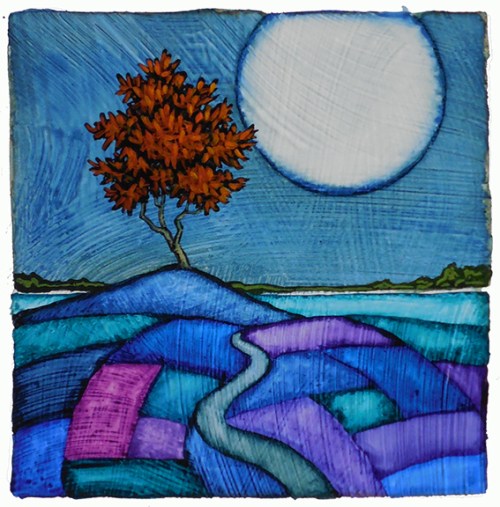
I guess it’s this thought that brought the title for the piece ( 4″ by 4″ on paper) at the top which I call Between. Simply put, I see it as the Red Tree being torn between the nebulous  desire of the Moon’s promise set against the security of its earthly home, represented by the patchwork quilt-like look of the surrounding landscape. Between the unknown and known.

Somewhere in between the yes and the no…

***********************

The post above ran back in 2015. I’ve edited it a bit for a little more clarity, to make it a little less gray.

Read Full Post »

********************************

The only quality that endures in art is a personal vision of the world. Methods are transient: personality is enduring.

–Edward Hopper

**********************************

Felt like a little Edward Hopper this morning and realized that, in all the years of doing this blog, I had never shown his most famous painting, Nighthawks, above. Can’t say why I had failed to display it. Maybe it just felt so obvious that it overshadowed other works from his career that also moved me. Regardless, it remains a defining painting, one that never fails to be striking.

His words just below the painting above are equally striking for me.

I often write about artists trying to find their voice. By that, I am talking about painting (or working in any other medium) in a manner that matches up with and captures the artist’s point of view, their thought process, and the many facets of their personality. Not every method or style jibes with every artist, allowing them full expression of the truth of their own personality.

And method alone only goes so far. Method is transient and without endurance, as Hopper points out, without personality.

How does this happen, this insertion of personality into one’s work?

I can’t really say. I guess it starts with having a point of view, an opinion, an emotion, a thought. I tell high school and college students that technique is important but it is even more vital to have a base of other knowledge to draw from. Art is not technique or method, it is expression of the self so have a fully realized self to express.

Don’t know if that’s right for everybody but, hey, it feels right for me.

Work on that and get back to me, okay?


Read Full Post »

Romare Bearden – Vampin’ ( Piney Brown Blues)

***********************

The artist confronts chaos. The whole thing of art is, how do you organize chaos?

–Romare Bearden

***********************

I think the beginning of this quote from the late artist Romare Bearden (1911-1988) is an important statement and observation.

The artist confronts chaos.

That really speaks to me. It better defines a bit the purpose and necessity of art, both in a general and personal sense.

Maybe the purpose of art is to bring clarity and order to the world that confronts us, to illuminate the hidden or overlooked elements of our existence.

I don’t know for sure but these few words and my own experience make me believe it to be so.

For me, art is a way of distilling the torrent of information and sensations that flow through each of us every day down to a single manageable expression. An expression that helps me better understand and tolerate the chaos before me.

For me, it usually boils down to familiar forms and expressive colors. Found order and harmony above the chaotic rhythm of the texture below.

Like hearing a language you don’t really know but seem to somehow understand and trying to translate it to others.

It is different for every artist, no doubt. The idea of organizing chaos might seem totally foreign to some. I can’t say for sure what drives every artist or what purpose they derive from their art.

I can only speak for myself. That, in itself, might be a valid definition for art.

To that, I answer with my mantra: I don’t know.

And that is undoubtedly the driving force behind art.

Here’s  Big Joe Turner and his Piney Brown Blues, the song that Romare Bearden references in the monotype at the top of he page. Have a good day.


Read Full Post »

« Newer Posts - Older Posts »