Feeds:
Posts
Comments

Archive for the ‘Painting’ Category

“Known in New Orleans art circles as a sort of ‘Goya of the ghetto,’ Ferdinand has described his work as rap in pictures, while some critics have placed his utterly honest depictions of inner city decay within the social realist tradition of Courbet.” —Times-Picayune

****************************

I was on a site that had a few images of some self-taught and outsider artists and saw one of the pieces from Roy Ferdinand.  In a lot of the work from outsiders artists there is often a child-like quality in the work, a feeling of naivete expressed in the rendering and brushwork.  Looking at Ferdinand’s work, there was a definite sophistication and stylization that really differentiated from the typical outsider.  It made me want to know more about this guy and, in my search, I came across the quote above calling him the Goya of the ghetto,  pretty high praise, I was really intrigued. 

Ferdinand was born in 1959 and hedied from a long battle with cancer in 2004 in New Orleans.  Though his work showed more sophistication, he did share much in common with other outsider artists.  Coming from a world of poverty, for example.  He depicted the hard world of the urban streets of New Orleans.  Often, there was implied violence and explicit sexuality in his work, with gangsters, drug dealers and junkies, pimps and whores often populating his images.  The pictures were gritty and tough snapshots of his time and place.

And while much of his work dealt with the harsher elements of his life, Ferdinand also painted the everyday gentler side of his world, providing a full view of his New Orleans.  I particularly love this piece, showing an older woman holding a piece of corrugated metal with a rough outsider-ish image painted on it.  I suspect it is her own painting she is holding from the gentle smile of pride on her strong face, which is rendered with tenderness, and the other piece of corrugated metal in the bottom corner with a simlilar painting on it.  Moreover, it’s just a lovely image and moment, far removed from the world he often painted. 
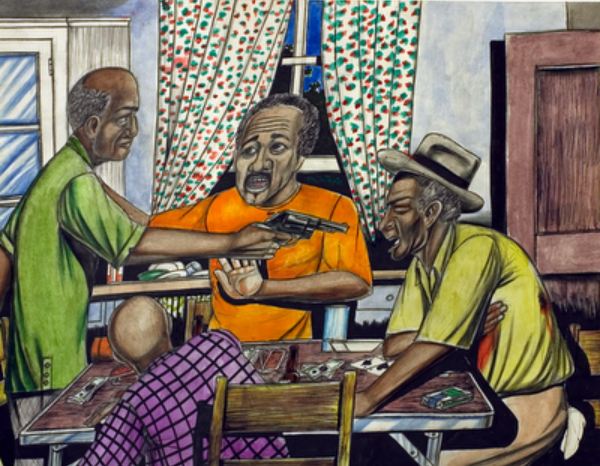
To my eye, his work has real eye appeal.  The colors work well together and there is a real harmony in the images as a whole.  The drama of many of his scenes only serves to make these images more compelling and probably will make them grow in stature through the years.  It would have been interesting to see what Roy Ferdinand would have painted in the aftermath of Katrina.  It would have been epic work for an artist so tied to the streets of New Orleans.  It’s a shame such a distinct and powerful voice wasn’t around to document it.

Read Full Post »

And therefore as a stranger give it welcome.
There are more things in heaven and earth, Horatio,
Than are dreamt of in your philosophy.

Hamlet, Act I, Scene V

^^^^^^^^^^^^^^^^

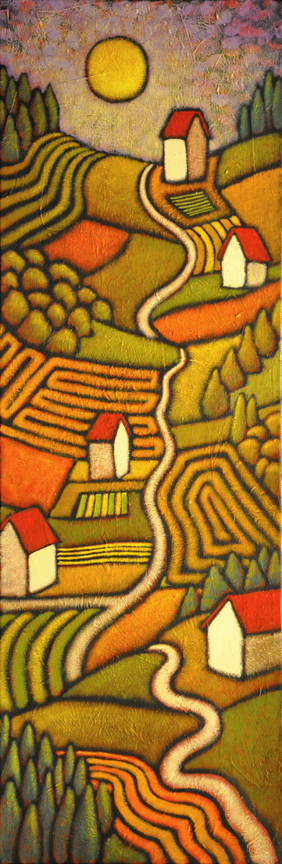
I call this new painting Heaven and Earth.  It’s about 7″ wide by 35″ tall on paper and is very much in the same vein as the very  large painting that I recently completed and featured here, The Internal Landscape.  This piece features a nocturnal scene however with a deep blue sky punctured by the light of stars.

The title might refer, in a way, to the lines above from Shakespeare’s Hamlet, where Horatio and Marcellus barge in on Hamlet’s conversation with the ghost of his father.  Horatio is a rationalist, philosophically, and to him  the idea of ghosts seems absurd so that when Hamlet asks him to swear to not  speak of what he has seenl he is mystified.  Hamlet then utters the lines — There are more things in heaven and earth, Horatio,/ Than are dreamt of in your philosophy.

I suppose this painting is saying much the same thing, that we live both in the world that we know and in a world of which we are unaware.  The stars above are, and have been, always with us but we know little of them, really.  The river  runs but we often know little of its journey and the roads travel to places we shall never see.  And around us at all times are radiowaves carrying voices and images from every corner of the globe, unseen and unheard.  And perhaps among all this  are the ghosts like Hamlet’s father, moving unnoticed by our eyes focused on that which we know and see.  Or, at least, are trying to know.

I guess the takeaway here is that there is often more than meets the eye, even when the scene before you might seem enough.

Read Full Post »

I don’t want to get into the habit of revisiting past blogposts here, as I did the other day when I reposted a blog on the similarity between a painting of mine and the trees from Dr. Seuss’ Lorax.  But there is a painting that I wrote about back in March of 2009 called Endless Time that I really wanted to revisit today.  It’s a personal favorite and one that hangs in my studio, always giving me pause when I let my eyes rest upon it, as it did in the very early hours of this morning.   It has dwelt here for a couple of years now and remains special for me, always making me think. 

Or better yet, not think.

   There is something in it that is as definitive of all that  I desire from this world and of myself as anything I have ever painted.  It makes no overt appeal to the viewer, like nature, not giving a whit if you enter or not.   It has gifts to offer for those who make the effort to enter but there is no path inviting them in.  No beckoning tree or clusters of humble homes.  It simply is. 

Here is what I wrote back in March of 2009:

I wanted to talk a little about the piece shown here, Endless Time, which is a 24″ X 30″ canvas. This is what I consider a performance piecemeaning that I have performed several paintings that have a similar palette and composition in different sizes.

Each piece has its own character and feel, distinguished by differing color intensities and textures. The colors of each are similar but have their own peculiar colors due to the factors that make my color palette differ from day to day. Things like humidity and temperature, different gessoes that I use with differing absorption rates and my own lack of consistency in mixing color.

I call these performance pieces because I equate painting them to a musician performing their own composition. The musician may often change bits of their own compositions, changing things like tempo or intensity. Changing the coloration of the notes and how they’re played. The composition is intact and is identifiable but each individual performance has its own character, its own wealth.

You may notice something quite different in this piece as well.

No tree. No red tree. Nothing…

This is really a direct descendent from my earliest work that focused on open spaces and blocks of color, work that was meant to be spare and quiet. The weight of the piece is carried by the abstract qualities of the landscape and the intensity of the colors.

With this piece, I have chosen to forego the kinship that the red tree often fosters with the viewer, acting as a greeter inviting them to enter and feel comfortable within the picture plane. In Endless Time the viewer is left to their own devices when they enter the picture. There is no place to hide, no cover. They are exposed to the weight of the sky and the roll of the landscape. They are alone with not a sound nor distraction.

It becomes, at this point, a meditation. One is not merely looking at a landscape. To go into this painting one must be willing to look inside themselves as well.

And I think that is where the strength of this piece dwells. I hope this is evident to some viewers and they feel welcome to enter this quiet space…

Read Full Post »

Every picture shows a spot with which the artist himself has fallen in love.

— Alfred Sisley


********************

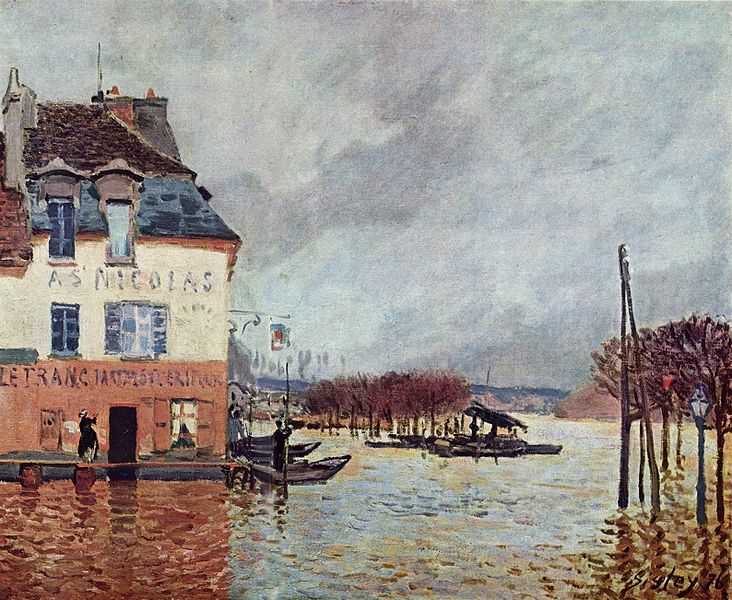
I’ve  loved the Impressionist landscapes of Alfred Sisley (1839-1899) for some time now.  I always liked the fact that he was solely a landscape artist that worked en plein air, never feeling the need or desire to paint still lives or figures.  He found his avenue of expression in the landscapes that he painted and always in the Impressionist style which fit his found voice.  There’s a sort of purity in his loyalty to his style and subject that I find endearing.

When I came across the quote at the top of this post, I thought at first he was talking about a physical location where the artist had actually fallen in love.  But reading it again, I realized that he meant a spot in each painting where the artist sees that stroke, that shape, that bit of color that made him want to express himself in paint in the first place.  I knew exactly what he meant at that moment. 

I am often asked to pick a favorite painting when I am at exhibits of my work, a question that I am often unable to answer fully. It is just for what Sisley expressed with these words that this remains juch an impossible task.  In nearly every painting that I have chosen to show over the years there is that spot that would shine out to me whenever I would look at it, a spot on the surface where the work seemed to take on its life for me.    It is usually something small and subtle, a small and simple line or the smudge of one brushstroke in what might seem an innocuous field of color.  Small but oh so important because when it meets my eye it rekindles a flame that is indeed love.

It’s a difficult thing to explain especially about a painting, something that many see only as an object.  But seeing that spot where it flares outward alive brings the artist that same excitement that seeing the one you love walk into the room brings to those in love. Seeing that spot in the painting is like meeting the eyes of your love and saying so much without uttering a word.  That may be the best way to put it.

Read Full Post »

Well, I am finished with the large canvas I started over three weeks ago.  It is the largest piece in size I’ve ever attempted by quite a bit at 54″ by 84″ which I often found intimidating at times, as I freely admitted here.  But that intimidation and fear faded over the weeks as the painting evolved, moving from the darkness in which it began to the vibrant brightness of the finished product.  This shift in tone mirrored my own shift in my feelings for the painting.  I began with a fearful anxiety that began to ease with each new layer of color added.  I began to feel a lightness in myself as the piece began to find its unity and rhythm and a sense of confidence when it began to start taking on a life of its own as it neared completion.

It was interesting  to see how its domination of the studio space changed.  At first, its size and darkness made it seem at times like a big canvas eclipse blocking out and absorbing all incoming light.  But near the end it bagan to have its own glow, seeming to give off more light than it absorbed.  Even after the large floodlight under which I work was turned off, its glow cut through the hazy darkness.  Those moments of seeing that really struck me and gave me a real sense that it was becoming what I hoped for it. 

 As the final strokes went on to the Red Tree that stands above the lake, bringing the piece into a state of completion, it began to move completely into its own realm, its own life.   I felt like a parent watching their child move out of their home and into their own life.  The  influence of the parent is evident but there is a point where the child moves on, no longer dependent on the parent.  It is a moment filled with both the joy of  pride and the sadness of loss. 

 Like this parent, I feel both of these emotions.  I am proud of how this painting has come around and grown into something strong and viable but sad that my time with it has come to an end.   Well, close to an end.  I will spend the next few months with it, making little tweaks here and there.  Nothing large.  Just a tiny  rounding of the edges here and a smoothing of the line there. 

I’m calling this painting The Internal Landscape.  I will discuss this at a later date along with some other observations about it.  But for now, I’m going to simply stand back and take it all in again.

Read Full Post »

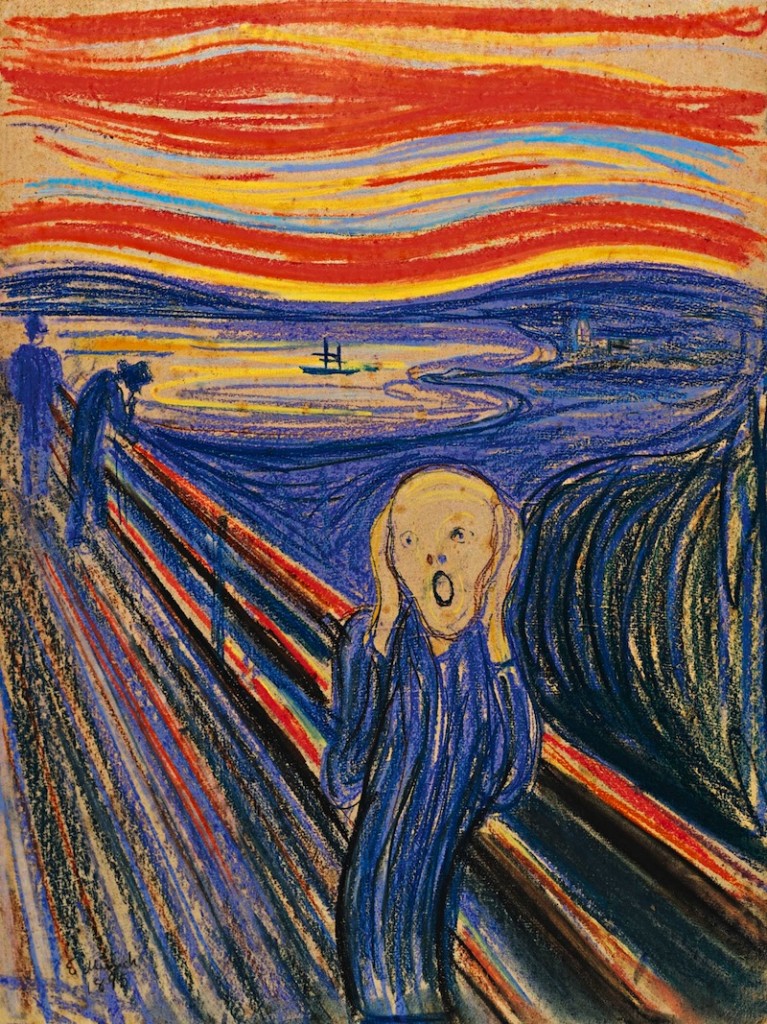
One evening I was walking along a path, the city was on one side and the fjord below.  I felt tired and ill.  I stopped and looked out over the fjord– the sun was setting, and the clouds turning blood red, I sensed a scream passing through nature; it seemed to me that I heard the scream.  I painted this picture, painted the clouds as actual blood.  The color shrieked.  This became The Scream.

–Edvard Munch, Diary 1889

*******************

This version of the classic painting The Scream by Edvard Munch has been in the news lately.  It is the last of the four versions, this one being pastel on board with a frame painted by Munch,  done by the Norwegian artist to be in private hands and it is coming up to auction in May at Sotheby’s.  Seldom does a seminal piece of work come up for auction and there is great anticipation for this sale, estimates currently hovering around the $80 million mark.   Yes, $80 million.

It’s really interesting how this image has resonated through the 120 or so years it has existed.  It really seems to connect with some existential chord within many people, a raw nerve capturing the often sheer anxiety of our coexistence with nature here on earth.  I think that most artists aspire to reach out through their work in such a way, to have the marks they make speak across time  and cultures.  To move in some way the everyman.  To have their work seen as timeless.

It’s something that an artist may never realize in this life.  The adulation of  the now does not always translate through time.  There are so many examples of artists and writers who were the most renowned creators of their era whose work never transcended their own time.  Their work remains a mere artifact of their own time whereas someone seeing The Scream might instantly connect on a basal emotional level where they see it as being of this very moment.

 So while part of me questions how the somewhat rough pastels strokes of the Munch work shown above are worth $80 million, I know that it is this rare air of timelessness that makes it so valuable.   The stuff that dreams are made of, as Sam Spade so famously said in The Maltese Falcon.  As in the movie, the stuff that dreams are made of are almost always priceless.

Read Full Post »

Not too long ago, I displayed a Chuck Close quote where he said that work is inspiration in itself, that by simply steadfastly doing  what you do will open up creative avenues to follow.  I frimly believe that and have experienced it on many occasions including just this past week. 

 As I have been documenting, I am working on a large canvas, which is nearing completion, by the way.  I showed, in a post last week, how I would cut the image into sections to weigh the strength of each area of the canvas to make sure that it had its own visual power to contribute to the painting as a whole.  I showed the two section from each edge of the canvas and concluded that both pieces stood up well as strong parts of the overall painting as well as compositions in their own rights. 

 In fact, the section from the far right kept me coming back to it.  I really liked the way it flowed upward with each piece interacting with those around it, creating a lovely harmony that really worked well, for my personal taste, at least.  It gave me a great sense of peace looking at it and I soon began exploring ways to make it work in a separate piece.

I felt a real sense of immediacy in creating something based on this and, searching the studio, realized I didn’t have any prepared surfaces ready in any dimension close to what I was seeing in my head.  There was a painting that was in a later state of completion, one that I had mentioned here recently.  It never really sang for me and had sat in a corner of the studio for quite  a long time, just waiting for me to give it the needed attention.  But every time I looked at it, I was less than inspired.  It just wasn’t working. 

 So, looking at it as a possible new surface to paint, it wasn’t a difficult decision to paint over  the image that had never really taken off for me.  It wasn’t a perfect choice, a bit smaller and narrower than the inspiring image, shown here to the left.  The original is somewhere in the 24″ wide by 54″ range whereas this piece is only 10″ wide by 30″ high, making it a much more condensed space in which to work.

  The resulting image is therefore different, which is as it should be.  It is inspired by, not a copy of, the original image.  For me, it flows in much the same manner and has the same sort of feel and harmony.  It works for me and having said that creates its own new sense of inspiration for other work to come.  Just like Chuck Close said– one thing leads to another.


Read Full Post »

This is a small piece that I used here last year in a blogpost featuring Richard Thompson’s song Shoot Out the Lights.  I showed this piece but didn’t say anything about it which I think was an oversight because it is one of my personal favorites from this particular series.  It’s called Two Sides and is part of my Outlaws series from several years back, a group that was influenced by some small Goya works done in carbon on ivory as well as by powerful imagery from some later films of the silent era.  Many of the pieces featured a single figure, often holding a handgun, usually in a monchromatic sepiatone.  A few, such as this piece, incorporated more color as well as a copper foil border.

Some folks saw these pieces as being a bit scary, with the handgun imagery and the figures often seeming to be peering out (or in, as some saw it) a window.  I understood the scary part but not for the same reason as those who saw it this way.  They saw the figures as menacing while I saw them as being frozen with their own fears.  These figures were the scared ones.

The title of this piece, Two Sides, is a reference to the polar opposites that make up a yin-yang symbol.  In fact, it’s composed like a yin-yang symbol. with the light of the hand and gun appearing in the dark shadow in which he stands and the darkness of his face appearing in the incoming light.  I see this as representing the light and dark,  the good and evil, that resides in everyone.  At any one time, we may appear to be more to one side  or the other but we normally, and hopefully,  exist between these opposing forces.  This piece reminds me to temper my darker side when it wants to push outward, to maintain this equilibrium.  It makes this a special piece for myself.


Read Full Post »

I wrote last week about the work of the Chicago-based artist Roger Brown, who was part of the Chicago Imagists which were a group of artists who were inspired by the pop imagery of comic books as well as surrealism.  Another artist who was in this circle was Jim Nutt, born in 1938 in Massachusetts and educated at a variety of universities including the Art Institute of Chicago, where he met his wife, artist Gladys Nilsson.  He has lived and painted in the Chicago area since the 1960’s.

Nutt’s early work in the 60’s and 70’s was very much in the comic book/pop art style with bold, flat colors that were often harshly contrasting and fantastic imagery bordering on the bizarre, as can be seen here in the image to the left.  It’s strong, exciting  work but for me the more interesting part of Nutt’s career has been his obsessive, repeated painting of a single imaginary female portrait over the past twenty-five years.  He spends nearly a year neticulously painting  each of these portraits of a woman with a hairdo that evokes the 1940’s and a most unusual large nose that is typically colored in direct contrast to the rest of the woman’s face.  He paints these works in thin acrylic paint with tiny brushes which accounts for the long time frame for each piece.  The resulting work, as a result of this technique, is meant to be seen up close where they reveal their refined surfaces and subtle tones, revealing beauty that belies the sometimes grotesque appearance of the image from afar.

I am always drawn to the artist who repeatedly revisits a form, finding something new in each new foray.  This subject of Nutt’s may be the same image he sees in his mind but each piece is decidedly different  in presentation and feel.  And, while I feel his early work is interesting and distinctive, it is this obsession that has held Nutt for the past 25 years that defines Nutt for me.

Read Full Post »

Left Side detail

In my last post, I wrote about how I was going over the large canvas on which I am currently at work, weighing the different elements against one another as I try to create balance in the composition.  It’s a large canvas, 54″ by 84″,  and there is so much more space to oversee, making sure that one area doesn’t so dominate the whole.  In a large horizontal landscape composition, if the one side is overly dominant, making the other seem weak or dull, the entire piece suffers  no matter how wonderful the strong area may be. 

  The right side with the heaviest grouping of houses  was very strong in the overall composition and I found my eyes always settling on the right side of the canvas.  There just wasn’t enough boldness in the sections to the left of center to counter the weight of the houses.  I wasn’t about to add more houses or elements so I decided to turn my attention to heightening the colors and contrasts on the left side, strengthening it so that it came closer to the right in weight.  I spent a day just going back in with colors that brightened the area and brought more attention to it.

Right Side detail

I decided to better see the strength of the different areas I would break up the canvas into sections on my computer. This would let me see their strengths without the influence of the surrounding areas and evaluate them as individual compositions.  The right side  (shown to the right here) was bright and strong with the houses just dominating the area.  But after making the changes on the left side ( the image above) I found that it had tremendous strength of its own and was equal in strength to the right, at least in my eyes.  The strength of the left side, for me, was in the weight created by the harmony of the colors and the elements.  In fact, looking at the left side detail above, I think that it could stand easily as a  really strong piece on its own.

 
Satisfied with this progress, I can now start to evaluate other parts of the painting and make the final touches that will hopefully pull it all together.

Read Full Post »

« Newer Posts - Older Posts »