Feeds:
Posts
Comments

Archive for the ‘Personal Mythology’ Category

Foundation smBack in early April I showed a painting , Geometry of the Heart, on this blog.  It was an overhead scene of a baseball diamond being crowded in by a mass of red-roofed houses, one in which I found a lot of personal meaning.  It represented the way the game embeds itself in the minds of those who love it, how it creates a connection to tradition and memories of youth.  Perhaps more than anything in my life, baseball makes me feel connected to my  country and its history.

Putting this feeling on canvas was long overdue and I was so pleased with how both the finished painting as well as the feeling I experienced as I painted that I felt that I would do a small group for the my upcoming Principle Gallery show in June.  The result was trio of three small paintings, all on paper, that show three ball fields.  The first is shown here on the left and is approximately 6″ by 12″ and  titled Foundation.  I see the diamond serving as a base or foundation for the buildings beyond the outfield fence which seem to be sprouting from it.  Maybe the thought here is that the diamond serves as a classroom for the life lessons needed to survive  in the world beyond the fence.  I’ve written before how baseball is a game that is very humbling, that the best hitters in the game fail 7 out of 10 times at bat and that the greatest pitchers ever have had many losses.  It rewards individual effort but only in a limited way in that winning is based on a total team effort, dependent on each member of the team performing their job with their best effort.

Diamond smThe next is titled simply Diamond, and is 6″ by 8″.  This is the most reminiscent of  Geometry of the Heat and has a simplicity that brings to mind the innocence of the first days of playing the game, that first foray onto a real field.  For me, it brings back memories of the Little League field in Waverly, NY and the thrill of being on that diamond.  It was a beautiful park with bleachers along both foul lines, a well manicured infield and a wooden outfield fence emblazoned with local merchants ads.  To hear your name announced on the PA was a big thrill, a rite of passage from throwing the ball safely in your own yard to performing before strangers.  Daunting, yes, but it all seemed familiar because the game was the same, the diamond the same.
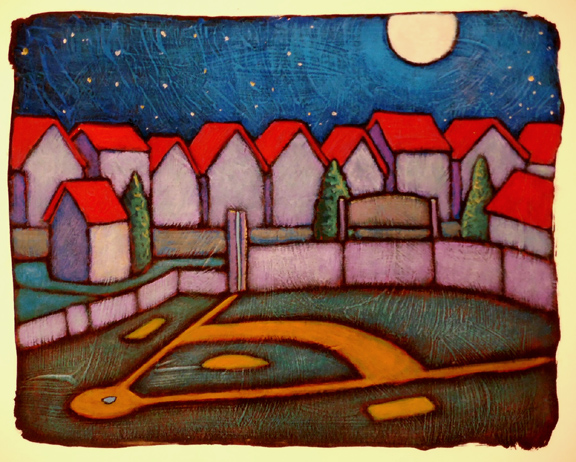
Night Game smThe third piece in this group is called Night Game and is 7″ by 9″.  The thing I get fro  this piece is that feeling when the daylight is fading and kids are still playing the game, not wanting to stop even as the ball becomes more and more difficult to see, until finally they must stop.   The empty field is still ringing with possibility and potential plays.  It seems as though there are always ghosts on ballfields,  phantoms from the past throwing the ball and running the bases.  This piece brings to mind a memory from my Little League days when I was put into pitch one game.  I had lousy mechanics and was never meant to pitch but I was game.  One of the first batters I faced hit a rocket that easily cleared the left center field fence. The whoops of the other team seemed to fade into the background as I watched the ball sail in the sky.

The ump came out to give me  a new ball as the other kid victoriously rounded the bases and the cheers from the other bench became loud again in my ears.  I smiled and said, “Wow, he really crushed that one, huh?”

“He sure did.”  He gave me the ball and I went back to it for a short while until I was mercifully pulled.  You give it a try and learn what you are and what you’re not.  Lessons learned.

Read Full Post »

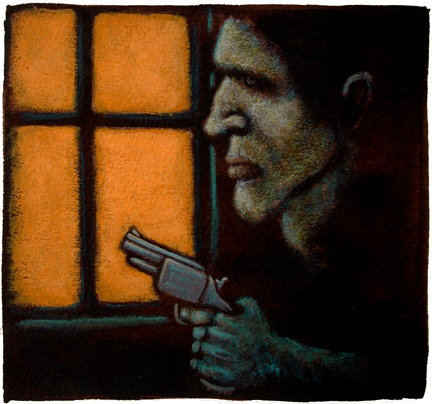
GC Myers  The Kid  Outlaws was a series of small  paintings that I did back in 2006.  They were  dark pieces, painted in a deep almost-black sepia,  where the light of figures emerge from the darkness.  There was a sense of desperation in each of these figures, a sort of inner struggle that overflowed to the outer world, that gave the series its title.  They are not necessarily breakers of the law but they are outside it, away from central stream of the world.  Outcasts more than pure outlaws.  Some of the characters held handguns, mainly in fearful, defensive positions.  The exception was the piece shown above, The Kid, which is most aggressive piece in the series and the one that most closely fits the textbook definition of outlaw.

996-240 Confession smIn most of my work, there are elements that take on symbolic meaning.  The Red Tree.  The Red Chair and Red Roofs.  The artifacts found underground in the Archaeology series.These things evoke some sort of  private meaning for most viewers, mostly familiar and gentle to them.  The handgun does this as well, although the reaction is definitely more extremely polarized.  I wanted a symbol that raised extreme emotion, wanted to see how people reacted.

Many people were disturbed by the imagery because it was so far  from the gentler alter-world I normally paint.  It had elements of fear and other darker emotions that are usually absent from my signature work.  The handgun piece, predictably, was the most disturbing to most people. 996-245 The Fear sm I have described here before how the pieces that showed the central figure looking through a window became a litmus test for  a person’s own level of fear or, at least, understanding of the fears of other people.   Some people saw the figure as a threat, peering in the window from the outside, ready to invade their home.  Others saw them as a figure looking out the window from the interior, fearful and haunted.  Although this result was not intended, it pleased me that it raised such distinctly different points of view.

996-229 Two Sides smI suppose this is akin to the way people view the ongoing debate on gun control.  Each sees gun control in different ways.  I grew up around guns.  My father wore a gun to work every day and we always had guns in the house.  Most people I knew  hunted and had guns.  I remember my grand-uncle taking me on an early morning  walk when I was about 5 years old.  We walked down to the cove, an inlet along the Chemung River where people dumped their trash,  which was not that uncommon at the time, unfortunately.  He sat up several coffee cans and bottles and stood behind me, putting his arms around me to help me steady the heavy blue steel of the handgun he took from his holster.  I remember the thrill of the jolt from the blast and the clang of the can.  The pungent smell of gunsmoke in my nostrils and the pointy ringing  in my unprotected ears.  It is an indelible memory.

996-221 Outlaw's Vigil smI don’t have a gun now and haven’t shot a gun in several years.  Can’t stand the noise, to tell  the truth.  But I respect the rights of hunters and shooters and feel that guns do have a place in our country.  That being said, the current debate has become poisoned by the fearful hyperbole perpetrated by the NRA and other advocates.  Any form of gun control is seen by them as the first move towards some  fascist, dystopian future, a paranoia which prevents any sort  of dialogue based on common sense.  They oppose any laws , any registries and almost all oversight.  They say that the laws on the book now should be enforced but they say it with a wink because they know that they have effectively disabled the effectiveness of this enforcement though crafty lobbying which has led to underfunded  agencies such as the undermanned ATF which are hampered in their efforts at every turn by restrictions imposed by lawmakers who are very friendly with the gun lobby .  Until we begin to look at how these agencies can once again be allowed to enforce the laws currently on the book as they are written,  new gun law legislation is a moot point and a distraction from the fact that the enforcement of any new laws is toothless by their design.

Unfortunately, they are a powerful and well funded lobby that knows how to play on the fears of gun owners.  They make people who are at no risk of losing any guns or the right to use  them believe  that the gun apocalypse is near.  They want to stay in the extreme position  because that is where fear is created.  They need that fear and they play on that fear.  It sells guns and ammo and that is the  bottom line.   It’s not about the Second Amendment, it’s not about stopping a Fascist American  government  and it’s certainly not about making us safer.  Their efforts certainly haven’t made any of us feel any safer, gun owners included.  The characters in these painting have guns and they certainly don’t seem any more at ease for it.

Free the agencies responsible to fully enforce the law…

Read Full Post »

Forty years ago this week, the region where I reside,  the Chemung River Valley, was visited by Hurricane Agnes , a storm that caused devastating flooding  throughout the area, including  the cities of Elmira and Corning.  It’s a study in contrasts in how these two cities responded in the aftermath  of the flood.  Corning, with a unified vision of how it would proceed,  rebounded and has relatively prospered while Elmira suffered missteps and missed opportunities and never really recovered.  There’s a new exhibit that opens this Friday at the Community Arts of Elmira called Agnes at 40: Personal Perspectives that features artists from the area looking back on that time with their work.

My contribution is a painting that I call Deluge.  It’s obviously not a true depiction of the events with its bright orange sky and aqua water.  People who experienced the flood recall all too well the murky brown color of the water and the mud it left in its wake, colors that stained many local buildings for some time after the flood.  My piece is more symbolic than purely representative of my own experience of the flood.  We lived on a country road that ran parallel to the Chemung River and  I remember that Friday evening  from 40 years ago very well.   Going home, we passed through the village of Wellsburg which was perched on the  banks of the river which was lapping menacingly at the lip.  We lived maybe three miles or so from the village and getting home, we decided we might want to shoot back into Wellsburg to grab some extra milk and bread at the store there.  In the several minutes it took to go home and then  go back to the village, the river topped the bank and what looked to be knee-deep water surged across the main drag.

The way our road was situated left us and our neighbors on the road isolated for several days as the three exits from it were under water.  We were islanders suddenly.  We would gather at the Chemung Bridge and watch the water and debris rush by.  Periodically, you could hear large  trees along the riverbank tumble over with a huge crash into the water as they broke loose from their roots.  The sight of the huge trees racing effortlessly in the rapid water still sticks with me.  The other thing that really sticks in my memory is how the bright shine of the water’s surface seemed to go on forever as we would look across the valley, especially when the sky was bright and almost colorless.  The water seemed to run to and merge with the sky.  It was quite beautiful and horrible at once.

We were pretty lucky as we lived well above the flooding so we didn’t feel the personal  losses that so many others experienced.  For that I am grateful.  There are, of course, many other memories and stories  that I could recount but it was that sudden isolation that the flood of  ’72 brought that I chose for my painting.

Read Full Post »

I’ve been reviewing past work over the last few weeks for a variety of reasons.  Sometimes I am looking for an idea or motif that has not been in use for some time.  A new lead to re-examine and follow anew.  Sometimes, it’s pure nostalgia, looking at the work as group with a small bit of pride, like a parent looking at photos of their kids. And I sometimes go back through my files because they serve as a form of memory for me.  While I may have the details of most of my work stored somewhere in the folds of my brain, I can’t always pull them forward.  Seeing the images brings back everything in a torrent.

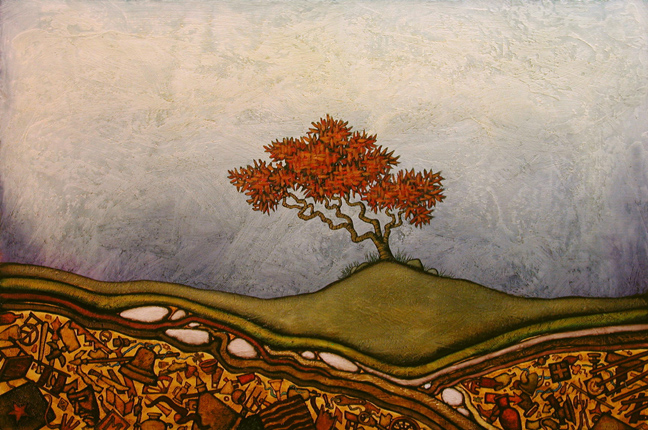
The painting above is a good example of this rush of detail.  Titled Archaeology: The Story Told, it’s a 20″ by 30″ canvas from  the 2008 Archaeology series.  Although I don’t like to publucly state that there are pieces that are favorites, this painting was one of my favorites from this group. 

There is so much I like about this painting from the moody duskiness of the sky with its purples that grade downward to the way the underground boulders create a visually rhythmic counterpoint.  But the thing that always stuck out for me was how the underground debris came together to form a narrative, which is where the title originated.  There was no intent in painting this.  All of the debris was painted in a freestyle manner, with each piece being painted independently from one another outside of possible relationships in size and shape.  It wasn’t until it was done that I began to see a stroyline running through the heap of items.

For me, it was the story of this country starting with  the obvious prompting of what looks to be an American flag at the center of the bottom.  There was a bell that reminded me instantly of the Liberty Bell to represent our Revolution and a Viking helmet that told of the earliest European explorers here.  There was a cowboy boot that symbolized our westward movement and what appeared to be a lance for the weapons that the native Americans used in their defense of their land.  There is a pitchfork for the agriculture that sustained and help the nation expand.  There  is an electric light to represent the inventors like Edison who transformed our country and machine parts for the industrialization.  There is a baseball bat for our national pasttime.  A peace symbol for both its inherent meaning as well as for its use as symbol of protest and our right to speak freely.

It’s all loosely associated and many may not even see them in a unified way but for me it all came together in a single glance and that was how I immediately read the painting.  It’s unlike any of the other paintings in this series in that way and that makes it special for me. 

Gary T., I hope you don’t mind me showing your painting!

Read Full Post »

I came across this painting from 2001 just this morning, one that had slipped off my radar some time ago.  It wasn’t in the studio for long and sold very quickly so I didn’t get to ponder over it for an extended period.  It is titled A New Mantra and  is 31″ high by 51″ wide on mounted paper.  I do remember painting this piece and how it hit every goal I had for it from the first moment I started on it.  It came so  easily that it felt as though it truly fell out of me, with not  a bit of struggle at any point.  I also remember just being exremely pleased with how this showed in its final state.  It was large and airy yet it had a real up close presence.  To me, it was how it must feel to have the secrets of the universe whispered mysteriously in your ear. 

It just felt powerful, whiich is probably why I was so surprised at seeing it again this morning.  How had it slipped out of my mind when it immediately rekindled such strong feelings upon seeing it again? 

I don’t know that there is any real explanation.  I think there are other pieces out there that will do the same for me, especially some work from the earlier years when my photo-documentation wasn’t as thorough.  I can think of one painting that I have often used as an example in an account of how some work flows easily while others are a stuggle from the first brushstroke.  This piece was done after a month of working on a series of paintings that resulted in a commissioned piece.  One morning I went into the studio about 5 AM and this large painting just fell out.  It was about 40″ square and I remember how the paintings of the past month had served as rehearsals for this very moment in time.  Every movement was really from muscle memory, moving without prompting and the conscious thought process was hushed and in the background.  Two hours later and it was done.

I would tell people who asked how long it took to paint a piece that this painting didn’t take 2 hours to paint.  It took over a month.  It couldn’t have happened without those other pieces building up to it.

To my dismay, that is a piece for which I can’t find an image.  But I will keep looking and hopefully, if I find one, I will feel as I did about once again finding A New Mantra.


Read Full Post »

I’ve written here before about the joys of digging through one’s genealogy and finding little bits about your family that have been hidden for generations.  Before I started, I knew next to nothing about my family’s history.  There had been practically nothing handed down and there seemed to be little interest in its past.  For all I knew, we had crawled from under a rock about a hundred years ago and were suddenly just here.  There were times when that seemed like a logical explanation.

But over time, I have uncovered a great depth of material, the sort of things that all families certainly have in their own pasts, that have been really gratifying and have made me feel much more connected to this world and this country than I felt at times before.  I’ve found descendents who fought on both sides of the Revolutionary War, the British Loyalist side being pushed up into Canada before coming back here generations later.  I’ve had many who fought in the Civil War, including a gr-gr-great grandfather who emigrated here from Scotland and fought for the Union  and was a captive at Andersonville.  Another was a nearly 60 year old Canadian who had settled in the northern Adirondacks and enlisted and served with his son, my great-grand uncle.

All folks of which I was unaware of growing up.  The ease of researching today makes this connection to one’s past so much simpler that I, like so many others, can easily fill in the black voids of our own history.

One of my favorites was another gr-gr-great grandfather, someone of who I knew absolutely nothing.  His name was Joseph Harris and when he died, the local newspaper, the Wellsboro Agitator ( I love the name of that paper!), ran a headline for his obit that stated  Well Known Musician Dies.  It went on to say that he had been the US banjo champion at one point in his life.  I have to say that I was pleased by this, even though I had never even heard of this man before my research and his musical talent didn’t trickle down through the generations to me. 

Again, my stories are not exceptional.  We all have this rich fabric in our past that binds us to history and ultimately together if we only choose to look beyond what we see in the present.  Perhaps we can discover more about who we are as a people by examining our families’ pasts.  I know that I feel more invested in my life and my country than I did before doing this research.  And I guess that is a good thing.


Read Full Post »

I have always regarded manual labour as creative and looked with respect – and, yes, wonder – at people who work with their hands. It seems to me that their creativity is no less than that of a violinist or painter.

-Pablo Casals

******************

I came across this shot of working hands and it made me think of how I’ve viewed hands through my life.  I’ve always looked at people’s hands since I was a child.  The liver spotted hands of my grandmother had thin ivory fingers, for instance. 

 The hands of Art, the landlord of an early home and a farmer, were thick and strong and missing at least one digit down to the knuckle, the result of an impatient personality and old farm machinery.  Not a great match.  I saw quite a few farmers with missing fingers.

 Fat Jack, who I wrote about here a ways back, had hands whose nails were longer than you might expect and permanently rimmed with the black from the oil and grease of the machines on which he was always working.  His hands were round and plump, like Jack himself, but surprisingly soft and nimble, good for manipulating the small nuts and bolts of his world.

There was a manager when I was in the world of automobiles who was a great guy but had extremely soft and damp hands.  It was like handling a cool dead fish when you shook hands.  A mushy, damp, boneless fish.

I admired working hands.  They reflected their use so perfectly, the scars and callouses  serving as badges of honor and the thick muscularity of the fingers attesting to the time spent at labor.  They seemed honest with nothing to hide.  They were direct indicators of that person’s life and world.

My own hands have changed over the years.  They were once more like working hands, calloused and thickening from many hours spent with a shovel.  There are a number of small scars from screwdrivers that jumped from the screwhead and into the flesh time and time again and another on the end of my middle finger from when I cut the very end of it off while trying to cut a leather strap with a hunting knife.  Not a great idea. 

I always felt confident when my hands were harder and stronger.  Now, I have lost some of that thickness of strength and the fingers are thinner and a bit softer from doing less manual labor.  I look at them now and wonder how I would have judged them when I was younger, when I measured a man by his hands, something that  I don’t do  now.  I now know there are better ways to measure a life, that the work of the mind is now a possibility– something that seemed a million miles away then.  But when I come across working hands, strong and hard, I find myself admiring them still.


Read Full Post »

I’m officially declaring this a No Funk Zone.

In the past, I’ve written here of a sort of letdown, a sort of glumness or funk that occurs in the aftermath of even highly successful shows.  It’s no stranger to me and I’ve talked to other artists who describe the same thing happening to them.  It most likely results from working so hard to meet the deadline for a show, having everything so geared up for a specific moment so that when it has passed a void is left.  A new purpose and immediacy must be found quickly to fill the vacuum left.

However, I’m finding that this hasn’t been the case after this most recent show at the Principle Gallery.  Perhaps it has to do with the fact that I am already deeply immersed in my next project, my annual show at the West End Gallery.  That gives me a sense of purpose and a target at which to shoot.  It leaves little time to mope around.

But I’ve had this same show after the Principle show every year for eleven years now and I have fallen into a funk several times after the first show.  But this time I ‘m back in the studio with a renewed vigor, eager to work and feeling oddly upbeat.  It feels good but worries me a bit– I’m not used to finding myself in this territory.

I have no good explanation for this mild elation except that perhaps this last show has made me feel somewhat more confident in the direction the work is heading.  I often speak about validation of ones work and perhaps that is what I’m feeling.  I have often lost confidence at certain points over the years, as was the case for a period of time coming into this show.  It’s a self-doubt that creeps in and nags incessantly, making me question every move I make as well as the validity of my work.  So when people respond in a way that you hoped they might, seeing the work as you wished them to see it, it validates what you yourself see there.  The self-doubts turn to self-assurance, which is energizing.

That’s the best rationale I can offer.  I’m trying to not overthink this.  I just want to enjoy this moment and take full advantage of the energy it supplies because I know all too well how quickly it can be gone, replaced by those questions and doubts.

So for now, welcome to the No Funk Zone.

Read Full Post »

I just love this photo.  It’s a classic from around 1920 from the great Lewis Hine, the photographer who is best known for his photos of children at work in the mines, factories and fields of  early 20th century America, images which aided in the crusade for child labor laws.  Hard to believe but nationwide child labor laws weren’t fully enacted as law until 1938, about 30 years after Hine started his documentation.  I will show some of those photos at another time.  They are extremely powerful and human and should be seen by those of us with short memories for our not so distant past.

But Hine also was fascinated by the interaction of the worker with the machinery in the burgeoning industrial world.  Man and machine.  His photos are very poetic, the beautiful curves of the machine encompassing the straining form of the worker. Beautiful work.

For me, I am reminded of the A&P factory where I worked for several years as a candy cook.  Our equipment was ancient, much of it built in the 20’s and 30’s with these same curves and weightiness of material.  I always felt like the building was one large machine with multiple parts and we, the workers,  were a sort of  flexible cogs that connected the various parts.  I often felt dwarfed by the sheer size and power of some of the machines but after a bit found that there was a wonderful sense of rhythm and empowerment in mastering a machine.  That’s sort of what I see in this photo.

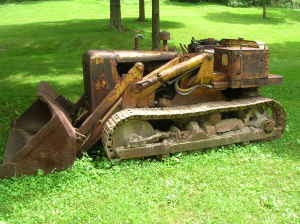
I’m also reminded of a piece of equipment I bought a number of years ago to clear some of my property here.  It was a late 1940’s Allis Chalmers track loader, much like the one shown here.  I spent as much time working on the machine with big wrenches much like the one the worker is using in the Hine photo as I ever did clearing land.   After many headaches, I finally got rid of it after a few years.  But I did come to appreciate the weight and intrinsic beauty of those big tools and still enjoy feeling them in my hands, if only to hold them for a moment.

Here’s a neat little videoon this photo from the George Eastman House, where much of Hine’s work is held.

Read Full Post »

I first painted one these faces back in 1995 when they became what I call my Exile series.  They were painted in very much the way I paint some of my landscapes, starting with one block of color and letting that block dictate what the next will be.  I had no reference points to work from, just letting the image grow on its own and for much of the time when I was painting these I had no idea how the face would emerge.  Often, they completely surprised me.

This 12″ square canvas was my first new Exile piece since that time and it took a while to reengage.  The originals were painted from a very emotional personal standpoint and  I am in a different emotional place now, sixteen years later.  But after I haltingly began there came a point where it began to take hold and pull out its own emotion, with which I began to empathetically identify.

Call it an existential melancholy.

I see some of these figures in that way, alienated from their past and haunted by memories.  They are, in a way, prisoners of their own experience, trapped in a moment long gone and never to be seen again.  Not all of them, but many, fall into this category.

I’ve been wanting to restart the Exiles series for some time.  To what end, I can’t say.  I don’t know if I will show these anywhere but here.  I don’t know if they would want to venture from the safe haven I offer them here. 

We’ll see.

Read Full Post »

« Newer Posts - Older Posts »