Feeds:
Posts
Comments

Archive for the ‘Photography’ Category

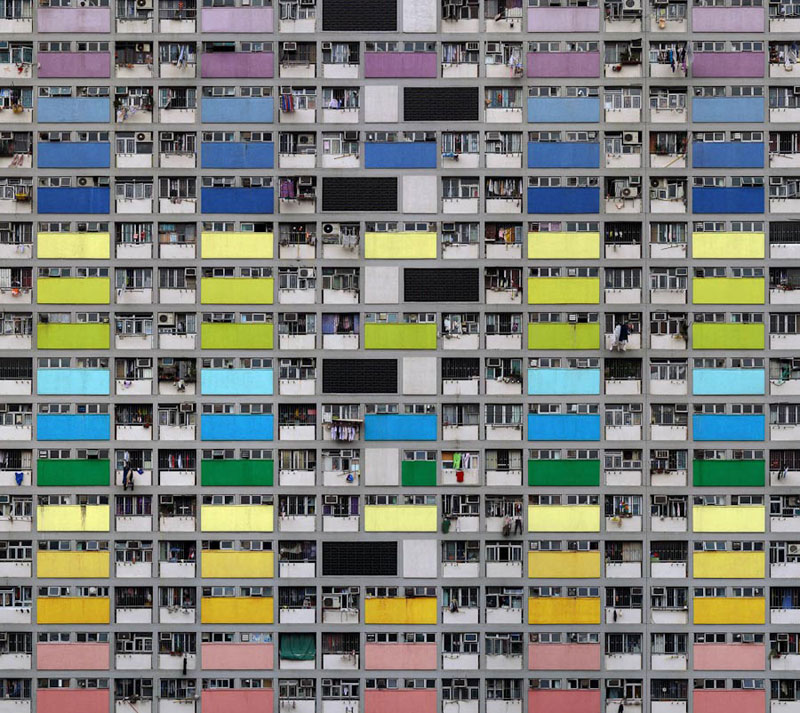
architectural-density-in-hong-kong-michael-wolf-8A friend sent me a link the other day to an article on TwistedSifter, a site that collects the most interesting visual images from the web on a daily basis.  While I enjoyed the article to which I was directed, about a French artist who makes creative use of the negative space in the photos he takes (I will feature his work here because it’s much more interesting than that), it was another image on the same page that really caught my eye.  It was a photo of several apartments towers in Hong Kong, the terraces filling the frame, shown here on the right.  It is a fascinating shot, with so much visual data that was both overwhelming and captivating with its abstraction and relentless chaos.

The photo is from the award-winning photographer Michael Wolf, who is German born but now resides in Hong Kong.  He has made a career out of capturing the imagery of the urban landscape.    This image is from his series and book, Architecture of Density, in which he takes away any glimpse of the sky or horizon, giving the viewer a claustrophobic feeling, as though there is no escape from the never-ending  sprawl.  It’s a bit scary but fascinating, nonetheless.

You can see more of Michael Wolf’s work at his site, photomichaelwolf.com.

architectural-density-in-hong-kong-michael-wolf-5 architectural-density-in-hong-kong-michael-wolf-3

Read Full Post »

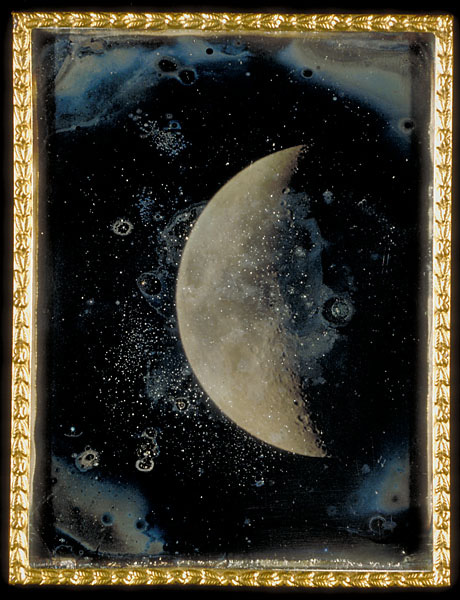
John Adams Whipple- The Moon 1851

John Adams Whipple- The Moon 1851

We live in an age where we are able to see, with the help of NASA’s Hubble Telescope and Cassini-Huygens spacecraft, truly amazing images of the far flung regions of our universe on a daily basis.   I often think that, as a result, we tend to simply stop looking up in the night sky and wondering at the moon and stars and planets that move above us in plain sight.  I know that one of my great pleasures was coming out of my studio to head home through the woods and looking up in the night sky to find those familiar landmarks.  Jupiter‘s strong glow as Castor and Pollux look on from a short distance away.   The constellation Orion‘s belt and brightest star, Rigel.  And of course, the large and calming presence of the moon in all its phases.

They become like friends after a while, true and  everpresent.  Well, when the winter sky isn’t filled with clouds.

John Adams Whipple- View of the Moon 1852

John Adams Whipple- View of the Moon 1852

All of this went through my mind in a flash when I came across the early photo shown above,  an 1851 daguerreotype of the moon, and this one here on the right, another moon image from 1852, from John Adams Whipple (1822-1891), a Boston area photographer who was a pioneer in early astronomical and night photography.  He took some of the earliest photos of the moon and stars using the Harvard 15-inch telescope which was one of the largest in the world at the time.

I like the idea that this image in its little precious case was perhaps carried and periodically looked upon  a century and a half ago, as one might look upon a photo of a friend or family member.  It makes me think that whoever carried this had similar feelings when they looked up into the night sky, a unity with something so much larger than that which is within our reach.  A nodding acquaintance with the eternal.

Seeing these images from Whipple makes me want to get out and look up into the sky.  Hopefully, the clouds will clear and I can see my old friends once more.

Read Full Post »

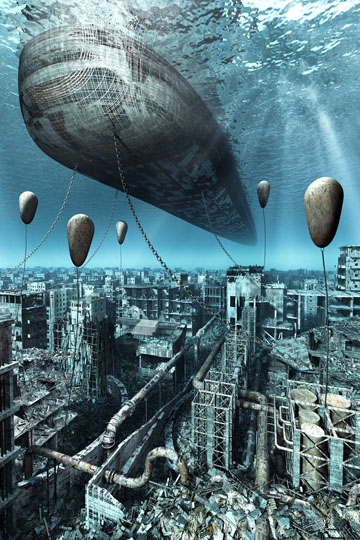
Giacomo Costa- Post Natural

Giacomo Costa- Post Natural

The last post, Brighter Days Ahead, featured a painting that dealt with the anticipation of the future.  The perspective of that painting had a somewhat optimistic and hopeful vision of what might be ahead.  There are, of course, grimmer visions of the future out there.  I  was reminded of this early this morning when I came across the photos of Italian photographer/artist Giacomo Costa.

Giacomo Costa- The Chronicles of Time   book coverCosta uses digital manipulation and , from what I can deduce, extensive architectural research to create large scale images that portray fantastic futuristic structures and cityscapes in various stages of decay.  They are very cinematic, easily fitting in any big budget sci-fi thriller,  yet stand on their own as pure, thought provoking imagery.  It was the cover of his book,  The Chronicles of Time, shown here on the right, that caught my eye.  I wasn’t aware of Costa’s work and thought this was a real building, one so fantastic and amorphous  that I couldn’t believe I had never seen it before this.

It may be a grimmer future, albeit one that may be a  millennium or two or more away, than we want to imagine but there is something beautiful in the recapture of the natural space by trees and oceans.  Perhaps, we may not be anymore at some point but nature will prevail in some form.  And that is, in some strange way, comforting, especially if you believe that we humans are not remote as a species but are entwined on a particle level with all natural life and will have some form of consciousness, even among the ruins of a human civilization.

It may not be the future we wish for but it is a future.  Check out the work of Giacomo Costa at his website.  It will make you think about the future and, hopefully, the present.

Giacomo Costa - Ground 1 2013 Giacomo Costa - Atto 9 2007 Giacomo Costa-  Aqua n 3 2007 Giacomo Costa

Read Full Post »

Sebastiao Salgado  Genesis Book CoverI don’t know where to start with the work of Brazilian photographer  Sebastiao Salgado.  He is widely celebrated for the importance of his work but I was unaware of him until I stumbled across this image from the cover of his most recent and most ambitious book, Genesis.  The image of a mountain river valley with a light filled flash of storm filling its upper end  fit so perfectly with the title, the stark black and white giving the whole scene a most biblical feel, as though you were witnessing the primal birth of man.  The image just filled me with awe and I couldn’t get it out of my head.

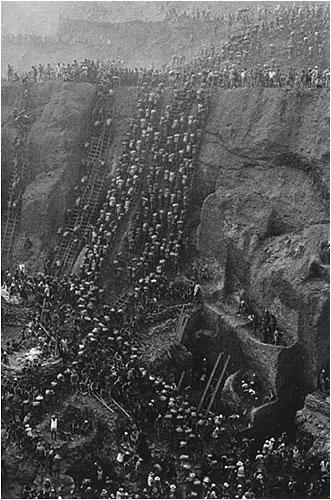
I began to look a bit more into the work of Salgado, born in 1944.  It is astonishing in many ways.  He has over the years documented some of the great brutalities of our time, photographing the plight of refugees, famine victims, migrant communities and manual laborers throughout the world.  It is work that is not easy to look on at times.  In fact, after one of his books, Exodus, which was about those fleeing genocide, Salgado’s faith was shattered by the horrors which he had witnessed.

Goldmine, Serra Pelada, Brazil 1986-- Sebastiao Salgado

Goldmine, Serra Pelada, Brazil 1986– Sebastiao Salgado

It was this despair that drove him the Genesis project, an eight year odyssey that took him to the furthest corners of the world.  His goal is to have us reconnect with the power and intelligence of the natural world, uniting a world that is divided by crises of greed and need.

Though much of his work in Genesis, where he is seeking to show the magnificence of the natural Earth, is downright beautiful, I struggle to call much of his work that same word– beautiful.  It is more than that.  It is powerful and daunting, not merely pretty pictures.  It pushes at you, tests your willingness to witness the rawness of ourselves.  It raises so many questions about who we are and what we are doing in this world.

Awe inspiring…

There is so much more that can be said about Mr. Salgado’s life work.  I urge you to do some research on your own and suggest you do a Google Images search of his work to get a real sense of the scope of his work.  You can do that by clicking here.


Read Full Post »

David Plowden - The American BarnI recently picked up a book from photographer David Plowden, The American Barn.  It is filled with beautiful duotone images of the grand old barns from the  heart of America, structures that are vanishing from our landscape as the family farm fades away.  The images are nostalgic but not sentimental, with a bit of melancholy in the air.  I’ve always been drawn to the beauty of the barn and often amazed at the scale of some of these structures.  They represent a level of personal industriousness and vision that I can barely imagine today.

David Plowden- HeartlandPlowden has  made documenting the vanishing parts of America  his life’s work, producing 20 books covering all aspects of the the American experience of the last century.  His books have covered the steamboats of the Great Lakes, the great and not-so-great bridges of this country, the railroads and both the small town experience and the grit of the industrial landscape.

The cover of one of  his more recent books, Heartland, has an image that speaks to my own personal vision of the landscape so its no surprise that I find his work engaging.  Looking at his photos brings on a great feeling of déjá vu, as though I have seen and walked in many of these places, at least in spirit.  They are often spaces that are filled with space and emptiness but still have the air of occupancy about them.

Ghosts, perhaps.

You can see more of David Plowden’s work at his self-titled  site.  It’s it definitely worth a look.  If you want a quick overview of his work, do s simple Google Images search using his name.

David Plowden- Abandoned Barn, Barns County, NDDavid Plowden-- Sherman Township, Calhoun Cty, IA 2004


Read Full Post »

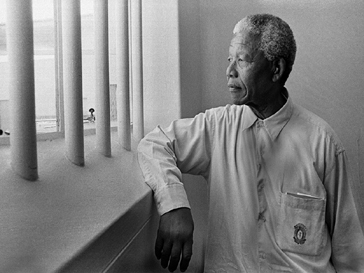
Mandela at Robben Island-Photo: Jurgen Schadeberg

Mandela at Robben Island-Photo: Jurgen Schadeberg

Difficulties break some men but make others. No axe is sharp enough to cut the soul of a sinner who keeps on trying, one armed with the hope that he will rise even in the end.

–Nelson Mandela

*****************

Nelson Mandela died yesterday at the age of 95 in his native South Africa.  His is a remarkable story of strength and perseverance, a man who fought in words and actions for the freedom of a people in a repressive society.  He experienced the greatest depths and heights in his long and often arduous life, becoming one of the greatest sources of inspiration for our time.

His death is a great loss for all people everywhere.  We have lost a source of tempered wisdom and the placid eyes of reconciliation and forgiveness.  We have lost a knowing witness.

There is much to grieve in the death of Nelson Mandela but there much more to celebrate in the life of Nelson Mandela.  And that is what we must do today– celebrate his life and the great inspirational gift he gave to us to carry forward.

It is a gift that must never be forgotten.

********************************

There is an interesting website at nelsonmadelaart.com that features lithographs of drawings from Mandela of Robben Island as well as iconic photos of him, such as the one above from Jurgen Schadeberg.  There is a lot of wonderful info on this site, making it definitely worth a visit.

Read Full Post »

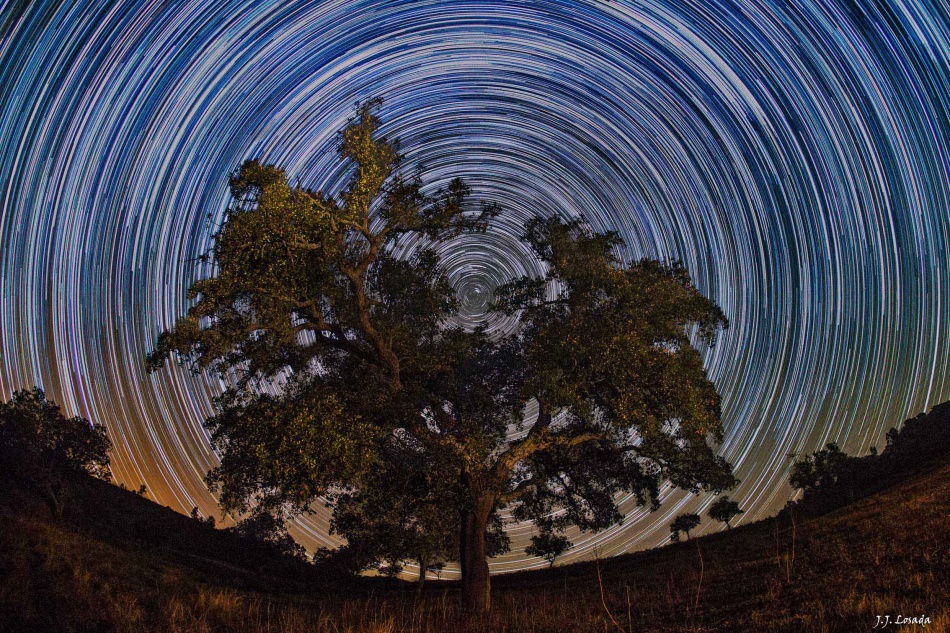
North Celstial Tree-- JeronimoLosadaI’ve been having some work done here in the studio recently and have been sharing my space with a couple of carpenters.  I am never comfortable sharing my  workspace with anybody and always feel a bit distracted, even inhibited.  But both Tony and Nick are good and easy going guys and I have been able to get some work done.

Yesterday, Tony told me to check out the NASA’s Astronomy Picture of the Day.  He thought it would look familiar to me.  Clicking on the site I was greeted by the photo above, a magnificent image of a great tree under a night sky taken by Spanish astrophotographer Jeronimo Losada  near Almaden de la Plata in the province of Seville, Spain.  Through a break in the upper reaches of the tree you can see the North Celestial Pole.  Losada focused on the North  Star and over two hours recorded a series of 30 second exposures which created the star trails that make up this spectacular sky.

It was just a great photo and it certainly did strike home even though the tree was not exactly my Red Tree.  But  Tony was right.  The tree , the saddle in the center of the photo created by the wide angle of the lens  and the silhouettes of trees on the horizon reminded me of much of my work.  I had even done a painting or two with that same swirl of light and color in the sky.

Please check out Jeronimo Losada’s  blog  to see some of his other wonderful shots of the landscape beneath the night sky.  There are some brilliant shots there and it’s well worth a visit.  It is a Spanish language site but most browsers have translators.

And for some other great shots of the heavens check out the Astronomy Picture of the Day.  Today’s is a great shot as well.


Read Full Post »

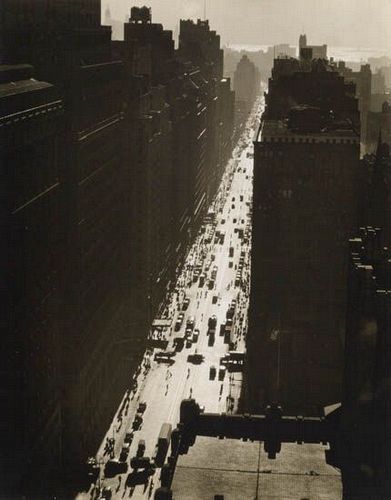
Berenice Abbott Seventh Avenue Looking South from 35th Street 1935New York City has long been a boon for photographers, with its constantly changing landscape of dramatic architecture and melting pot of cultures.  There is always an interesting juxtaposition of the old and the new which makes for fascinating viewing.  I am often drawn to photos which play on this contrast and some of the best are the photos of the late photographer Berenice Abbott.

Abbott was born in Ohio in 1898  and made her way via NYC to the post-war Paris of 1920.  She studied sculpture there but came to photography when she was hired as a studio assistant to avant-garde artist/photography Man Ray.  He chose Abbott because she had no experience at all with photography so would therefore do just as said.  That decision changed her life as she took immediately to photography and never looked back.

Berenice Abbott -Exchange PlaceWhile visiting NY in the late 20’s, Abbott became  enchanted with the photographic possibilities of the fast evolution of the city and began work on a project of shooting the landscape of the city that lasted for several years.  The result was a book, Changing New York, published in 1939.  The images of the city shown  here are from this time.

Abbott had a long and productive career as a photographer, dying in Maine in 1991 at the age of 93.

I was really taken with her photos of NY, particularly the image at the top right, Seventh Avenue Looking South from 35th Street.  She captures the beautiful contrast of light and shadow that takes place among the tall buildings and long avenues in the late afternoon.  There is a hardness in the edges and angularity of the buildings that plays off the softness of the light.  Just a wonderful shot, as is this shot here on the left of Exchange Place.  Its unusual proportions with the the walls of the buildings closing in give it a claustrophobic feel while the ant-like people on the streets below accentuate the vast space.  It’s a great contrast that really makes the image sing.

If you like images of the changing urban landscape, especially in those fast evolving years of the early 20th century, do yourself a favor and Google Image the work/photos of Berenice Abbott.  Just plain good stuff from a name that you probably do not know.

Berenice Abbott- Nightview_ New York 1934Berenice-Abbott-Flatiron-Building,-Manhattan

Read Full Post »

Lumqua, Hong Kong painter- John Thomson

I have come across this photo a number of times and have always lingered over it.  Maybe it’s just  professional curiosity, wondering how painters in other times and places worked in their studios.  But while I had seen this photo I had never really examined who the artist was.  It turns out he was named Lumqua and he was active in Hong Kong in the middle part of the 19th century.

This photo was taken in the early 1870’s by John Thomson and published in an 1873 book of photos and descriptions of the Chinese people.  Below is an excerpt that describes Lumqua.  The part that I find interesting is Thomson’s description of the groups of painters that would scour the Hong Kong docks trying to sell the sailors a finished painting that reproduced a photo they might possess so that they might have a larger, color image of their loved one to take home as a souvenir.  They offered a 24 hour tunaround.  Thomson’s description of how they divided the work on these pieces so that they could quickly and ably finish this task foreshadows the current businesses that turn out cheap paintings in the thousands to be sold around the country in  local Holiday Inns at so-called  Starving Artist sales.

This is the description that Thomson attached to this photo:

Lumqua was a Chinese pupil of Chinnery, a noted foreign artist, who died at Macao in 1852. Lumqua produced a number of excellent works in oil, which are still copied by the painters in Hong-Kong and Canton. Had he lived in any other country he would have been the founder of a school of painting. In China his followers have failed to grasp the spirit of his art. They drudge with imitative servile toil, copying Lumqua’s or Chinnery’s pieces, or anything, no matter what, just because it has been finished and paid for within a given time, and at so much a square foot. There are a number of painters established in Hong-Kong, but they all do the same class of work, and have about the same tariff of prices, regulated according to the dimensions of the canvas. The occupation of these limners consists mainly of making enlarged copies of photographs. Each house employs a touter, who scours the shipping in the harbour with samples of the work, and finds many ready customers among the foreign sailors. These bargain to have Mary or Susan painted on as large a scale and at as small a price as possible, the work to be delivered framed and ready for sea probably within twenty-four hours. The painters divide their labour on the following plan. The apprentice confines himself to bodies and hands, while the master executes the physiognomy, and thus the work is got through with wonderful speed. Attractive colours are freely used; so that Jack’s fair ideal appears at times in a sky-blue dress, over which a massive gold chain and other articles of jewellery are liberally hung. These pictures would be fair works of art were the drawing good, and the brilliant colours properly arranged; but all the distortions of the badly taken photographs are faithfully reproduced on an enlarged scale. The best works these painters do are pictures of native and foreign ships, which are wonderfully drawn. To enlarge a picture they draw squares over their canvas corresponding to the smaller squares into which they divide the picture to be copied. The miniature painters in Hong-Kong and Canton do some work on ivory that is as fine as the best ivory painting to be found among the natives of India, and fit to bear comparison with the old miniature painting of our own country, which photography has, now-a-days, in great measure superseded.

So I know a little more about this photo.  I still have questions about he worked, wondering if his studio was really as organized as this photo.  My studio is never so tidy.  Oh, well…

Read Full Post »

The tools I create and work with are pinhole cameras. With pinhole photography, the same air that touches my subject can pass through the pinhole and touch the photo emulsion on the film. There’s no barrier between the two. There are no lenses changing and manipulating light. There are no chips converting light to binary code. With pinhole what you get is an unmanipulated true representation of a segment of light and time, a pure reflection of what is at that moment. With some exposure times getting close to 2 hours, it’s an unsegmented movie from a movie camera with only one frame.

–Wayne Martin Belger

*****************

Wayne Martin Belger-Yama Pinhole Camera

Wayne Martin Belger-Yama Pinhole Camera

I recently came across the very intriguing work of Wayne Martin Belger, a contemporary artist/photographer working out of the Los Angeles area.  He makes pinhole cameras from found and unusual materials and uses the cameras to photograph scenes related to the theme of the camera.  Pinhole cameras are very simple in their nature but Belger’s creations are nothing like the shoebox or milkcarton cameras from one’s childhood.  They are elegant and strange, often elaborate in their construction.  The images he pulls from these cameras are often just as elegant and strange.  For example , Belger has a camera called Roadside Altar which , of course, he uses to photograph  the altars that are erected at the sight of fatal road accidents.   His website,  Boy of Blue Industries, tells this story  as well as give complete backgrounds on all of his cameras and Belger himself.  Fascinating stuff which I encourage you to investigate further.

Wayne Martin Belger-Wood Camera

Wayne Martin Belger-Wood Camera

One of my favorites, among many here, is the Wood Camera, which Belger describes as being designed to study distance.  He writes on his site:  The Wood Camera is made from Wood, Aluminum, Copper, Steel, Acrylic, and Insects. Most of the camera parts were found in Death Valley, CA. The camera has an interchangeable front plate used to float objects in front of the pinhole. With pinhole photography the focus is infinite. Objects which are a quarter-inch in front of the pinhole are just as in focus as objects 20 miles away.

He floats small objects in front of the pinhole to create great juxtapositions as both the object and the scene in the far distance remain in focus.  It made me realize that I often paint as though I were a pinhole camera.

Wayne Martin Belger-Wood Camera Photo

Wayne Martin Belger-Wood Camera Photo

Wayne Martin Belger-Wood Camera Photo 2

Wayne Martin Belger-Wood Camera Photo 2

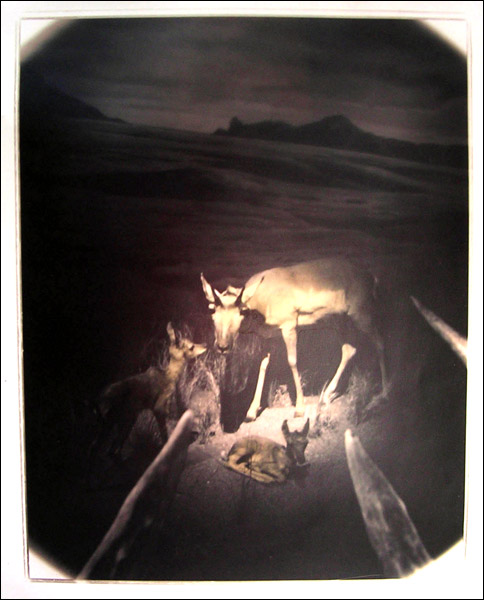
Here is the Deer Camera which is used to take photos of deer, of course.  Again, for more info on this work, check out his site.

Wayne Martin Belger-Deer Pinhole Camera Front View Wayne Martin Belger-Antilocapraamericana (Mother & Babies)

Read Full Post »

« Newer Posts - Older Posts »