Feeds:
Posts
Comments

Archive for the ‘Photography’ Category

Abraham Lincoln Tintype Medallion  1860I’m always intrigued whenever I come across images of Abraham Lincoln.  There aren’t many I haven’t seen  as his image has remained in the public eye on a regular basis throughout my life.  Growing up, in our family photos there was a small image of Lincoln that was mixed in with a handful of early photos from my great-grandmother.  I didn’t yet understand the place that Lincoln held in the heart of the American people   and wondered why it was there.  I actually felt more related to his image in that I at least recognized who he was which was something I couldn’t say for some of the folks in those old photos of people standing in front of what appears to be 1920’s automobiles in some totally unfamiliar rural farm setting .  Maybe that’s why I am drawn to his image even now.

So when I come across an image that doesn’t seem familiar, I take notice.  It’s part of trying to capture another part of the prism of the man, to fill him out as a human rather than as the icon he has become.  The token shown above, obviously a souvenir from the 1860 campaign, is new to me.  Lincoln is still youngish in appearance, not yet showing effects that the ravages of the weight of a nation at war would  appear  in later photos.
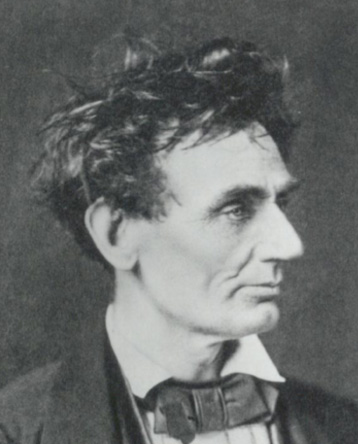
Abraham Lincoln- Early with Wild hairThis photo on the right brings up questions.  Why was his hair so wild?  Would he not have been aware of that when he agreed to sit for the photo?  It’s not like there was a paparazzi at that point snapping candid shots at every turn or a White House photographer documenting every moment.  You had to more or less pose for most photos.  But I like it.  Again, it fills out the man.  And it makes me feel a little better about my own crazy professor hair as I sit here.

There are a few more images below and some of them are a bit more familiar.  The first one seems to be a shot from the same sitting as the wild-haired one above.  Maybe the photographer noticed and offered up a comb.  I don’t know.  The second is from the War years and he has began to age.  But it’s a noble and strong image with that steely look of determination staring directly into the camera. The last is an earlier image when he is obviously not as consumed by the tasks before him.   But all are interesting in their own way and give us more insight into this most compelling character.
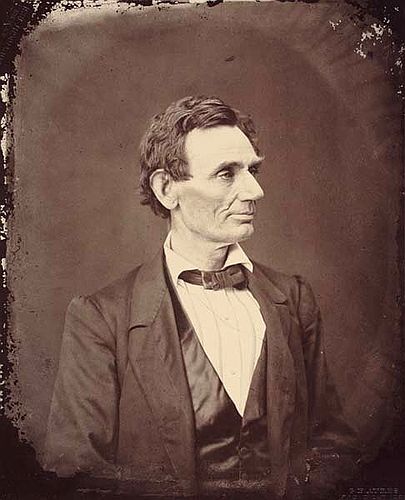
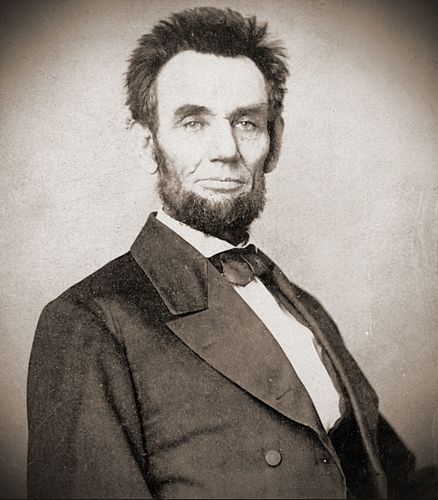
Abraham Lincoln George Ayres 1861

Abraham Lincoln- Alexander Gardner 1860s

Abraham  Lincoln-attributed to Nicholas H Shepherd

Read Full Post »

I had a good trip down to Alexandria yesterday, a fast down and back jaunt with a pleasant, as always, visit with my friends there.  It’s always great to spend a little time with the folks there– Michele, Clint, Julia and Chris.  Oh, and my dog, Asher, who wants to play fetch from the minute you enter the gallery to the minute you leave.  He pretends to be Clint’s dog but I know that he’s really mine.  But since Clint wouldn’t part with him for the world and takes great care of him, I guess that’s okay.  Thanks for making me feel at home there, guys.

Sartenada -klaukkala_tsasouna_finland I was going to write about the trip a bit more but I was looking at a photo blog that I read on a semi-regular basis, Sartenada’s Photo Blog.   He is a retired pilot and amateur photographer   who travels around his native Finland and Europe snapping photos of some interesting subjects.  I particularly  like his photos of the rustic wooden churches in Finland, such as the one shown here on the left,  that are so beautifully designed.

Sartenada- ahlainen_church_iglesia_eglise_-16A recent post featured a group of folk art sculpture that he had noticed outside several of these churches, near life-size figures of what seemed to be people in great hardship, some missing limbs.  They often have a hand out as though asking for help.  It turns out that these are Poor Man Statues which are really just large and elaborate poor boxes.  There are slots in the sculptures to insert money that will be passed on to the needy of the church and the community.

Sartenada -pomarkku_church_iglesia_eglise_-19I was really taken by these statues which reminded me so much of some of the great folk art sculpture of the past  here in the States.Some are really expressive such as this one on the left. His face has deep creases in his weathered face  and, as Sartenada implies, may be based on an actual member of the church or community.  I think these are just wonderful and wanted to pass them on.  I’m pleased to see these surviving and hope that they will be preserved.

Again, you can see more of these at Sartenada’s Photo Blog.   It’s worth a visit if only for the statues and the beautiful rural churches of Finland.Sartenada-- historic_wooden_poor_man_statue_in_kuortaneSartenada - siipyy_church_iglesia_eglise_-4

Sartenada- pomarkku_church_iglesia_eglise_-18

Read Full Post »

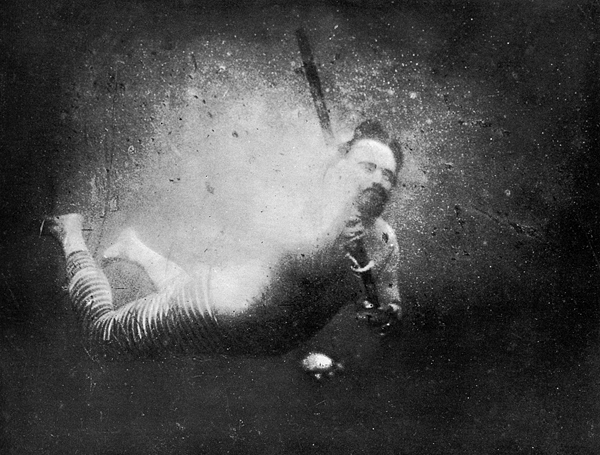
Louis Boutan- Underwater Photo ExperimentA friend of mine had a picture on Facebook yesterday that was taken underwater.  It was bright, clear and detailed, full of the color of the sea.  The fact that anyone can easily take such sharp underwater photos made me wonder about how underwater photography had evolved.  Doing a little research I came across the photo shown here on the left that really caught my eye.  It has a real magical quality to it with the light burst at the center and the diver appearing like some odd creature in mid-birth.  It was by a French marine biologist, Louis Boutan, from the early 1890’s and is one of the earliest surviving underwater photos.

There had been an earlier photo,  from 1856 by William Thompson in the waters of Dorset in the UK.  It was taken by a camera attached to a pole and showed the underwater plant growth of the shallow sea bottom. The photo has been lost  however which  and it takes almost forty years into the future before Boutan takes up the quest for documenting what he was seeing under the sea as a marine biologist.  You have to realize the difficulties he faced in achieving this goal.  First, diving and photography were in their early stages and the equipment for both was large and cumbersome.  It would be decades before scuba gear was introduced and cameras were large boxes with long exposures and flash systems that consisted of burning magnesium.  You couldn’t just whip out your iPhone and snap some pix.

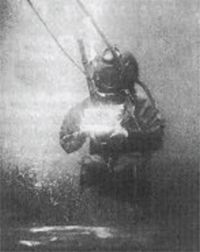
Louis Boutan in his Diving SuitBut Boutan persevered and with the aid of his engineer brother devised systems, that would be enormous by today’s standards, allowed him enough mobility to move them to the sea bottom and photograph.  His experiments included shallow shoots such as the one featuring the diver above and, ultimately, dives that descended to 164 feet beneath the sea in a diving suit.  The image to the right is one of these first deep images.  As I said, the exposure were long, up to 30 minutes for the film of the time at such low light, and Boutan would sometimes suffer nitrogen narcosis– the rapture of the deep.  It was a dangerous effort to document the world he loved.

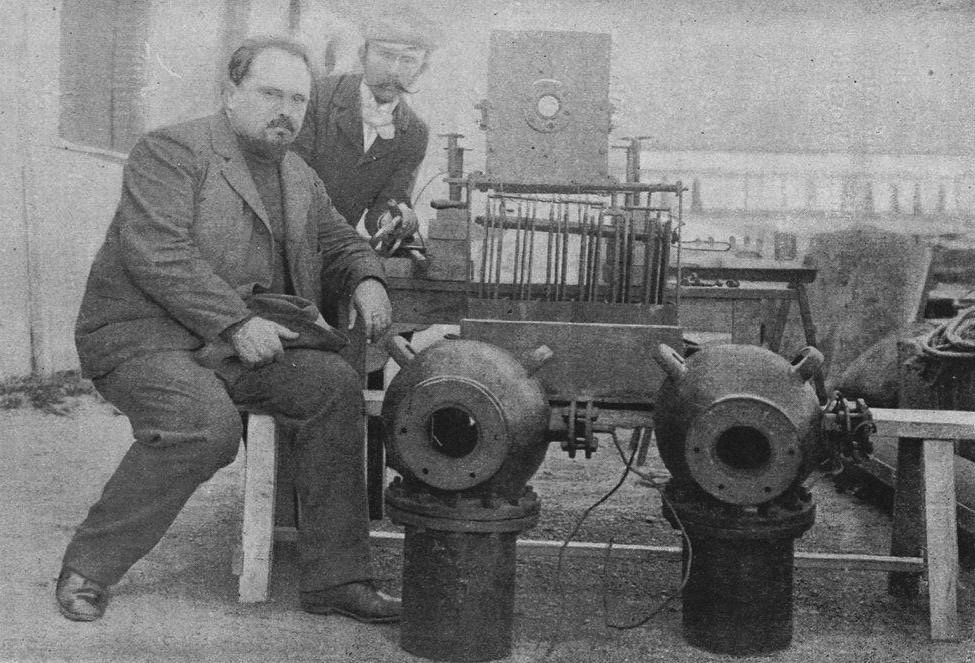
Louis Boutan on left with his Dual Carbon LampsThis a photo of Boutan (on the left)  and his equipment at one of the later stages of his 1890’s experimentation.  Even though it looks huge to us, this was pretty compact for the time.  The two steel orbs in the forefront are carbon arc lamps that he developed to replace the earlier system which was a huge wooden barrel with a large glass globe affixed to the top that encased a ribbon of burning magnesium.  Portability was not its big strength.

I like this photo of Boutan and his equipment because there is a feeling of the past and the future in it.  He appears so modern in contrast with his appearance, with his sport coat and haircut when compared to his assistant standing behind him who is obviously a product of his age with handlebar moustache, necktie and cap.  Boutan could walk into the room today and be contemporary.  I think that speaks to his drive to evolve his process.  He would not be tied to the static present and the lingering past.

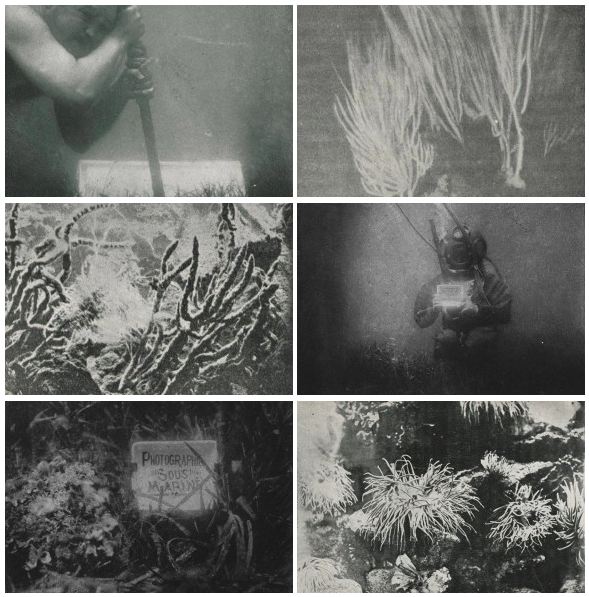
Boutan also published a book in the 90’s that featured many of his images and documented his work.  Below is a group of these images.  So, when you pull out your compact camera the next time and dive into the water to snap a shot of the kids or some colorful fish, remember Louis Boutan.  He set the whole thing in motion.

Louis Boutan Group of Photos from his 1890s Book

Read Full Post »

“Not I, nor anyone else can travel that road for you,
You must travel it for yourself.

It is not far, It is within reach,
Perhaps you have been on it since you were born, and did not know,
Perhaps it is every where on water and land.”

–Walt Whitman- Part of Song of Myself from Leaves of Grass. 1855

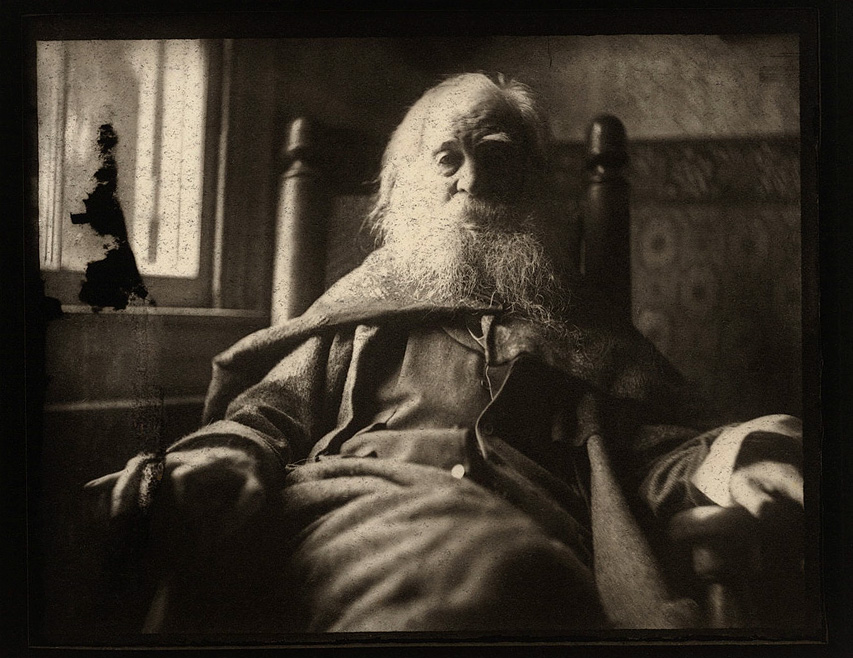
Walt Whitman-  Thomas Eakins 1891

I’m in a bit of a hurry but really wanted to show this great photo of Walt Whitman.  I don’t think I’ve ever seen a photo of him that wasn’t interesting but this one is special.  It’s taken by the great American painter Thomas Eakins in 1891, a year before Whitman’s death in 1892.  Eakins was also a pioneer in the use of photography in the art studio and an innovator in motion studies with film, among many other things.  I plan on writing more about his remarkable career in the future.  But for now, I just wanted to show this simple elegant photo of America’s voice.  At least to my ears.

Read Full Post »

Cameron_Julia_Margaret_Iago_Study_from_an_ItalianA few months ago, I posted one of my favorite photos, Sadness, from the  British Victorian era photographer Julia Margaret Cameron.  I was struck by the contemporary feel and presence of the photo taken of the actress Ellen Terry in 1864.  It had a naturalness that was unlike much of the photography that we think of from that era, making me feel that it could be a photo from any time.

I recently came across another of Cameron’s photos that hit me in very much the same way.  It is an 1867 study of a young Italian man,  Angelo Colarossi, portraying Iago, the betrayer of Shakespeare’s Othello.  With downcast eyes, his unshaven face fills the frame and you don’t see any props to give away his character.  It may be betrayal that fills his face but for me it is more along the lines of Judas than Iago.  There seems to be remorse and even a bit of Christlike genuflection in his downward gaze.
Like Cameron’s Sadness, this piece has a freshness that makes it feel out of time.   It is a document of emotion that crosses time.  Cameron had a real knack for capturing the universal and eternal in her work, when all others were capturing stiff, glassy-eyed portraits in her own time.  For me, I use Cameron’s work as reminder of the quality that I want in my own work, that universal and timeless appeal, even though our methods and materials and eras are so different.

Just a great photo.

Read Full Post »

henri-cartier-bresson-leningrad neva riverI wrote the other day about the decisive moment  and mentioned the French photographer, Henri Cartier-Bresson,  who made great use of the term and concept in his work.  I am a fan of his work.  It would be hard to not find something in his work that draws you in.  Many are simply great images  with superb composition and an artistic rhythm running through them, showing the influence of his early training as a painter.  Some are mysterious and enigmatic, making you stop and just wonder what exactly was the story behind the photo, such as the image shown above of a sun bather along the Neva River in 1973 Leningrad .  And many capture defining moments in the 20th century, moments of history and change.

Decisive moments.

henri cartier-bresson_gestapo_informer_1945Cartier-Bresson was born in 1908 and witnessed nearly a century of such moments, his death coming in 2004.  He lived through both World Wars in Europe.  He fought in the second war and was a POW for nearly three years until he escaped and continued the war serving with the French underground resistance.   The photo here on the left is from 1945 showing a Gestapo collaborator being confronted in the aftermath of the war.  He traveled around the world at important moments, capturing the people on the street as change was taking place.  His photo of henri-cartier-bresson China 1949people in 1948 China in a crushing line to get gold allotted to them by the government as it teetered on the brink before finally falling to Communism.  Ten people were killed in the crush of this line.  In that same year, 1948, Cartier-Bresson also met Mahatma Gandhi.  He was one of the last people to meet Gandhi and his photos, taken a mere hour before he was shot and killed, are the last photos of him while alive.  Again,decisive moments.

As I said, there’s a lot in his body of work, something for everyone.  He is considered the grandfather of modern photojournalism, making the move from clumsy large  format cameras to the more portable 35mm  that allowed greater spontaneity and mobility.  It brought the immediacy of the moment on the street to film.

Something I find interesting about his grand life is that  he hung up his camera almost thirty years before his death and spent his final decades at his first love, drawing and painting.  Just an amazing life, a witness to a world at the most decisive moments of the time.

henri-cartier-bresson Aquila degli Abruzzi 1952henri cartier-bresson istanbul 1964


Read Full Post »

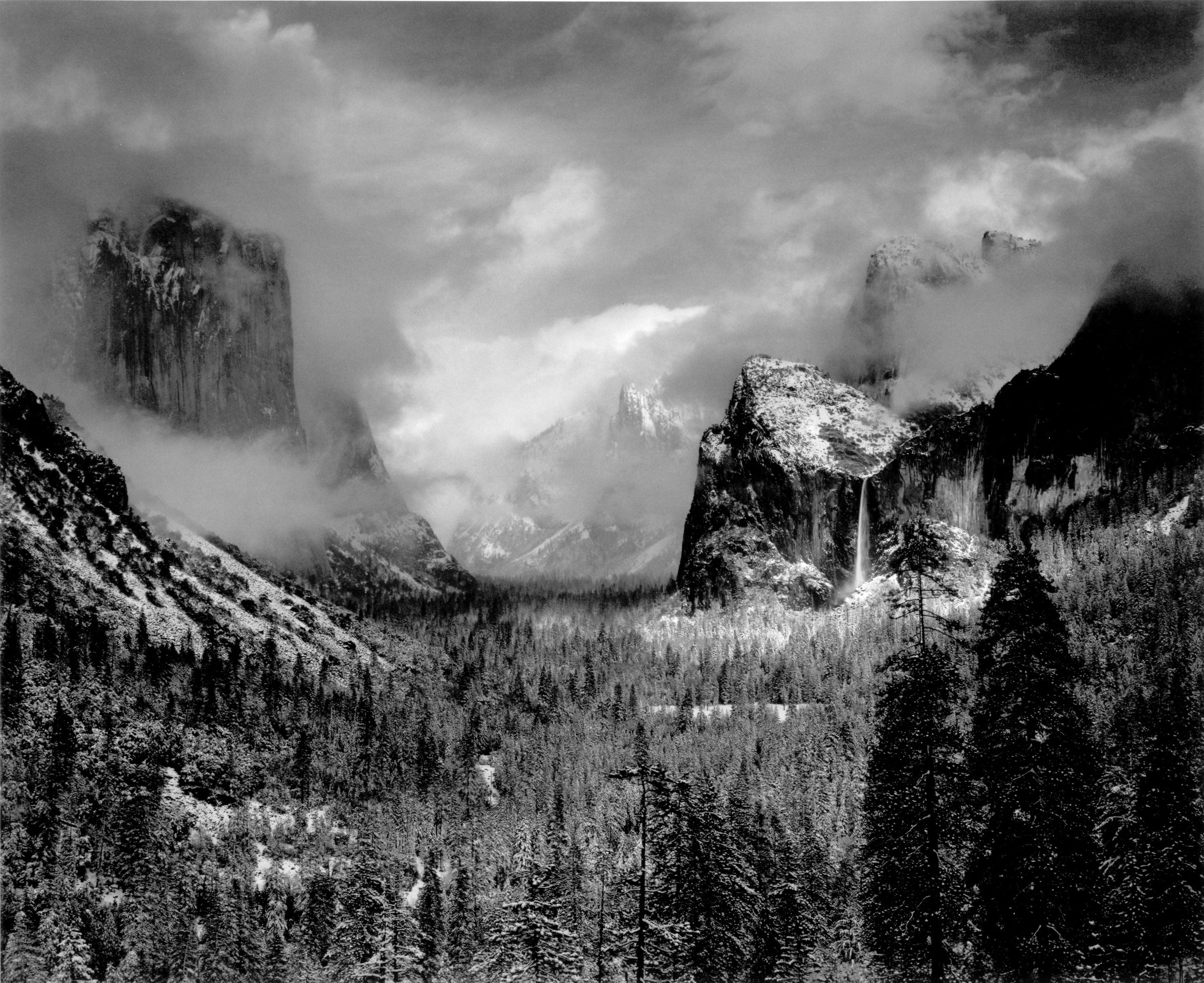
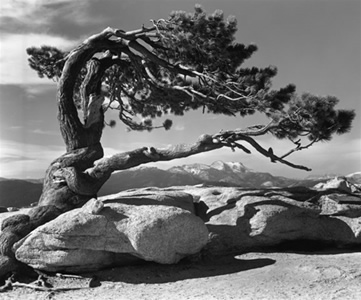
One of the things I am looking forward to next week when I head to California for the opening of my show at the Just Looking Gallery in San Luis Obispo is the couple of days beforehand that we will spend in Yosemite National Park.  I have never been there but know well the iconic images of its beauty from the photography of the great Ansel Adams.  While he is known for many photos of other locales, his images of the Yosemite Valley have come to be most closely associated with his name.

Adams (1902- 1984) first encountered Yosemite as a teen on a family excursion  on which he carried his first camera , a Kodak Brownie.  He was smittten by the spectacular landscape and the light as it filtered through the valley.  He would  return  over and over through the coming years, his prowess as a photographer growing.  He eventually married a local Yosemite girl, Virginia Best, whose father ran  Best’s Studio there.  She inherited the studio in 1935 and she and Adams ran it until 1971.  It is now called the Ansel Adams Gallery , where his work and the photos of  other great contemporary photographers are shown and sold.  The gallery  is still in the hands of the Adams family.

I’ve always loved his images of the grandeur of the Yosemite Valley and have formed my own idealized version of how the place might be in my mind through them.  I am hoping that reality lives up to expectations that have grown over many years.  I f any place can do this, I believe it might be Yosemite.

Read Full Post »

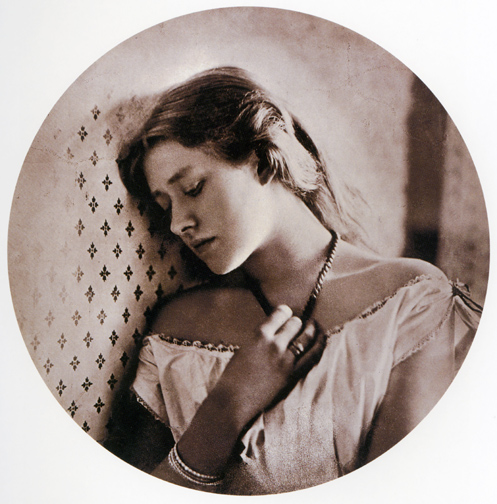
If you are a regular reader, you probably know that I like old photography from the 19th century.  I am constantly fascinated by being able to step into that time period via these images, more so than reading a passage from literature of the time.  There’s something about seeing how the reality of the time is portrayed as well as seeing how our commonality as humans remains over time.  It’s like the difference between picking up a worn book printed in that time, the pages frail and stained with waterspots, and looking through a clear window that somehow takes you back to that moment.  I think this photo shown here is a great example of this.

This photo is called Sadness and was taken by the British photographer Juliet Margaret Cameron in 1864.  Cameron was a Victorian aristocrat who took up photography, in the medium’s relative infancy, at the age of 48.  Over a ten year period she took over 3000 large format images of many of the celebrated figures of the time– Lord Tennyson, Carlyle and Darwin, for example– as well as staged recreations of literary and dramatic scenes.  She moved to colonial India in 1875  at which point her career in photography effectively ended.

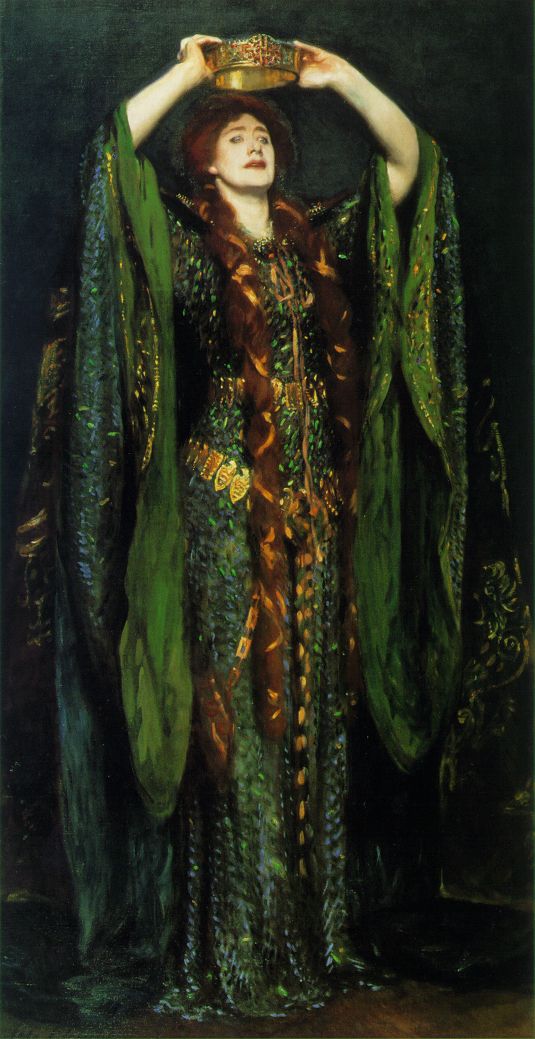
Sadness is an image of the legendary British actress Ellen Terry, who became the most celebrated Shakespearean actress of the 19th century and continued well into the 20th century until her death in 1928, a career that spanned 70 years.  You may not have heard of her but her image as Lady MacBeth was immortalized in this  1889 painting  by John  Singer Sargeant .  In Sadness,  Terry was but a girl of 17 and was about to be married to a much older man, artist George Frederic Watts.  Perhaps the sadness portrayed in this image foreshadowed their short  marriage, which lasted less than a year.

History aside, I find the immediacy and presence of the image very appealing.  I don’t feel as though I am looking back in time.  This could be this very morning.  The humanity in it is great and I can easily feel the moment, could feel myself in the very instant that it was set.  I think this sense of  being set in the now of the viewer is a defining quality of  all great visual art, at least in my eyes.  And this image from Juliet Margaret Cameron has that.

Read Full Post »

I was going to write about last week’s election here, about the runup to the election and the aftermath, particularly the awful spinning by Karl Rove and his ilk who try to justify their deceitful tactics and the ridiculous expense of these campaigns (from which they profit very nicely) with a continuance of their takers versus makers argument, one that drives me mad.  But I’m too fatigued by the whole thing.  So I set out to seek something that might catch my eye and, as I often do, headed over to Luminous Lint where I came across this striking image, a blaze of color and shape that filled the frame  like a Pop Art vision.  Indeed, in the thumbnail as it was shown I thought that it was a painting.

It wasn’t until I clicked on it to see the larger image that I realized that this was actually a person in costume.  Titled Junkanoo #1, it was an image taken by photographer Edward Yanowitz around  1979 in the Bahamas.  This image was actually used as a postage stamp for the Bahamas in 1979.  Junkanoos are street parades, much like a Mummers-type event,  that are common in the Bahamas and about which Yanowitz wrote when describing this image:

“It takes place once a year on two nights, Boxing day (26 Dec.) and New Years morning. It starts at 3 or 4 in the morning until about 8am. Groups called “gangs” compete against each other for the best costume designs and rhythm sounds, there are hundreds of people dancing around, playing on goat skin drums, beating cow bells together, whistles and various instruments. It’s a very powerful sound. When I photographed it during the seventies there were very few street lights so it was in complete darkness. I had to wait for the slides to come back just to see if I got anything, and if you discovered something in your work, you had to wait another year before you could utilize it the next time.”

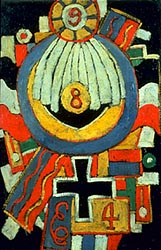
I immediately thought Pop Art at first but the more I looked at this the more I realized that this really reminded me of some pieces by one of my favorite Modernist painters, Marsden Hartley.  His Portrait from around 1914 is shown here.  He did several of these colorful pieces with strong shapes and lines that are juxtaposed on dark backgrounds.  As I was searching for my own voice, these pieces were deeply influential.  The darkness underneath  both gave the color a boost and created a different subtext for how the viewer might take in these colors,  not simply as being bright and joyous.  This was one of the things I wanted so much in my own work.

Maybe that’s why this image of the Junkanoo parader stopped me in my tracks.  I don’t know for sure.  But it is definitely a great image.

Read Full Post »

While trying to find something to divert my attention away from the last few anxiety-filled days of the current political campaign (there’s a lot I would like to say about this but I have pledged to keep my politics out of this– for now), I turned to one of my favorites sites, Luminous Lint,  once more.  It has a treasure trove of incredible photography of all sorts and I always quickly find something there that captures my imagination.  One of my favorite things there is to see  images of people from from the earliest days of photography, the 1840’s and 1850’s, just to study them a bit, to see  how these people who lived in a time so unlike the time in which we currently dwell might be similar to us.  It puts a face on history for me, much more so than formal  or even folk portraiture.

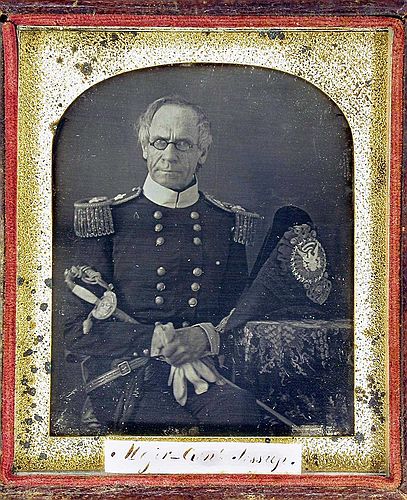
The  photo above on the right  is good example of this.  Found in a section that was a collection of early occupational daguerreotypes (click here to see the whole group) that depicted people of the time with the tools and dress of their trade, it is an image of a General Thomas Jesup from around 1847.   Shown with his sabre and the uniform and hat of his rank, the photo tells me so much more than this official portrait shown here on the left.  He is so much more rounded as a  human.  His eyeglasses and the his gaze toward the camera give him a more shrewd and studious look making me think that while he was a man of action, he was also a thinker, a planner.  And indeed he was.  He was the Quartermaster General for 42 years until his death in 1860 at the age of 72, making arrangements for the acquisition and delivery of supplies to our troops over the quickly expanding nation.

There’s something extraordinary for me in  looking at a photo like this and seeing the  actual face of someone who fought in the War of 1812 and was a contemporary of someone like the legendary Andrew Jackson.  I feel so much more connected to history in being able to see his actual demeanor before the camera.  It really does take my mind from the present time, letting me live for moments in that bit of history rather than in the history we are currently making. And sometimes that little journey back in time is a relief…

Read Full Post »

« Newer Posts - Older Posts »