Feeds:
Posts
Comments

Archive for the ‘Quote’ Category

******************

Three Rules of Work: Out of clutter find simplicity; From discord find harmony; In the middle of difficulty lies opportunity.

–Albert Einstein

****************

This Einstein fellow is a pretty smart guy.

Simplification, harmony and opportunity could be ingredients for any recipe to success in any field but I think they apply particularly well to the creative arts. I know that I can easily apply these three rules to my own work.

For me, its strength lies in its ability to transmit through simplification and harmony. The forms are often simplified versions of reality, shedding details that don’t factor into what it is trying to express.

There is often an underlying texture in the work that is chaotic and discordant. The harmonies in color and form painted over these create a tension, a feeling of wholeness in the work. A feeling of finding a pattern in the chaos that makes it all seem sensible.

And the final rule–opportunity lying in the midst of difficulty– is perhaps the easiest to apply. The best work always seems to rise from the greatest depths, those times when the mind has to move from its normal trench of thought. Times when it has to find new ways to move the message ahead.   The difficulties of life are often great but there is almost always an opportunity or lesson to be found within them if only we are able to take a deep breath and see them. These lesson always find their way into the work in some way.

Thanks for the thought, Mr. Einstein. I hear good things about you.

*****************

This post ran here several years ago. Just thought I needed a reminder of what I should be doing.


Read Full Post »

The Scale of Our Competence

****************************

“Our understandable wish to preserve the planet must somehow be reduced to the scale of our competence – that is to wish to preserve all of its humble households and neighborhoods.”

― Wendell Berry, The World-Ending Fire: The Essential Wendell Berry

*****************************

I wrote a longer post about the power of the small actions of one person in the face of the big problems hovering over this world based on the words above from poet Wendell Berry but ended up trashing the whole thing.

It was just way too much… well, way too much.

I simply like the term Berry used: the scale of our competence.

Simply put: Don’t wait for big answers. Do what you can do where you are. And do it now.

Big things often begin from the actions of one single person doing what they can do where they are.

Don’t focus on the scale of the problem. Focus on the scale of your own competence, of what you can do in the here and now.

Then do it.

Amen. End of sermon.

Now leave, okay? Go do what you can.


Read Full Post »

*************************

Whenever I find myself growing grim about the mouth; whenever it is a damp, drizzly November in my soul; whenever I find myself involuntarily pausing before coffin warehouses, and bringing up the rear of every funeral I meet; and especially whenever my hypos get such an upper hand of me, that it requires a strong moral principle to prevent me from deliberately stepping into the street, and methodically knocking people’s hats off – then, I account it high time to get to sea as soon as I can.

–Herman Melville, Moby Dick

*************************

I’m no sailor but I know that feeling, that drizzly November in my soul as Melville wrote. A glumness descends accompanied by an anxiety that cannot be quelled and the idea of being around people sets my jaw hard with my grating teeth. If people still wore hats I am sure I would be aiming to knock them off their heads.

Or worse.

I can’t head to the sea to alleviate my hypos as Melville describes this feeling which I believe is taken from the word hypochondria. No, for me, it is time to try to barricade myself in the studio and pick up my brush which is my equivalent to hoisting the sail.

With brush in hand there is a freedom with no boundaries that can hold me. No rules to follow, no one to tell me what I can or can’t do.

A brush loaded with paint is like a sail filled with a strong wind that will take me anywhere I want to go.

I can create my own sun when it’s gloomy outside or my own moon and stars to guide me through the dark. I can look out on a landscape free of all traces of people and if I occasionally want to see one I can make them far away from me, small and distant.

That keeps me from knocking off their hats.

The hypos seem to be getting the upper hand of me so I think it is high time to pick up my brush and set sail.

But if you see me on the street in the meantime, hold onto your hat.


Read Full Post »

George Bellows- Blue Morning 1909

*******************

Try everything that can be done. Be deliberate. Be spontaneous. Be thoughtful and painstaking. Be abandoned and impulsive. Learn your own possibilities.

–George Bellows

********************

George Bellows- Stag at Sharkey’s 1909

I’ve been an admirer of George Bellows’ work for a long time. He was a member of the Ashcan School, the group of painters from around the turn of the 20th century who painted gritty scenes set in the streets and buildings of urban America. He did a series of scenes with club fighters of the era that are favorites of mine, such as Stag at Sharkey’s here on the right, reminding me of my own grandfather who was a club wrestler of that same era.

My grandfather had numerous matches in the men’s clubs as well in the vaudeville theaters that were common in our hometown. He was called Shank for his ability to put a leghold on his opponents and hold it until they submitted. He had matches that lasted for several hours and had a pretty large local fanbase.

I can easily envision him at home in the dark scenes that were painted at that time by George Bellows.

While best known for his dark and gritty work, Bellows seemed to have paid attention to his own words of advice above. Though he died prematurely in 1925 at the age of 42 from peritonitis from a ruptured appendix, he stretched his work in many directions beyond his work as a member of the Ashcan group. He did portraiture, war scenes, landscapes and Maine seascapes and a host of other sorts of paintings in his prolific but short life. All were distinctly his own.

I wonder if he ever fully learned the extent of his own possibilities. While we may never know the answer, he left us a lot of hints as to what they might have been.

George Bellows- Love of Winter 1914

George Bellows- Big Dory 1913

George Bellows- Cleaning Fish

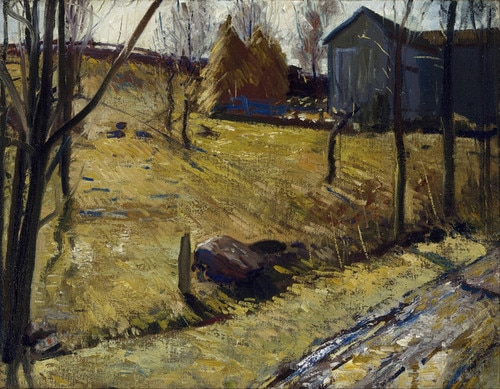
George Bellows- Haystacks and Barn

George Bellows- Massacre at Dinant (War Series) 1918

George Bellows- Shipyard Society 1916

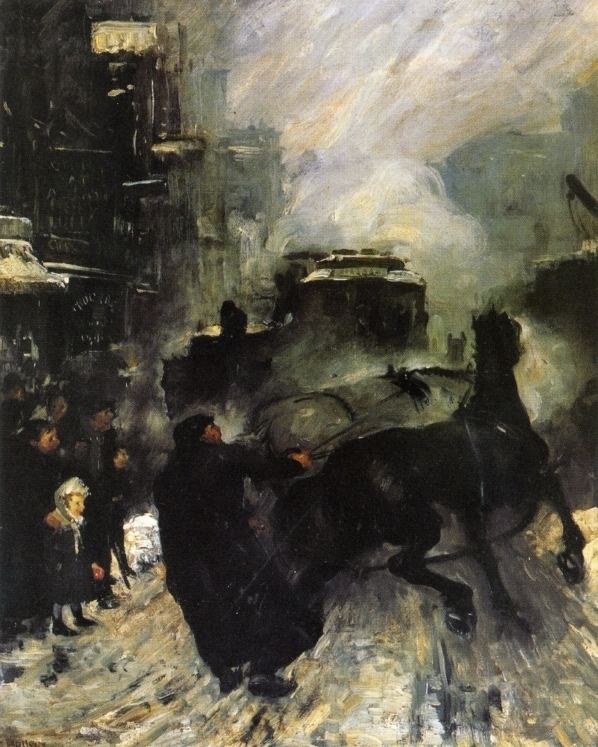
George Bellows- Steaming Streets 1908

George Bellows- The White Horse 1914

George Bellows- Up the Hudson

George Bellows- The Fisherman’s Family 1923


Read Full Post »

With about a foot of snow already on the ground and more falling as I write, I spent my first few hours this morning shoveling and plowing but still felt that I should post something. I am running one of my favorite posts, one that I run every few years. 

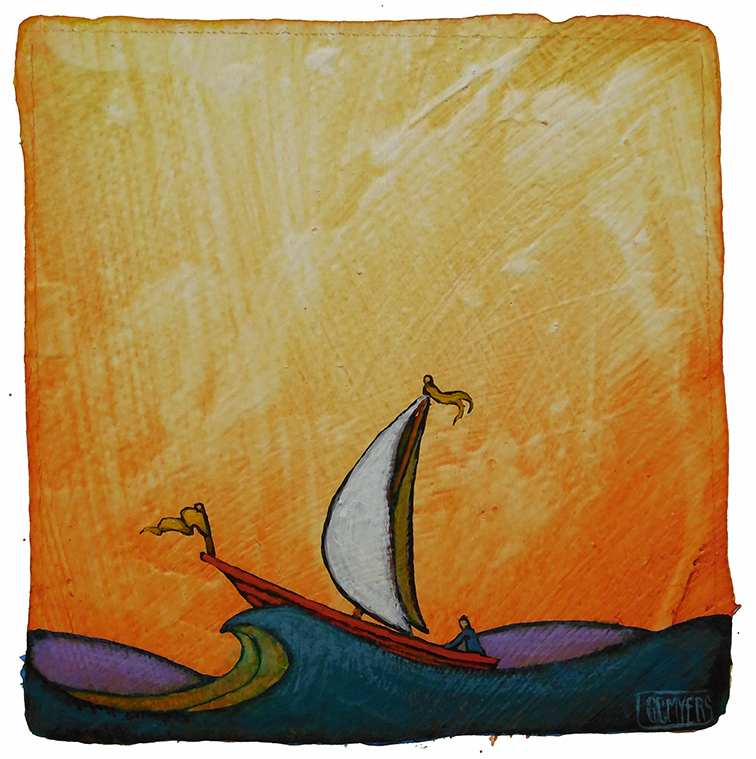
GC Myers- Heliotrope sm***************************

“Patience and perseverance have a magical effect before which difficulties disappear and obstacles vanish.”

-John Quincy Adams

**********************

I don’t what made this pop into my head but I was thinking about a conversation from a few years back that I had with a friend who is also a painter. He has been a working artist for almost his entire adult life, fairly successful for much of that time. We both agree that we are extremely fortunate to have found the careers that we have, one that feels like a destination rather than a passageway to some other calling.

For me, I knew this was the career for me when I realized I no longer looked at the job listings in the classified section of the paper. For most of my life, I felt there was something else out there that would satisfy me but I didn’t know what it was or how to find it. Maybe it was as simple as finding the right job. Or so I thought.

When you don’t know where you’re going, any direction feels like it might be the right direction.

But during this particular conversation this friend asked, “What would you do if you suddenly couldn’t paint? What if you were suddenly blind?”

For him, it was unthinkable. His life of creation was totally visual, based on expressing every emotion in paint.

I thought about it for a second and said simply, “I’d do something else. I’d find a way.”

In that split-second I realized that while I loved painting and relished the idea that I could communicate completely in paint, painting was a mere device for self-expression. But it was not the only way to go. I knew then as I know now that the deprivation of something that has come to mean so much to me would, in itself, create a new need for expression that would somehow be satisfied. I have always marveled at the people who, when paralyzed or have lost use of their arms, paint with their toes or their mouth . Their drive to communicate overcame their obstacles. Mine would as well.

If blinded, I could or do something with words, using them to create color and texture. Perhaps not at the same level as my painting but it might grow into something different given the circumstance. The need to communicate whatever I needed to communicate would create a pathway.

It was an epiphany in that moment. Just knowing that I had found painting gave me the belief that I could and would find a new form of expression if needed.

I did it once and I could do it again. And I found that greatly comforting.

Yes, I’d find a way…

Read Full Post »

Ablaze

***********************

In everyone’s life, at some time, our inner fire goes out. It is then burst into flame by an encounter with another human being. We should all be thankful for those people who rekindle the inner spirit.

–Albert Schweitzer

*********************

One final reminder here at the end of a week based on giving thanks. Don’t forget those folks who have inspired, encouraged, assisted, paved the way, opened the door, gently pushed, opened our eyes, morally supported and lifted us up.

They are the spark that sets the inner fire burning.

Hope your fire is ablaze.

Read Full Post »

Another Grateful Moment

Grateful Moment- GC Myers 2014

++++++++++++++++

Gratitude is not only the greatest of virtues but the parent of all others.

– Marcus Tullius Cicero

++++++++++++++++

I thought I would rerun the post below about gratitude that ran last year on the day before Thanksgiving.

I am a firm believer in the words of Cicero above, feeling that, if it is fully embraced, gratitude permeates everything we do in a positive way.

I also believe that nobody achieves anything solely on their own, that everyone owes someone something for getting them where they are. Someone along the way taught them something, pointed them in a direction or opened a door that greatly helped them move along. 

As much I would like to think I have done everything on my own, even the small amount of success I have achieved is the result of a lot of help and encouragement from hosts of people. Without them I am nothing.

A sense of gratitude makes everything it touches better. And as I wrote below, a lack of gratitude debases everything. Take a look:

+++++++++++++

It’s Gratitude Week here on RedTreeTimes. It’s kind of like Shark Week without the carnage. Or sharks.

Well, there is a little carnage but I can guarantee there are no sharks.

For today’s installment, the great Roman orator Cicero certainly has it right. When you think of the great virtues– honor, courage, loyalty, honesty, compassion, respect, and grace along with so many others– you can easily place gratitude as a contributing factor to each. These virtues are often just gratitude set in motion.

If gratitude is not the parent of all virtues, it is at least a conjoined twin.

I am not harping on gratitude now just because it is the week of Thanksgiving. No, it has become painfully obvious that there is a lack of gratitude, and by extension, the absence of accompanying virtues, being shown by many of our public leaders. This includes one person in particular.

Simply put, this lack of gratitude trickles down ( much more so than any tax cuts!) from the top to the general population. As a result, we end up with ugly attitudes permeating our daily life.

Gratitude transforms into a sense of entitlement

Humility becomes boastful self-aggrandizement.

Respect is replaced by insult and denigration.

Courage becomes cowardice.

Loyalty becomes a temporary transaction where one’s loyalty is given only for as long as the other person remains useful.

Empathy devolves into a mocking of the shortcomings and weaknesses of others.

Responsibility is replaced by a need to place blame on others.

Honor becomes disgrace.

Trust turns to deep skepticism.

Grace transforms into insolence and coarseness.

And honesty?

Honesty has turned into a sort of mythological creature, like the Bigfoot or the Loch Ness Monster– seldom seen and so shocking that when it finally shows itself, we don’t believe what we are seeing with our own eyes. Dishonesty becomes the accepted norm and we lose the ability — or even the will–to recognize the lies from the truth.

We become a nation of liars, a land without virtue or honor that can no longer be trusted.

It doesn’t have to continue in this way. We are a nation based for centuries on its virtues, always moving towards doing what is right, no matter the cost. We can reclaim that. We can be a country of virtue.

It all starts with simple gratitude.

Be thankful for all that you have. Express it in your words and, more importantly, in your actions.

Read Full Post »

***************

There are two ways of spreading light… To be the candle, or the mirror that reflects it.

–Edith Wharton

***************

This is a sort of new painting headed to the Principle Gallery for their upcoming Small Works show that opens next week. I say sort of new because it is a painting from a few years back that was changed in a way that made it a completely different piece.

Back then it was titled Candle and it was just as it is without the female figure and the boat. With its simplicity and color, it was a favorite of mine and it has been here in the studio for the last year or so, much to my delight. There has always been something in it that speaks to me.

But I have recently worked on a few paintings with small female figures in them and their presence has had a real impact in those compositions, adding a real layer of meaning and depth to those paintings. In the studio, I started to to look at this painting– without the figure– and began to see her there. I could see her adding a symbolism that would change and enrich the painting.

I wasn’t sure I wanted to change the original painting but day after day all I could see was a ghost of that figure in place. The original began to fade for me, began to seem lacking, as thought it had waited for me to add this figure and make it whole.

So, this what you have now.

I changed the title of this painting with another addition, becoming Fiona’s Candle. The Fiona comes, of course, from the British born US Diplomat Fiona Hill who testified in the recent Impeachment Hearings. Her strength, her intelligence, her straight forward approach, sense of purpose, and her unwillingness to suffer fools or alter her moral compass for them made a deep impression on me and many others.

We could use a few more Fiona Hills.

In this painting, I see the female figure as having those same characteristics. She is seeking, as Edith Wharton wrote above, to spread the light, to illuminate the truth– which I see here as the Sun, a set and constant thing– as either the candle or the mirror that reflects it.

I am usually averse to changing pieces that speak so strongly to me, that seem to already have a life force in them. But there are always exceptions and this painting, for me, seems to have been fortified, made stronger by one simple addition.


Read Full Post »

*********************

Sometimes you give birth to something or you’re part of a team that gives birth to an idea, and it grows and has a whole life of its own, and you feel grateful. It’s just so humbling.

–Glen Hansard

*********************

I understand the type of gratitude that singer/songwriter Glen Hansard is describing above. He was talking, I believe, about the life of Once, the movie that he, along with Markéta Irglová, starred in and wrote and performed the songs that made this little low budget film a hit in 2007. It then went on to be adapted for a stage production on Broadway in 2012. It was a hit there as well, winning 8 Tony awards.

Once— as an album, a movie and a play– definitely took on a life of its own and Hansard’s gratitude is understandable.

I know that feeling for myself, albeit on a much smaller scale. Every artist, I think, hopes their work will have meaning that reaches out to people in a way that it affects them deeply but that hope alone doesn’t make it happen. There is something beyond the intention and control of the artist.

That outcome is not predictable. It is a convergence of the work, time, tone, and the emotional perception of the person taking in the work.

In short, it is a small miracle.

To have a work go beyond my own understanding of it, to generate meaning that I never saw in it, and to become a real part of someone’s life is a certainly a wonder of sorts. And for me, there is nothing more gratifying than to be associated in any small way with such an occurrence.

I also feel humbled because, and I don’t know if this makes sense, it makes me feel my own smallness in the larger aspect of the work. I realize then that I only play a small part in whatever alchemy creates the miracle of art.

Hmm. Something to think about as we head into Thanksgiving.

Here’s Glen Hansard and Markéta Irglová peforming the Academy Award winning song Falling Slowly from Once.


Read Full Post »

***************

As an artist you have to find something that deeply interests you. It’s not enough to make art that is about art, to look at Matisse and Picasso and say, how can I paint like them? You have to be obsessed by something that can’t come out in any other way, then the other things – the skill and technique – will follow.

–Anselm Kiefer

***************

Anselm Kiefer (b. 1945) is one contemporary artist that continually fascinate me. His work often deals with history and how we in the present time are connected to it. One of his projects is a long term exhibit at the Massachusetts Museum of Contemporary Art that features 30 very large paintings, all about 6′ by 11′, assembled in one space. The exhibit is titled Velimir Chlebnikov based on a theory from the Russian Futurist of that name ( who died in 1922 at the age of 36) who believed that major naval battles happened every 317 years and had some sort of cosmic importance for the human race.

This group of paintings from Kiefer deal with nautical warfare and are built up on heavily textured grounds comprised of a variety of materials one doesn’t often associate with painting–dirt, sand, straw, rust and lead. It’s gritty and rough yet striking and somehow beautiful at the same time.

Now, I can’t comment on the theory. Maybe there is something in Chlebnikov’s metaphysical numerology. Who knows?

But I can comment on the impact of the assemblage and display of this group of work, this obsession of Kiefer. As an artist, I find it awe inspiring. It makes me want to push beyond my own creative inhibitions, to work on my own obsession in a way that makes a large statement.

Big work.

Bold work.

Work that pushes past what I know and how I work now.

Work that forces me in a direction I can’t foresee.

Work that changes me in some fundamental way.

It’s something to think about.

I guess that is one way in which art influences art.

Anselm Kiefer’s Velimir Chlebnikov, a series of 30 paintings devoted to the Russian philosopher who posited that war is inevitable, is on display at the Massachusetts Museum of Contemporary Art.


Read Full Post »

« Newer Posts - Older Posts »