Feeds:
Posts
Comments

Archive for the ‘Quote’ Category

Klee/Art as Memory

************************

All art is a memory of age-old things, dark things, whose fragments live on in the artist.

Paul Klee

************************

When I need something to get me through periods of stress, something that engages me and makes me question myself while at the same time inspiring me, nothing serves me better than a dose of Paul Klee.

In his work I definitely feel like I am looking at the age-old memories of the artist. In fact, the attraction comes in the fact that I see his age-old memories and dark things as being my own.

A sense of familiarity.

Like being in an alien world and hearing a familiar language from some distance away. Words and phrases, bits of meaning, gleaned from a cacophony of unintelligible garble. It makes you alert and hopeful that there is a possibility of connection, of communication.

I can use a little Klee this morning.

Read Full Post »

*****************

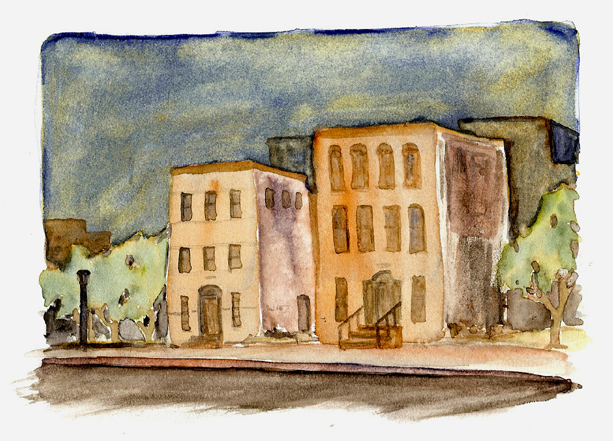
GC Myers  1994 Early Work Illustrative Styling

****************

To exist is to change, to change is to mature, to mature is to go on creating oneself endlessly.

~Henri Bergson

****************

If you have read this blog for some time, you probably have noticed that I periodically like to revisit old work, especially those early pieces from when I was still in the process of finding voice. It’s an interesting period for me to look at because the changes were coming fast, sometimes on what seemed to be a daily basis, as new things were tried, some sparking new directions and some being quickly set aside.

It was a much different set of circumstances than the way I currently work. It was a period of fast and furious fireworks, little pops and crackles with every step forward where today it is quieter for periods of time followed by louder booms. I don’t know if I can explain that any better and am pretty sure it means nothing to anyone but that is the nature of this whole endeavor– trying to make sense of something inexplicable.

I was looking at some early pieces and stopped on this one at the top for a bit, looking at it closely for the first time in many years. It’s from around 1994 and was at a point where I was still trying to figure out things. It was very illustrative– I could see it being used in a kid’s book– but there were things I took from it. The treatment of the sky, for instance, presaged the way my process evolved. It’s a pleasant little piece but it is far from where I wanted to be and even back then I knew it when I finished it then set it aside. It was not an emotional carrier for me at the time and that was what I was seeking.

The piece below, Into the Valley, was from around six or seven months later, in early 1995, and shows the changes that were taking hold in my work.  It is simpler in construction yet seems to say more for me, seems to have some more fundamental thought and feeling in it. GC Myers Into the Valley 1995

I usually take something from these little visits back in time. The changes become more evident as the style matures then levels off, becoming a bit more subtle, less drastic but more confident. But always changing, always recreating itself as it matures.

Or so I hope…

Read Full Post »

Idleness/Klimt

Gustav Klimt- Farm Garden with Crucifix

*********************

Even when I am being idle, I have plenty of food for thought, both early and late – thoughts both about and not about art.

–Gustav Klimt

*********************

I am in the midst of a slightly lazy period, as far as my work is concerned. I am not spending as much time in front of an easel or at my big painting table as I would like. Not getting much done at all which eats at the part of me that worries about productivity, that part that knows there are only so many days and hours remaining in my creative life so to waste even one day or a handful of hours means they are lost forever.

But the idle part of me doesn’t care about that. It wants to focus on other things for a bit. Wants to watch the news on the tv too often. Wants to read history or revisit artist books that have been unopened for too long. Strum the guitar. Want to stare out the window and pet my Hobie cat.

It all seems like simple laziness from a distance, even to myself, the lazy one in this picture. But I know from experience that it’s a necessary idleness, a time to recharge my creative batteries, to explore new (and misplaced older) ideas and form new tracks of thought.

And, like Klimt points out, not all these thoughts are concerning art. But because they become part of who one is, these thoughts eventually do  show up in the art in some way. Art is a product of the mind so any changes to how the artist perceives their world changes their art.

Oh, man, I am wiped out after writing that. I have to go now because there are things to not get done. Have yourself a lazy day, folks.

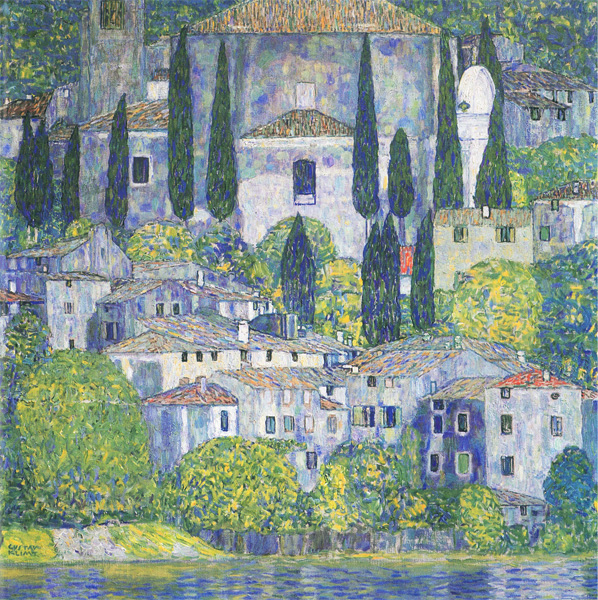
Gustav Klimt- Church in Cassone

Read Full Post »

Romare Bearden – Vampin’ ( Piney Brown Blues)

***********************

The artist confronts chaos. The whole thing of art is, how do you organize chaos?

–Romare Bearden

***********************

I think the beginning of this quote from the late artist Romare Bearden (1911-1988) is an important statement and observation.

The artist confronts chaos.

That really speaks to me. It better defines a bit the purpose and necessity of art, both in a general and personal sense.

Maybe the purpose of art is to bring clarity and order to the world that confronts us, to illuminate the hidden or overlooked elements of our existence.

I don’t know for sure but these few words and my own experience make me believe it to be so.

For me, art is a way of distilling the torrent of information and sensations that flow through each of us every day down to a single manageable expression. An expression that helps me better understand and tolerate the chaos before me.

For me, it usually boils down to familiar forms and expressive colors. Found order and harmony above the chaotic rhythm of the texture below.

Like hearing a language you don’t really know but seem to somehow understand and trying to translate it to others.

It is different for every artist, no doubt. The idea of organizing chaos might seem totally foreign to some. I can’t say for sure what drives every artist or what purpose they derive from their art.

I can only speak for myself. That, in itself, might be a valid definition for art.

To that, I answer with my mantra: I don’t know.

And that is undoubtedly the driving force behind art.

Here’s  Big Joe Turner and his Piney Brown Blues, the song that Romare Bearden references in the monotype at the top of he page. Have a good day.


Read Full Post »

****************************

Our imagination is stretched to the utmost, not, as in fiction, to imagine things which are not really there, but just to comprehend those things which are there.

–Richard Feynman

****************************

I was thinking recently about the importance of imagination and came across the words above from the late physicist Richard Feynman. His thought really meshed with my own thoughts on the imagination, which focused on the importance of it not only in art or literature but in so many aspects of our lives.

Actually, my thoughts were more about the lack of imagination I was sensing in all too many people. They seem to not be able to see beyond what is immediately in front of them or to extrapolate what might happen in potential situations beyond the next few minutes. I guess you would call it being short-sighted, a condition that often leads to fear and cynicism. Fearful of the new and cynical of anyone who dares to see beyond tomorrow.

You see this in how people react to many of our current events. This lack of imagination makes them willing to accept only what they can see now, blocking out any vision of what the ramifications might be into the future. This lack of imagination also makes these same folks blind to the patterns that brought us to this current condition.

Their shortsightedness tends to go hand in hand with a short-term memory, one that easily discards facts– and often their own words– that don’t coincide with what they see in the present moment. As a result these folks tend to fall prey to leaders offering them hollow promises and easy answers.

And scapegoats.

Because besides shortsightedness and short-term memory, a lack of imagination also often leads to a lack of empathy and compassion. These folks lack an ability to envision people different than themselves living in different situations. They can’t imagine the hardships or injustices that affect the lives of others. It’s all too easy to turn these people with differences into scapegoats for those lacking in imagination.

I am not writing this because I feel I have any special amount of imagination. I certainly have at times limited my life through my own lack of imagination and the fears and cynicism that it enables. I am sometimes small when I could be large and large when I should be small.

I just want to know how to communicate clearly with those folks who seem to have this lack of imagination, to get them to see possibilities and potentials beyond their own noses now and years into the future. This chasm between those with and without imagination seems to me to be the dividing line in this world right now.

I can still, against the evidence of the present, imagine a better world. But I can also imagine a much worse world. I believe it all depends on inflaming the imaginations of those who have refused to use them to this point.

At this point, I don’t know what or who can do such a thing.

My imagination is still hopeful.

Read Full Post »

I used the beginning paragraph from an Immanuel Kant essay as an intro when I first wrote the blogpost about the painting below, Dare to Know. Recent events sent me back to the 1784 essay, What is Enlightenment?, from which they were taken. I found that the rest of the essay was equally as compelling as that first paragraph, describing how the vast majority of people are willing to relinquish the choices in their lives to others. It seems to say that people are  basically fearful of taking responsibility for much of anything and will gladly sacrifice the freedom to think and decide for themselves to anyone willing to tell them what to do, even when it is not in their best interest. This essay urges people to step forward into the light, to question things, to think independently, and accept responsibility. That is how enlightenment can be found.

It seems to me that this describes the current divide in this nation and throughout the world. There are those willing to blindly believe that those in positions of trust, such as our leaders or clergy or captains of industry, will act responsibly, doing what is best for the vast majority of the population without self interest. They choose the path of least resistance, believing hollow promises that require little from them.

And then there are those who question, those who seek truth and clarity, those who demand that trust be earned. They want take responsibility for the decisions in their lives, even those that are difficult and require sacrifice. They desire accountability for themselves and for those others who claim to know what is best for them. 

While it is not always an easy path, that willingness to dare to know may well lead to enlightenment, as Kant indicates. Myself, I prefer that path.

Here is the original blogpost:

**********************

“Enlightenment is man’s release from his self-incurred tutelage. Tutelage is man’s inability to make use of his understanding without direction from another. Self-incurred is this tutelage when its cause lies not in lack of reason but in lack of resolution and courage to use it without direction from another. Sapere aude!- ‘Have courage to use your own reason!’- that is the motto of enlightenment.”

― Immanuel Kant,  What Is Enlightenment?

**********************

Sapere Aude!  From the Latin for Dare to Know.

I came across the passage above from the 18th century philosopher Immanuel Kant and felt immediately that it was a great match for this new painting. In fact I am calling this piece, 11′ by 15″ on paper,  Dare to Know (Sapere Aude!)

The Red Tree here is removed away from the influence and shading of the other trees and houses in the foreground, out of darkness and into the light. There is a light about the Red Tree and a sense of freedom in the openness of the space around it. It is free to examine the world, free to seek the knowledge it craves, and free to simply think for itself.

It’s a great idea, this concept of enlightenment and one that we definitely could use today. Too many of us form our own base of knowledge by relying on the thoughts and opinions of others, often without giving much consideration as to their truthfulness, motives, or origins. Or we shade our base of knowledge with our own desires for  how reality should appear, holding onto false beliefs that suit us even when they obviously contradict reality.

In short, there is no enlightenment based on falsehoods, no way to spin darkness into light. Enlightenment comes in stepping away from the darkness of lies and deceptions to see the world as it is, with clarity. It means stripping away our own self defenses and admitting our own shortcomings, prejudices, and predispositions.

It may not always be what one hoped for but it is an honest reality. And maybe that is enlightenment, the willingness to face all truths with honesty.

To dare to know.

Sapere Aude!

Read Full Post »

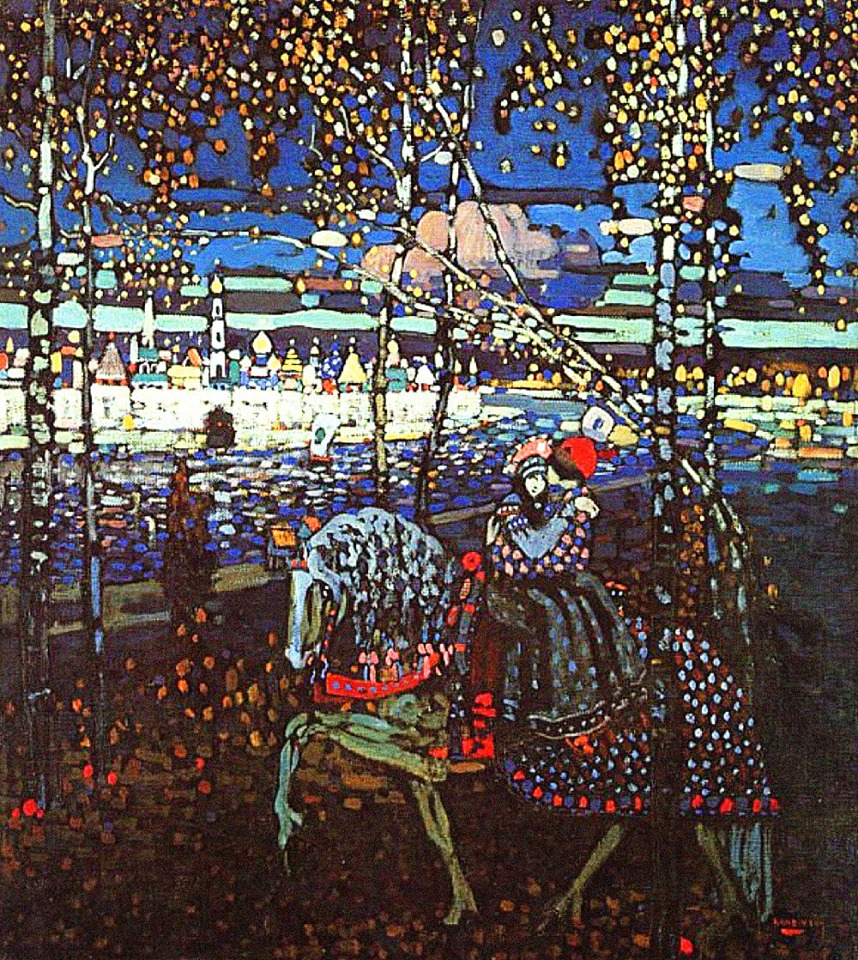
Wassily Kandinsky- Couple Riding 1906

**********************

The true work of art is born from the Artist: a mysterious, enigmatic, and mystical creation. It detaches itself from him, it acquires an autonomous life, becomes a personality, an independent subject, animated with a spiritual breath, the living subject of a real existence of being.

–Wassily Kandinsky

**********************

Leave it to the great Wassily Kandinsky (1866-1944) to so well describe that sense of life I am looking for in my work and about which I have often written here. When it is real, it takes on a life of its own. It still possesses the personality and psyche of the artist but grows, adding layers and dimensions that take it well beyond the reality of the artist.

These two sentences from Kandinsky hit the mark squarely — animated with a spiritual breath, the living subject of a real existence of being–and are just perfect for how I see this process.

Read Full Post »

*********************************

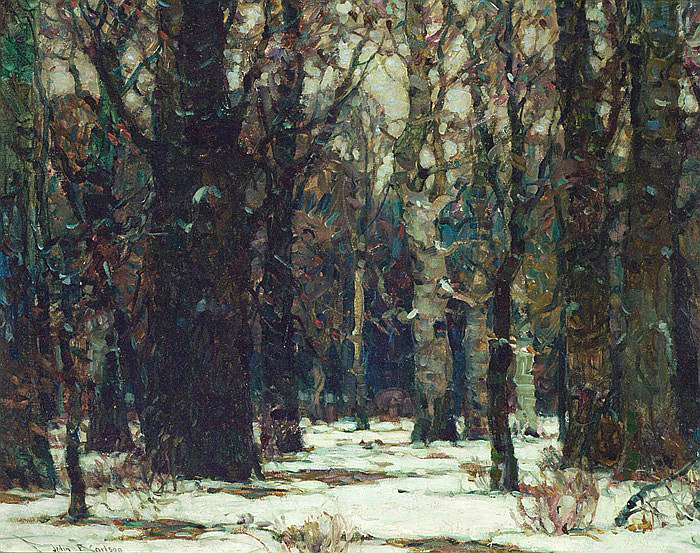
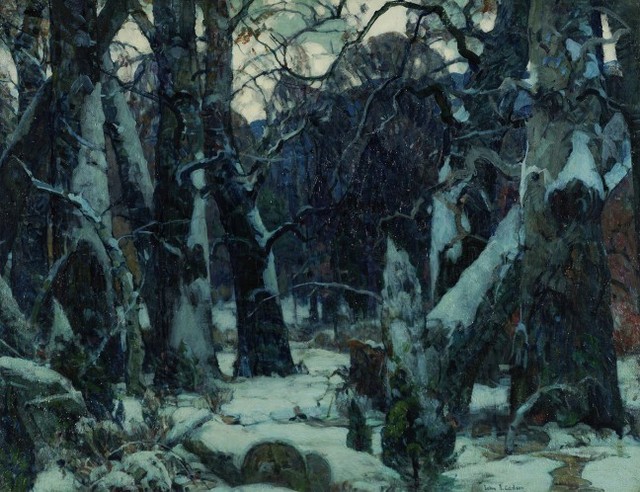
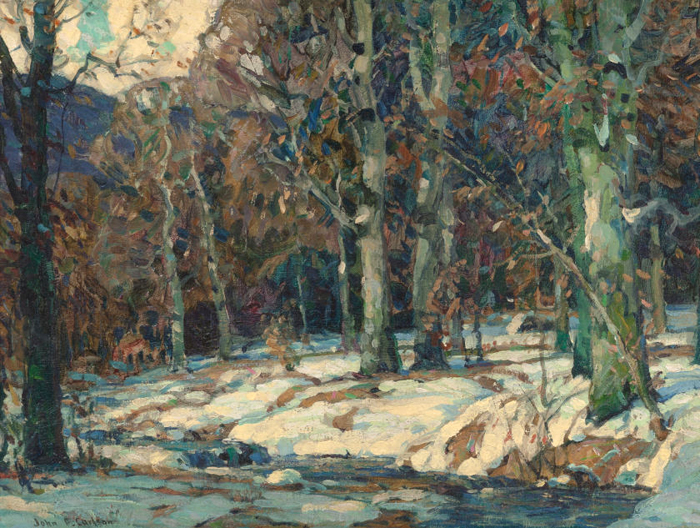
“I’ve spent a good part of my life painting trees. Naturally I’ve gotten pretty well acquainted with them. Excellent friends they are and, for me, the most fascinating ‘sitters’. Trees are a lot like human beings; rooted men, possessing character, ambitions and idiosyncrasies. Those who know trees see all their whims; see their struggles too; struggles with wind and weather; struggles to adjust themselves to their society. For nature will not allow them to run amuck, heedless of their neighbors; their individual propensities must conform to the cosmic laws within their own democracy. Thus there is a certain rhythm in a wood; a flow between parts, a give and take that is rigidly observed.”

–John F. Carlson, American Artist interview, 1942

********************************


To the artist, the forest is an asylum of peace and dancing shadows.

-John F. Carlson (1875-1947)

********************************

You may not know his name, but the Swedish born American painter John F. Carlson had a big influence on generations of modern realist painters. He wrote a book on landscape painting in 1928 that is still well regarded today and his work is included in the collections of most major museums. You probably see echoes of his work in painters you see working today.

Beyond that, I like, and agree with, his thoughts on trees and forests, those places where I spend much of my days.

*********

“No one, it seems to me, can really paint trees without being extremely sensitive to their rhythm and all that is going on in the woods, without indeed having considerably more than a casual acquaintance with sylvan society.”– John F. Carlson

************************

Take a look for yourself.

Read Full Post »

**********************************

Truth made you a traitor as it often does in a time of scoundrels.

Lillian Hellman, Scoundrel Time

***********************************

I am forcing myself to write about something removed from the news, lest my anger . There are things happening, both here and in our foreign policy decisions, that are deeply disturbing with ramifications that will echo for years to come around the globe. I will just let the words above from Lillian Hellman‘s autobiographical memoir, Scoundrel Time, sum up my view of the whole thing.

We are definitely in a time of scoundrels.

So, instead, I am making an unusual request.

The painting at the top, Exiles: Blue Guitar, is one that I painted back in 1995 as part of my Exiles series. This is one of the paintings I most regret letting go. It was the largest painting and the true centerpiece of the Exiles series besides having a lot of personal meaning for me.

Regrettably, this painting went to the Kada Gallery in Erie in 1997 or 98 where it was sold to an unnamed collector.

I am not trying to get it back, though I would gladly repurchase it. My desire is to get an image of it as it is now. You see, in 1997 I believe it was, I darkened the background in the painting. Any documentation of that change is lost and I have no idea or image of its final appearance. I would love to get an image and perhaps reframe the painting for its current owner. It was framed at a time before that in which I started using my signature frame. It is in an unusual frame, one that I think is probably inappropriate for it, along with a plexiglass covering that only used once or twice early on in my career. It deserves to be seen in a better setting.

My request is to any of my readers in the Erie area. Or any of my readers anywhere, for that matter. If you know of this painting or know anyone who might have my work but you’re not sure, ask them to get in touch with me here. I would like to hear from them.

I know it’s a long shot but I thought it was worth putting out there. This has been on my mind for many years now and I would like to take care of this.

Thanks!


Read Full Post »

************************

“She was fierce in the presence of death, heroic even, as she was at no other time. Its threat gave her direction, clarity, audacity.”

Toni MorrisonSong of Solomon

************************

I’ve been working with a new element in my work lately, a lone female figure like the one in the new painting above, and it has been making me think.

Probably explains the headaches– that dull pain that comes after using long neglected muscles.

I joke, of course. Never had those muscles in the first place to neglect.

Again, a joke. My apologies.

This lone figure strikes me in a much different way than the lone male figure I sometimes employ in my work. While he sometimes feels remorseful or lonely, this female figure doesn’t give me those feelings at all. There is a sense of boldness, determination, and empowerment that comes with her that really pleases me.

She feels absolutely strong.

Fierce.

Audacious.

It was something I hoped for In the work. Being in the world of art for last couple of decades has exposed me to many strong and bold women, both behind the scenes and as artists. It excites me to see so many young female artists recognize the importance of their own voices and the need to step forward to let the world hear them.

I think that is what comes through in the painting above. The title certainly hints at that– Light Favors Audacity. Boldness is something I fully believe in. This world doesn’t favor the meek and timid and nothing is given unless it is either asked for or simply taken.

This stands in stark opposition to the phrase that so many folks hang on to tightly, better safe than sorry. Those folks that invoke the phrase often end up being both sorry and sad in their safety. You know those people, the ones who constantly start their stories with if only or I could have or I should have.

Stop waiting for others to find you. Set out on your own journey and stay true to your values and your voice. It is as important and valid as that of anyone else.

Be audacious and let the world know you are there. The light will usually find those who are bold enough to seek it.

Here’s this Sunday morning music. It’s a neat rendition of the Billy Idol song, Dancing With Myself, done in the form of a jazz quartet from the Postmodern Jukebox, which is a group of rotating musicians who rework modern songs into different vintage genres. This song translates really well and I find it highly enjoyable.

See for yourself. Have a good Sunday.

Read Full Post »

« Newer Posts - Older Posts »