Feeds:
Posts
Comments

Archive for the ‘Quote’ Category

*************************

No matter how individual we humans are, we are a composite of everything we are aware of. We are a mirror of our times.

Louise Berliawsky Nevelson

************************

I am always intrigued by the images I see of the work of Louise Berliawsky Nevelson (1899-1988) who emigrated to the US from Ukraine in the early part of the 20th century. She is best known for her sculpture that is comprised of found objects assembled in large, monumental wall pieces that are often painted in monochromatic tones. There is visual excitement provided by the various shapes of the many bits and pieces contained within the sculptures. They are familiar forms, often dissembled furniture elements, that take on a new meaning in the work.

It makes me want to try to do that sort of thing but the pull is not strong enough to ever get me to actually try. It’s interesting work that makes me try to see a meaning within it that fits my own vision and needs. But I can never quite see a way where it can do what I need it to do for myself. I take that as a sign that it is not my form of expression.

Plus, from a pragmatic standpoint, it looks like it would be a nightmare to dust.

Nevelson’s words above resonate with me. As humans, we are composites of everything we take in. Likewise, artists express this humanness in their work, mirroring their feelings taken from these influences.

I know this is definitely true for myself. I generally can’t help but reflecting my feelings on the world around me. I would think to try to not do so would make one’s work cold and distant. Inhuman.

And that takes us away from the purpose of art as expressions of our humanity.

So, to my artist friends out there, take in all you can and let the world know how you feel it. It’s the human thing to do.

Read Full Post »

Rothko/Experience

Mark Rothko- Red and Black 1968

*****************

A painting is not a picture of an experience, but is the experience.

Mark Rothko
.
*****************
This quote from Mark Rothko made me stop this morning. I hear a lot of artists talk about capturing a moment with their work. I am pretty sure those words have come out of my mouth when I am just blathering on. But a piece of art works best when it causes the viewer (for visual artists) to feel as though they are experiencing something new in that moment when they stand in front of it.
.
Not a representation of a moment but a moment in itself.
.
But how do you do that?
.
I can’t really say for sure. Maybe it comes in being fully engaged emotionally during the creation of the work. Perhaps that moment of emotion becomes part of the piece and it is that which the viewer senses and experiences in the work.
.
I don’t really know but it is something I will consider when I am in front of the easel in a few minutes.

Read Full Post »

********************************

The masses do not see the Sirens. They do not hear songs in the air. Blind, deaf, stooping, they pull at their oars in the hold of the earth. But the more select, the captains, harken to a Siren within them… and royally squander their lives with her.

–Nikos Kazantzakis

********************************

I am still working on the Multitudes paintings with their masses of eyeless faces. It’s work that is consuming, acting as a siren of sorts, drawing me to it and keeping me from moving on to other things. It is much like author Nikos Kazantzakis describes above.

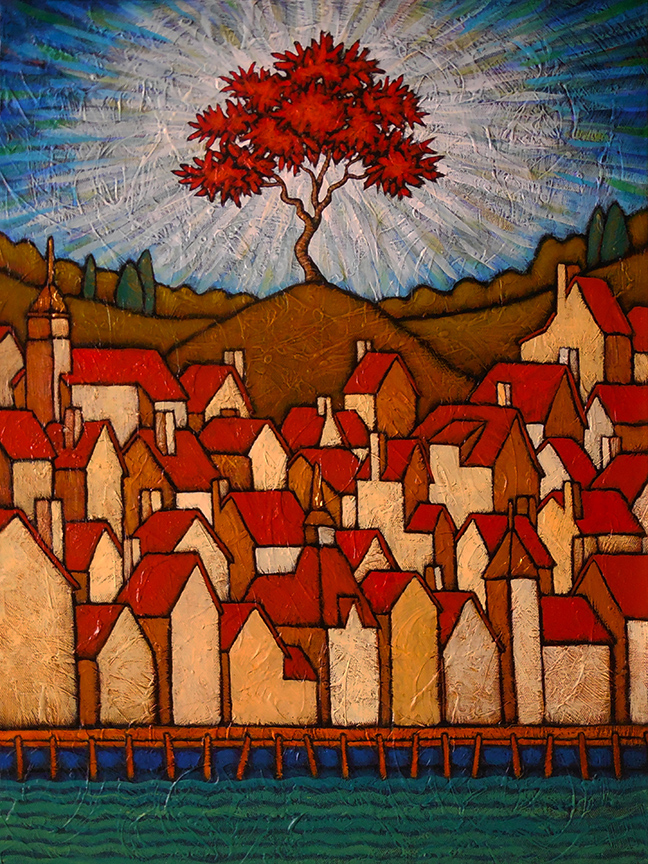
It reminds me also of a newer painting shown at the top that was finished just before jumping into the Multitudes pieces. It is a 24″ by 18″ canvas that I am titling Call of the Siren. It incorporates the Red Tree and the Red Roofs along with a band of color at the bottom that represents the sea.

This bottom section has a pattern that seen with the vertical piers of the dock creates a pattern that feels Greek to me. It wasn’t intended and I can’t say if this pattern, as I see it, is really Greek in origin. But it feels that way to me and perhaps brings the thought of the Sirens of Greek mythology to mind when I look at this piece.

Another thing I note in this painting is the the massed buildings of the town seem to form a fence It is another barrier, beyond the sea journey that brought them here, that must be overcome for those who are called by the Sirens. And once one has made it over wide waters and through treacherous cities, there is still a hill to be climbed.

The Sirens never makes things easy.

I know this to be true– I’ve royally squandered much of my life chasing their song.


Read Full Post »

A Little Frida

*******************

Nothing is absolute. Everything changes, everything moves, everything revolves, everything flies and goes away.

–Frida Kahlo
*******************
.
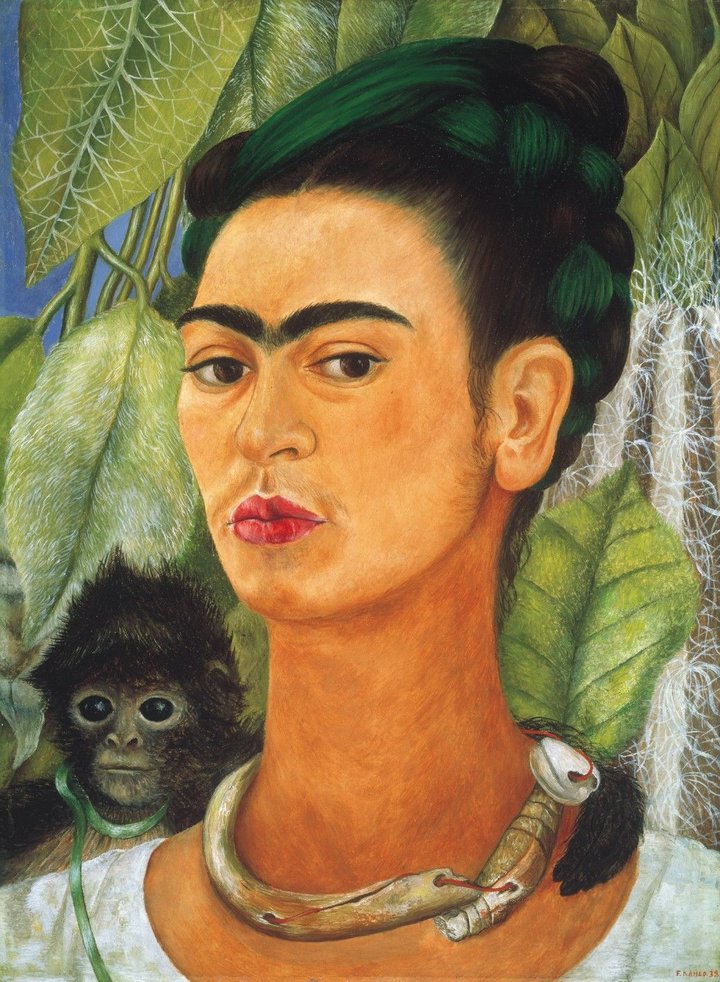
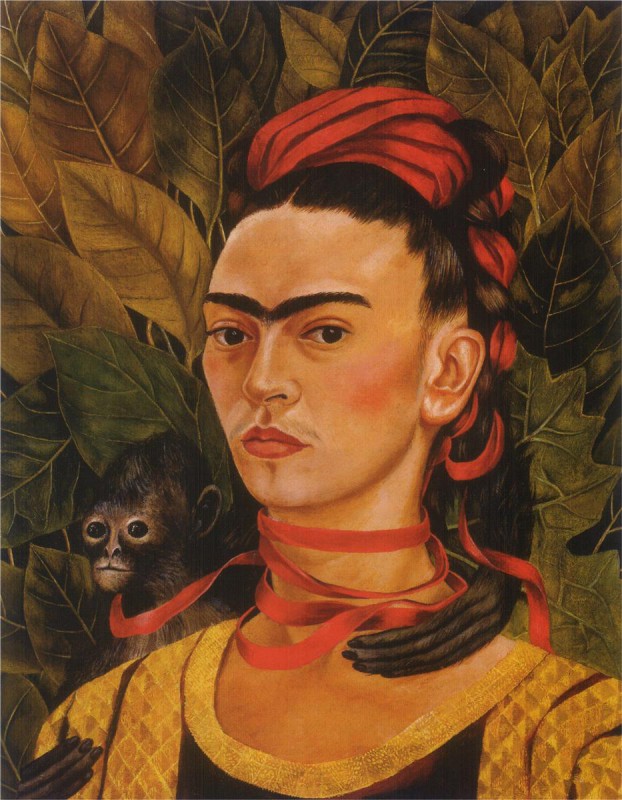
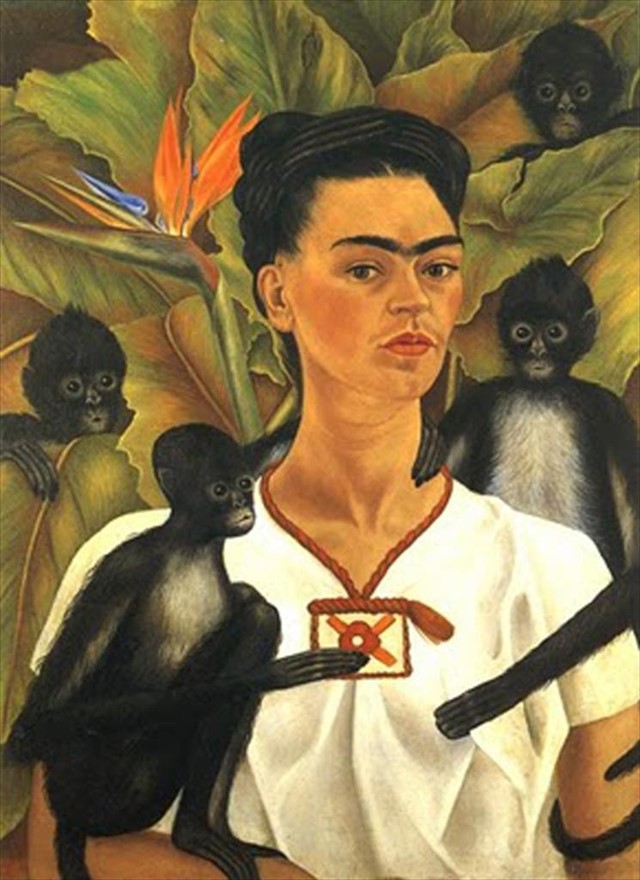
I have been wanting to feature Frida Kahlo (1907-1954) for some time now. Her work is a unique and deeply personal voice in the world of art, one that touches on her identity as a Mexican, as a woman and as a political being. Her body of work might well be the the most overtly biographical collection done by an artist. Her famed self portraits make up about a third of her output.
.
I have no doubt that most of you have seen her work and are somewhat aware of her story. She has become an icon in modern art, the story of her all too brief life– the debilitating pain she suffered from childhood polio and a later accident, the turbulent and loving marriage to the painter Diego Rivera, her political beliefs, her affairs and much of her personal life– captured in books and film.
.
So, I am not going to spend a lot of time on that. Instead, let’s just take a look at a few of her paintings. As I said, they are unique and deeply personal but there is something in them that appeals to aspects in many of us. There is also a short film with more of her paintings set to a song about her.
.

*************


*************

Read Full Post »

*********************

Walt Whitman: Song of Myself, Part 51


The past and present wilt—I have fill’d them, emptied them.

And proceed to fill my next fold of the future.

Listener up there! what have you to confide to me?

Look in my face while I snuff the sidle of evening,

(Talk honestly, no one else hears you, and I stay only a minute longer.)

Do I contradict myself?

Very well then I contradict myself,

(I am large, I contain multitudes.)

I concentrate toward them that are nigh, I wait on the door-slab.

Who has done his day’s work? who will soonest be through with his supper?

Who wishes to walk with me?

Will you speak before I am gone? will you prove already too late?


*******************************

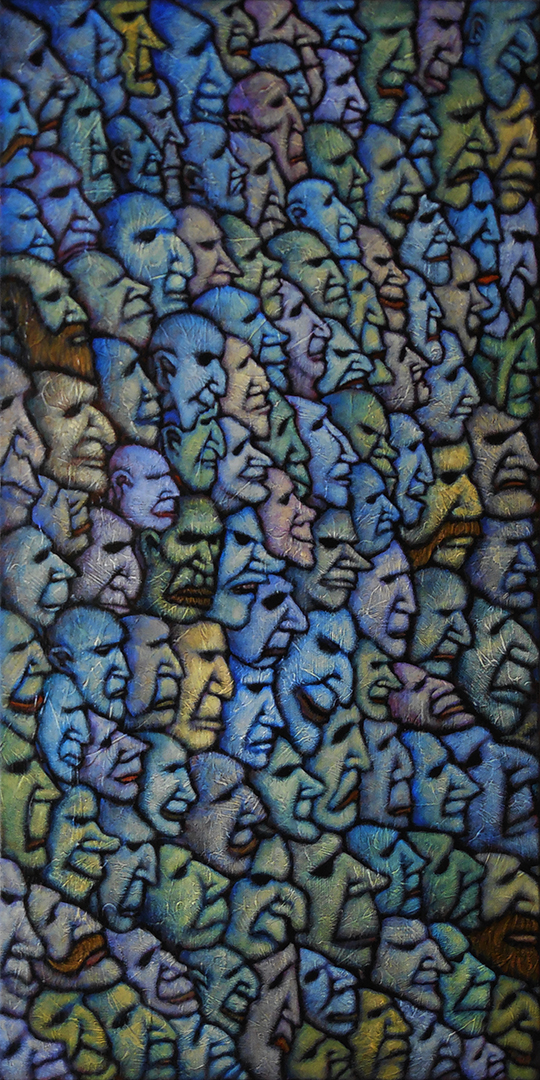
The image shown on the right is another new painting, a 36″ by 18″ canvas that is part of a new group that has drawn a great deal of my attention lately in the studio. They are large groups of faces that are painted in an almost subconscious manner, with little if any forethought given as to how they relate to the surrounding faces. They emerge from dashes of paint and quickly rendered shapes that cause me to simply find human form in them.

It is very intuitive work. It reminds me very much of the process involved in painting the subterranean artifact layers in my Archaeology series. Just make a mark then transform it into something tangible, something possible.

I have known most of these faces for forty or fifty years. They have lived in me, have emerged periodically on bits of paper, on journal pages and in the margins of the newspaper. Some have shown themselves individually in some of my work through the years– the Exiles, Outlaws and Icons series for example.

But they all seem familiar to me. Some possess a pleasant and friendly aura and others much less so. Some are ugly and bitter in appearance. Some even seem evil and worry me a bit, causing me to ask if they are all just variations of my own self.

I don’t really know.

Part of me says yes. I was instantly reminded of the line from Walt Whitman’s Song of Myself  (shown above):  Do I contradict myself?/Very well then I contradict myself,/(I am large, I contain multitudes.)

Whitman’s grand poem had him speaking as the voice of the collective consciousness of mid-18th century America, a voice that encompassed all sorts of people and attitudes that make up the stewpot that is this country, then and now. As an artist, the hope is that your own work taps into that same vein, that it speaks to connects with the wider spectrum of people. So, in doing this, in attempting to access this collective multitude, to pull them all from your own inner self.  To do so, you have to find that part of yourself that is part of all of them.

Can it be hope and love? Fear and anger? Or just the emotion of being?

I don’t really know.

What I do know is that there is something in this work that seems right for the moment.  Seeing these groups of faces had me wondering how this had slipped by me for so long. It feels natural, like it should have been part of my work for some time now.

So how had I not did this before? I think the answer is that I needed to develop the skills and visual vocabulary to do these pieces in a way that used the faces in the most impactful way. If I had did this years ago, I think it would have been lacking the color, rhythm and forms needed to make them effective. Those are all things that have come from years and many tens pf thousands of hours in the studio. For me, these paintings are a great coupling of subject-these crude faces– and those elements– color, rhythm and form. I find myself attracted as much by the colors and shapes as I am by the individual faces.

I am considering calling this group Multitudes from the line from Uncle Walt. Or it might still be Masks from the for the appearance the faces have with their dark eyelessness.

I am still trying to figure this out so excuse this off the cuff writing. There are a lot of thoughts emerging and growing even as I write this so I reserve the right to change to contradict myself at some later point. Like Walt, if I contradict myself, so be it — I am large, I contain multitudes.


Read Full Post »

President’s Day

A few presidential quotes to celebrate Presidents Day:

However [political parties] may now and then answer popular ends, they are likely in the course of time and things, to become potent engines, by which cunning, ambitious, and unprincipled men will be enabled to subvert the power of the people and to usurp for themselves the reins of government, destroying afterwards the very engines which have lifted them to unjust dominion. 

– George Washington

****************

If national pride is ever justifiable or excusable it is when it springs, not from power or riches, grandeur or glory, but from conviction of national innocence, information, and benevolence. 

John Adams

****************

To waste, to destroy, our natural resources, to skin and exhaust the land instead of using it so as to increase its usefulness, will result in undermining in the days of our children the very prosperity which we ought by right to hand down to them amplified and developed. 

– Theodore Roosevelt

*****************

The only limit to our realization of tomorrow will be our doubts of today.

-Franklin Delano Roosevelt

******************

Let every nation know, whether it wishes us well or ill, that we shall pay any price, bear any burden, meet any hardship, support any friend, oppose any foe to assure the survival and the success of liberty.

-John F. Kennedy

*******************

I don’t care. I believe Putin.

-The 45th President* of the United States

*********************

The last one here is significant because it is one of the very few times on record that the current placeholder has actually spoken the truth.

Happy Presidents Day?


Read Full Post »

Loving Truth

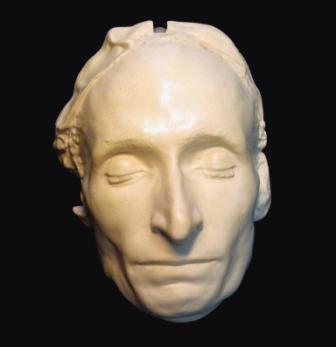
Blaise Pascal Death Mask

***************************

Truth is so obscure in these times, and falsehood so established, that, unless we love the truth, we cannot know it.

–Blaise Pascal

***************************

We live in a time of falsehoods. It is a time where some choose to deny the obvious truth and instead believe the desired lie.

Their opinion, their own sense of belief, has more value to them than all the mountains of truth and evidence that could be stacked against them.

How do you change such people? How do you make them see truth where they see only falsehoods?

You don’t change them.

You can’t change them.

You can only maintain a love for truth and continue to shine a light on it.

Then you must use that truth to defeat those who believe in the current false reality.

No persuasion will ever convert these people.

It must be defeat. Complete and devastating defeat.

A defeat so absolute that some will, in time, begin to understand how far they had veered off the path of truth and reality.

Some will never see the truth and will forever see themselves forever as victims.

Victims of a conspiracy. Victims of circumstance.

Always victims.

How this defeat comes about, well, that is yet to be determined.

But defeat must come.

Sounds harsh, I know.

And in the end, it may turn out to be harsh.

But to let truth be obscured by falsehood, to accept and live in a world completely based on lies, would prove to be far more severe and brutal.

The truth must continue to be loved and spoken.

Truth must prevail.

Amen.

Thus ends today’s sermonette.

Thanks for letting me vent and special thanks to French mathematician, theologian and general brainiac Blaise Pascal (1623-1662) for today’s quote and all of his various and many contributions to truth and the betterment of mankind.


Read Full Post »

***************************

The best reason to paint is that there is no reason to paint… I’d like to pretend that I’ve never seen anything, never read anything, never heard anything… and then make something… Every time I make something, I think about the people who are going to see it and every time I see something, I think about the person who made it… Nothing is important… so everything is important.

Keith Haring

***************************

I can’t say that I was ever a huge Keith Haring fan. Maybe it was because his Graffiti-based Pop Art imagery seemed to be everywhere all of the time  through most of the 80’s and 90’s. It seemed like you couldn’t turn around without seeing his images. But I have to admit that I have come to have an appreciation of his work, especially the prodigious output he produced in his short life. He died at the age of 31 and created a pretty amazing body of work in the limited time he spent on this planet. Even if you don’t recognize the name, you most likely have seen and recognized his imagery at some point.

Part of my newfound appreciation comes from the fact that I am able to look at his work now and find things in it that I may be able to transfer in some way to my own work. Take for instance, the rhythms of some of his black and white pieces shown below. I see something in them that speaks to me and might work in my voice, as well.

I also like the attitude he took with the quote at the top. The idea that the importance of art comes from the fact that we see something in it that makes it important to us is a striking and sometimes abstract concept. It’s one that has struck me at times in the studio when I am suddenly hit by the absurdity of the idea that I am standing there smearing paint of a piece of board. In that moment I can’t think of a reason why I should be doing this thing.

And maybe it is that absurdity that makes it worthwhile. Perhaps to continue to do something that seems so unimportant in the grand scheme of things creates its own importance.

A sort of testimony to both the futility and significance of our existence.

And maybe that is art’s true purpose, to let us feel both humble and expansive.

Something to think about while I am wondering what the hell I am doing here in the studio today.

*******************


Read Full Post »

********************************

“The sun –the bright sun, that brings back, not light alone, but new life, and hope, and freshness to man–burst upon the crowded city in clear and radiant glory. Through costly-coloured glass and paper-mended window, through cathedral dome and rotten crevice, it shed its equal ray.”

― Charles Dickens, Oliver Twist

********************************

I guess it’s wishful thinking to be discussing a painting based on light and warmth on a day when we are just beginning to feel the brunt of the bitter cold that has swept down from the polar regions. It’s below 0° right now and it won’t get much above that for the next few days around here. Brrr! So the hope contained in a rising sun and the light and heat from it becomes something to really think about.

The painting above is a new one, a 24″ by 24″ canvas, that I am calling Reaching For The Light. The jumble of upward rising buildings has a new addition to go with the regular roofs and spires–chimneys. This new element gives the effect of an appendage reaching upward from each building to get to the sunlight.

I like that feeling that it gives.

I thought the descriptive snip above from Dickens’ Oliver Twist fit this painting. I often have images based on Dickens’ vivid descriptions of cityscapes from Victorian England in mind when I am working on these type of paintings that are cramped and crowded with buildings. His words created an imagery that stuck firmly in my mind from when I first read them so many years ago.

It was a place of darkness, soot, and shadows. The idea of the sun cutting through the grayness with its cleansing light and warmth is one of hope, one of moving to a better situation beyond the squalor and despair of the moment.

That’s how I am seeing this painting with the Red Tree serving as the symbolic central figure acting out this idea of grasping for the light.

So, on this coldly bitter day, I have to find hope in the same sun that we have come to fear as the ever increasing effects of global climate change become apparent.

Stay warm, folks.

Read Full Post »

Was looking through some images of work from around 2006 and 2007 and came across this painting, The Middle Way. It really jumped out at me so thought I’d share it along with a blogpost from back in 2009 about a Henry Miller essay. The painting and the essay seem to fit together well.

*****************

 ***************************

    From the very beginning almost I was deeply aware that there is no goal. I never hope to embrace the whole, but merely to give in each separate fragment, each work, the feeling of the whole as I go on, because I am digging deeper and deeper into life, digging deeper and deeper into past and future. With the endless burrowing a certitude develops which is greater than faith or belief. I become more and more indifferent to my fate, as a writer, and more and more certain of my destiny as man.

      – Henry Miller, Reflections on Writing

****************************

This is a fragment of an essay, Reflections on Writing, from a book of essays, The Wisdom of the Heart, by Henry Miller, the great and controversial author. When I was young his books such as Tropic of Cancer and Tropic of Capricorn were still being characterized as “smut” and many libraries didn’t have them on their shelves for fear the morality police would swoop in and raise a fuss. Probably many only know the existence and influence of his books from their use in a memorable Seinfeld episode, the one with Bookman the library cop whose hard-boiled dialogue still makes me hoot.

For me, I wasn’t so much attracted to his books by the raciness of the stories but rather by his way of speaking through his words and expressing views that I found at once to be compatible with my own. He observed and said the things that I  wished I could say with a voice and power I wished I possessed. I can pick up one of his books and open to a page anywhere in the book and read and be fascinated without knowing the context of what I’m reading, just from the sheer strength of his writing’s voice.

I see a lot of things in this particular essay that translate as well for painting or any other form of creation. It opens:

Writing, like life itself, is a voyage of discovery. The adventure is a metaphysical one: it is a way of approaching life indirectly, of acquiring a total rather than a partial view of the universe. The writer lives between the upper and lower worlds: he takes the path in order to eventually become that path himself.

Substituting artist for writer, I was immediately pulled in. The path he refers to is the path I often refer to in my paintings, the path we all walk and struggle along on, trying to find the middle way between these upper and lower worlds.

It’s a good essay and one I recommend for anyone who creates in any form and struggles with the meaning of their work beyond its surface. For anyone seeking that path…

_________________________________________________________

Read Full Post »

« Newer Posts - Older Posts »