Feeds:
Posts
Comments

Archive for the ‘Quote’ Category

We are at a crucial time in this country and, maybe as well, the world as a whole. I think even those who refuse to pay attention are beginning to see that something very wrong has taken place and there is an effort to find the truth behind it. If this situation were a painting, it began with an underpainting of a scene based on lies. But each new day brings more and more strokes and color in the form of facts and truths that expose the underlying falsehood, the illegitimacy of the scene painted for us two plus years ago.

With each day, the final painting is becoming clearer and clearer.

I could go on but that would most likely be overkill. Too pedantic and preachy.

Instead, I thought I would share some of my favorite quotes– I do love a good quote— dealing with lies and liars. A page of lies. Actually, not lies but about lies. As a liar myself, I can attest to the veracity of most of these but you would have to take my word for that. And, believe me (the liar’s favorite phrase, by the way), you don’t want to do that.

Though I think these are all pertinent, the most applicable to the current situation might be the last from Ray Bradbury‘s dystopian classic Fahrenheit 451. Most people will not be told, will not dare to extrapolate into the future. They only see the present moment and even then, it is seen with a subjective sort of vision, the kind that only sees and knows what is in its immediate reach. But once the fallout from this hits them, they will ask how this could have possibly happened, even though they themselves enabled it with their lack of attention.

The Albert Camus quote is also a favorite. The projection of self by the liar is most illuminating.

But don’t trust me, take a look for yourself.

Read Full Post »

I normally don’t rerun posts on Sunday which is when I feature a musical selection. But this week I thought the chosen song matched up well with this post and the painting in it, which is one that feels very personal for me.. So, here’s a post from a few years back accompanied by a selection,On The Nature Of Daylight (Entropy), from contemporary composer Max Richter. It’s a beautiful piece of music.

Have a good Sunday…

********************

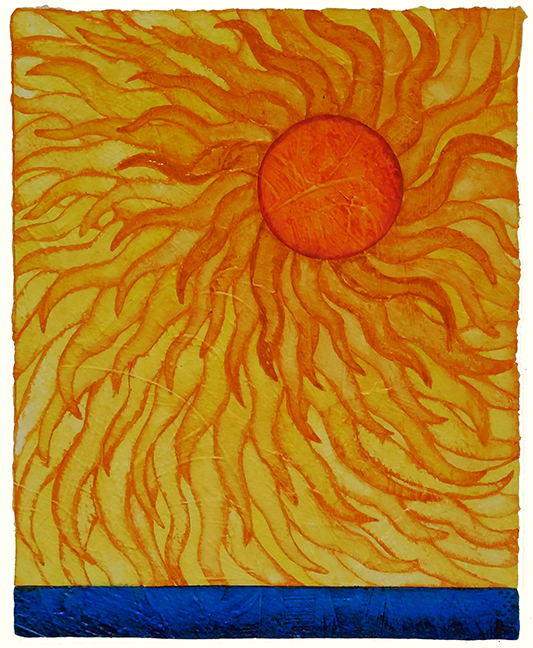
GC Myers- CandleThere are two ways of spreading light… To be the candle, or the mirror that reflects it.

–Edith Wharton

***************

This is a new piece,  8″ by 10″ on paper, that I am calling Candle. Working on this painting, I determined that I wanted to keep the composition very simple and stark. There was so much energy in the radiating forms that adding anything beyond the blue panel at the bottom would change the whole feel of the piece as I was seeing it. The blue provides contrast and forms a horizon line that gives the whole image a measure of inward depth without detracting from the simplicity of the image, which I see as being essential to the strength of this painting.

Simplicity, as is often the case, translates as grace. And grace of some form was what began to show in this piece as it unfolded. I was reminded as I worked on this of the great (in my mind, the greatest British artist) JMW Turner‘s reputed dying words: The sun is God. There is a spiritual element in how the sun is depicted in his work and I often feel that I am representing something more than a source of physical light and energy when I paint these sun orbs in my work.

Perhaps that something more is a presence beyond the physical.

I don’t know. But for a moment, my uncertainty is relieved and I feel connected with the warmth and light from the presence that is the sun in this piece.

Read Full Post »

*************************

My originality consists in putting the logic of the visible to the service of the invisible.

Odilon Redon

*************************

This is a bit of a continuation of yesterday’s post where Magritte spoke of poetry and mystery in his work. The above quote from Odilon Redon (1840-1916) describes very much that same sentiment.

A work of art should have a sense of logic to it even if it might go against all that we know of the natural world. This created logic allows us to accept what we see before us, permits us to fully absorb the poetry and mystery–the invisible elements to which Redon alludes–without question.

This acceptance allows us to move beyond the visible, allows us to perceive our reality in a different manner, perhaps in an enhanced way.

As a viewer, I know the works of art that move me most of all fall into this category. They may not seem unusual at first look. Their subject might even seem mundane. They seem outwardly logical but there is something that moves them into that area of mystery and poetry, that gives them an sense of the indefinable.

As an artist, it is something you hope to achieve but don’t really know how to explain how you do it because you don’t really know for sure. It sometimes either happens or it doesn’t.

And that is its own mystery.

It’s a mystery that keeps the artist wanting to always move ahead with the hope that it will all someday be revealed.

Will it one day be revealed? Who knows? It’s a mystery.


Read Full Post »

************************

People who look for symbolic meaning fail to grasp the inherent poetry and mystery of the images.

Rene Magritte

************************

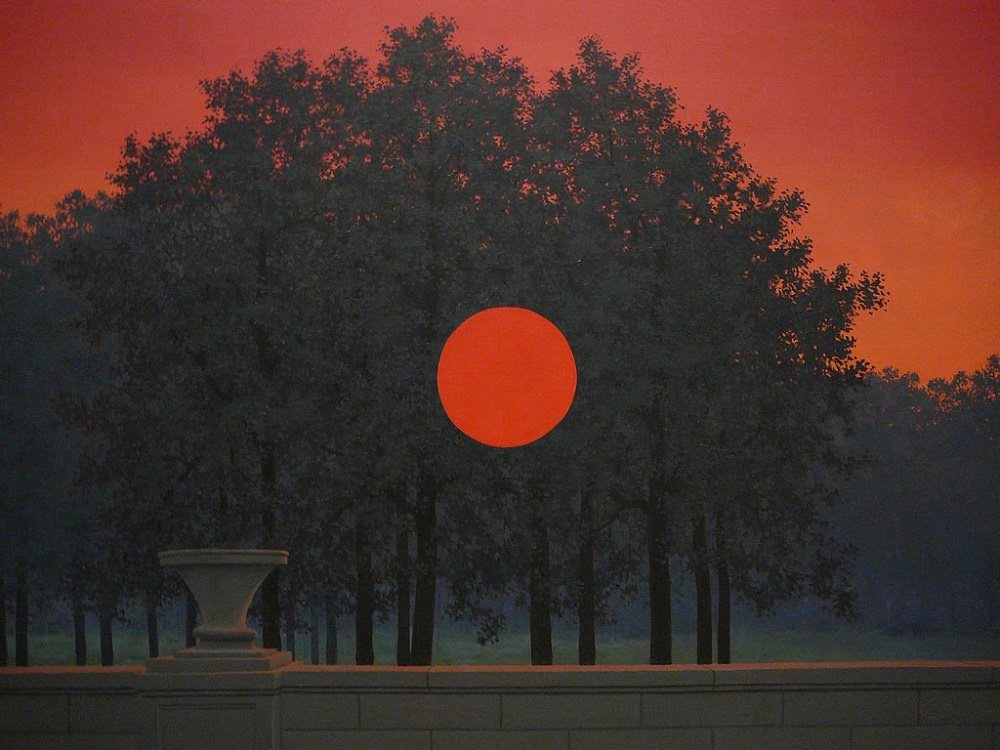
I absolutely love this painting, The Banquet, from Rene Magritte in 1958. It has the effect where I don’t question anything about it. I just accept it as it is presented. I am not looking for symbolism in it at all, not looking for a reason why the red ball of sun is hovering low in front of the trees. The colors, the contrast, the composition– they create a whole sensation doesn’t need a why or what or how.

As Magritte points out, it contains poetry and mystery.

And that is something to try to understand. I know I often feel the need to try to explain my work, to point out where I find an emotional base in a piece. Sometimes that is easy, almost jumping out at you. But sometimes it is not so obvious and it is simply the mystery of the created feel, a great intangible pulse, that makes a particular painting work.

You see it, feel it, accept its reality yet you don’t fully understand the why and how.

And maybe that is just as it should be. Not all we behold can or should be explained. Sometimes, maybe we simply need to experience poetry and mystery.

Read Full Post »

**********************************

“The world concerns me only in so far as I owe it a certain debt and duty, so to speak, because I have walked this earth for 30 years, and out of gratitude would like to leave some memento in the form of drawings and paintings—not made to please this school or that, but to express a genuine human feeling.”

Vincent van Gogh, The Letters of Vincent van Gogh

**********************************

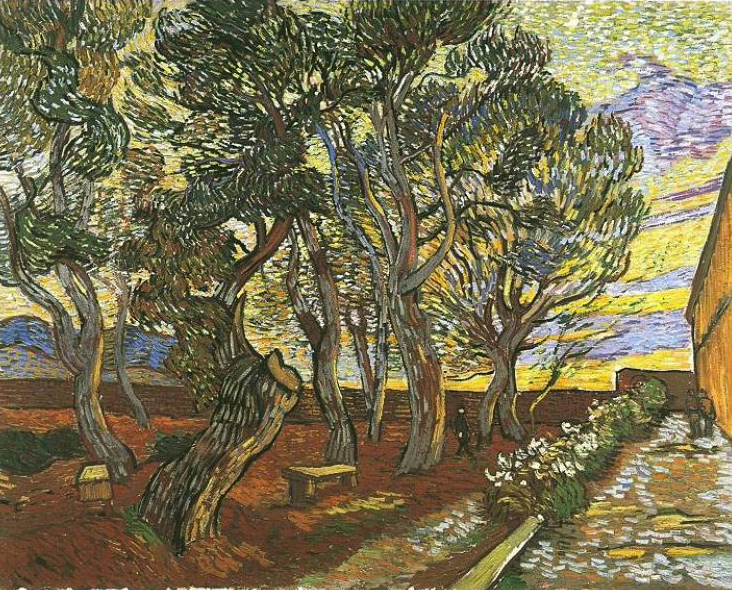
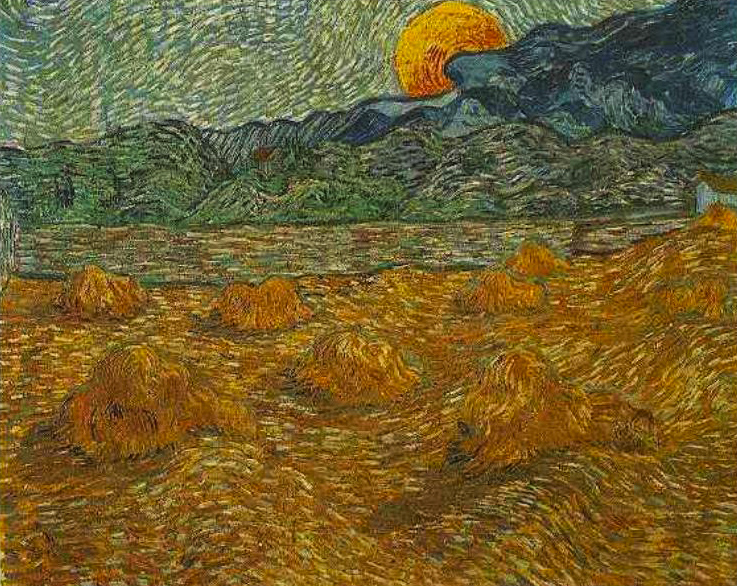
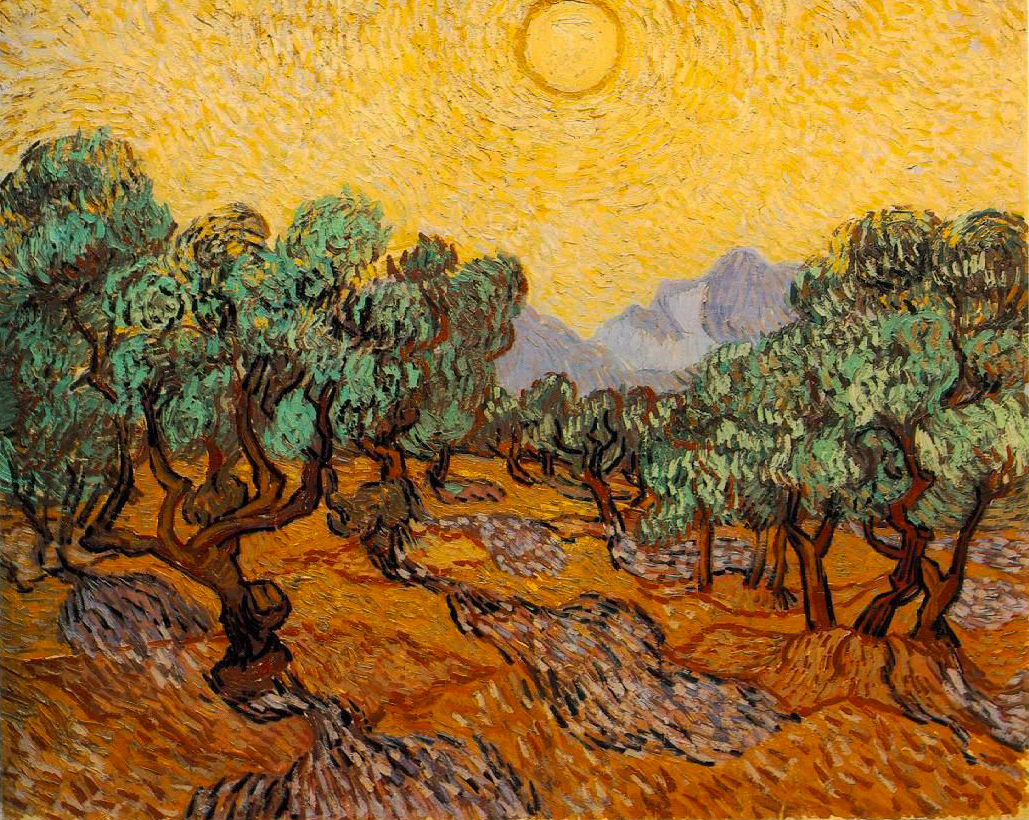
Thought a good way to kick off this week might be to share a few paintings from Vincent van Gogh along with a quote from one of his letters that speaks very much to my own feelings about my own reasons for doing what I do. These are not his better known paintings, though some of you may well know these pieces. They’re pieces that speak to my own personal inclinations. You might notice that most of these paintings have his ball sun/moon.

The idea of feeling a need to leave a memento behind that expresses one’s gratitude and one’s expression of self is one that is not foreign to me. I often think about how my work will speak for me after I am gone. Actually, if it will speak into the future at all and if so, will it be an honest reflection, a true representation of my voice.

I know that an artist, for all of the ways they try to guide the narrative about their work and life, have little control on the future.

What will be, will be.

Their voice might echo but it is always just that, an echo, a one-sided conversation from the past. Hopefully, what is said in that echo reverberates and speaks to someone of that future time so that they can fully understand and connect to the feeling behind it. And if so, with the hope that they might respond to that voice in some small way that continues to give life to it.

As I said, an artist has little control over this outside of doing their work with honest efforts and emotions. It’s obvious this was the case in the work of van Gogh and we continue to have a conversation with his echoes from the past, his mementos of gratitude.

Read Full Post »

***************************

To have a sacred place is an absolute necessity for anybody today. You must have a room or a certain hour of the day or so, where you do not know who your friends are, you don’t know what you owe anybody or what they owe you. This is a place where you can simply experience and bring forth what you are and what you might be.

–Joseph Campbell

***************************

I was thinking about my studio and how it shapes the work I do. It’s size sets some limitations on how large I can work and I sometimes wish I had twenty foot ceilings where I could do massive canvasses. But that mild complaint does little to take away from how wonderful a space it has been in which to work on a daily basis.

It is comfortable and warm with views that look out on a very private yard with mature trees, several huge rhododendrons and a constant parade of wildlife. It has room to work with a large, well appointed basement for framing and prepping my surfaces. One of the three bedrooms serves as a library and the other two hold paintings and papers. The stone fireplace that I face most of each day in my main space gives me an elemental, grounded feeling and the light that streams muted by the trees provides a coolness to play off the warmth of the space.

The seclusion it offers is all I could ask for. My large front window looks out on the driveway that curves gently in and whenever I see anyone coming in, it almost feels like an affront, like an invasion into my private world. A private world that is an extension of the internal one that provides the landscapes I paint. My studio complements that inner world so well, creating a sacred space for me to hopefully bring forth what I am and what I might be, as Joseph Campbell points out in the quote at the top.

It might be the one place on this earth where I feel completely at ease. Not always, but most of the time.

I thought I’d share a shot today of the studio, my sacred space, in all its cluttered glory. It has come to reflect me and I, it.

Read Full Post »

**********************

The real voyage of discovery consists not in seeking new landscapes, but in having new eyes.

Marcel Proust

**********************

This painting is titled To the Fields of Fortune. It’s one of those pieces that I to which I personally respond strongly. Maybe it’s the mood I feel from it or simply a chemical reaction to the juxtaposition of colors, forms and contrasts. Who really knows what truly causes a visceral reaction to art or music?

But the meaning that I attach to this painting has some influence on my reaction. I call these type of paintings my Acres of Diamonds pieces alluding to a story that I have replayed here a few times over the years. It is basically a tale of a farmer who sells his land and heads out, seeking to find his fortune in diamonds. He travels all over for years in his fuitle search, failing at each attempt until he ultimately takes his own life. Meanwhile, his original homestead turned out to be the location of the biggest diamond mine in Africa, where this story takes place.

What he sought was right beneath him all the time, if only he had taken the time to see what he had at hand.

And isn’t that too often the case with many of us? We believe that the grass is always greener elsewhere, making us think we need to seek far and wide when what we really need is with us, sometimes within us, all the time. As the author Marcel Proust states above, the real voyage of discovery comes in having new eyes to see what is already all around us.

There are diamonds waiting for us to simply bend down and pick them up, if only our eyes will see.

****************

This piece, along with a few other newer paintings, will be headed to the West End Gallery within the next few days.

Read Full Post »

*********************

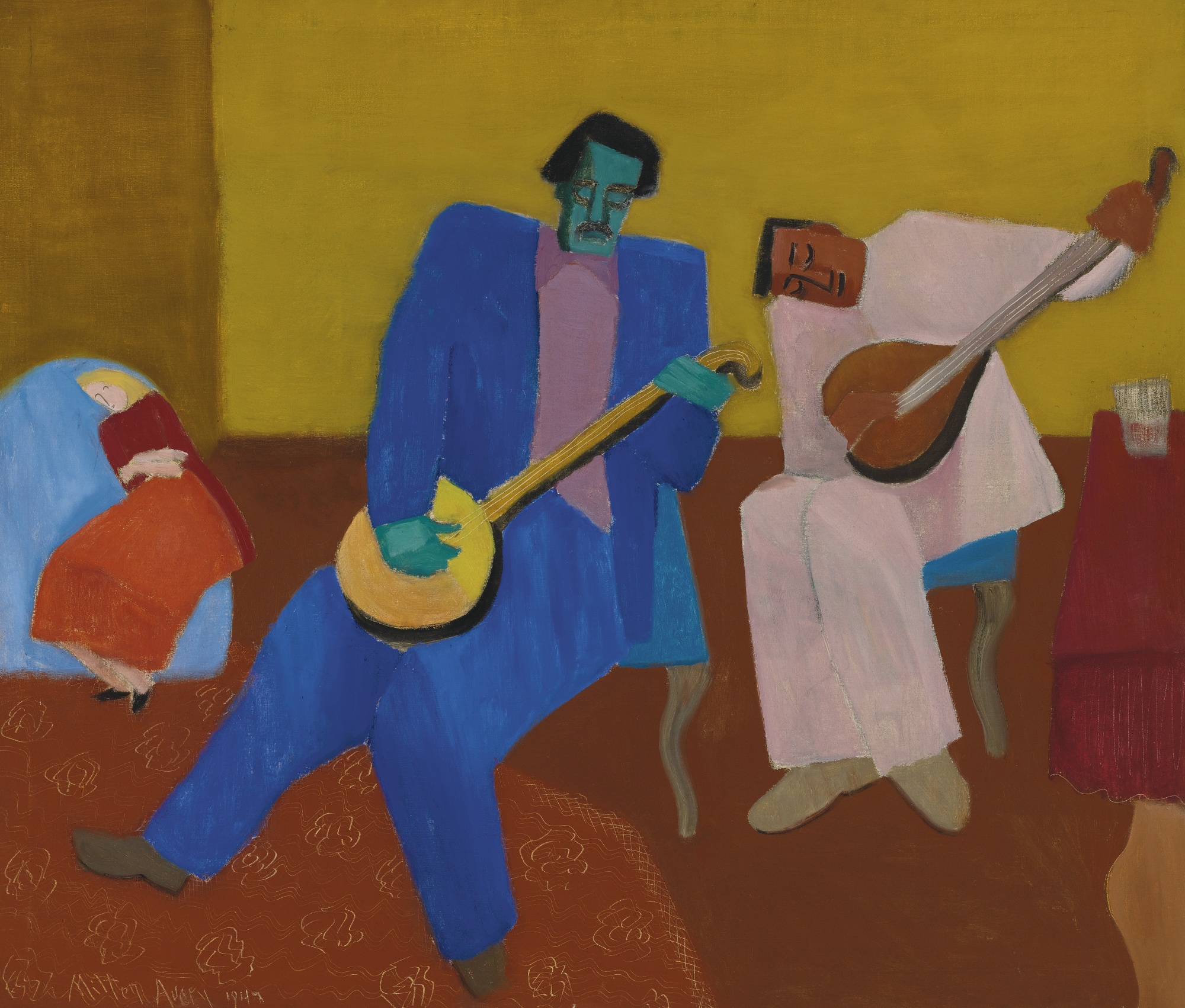
What was Avery’s repertoire? His living room, Central Park, his wife Sally, his daughter March, the beaches and mountains where they summered; cows, fish heads, the flight of birds; his friends and whatever world strayed through his studio: a domestic, unheroic cast. But from these there have been fashioned great canvases, that far from the casual and transitory implications of the subjects, have always a gripping lyricism, and often achieve the permanence and monumentality of Egypt.

Mark Rothko, 1965

*********************

While not a huge fan of the paintings of Milton Avery upon my first encounters with it, I find myself respecting and appreciating his work the more I look at and read about it.

Born in 1885, Avery worked blue-collar jobs into his thirties. He felt a desire to paint and began taking classes while still toiling as a laborer, working in obscurity for many years. He moved from pure representation of his subjects to an abstracted representation built on blocks of color and a flattening of the picture plane that became his signature style. His work eventually was recognized by a wealthy collector who set out to make it better known by distributing it among various American museums.

It worked and Avery became a leading light of the early abstract movement with his abstracted takes on representation and was considered a master colorist, sometimes referred to as the American Matisse. He died in 1965 at the age of 80.

I find that there are commonalities between us that give me a better sense of his work. First, there is his late entry in the world of art and a prior existence as a blue-collar worker. I certainly can relate to that.

Then there is his use of blocks of color, especially colors that seem radical for the subject. Looking at his work, I can easily relate to how he composed his paintings, how each block of color relates to those around it.

I also like the fact that Mark Rothko pointed out the lyricism of his work which refers to the fact that his painting, even when the subject matter seems most mundane, has high emotional notes that give it great weight beyond the subject matter. That lyric quality is something I desire in my own work.

I also like some of the writings from Avery especially one quote that rings true for me:

I try to construct a picture in which shapes, spaces, colors, form a set of unique relationships, independent of any subject matter. At the same time I try to capture and translate the excitement and emotion aroused in me by the impact with the original idea.

That is exactly what I trying to do– trying to capture the excitement and emotion aroused in me— each day in the studio. I think I often use those very words when talking about my work practices.

So, these common bonds allow me me to see Avery’s work in a better light. I find myself liking the consistency of his work, how he confidently used his native voice to express himself.

Respect is now there.

Read Full Post »

++++++++++++++++++++

There is an electric fire in human nature tending to purify – so that among these human creatures there is continually some birth of new heroism. The pity is that we must wonder at it, as we should at finding a pearl in rubbish.

–John Keats

++++++++++++++++++++

I find myself nodding in agreement with the above words from the poet John Keats. It seems that there is ample evidence that humans have the desire and capability for living heroic lives. Yet to do so is a rare and wondrous thing.

A pearl in rubbish, as he says.

Maybe our failure is that we only see heroism defined in epic terms, not in the bravery of the responsibility that comes in making everyday decisions that opt for doing what is right and not expedient or self-serving. Not every hero wears a cape or jumps from buildings.

It’s a matter of perspective.

I think of when my mother was dying from cancer many years ago now. In her final months, she had a picture next to her bed of my father in a small cheap frame with press-on letters on the bottom leg of it that spelled out the word hero.

Now, hero is not a term I have often equated with my father, a man who is deeply flawed in many ways. I confess that, in this aspect, the apple doesn’t fall from the tree.

But this was especially evident when it came to his relationship with my mother. Most of their life together was loud and contentious. They were always one word or a single side glance away from their next battle royale, the horror shows of mine and my siblings’ childhoods.

But somehow through the years of anger and adversity she still saw something in this man that she recognized as being heroic. Maybe it was that he had simply stayed, had maintained a sense of responsibility and caring for her that became very obvious in her last days.

I will never know for sure. The psychology of it all evades me. But that cheap frame on a dying woman’s bedside table with that word hero on it still lingers with me and always will.

It’s a matter of perspective.

I didn’t plan on writing this for today’s post, didn’t seek to be so personally biographical. It just came and I guess I can live with that. I only wanted to jot down a little something to introduce the song below for this Sunday morning music. It is one of my favorite David Bowie songs, Heroes, performed by the Ukulele Orchestra of Great Britain. I know it sounds like it should be a joke or a parody but it’s a wonderful version. I think my mom might well understand it.

Have a good day. Be a hero to somebody.


Read Full Post »

A number of artists, take Picasso and De Chirico for examples, talk about about trying to maintain the mind of a child in order to create art. I think there is definitely something to that.

I know that I feel best about my work when kids are attracted to it and know a work is at its best when a kid gives it their approval. They look at it without preconceptions and biases, judging it solely on how it speaks to them personally. They often can read the emotional tenor and meaning of the work without needing explanation of any sort. They seem to have a built-in ability to read the innate symbolism of art.

How to stay in that dreamlike state, that mind of a child? That is the real question and I don’t know that there is an answer. Maybe not trying to answer the question is part of the answer. Just do the work with the trust that you are being open and honest without condescending your message to anyone. Perhaps then the work may approach that goal, might speak with and to the mind of a child.

Or so I hope.

Read Full Post »

« Newer Posts - Older Posts »