Feeds:
Posts
Comments

Archive for the ‘Recent Paintings’ Category

Comforter

I’ve been dabbling on this painting for the past month or so, working on it for a while then setting it aside.  Taking some time before jumping ahead, lettting time give me a better view of where I was going here.  It’s a fairly large canvas at 30″ by 30″ and features the Red Chair that is the central figure of a number of my paintings.  I consider the chair an icon-like object that has meaning (or personification) for many people beyond its obvious nature as a mere chair.  For instance, for me it often signifies memory but others see it as a seat for past family members or as a place to sit and pause on their own journey in life.  It’s a subjective meaning and there is no right or wrong here.

As significant as the chair is here, the tree equally shares the role as the central figure in this piece.  I decided to make this tree a bit of an anomaly for my work– not a red tree.  The greens are not deep or opaque in color and allow the red oxide underpainting to shine through, giving it a reddish tint and creating depth in the foliage.  The tree forms a very bold figure in the middle distance, one that relates in some way to the Red Chair in the foreground.

How does it relate?  What is this piece saying? I’m still working on this myself.  It sometimes takes me longer to translate a piece than it does for someone who first sees it for a few moments in a gallery.  I can say that this piece has a very comforting feel for me.  Their is a warmth in the colors and the composition seems to  cradle the eye as it progresses into the picture along the rolling path.  The sky has a brightness and the darkness at its edges is not overly foreboding.  While there is a contemplative feel to the chair, it is not anxious but, rather, tranquil.  As I said, comforting.

I am still taking this painting in and this reading will evolve over time.  But for now, I’m happy to have it in sight to feel its calming effect.

Read Full Post »

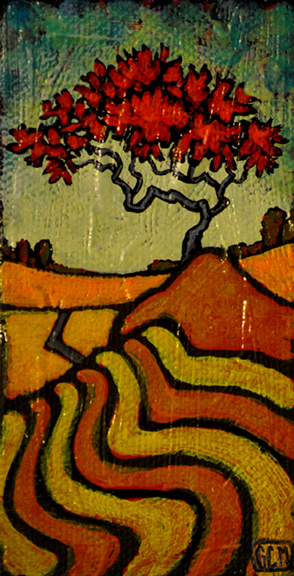
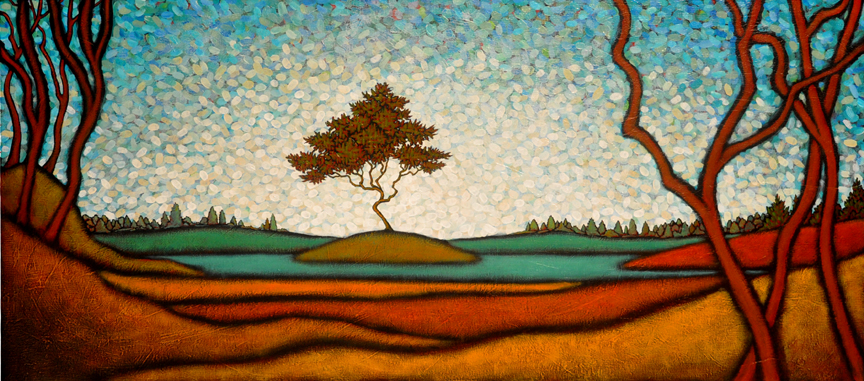
This is a new piece that I’ve been working on for the last week.  It’s fairly large at 30″ by 40″ and carries the size well, drawing my eye back to it on a regular basis from across the studio.  I am drawn to the rhythm of the landscape and the quiet of the central red tree against the action of the confetti-like sky.  It has a calming effect for me, one that centers my anxieties and slows me down a bit.  Applied patience in a turbulent world.

I’ve talked about this here before.  The purpose my work holds for me is to act as a  sort of pacifier, to create a world and landscape that takes me just a bit further from the reality of the world in which we actually live.  I consider this alternate landscape  a world based on reason.  At least, that’s how I see it.

I documented this piece in a series of photos as I was painting, snapping shots after small bits were done.  I am in the process of putting them together in a video similar to the one I posted last week, Growing a Painting.  This video would be more in depth and detail as far as the way the piece comes together.  I’ll post it when it is done. Hopefully, it will turn out well.  We’ll see…

Read Full Post »

I just finished a small group of tiny paintings for an annual show held at the West End Gallery in Corning, called Little Gems.  Held every February, it’s a show of miniature paintings from the gallery artists.  I’ve mentioned before that this show is a sentimental favorite of mine.  The first time I exhibited my work in public was at a Little Gems show in 1995, at a time when the idea of being a collected painter seemed awfully far away, if even imagined at all.  Most of the work I was creating at the time was small and pretty much fell in line with the theme of the show.  It was a turning point in my life, opening doors of new possibility to me.

Since that time, I have always held a special spot for this show for that reason and for the fact that it has original work, albeit small in size,  offered at very affordable prices, giving  people of modest means an opportunity to collect work  they might admire.  There’s something very egalitarian about it, far from the perception of the art gallery as an elitist institution.  And I like the idea  that art is for everyone.

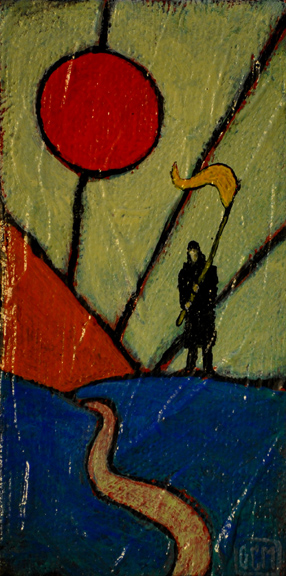
This is a group of tiny 2″ by 4″ canvas paintings that I frame in a slightly larger (just under 6″ by8″) shadow box frame that makes the piece seem a bit larger .  The petite canvas size creates a challenge and I like to include a few twists on my normal compositions, such as this piece to the right with the yellow flag and the divided sky.  But I often try to keep the work typical of my style and subject vocabulary.  This goes back to the thought in the last paragraph.  This might be the only piece of original art that is bought by the person who selects this painting and I would like to give them opportunity to have a piece that is obviously recognizable as my work.  That’s one of the reasons that I have always strived to paint these little pieces with all the effort and care that I use in much larger pieces.

This show, Little Gems, opens next Friday, February 4th, at the West End Gallery in Corning, NY.

Read Full Post »

I worked on a new piece the last couple of days, a large canvas that is  2′ by 4′ .  I had already gessoed the canvas with a distinct texture and applied a layer of black paint.  I had vague ideas of where I thought the painting might go from a composition standpoint but knew that this was only a starting point in my mind.  Like most of my paintings, the finished product is often drastically different than what I imagined at the beginning.  As I paint, each bit of paint dictates the next move and if I don’t try to force in something that goes against these subtle directions given to me by the paint the piece usually has an organic feel, a natural rhythm in the way the different elements go together.  A cohesion of sorts.

Knowing I wanted to use a cityscape in this piece, I started in the bottom left, slowly building the city with geometric forms and rooflines in a red oxide paint that I use to block in my composition.  I like the red oxide because ti gives a warmth under the layers paint to come that comes through in small bits that are almost undetectable at a quick glance. 

At this point I still am unsure where the painting is going.  I have thoughts of filling the canvas completely with the cityscape with the smallest view of the sky through the buildings but am not married to this idea.  The paint isn’t telling me enough yet to know.  But it has told me that I want a path of some sort- a street or canal- through the composition.   I make room for one near the center before starting on the right side with the buildings there.  I go back and forth between the right and left sides as I build the city, constantly stepping back to give it a good look from a distance to assess its progress and direction. 

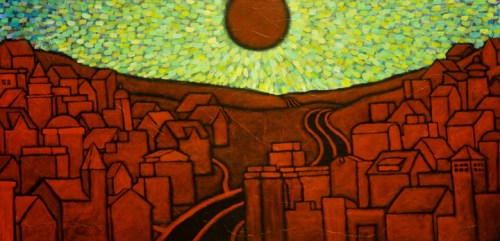
 At a point where the city is nearing the halfway point on filling the canvas, I decide I want this piece to be less about the cityscape and more about how it opens to the open sky beyond it.  I extend the road that started at the bottom and twist it upward, terminating it at a bend in what will be now a field beyond the city edge.  The sky, though still empty, is pushing me ahead, out of the city.  The piece has become about a sense of escape, taking the street from the cityscape and heading upward on it towards the open fields and sky.  Painting faster now, another field with a bit of the road appearing is finished beyond the first lower field.  I have created a cradle in the landscape for the sky to which I now turn my brush.

There’s a certain symetry at work here and I decide I want the central focus of a sun in this composition.  I roughly block in a round form, letting it break beyond the upper edge of the canvas.  I pay little attention to the size of this sun except in its relationship to the composition below it.  My suns and moons are often out of proportion to reality but it doesn’t matter to me so long as it translates properly in the context of the painting.  If  it works well,  it isn’t even noticed.

I finish blocking in the sky with the red oxide, radiating the strokes away from the sun,  and step back.  The piece has become to come alive for me and I can start to see where it is going.  The color is starting to fill in in my mind and I can see a final version there.  This is usually a very exciting time in the process for me, especially if a piece has a certain vitality.  I sense it here and am propelled forward now, quickly attacking the sky with many, many brushstrokes of mutiple colors. working from dark to light. 

There are layers of a violet color in different shades that are almost completely obscured by subsequent layers.  I could probably leave out these violet  layers but the tiny shards that do barely show add a great depth to the flavor of the painting for me and to leave them out would weaken the piece in a way. 

I ahve painted several hours on the sky now and still have a ways to go before it reaches where I see it in my mind.  There are no shortcuts now.  Just the process of getting to that final visualized point.  But it’s dinnertime and my day is now done.  I pick up and step back to give it one final look before I head out into the darkness.  This is where the painting is at this point, where I will start soon after I post this:
Read Full Post »

Patchwork

It’s the week after New Year’s and I’m still trying to get back into some kind of rhythm in the studio.  This week is filled with several distractions that keep me from fully investing mentally in the work and, as a result, I find myself working on smaller tasks that need to be done around the studio easily.  I keep putting off the full jump back into painting, avoiding the total immersion for a few more days.  This is not unusual for me at this time of the year and has become a behavior that I cultivate now for the effects it produces in the aftermath.

Normally, this extending of the time before I jump back in  is a very fertile time, with ideas and glimpses of where I want to take the work simmering at first , finally coming to a full boil when I ultimately make the move back to painting.  This stewing period often sets the tone for the next several months and I’ve learned that it’s better to just go with the flow during this time instead of worrying about not being at the easel.

Another result of this time is that I find myself mentally chaotic and unfocused until the time I am painting.  It’s probably evident in this blog.  But I wait patiently now for that moment when I’m back in full rhythm, a moment that bursts upon me without notice of any sort.  One moment I am feeling as I do now, unfocused and a bit anxious in my waiting, and the next I am back in full painting mode, mentally attached to the surface before me and clear in my thought process.

That is the patchwork of my days now.  By the way, the piece shown here is another little canvas, a 3″ by 5″, titled Patchwork Days.  It sort of represents for me the path ahead that I am trying to follow and the distractions that keep pulling at my attention, represented by the smaller field segments of differing colors.  This small piece has a very nice rhythm and feel.

Read Full Post »

The Wending

Every day is a journey, and the journey itself is home.

—Matsuo Basho


****************

I’ve been looking at this piece in the studio for the last several days.  Called The Wending, it’s a painting on paper that’s about 17″ square.  I always get the sense of it being painted on fabric when I glimpse at it.  I don’t know why.  In the color there is a mix of saturation and of a feel of fading, as though the color is slightly worn from use.  Like an old t-shirt that was once sharply bright in its color and over the years, through sun and sweat and repeated washings, has become a softer shade of its original self. 

Comfortable in its place.

And that’s how this piece makes me feel.  There is the sense of the journey yet it doesn’t feel alien or strange.  There is an absence of trepidation about moving ahead, as though, like the words of Basho above, the journey itelf is home.

It’s an immediate and comfortable sensation in this painting and I think most of it derives from this softened color.  The darkness under the color is even softened and less foreboding which adds to the ease of this piece.  It feels like a good path, a good journey.

All I ask of it.


Read Full Post »

It’s a new year, only a few hours fresh with no creases or dents or foul smells emanating.

 Yet.

Yeah, they’ll come soon enough but for the moment we can revel in the prospect of a new year and a new decade, clean and open to all potentialities.  Tabula rasaClean slate.

It’s a time for resolutions, promises to ourselves that we will head down the exemplary path from this moment onward.  I’ve never been big on resolutions, never felt that one can make wholesale changes to one’s behaviors or attitudes at one chosen moment in time.  If you can change now, you can change anytime.  Or so it seems.  The real matter is not the timing but whether there is the capacity for change.  And in my case, and in the cases of many others, I suspect, this capacity may be lacking.

I’ve come to a point in my life where I realize there are behaviors I possess that I would like to do away with or at least change.  But coming this far, I know I probably won’t do either.  These irritations of the character have become part of who I am and something in me conspires to keep them intact, much to my dismay as a younger man.  I hadn’t yet learned what I was and wasn’t in this world and was still saddened to learn that I often wasn’t what I thought I was.

But I have learned and set aside dismay for the most part.  I am as I am now.  For better or worse.

No resolutions will change that.

*******************************************

The piece at the top is titled Stratus Historum and is a small 3″ by 5″ canvas.  A little slice of time…

Read Full Post »

Now that we’re in December, I’m beginning to tie up the year’s work.  I’m tryiong to finish up a few obligations such as a couple of smaller commissioned pieces befor ebeginning to gear up for the coming new year.  I ‘ve been mulling over going ahead with some concepts that I’ve been pushing aside for years now and I’m getting pretty anxious to get at them. 

I have plans to doing a few larger paintings, including a couple that are very large.  I am also working on a series that relates to the Exiles series that I did back in the mid-1990’s, such as the piece shown here.  The newer pieces will not emulate this work as they were surely emotional products of that time in my life and, as such, cannot be simply replicated.  At least, I can’t do that.  So they will emerge with a different look and probably a different feel, which is exciting in itself.  One idea involves a large assemblage of small paintings in this theme.  I will reveal more as the work comes about.

This period of getting ready for the upcoming year is always exciting, for the most part.  I have had years where I struggled early on to find something to move me ahead, something that lit the fires under me.  Inevitably, the ignition came but it feels much better to start the year with a fire already ablaze.

There are also a couple of other things in the works that I will announce in the new few months that I am pretty excited about.  Hopefully, they will turn out as well as I hope.

And if not, we’ll make it work…

Read Full Post »

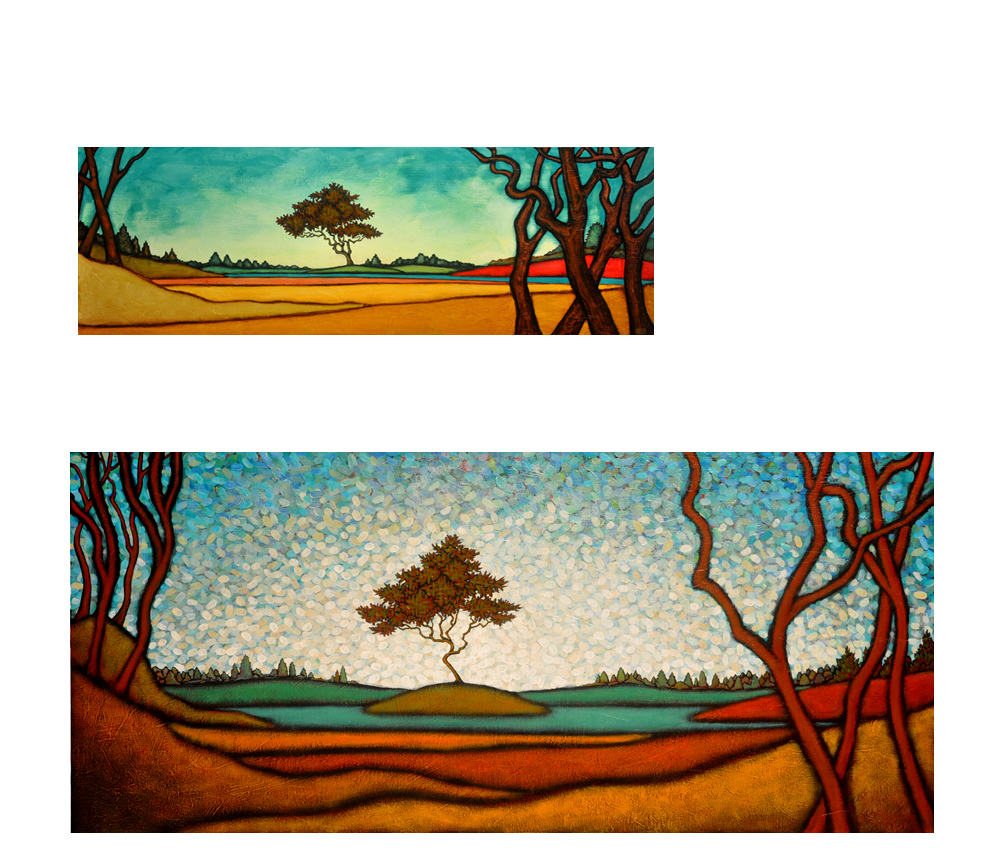
I recently finished a commissioned piece for a couple in NYC.  It was a little different and offered more challenges than many of my requested pieces. 

First,  it was a larger version of a smaller existing painting, Destination, which was a 12″ by 36″ canvas.  The requested piece is a 24″ by 54″ canvas.  So, while it is larger, it also has has a different ratio of height to width than the smaller painting, meaning it is less panoramic and changes the relationships of  all the elements in the painting to one another.

The second problem was that the original piece was painted in what I have referred to here as my reductive style.  It is a process that I use that places a lot of wet, liquid paint on a horizontal canvas (or paper) and takes away paint with brushes or rags until I have achieved the color and intensity I’m seeking.  I use transparent paints which allows the gessoed surface underneath to glow through.  

The other way I paint is an additive process.  By that I mean that paint is simply built up from the surface by adding stroke after stroke of paint, usually going from darker tones on the surface to lighter tones.  It is a more traditional method of painting.  My work tends to have a bit less refined appearance when I paint in this way as a result of generally using larger brushes and allowing the skies in my landscapes to be unblended color comprised of individual brushstrokes.  I also usually start these paintings with a layer of black paint over my normal gessoed surface.  This was the method that was requested for this new piece.

So, the request was for this smaller, more panoramic painting to be translated into a larger, somewhat boxier piece painted in a different method.  At first, I was skeptical that it could be achieved to either my satisfaction or their’s.  After a short bit of consternation, I decided to simply jump in and keep some of the elements the same and try to carry the tone of the colors through but let the painting take its own course.   I changed other elements and colors as I felt were needed in the context of the new painting.  For instance, the trees in the foreground are thinner and more expressive, as well as lighter in color.   I ended up with a piece that carries the influence of the original yet has become something of its own, complete with a different feel and attitude.  Just what I had hoped for when I started.  I was very pleased and, fortunately,  the folks who requested the painting were very happy as well. 

Here are how the two compare, when placed together in relative size.

Read Full Post »

I don’t normally show my paintings here with the framing, instead focusing on the image only.  But framing and presenting the work properly is a big deal.  A poor presentation can lessen the impact of a good piece, create a barrier that the viewer can’t get past.  A good presentation allows the work  to be seen in its best light, holding the piece  as though it were a gem and the frame was a fine setting.  You may notice it but the painting itself remains the focus.

I’ve had a certain look for many years now.  It’s a simple profile with a distinctive color that is built for me by a friend, Stephen.  For about the last 13 or so, he has provided me with sturdy raw frames built to my specs and I stain them to attain the color I desire which is normally a  warm yellowish tint with red undertones.  The edges are normally black. 

I tend to use the same frame for almost all my work.   It is simple and is immediately recognizable as my framing.  It also allows work from different years to hang easily together, giving them a sense of continuity and unity.  Plus, it allows me more time to paint by taking away the decision making process in choosing frames for individual pieces.  Early in my career, I learned that this process of choosing was very time consuming and wanted to come up with a way that took it away yet still gave me a distinctive and complementary frame.  Hence, the frame I’ve used for well over a decade came about.

But I still want to change things up periodically, if only to see my work in a different setting.  The piece above is a new one that I call Into the Mix which is a 10″ by 22″ image on paper.  It has a very distinct texture with raised ribs of gesso running chaotically through the background beneath the paint.  All in all, a very strong and individual piece. 

I really wanted to try something different with the presentation of this piece so I went with a frame that I’ve been experimenting with on a very limited basis.  This is only the third one of these I’ve produced.  It is a very simple flat frame with layers of gesso built up on top of it in the form of thin ribs, echoing those in the painting, then painted black.  The black gives the ribs visual depth and the gessoed ribs effectively cover the mitred corners, giving the frame a feel of unity and strength.  I like the look very much for certain pieces such as this, but don’t know if I will adapt it any way for wider use.  It’s just something I need to try to periodically see how the work looks in different settings.  Here, I think the new look works pretty well.

I’ll have to think on this…

Read Full Post »

« Newer Posts - Older Posts »