Feeds:
Posts
Comments

Archive for the ‘Technique/History’ Category

 In a post from a few days ago and several times before, I have mentioned the stained glass windows that came from the studio of Louis Comfort Tiffany in the early part of the 20th century.  They have been a large influence on my work over the years, from their use of complex color harmonies to the way they are composed using simplified forms and strong lines which divide and define the panels.  I never try to imitate any one piece or even have them in mind when working, but I often find myself comparing my work, after it is completed, to them as far as color and composition are concerned.  Often, the paintings that satisfy me the most have an opalescent quality in their color with each color having elements of several colors combining to create a depth of harrmony in the piece, if done well enough.

The panel shown here is a good example.  It is a panel of magnolias that resides at the First Unitarian Congregational Church in Brooklyn, NY.  This is a little darker and contrasted than the image of this window that the church uses on an available  notecard but , for our purposes, this works well.  It shows distinctly the many colors that make up the distant sky– the multiple blues, yellows and pinks which combine masterfully.  In other hands, such a melange could come off as shrill and sharp.  Even cheesy.  But here it has a glowing harmony.

The beautiful silhouettes of the magnolias that cut the sky are graceful  and delicate yet powerful as they climb across the ocean of color behind.  The whites of the flowers are multi-colored with only hints of actual white.  The landscape that runs to the distanet has greens and blues and purples running through them as they provide a deep counterpoint that only enhances the depth of the sky.

Just beautiful.

So, when I mention the windows of Tiffany, you’ll hopefully have a better idea of what I mean.  We’re very lucky that Tiffany Studios was tremendously prolific and that many of these windows still are preserved for our viewing pleasure.  I am always enthralled when I come across one and never turn away feeling less than inspired.  It is that feeling that I hope most carries through in my own work.
Read Full Post »

In the past year or so,  I have done a series of paintings where I took out much of the color in my work, leaving behind sometimes monochromatic renderings of my compositions.  But recently I have swung back to the deeper, richer colors that has long marked my work.  I think this new painting is a good example of this return to color.

I call this piece Discovery’s Door and it’s a 15″ by 25″ painting on paper.  The Red Tree here is again the central figure and holds a position that feels like it is in a spotlight as its image emerges into sight from behind the darker trees that frame it.  It’s this emergence that gives me the discovery in the title as well as the bright light that seems to be illuminating the tree.  A light of epiphany, self-discovery.

The colors here are very strong but there is a harmony between them that makes their impact seem softer and natural.  I don’t think this will come through in this image on a computer screen but the blues and greens of the sky and the water have an opalescence that brings to mind a favorite color of mine from the windows of Louis Comfort Tiffany.  It gives this piece  a bit of the feel of a stained glass panel, something I often hear from people who see my work for the first time.  I definitely see that here.

I also think the intensity of the color here enhances the sense of self-discovery implied in the title.  As though the realization of one’s true self suddenly makes everything near seem more vivid and alive, forcing their way into the memory of the moment, creating a sensory marker. I know that I often remember major moments of my own life either  in deep colors or in strong scents.  That is what I see here in this image of a moment of self-realization– the vividness of the moment.

Read Full Post »

I think I’ve mentioned here that there is some of my early work where my documentation is a bit sketchy.  There is a handful of pieces of which I have no images, which bothers me a bit now.  The rest of the work from that time is from iffy slides, photos and simple photocopies where the work was small enough to fit on a copier bed.  I was trying to organize some of these old images recently and came across one of those photocopies.

It was the piece shown here. This was a 7″ by 9″ image on paper.   I’m still trying to locate it’s title which is a bit embarassing for me, mainly because this painting rekindles so many memories when I see it.  I remember distinctly how this piece came about.  I had been looking at a framing magazine ( this was a time when I was still uncertain of how I would present my work and hadn’t settled on my own framing which I’ve used for about 14 years now) and came across an ad featuring a painting that caught my eye.

I don’t remember who painted that particular painting but it didn’t really matter.  The painting itself did nothing for me.  I wasn’t crazy about the color or tone of the image.  I wasn’t interested in its texture of atmosphere or all of the detail that painter had used in the fields and trees.  But the composition screamed out at me and in my mind I was immediately transforming the composition into my own work, with my own simple forms and lines.  We’re talking a matter of seconds here.

It was like the composition was merely a sculptural armature, a framework underneath, that served as a foundation but could be transformed on its surface.  While I used the armature of that painting in the magazine, it would be hard to see the similarities between my piece and that original image.  That tranformation and how quickly it happened in my mind always remains in my memory, permanently attached to this painting.  I felt like I was really finding my own voice in that moment, where I could synthesize influences in a very distinct  individual manner. 

I wish I could see this piece again in person, to see if it holds that same feeling for me.  To see how the person who owns it now sees it and to let them know how strongly it remains in my own memory.

Read Full Post »

Whenever I take up a newspaper, I seem to see Ghosts gliding between the lines. There must be Ghosts all the country over, as thick as the sand of the sea…. We are, one and all, so pitifully afraid of the light.

Henrik Ibsen, Ghosts

Another newer painting, this one on paper and measuring about 9″ high by 26″ wide.  I call this piece The Ghost in Memory, using the Red Chair here as an icon for memory, both personal and collective.   Although the Red Chair can have many differing  interpretations for many people, I often see it  as a symbol for memory personally, seeing in it people, places and events from my past . 

Stylisyically, this painting bridges the gap between some of my recent monochromatic work and my typical pieces filled with color.  The sepia pall that hangs over the scene gives it a feel of ghostly nostalgia that was unintended during the painting of it.  There is a waviness in the wash of color that creates vague amorphous shapes that seem to be making their way to the horizon as though being coaxed forward by the hazy light of the sun.  The blue of the trees in the foreground that create a frame for the scene contrast sharply as though marking the boundary between a world that we see and one which is hidden from us.  The Red Chair straddles both of these worlds here.

This is a very simply composed piece with a spare color palette yet it has, for me, a nice depth of feeling and meaning.  It wastes nothing and all of the elements contribute to the overall atmosphere in it.  Though the color is subdued, it still dictates the emotion of the piece.  The sepia gives it an eerie feel yet still has a warmth in it that makes it still inviting.

As to what the actual meaning is here, I leave that up to the viewer to decipher on their own.  Is it about ghosts?  I can’t say except to say that I believe that ghosts exist mainly in our own minds and memories.  That is where most of us are haunted.


Read Full Post »

I recently finished this new painting, an 18″ by 26″ piece on paper, that is the newest addition to my Archaeology series.  Titled Archaeology: Rainbow’s End,  this painting features the subterranean debris field that marks this series including some of the recurring icons that show up in most,  or at least many, of the pieces in this series.  There’s a shoe, a peace symbol, a red chair, a self-referential painting and a mask, amon many other little bits and pieces.

I don’t know if there’s something in my psychology that is at risk here , some flaw that I’ve managed to hide from the world that might be exposed in this field of trash.  If so, I guess that’s risk I’m willing to make.  I really like the feel of this group and the way it creates a rhtymic pattern in the underground that feels like faded wallpaper in an old house, which is pretty fitting.  There’s a sense of the nostalgic here perhaps enhanced by the warmth of the sky above, aglow in reds and gold.

The Rainbow’s End part of the title comes from the colors of the strata above the artifacts.  Whenver I loooked at this piece that immediately struck me and I began to think of this as the rainbow painting over the long time that I worked on this piece.  I worked on this in bits and pieces for several months, never quite wanting to finish this particular painting.  Even now, after it is done and headed out to what will certainly be a new home, I have regrets about finishing it, as though it represents a personal piece.  Maybe there is something in that trash heap that I haven’t recognized yet.  I don’t know.

Maybe this hesitation to let a piece like this go is the reason I do so few of the Archaeology paintings lately.  As well as the longer time it takes to finsih these paintings, there also does seem to be a different type of mental investment in these pieces.  Like pouring out all the detritus that has accumulated in my mind over time for all the world to see.  There is less control in this than in the painting of a landscape, at least in how the pieces are read by the viewer. 

Maybe that’s it.  Again, I don’t know.  I never do.  So, I keep painting in the hope that I will find something that finally does let me know.  Maybe there’s something in this debris that I’ve missed.  I better look again…

Read Full Post »

A Shift

Sometimes my own view of a piece will shift over time.  Sometimes I might see something in the work that was not the focus of my attention when I was painting, something that gives me deeper appreciation of the piece.  Or it might work in the reverse, where I lose sight of that thing in the work that once was my focus in it and the work seems to resonate less with me.  I suppose this little painting, only about 5″ by 8″ on paper,  shown here falls in that first category.

This piece seemed to be a struggle from the outset.  The colors never fully went where I thought they should and the whole thing just never seemed to sing for me throughout the process.  The sky took on a murky shade and I worked at scrubbing away as much as I could but it was one of those situation where the atmospheric conditions and the gesso underneath  made the paint grip tighter in the creases and folds . 

 It just seemed blah.  I did this piece earlier in the year back in June and set it aside, next to a group of pieces that still need work or are in the same category as this painting.  I would look at it every so often and feel dismayed because it should work for me but it just didn’t have that crisp color with the depth that I try to find in most of my work.

 But over time, a shift in how I viewed this piece began.  Maybe the distance in time from the struggle of creating it  had allowed me to just look at it as a piece without the  memory of the process affecting my reaction.  I began to see the rubbed out sky not as failure of paint but as an interesting texture, kind of like a rough woodcut underneath the paint.  Each time I picked it, I did so with more and more affection, seeing it for what it was rather than what I hoped it might have been once in my mind.  It was a different version of my normal melody, my normal song.  Instead of being tainted by other versions, I now let this piece sing in its own voice. 

And I liked it.  The shift was complete.

It makes me wonder how many other things we view with a perspective tainted by our expectations and never allow that which we view to show itself for what it really is.  I know that I have often failed to go beyond my own biases and expectations and have probably missed the true nature of many things.  Therein lies the lesson…

Read Full Post »

I have mentioned here that my work will be the subject of an exhibition at the Fenimore Art Museum in Cooperstown , NY next year, running from August 17 through December 31, 2012.  I had not been at the museum for many, many years so last week Cheri and I decided to pay a visit to both see the space where the exhibit will be hung and to see the museum as a whole.

I haven’t been to Cooperrstown in quite a while but from the moment I enter this little gem of a village I remember how much I like the place.  I’ve used the word idyllic several times recently here but must use it again to describe the atmosphere of this village built around the southern end of Lake Otsego, the lake famously referred to as Glimmerglass by James Fenimore Cooper, a name that now graces the renowned seasonal operatic company that resides there, the Glimmerglass Opera.  It is just a lovely  place especially in the quieter days of late autumn when the tourist trade is a bit slower and the beauty of the place shines through. 

Turning by the grand Otesaga Hotel, you head north up the west side of Lake Otsego and come quickly to the museum, resting on a slight rise above the lake.  The museum was built on the former site of the James Fenimore Cooper farmhouse and across the road is the famed Farmer’s Museum with its beautiful stone barns and outbuildings. 

I can’t really tell you how impressed I was with the museum, from the moment I entered the front doors  until the moment we drove away.  It is a truly beautiful space that is maintained to the highest standards.  We met with with Paul D’Ambrosio who we have known for many years and who is the President of the museum.  He gave us a tour through the galleries, giving us an education on many of the pieces.  For instance, the piece shown to the right, Eel Spearing at Setauket from William Sidney Mount, is considered the painting which serves as the face of the Fenimore Collection.  We were told that the lady in the painting from 1845 still has family that lives near the site of this painting on Long Island and that they periodically make the pilgrimage to the museum to visit their now famous ancestor.

After seeing most of the collections, including the  fabulous Thaw Collection of American Indian Art, we finally made our way to the galleries on the second floor and came to the East Gallery, where next year’s exhibit will be held.  I was a bit nervous with anticipation, to tell the truth.  But finally seeing the space and visualizing my paintings in the space helped settle my nerves.  The space is neither small nor large but has a sense of intimacy that I think will serve my work well.  There is a fireplace at one end that I could see my work easily hanging above.  The anxiousness of the unknown faded away and the actual idea of how the show might look began to take its place.  I now had sometihing tangible on which  to build the show.  A different sort of anxiety set in but it is the kind I often have before any show so I view it as an old friend who will ultimately help me in my task.

We talked for a bit about wall colors for the show which I hadn’t even considered.  I began considering colors that will push the work forward off the walls and accentuate the color in my work.  As we were leaving, Paul told me that my show would ne hanging at a great time next year as the show  hanging at that time in the other upstairs gallery would be an exhibit of American Impressionism featuring Mary Cassatt.   They would have a Monet, as well, to show his influence on the American painters.  He said there would be great crowds in the late summer for that show and would be great exposure for my exhibit.

So, we departed and I drove through the rain of that day with new concepts of how the work in the exhibit would relate to the space and to each other.  I began to have second thoughts about some pieces that I had originally thought might be perfect and paintings that I had dismissed began to come back into play.  The visit and the tremendous quality of the space and the works there raised the bar for what I wanted from my own work.  The task now seemed larger than before and I knew that I would have to really focus in order to make it work as I know it can.

In short, it was a good visit.  Thanks for the wonderful tour, Paul!

Read Full Post »

Big Foot Stomp

Singing and Mending-- Robert Gwathmey

I was looking through a book containing many of the works of the painter Robert Gwathmey when I came across an image that reminded me of a small piece that I had painted several years back.  Gwathmey’s painting was titled Singing and Mending and featured, like many of  his paintings, a depiction of  African-American life from the rural South.  This piece had a man in overalls playing a guitar while a woman mended a piece of clothing. It was the man playing the guitar that caught my eye.

Perhaps it was the overalls or the position of the guitar or the bare feet but all I could think of was a similarity in its nature to a small painting that I had painted a few years ago and which now hung on my sister’s wall.  It is a little oddity that I always look at with interest whenever I go to her place. 

 I call it Big Foot Stomp.

It was an experimental piece, a revisiting of another earlier foray in paint when I was just starting  years before.  I can’t quite recall what my initial intentions were with this piece. I remember that I laid down the splattered background with spray bottles of paint, masking the lighter center with a piece of matboard as I did the darker outer edge.  But I don’t think I ever had this figure in  mind when I began to paint in that center.

But I’m glad that he came out in this way.  I recall painting the head first, just laying down a silhouette of paint then trying to make something from it.  I remember liking the way the dark paint seemed to pop from the lighter background, making me think this was a black man.  The rest is hazy in my memory except for a slip in my brushstrokes that affected the size of his feet and for the decsion to leave out  the parts of his clothing that would normally be visible.  For me, these two elements really make this little guy special. 

There’s something about the white space where his clothing  would be that brings a spiritual element to this piece for me, as though his playing and the rhythm of his large feet on the floor are taking him to a place beyond the here and now.  I think the way he rests in the splattered background enhances this.

I’ve never painted another piece like this.  Maybe he was just meant to be one of a kind.  He certainly feels that way.  But at least in the Gwathmey piece I have found a spiritual relative to this lone guitar player.

Read Full Post »

Just a small piece on paper that I recently finished that I call Impassionata for what I think are obvious reasons.  It seems a bit darker on my computer screen at the moment than it does on the easel where I photograph so  it may require a new shot but for the present time this image will have to do.

This is a simple painting, one that is typical of my work.  There’s a nice combination of elements in this painting that make it feel deeper than its composition including a sense of depth into the picture even though there is nothing in the background to give perspective.  Perhaps it’s the gradation of the colors in the sky or the contrast between the deep red of the foreground and the bright yellow edge of the lit horizon.  To tell you the truth, I don’t really know myself.  The same composition with just a tweak here and there in color and texture would feel much different.

It’s a funny thing how a piece whose subject is so similar to many other pieces in  my body of work can still excite me.  I’ve often said that the subject matter really isn’t the focus of my work, that the passion for me comes from the color, form and texture.  The subject is merely a hand  extended outward to others to invite them in.   Many people may only focus on the subject before they realize they are really responding to these other elements that I mention. 

Well, at least that’s one theory.  It may change before the morning ends.  I reserve the right to contradict myself.  As Whitman wrote:  Do I contradict myself?  Very well, then I contradict myself, I am large, I contain multitudes.

Read Full Post »

Seeking Rhythm

This is a new piece, a small painting about 7″ by 11″ on paper.  I still have no name for it.  I’ve been spending the last several days trying to refind my normal painting rhythm.  I use the term rhythm quite often in describing what I do and always struggle when trying to descrribe exactly what I mean when using it.  But this time it means the actual ebb and flow of the act of painting, the tempo of the creative process as an idea forms and takes shape before me on the surface. I normally fall easily into a pattern where one action of painting inspires another and so on, almost self-perpuating.  Color begets color and line begets line, each sparking a new idea, a new thought.  It’s a rhythm that I have depended on for most of the time I have painted.

When I’m away from painting as I have been lately, doing needed projects around the home and studio, I fall out of this rhythm.  I can tell during the day, an uneasy knot forming in my gut.  This rhythmic pattern has become vital to my well-being  and when it’s disrupted, I get antsy and out of sorts.  Usually, I am back into it within a day or two with little loss of momentum and this unease fades quickly into the paint and routine.  Some times, as is the case at the moment, it becomes more of a struggle to regain that rhythm, to find that groove in which to take hold.  Nothing starts nor finishes easily.  Color doesn’t sing on the surface, laying there with an uninspired flatness.  Lines are listless and forms dull.  One piece does not inspire the next.  In fact, it brings dread to the next piece.

 I find myself trashing piece after piece,  something I seldom do.  I normally can find something that I want to keep in a piece even if it is only for the lesson learned from its deficiencies.  But these failures seem dismal and dull.  Their very existence bothers me and they go in the trash.

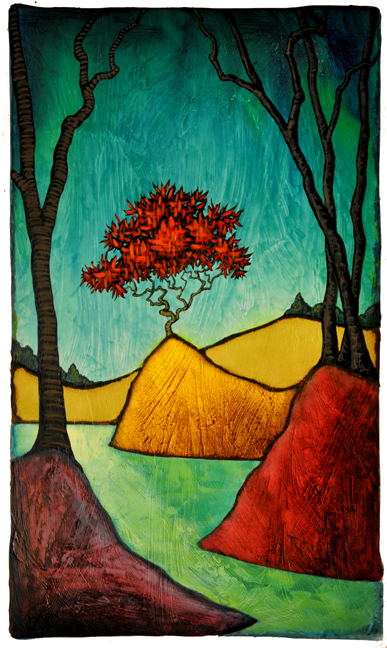
But time has taught me not to panic when I am struggling to find footing.  I became more determined and go back to basics, working on small blocks of color, trying to find life and visual excitement in each little block.  At first, even this was a chore, like slogging in ankle deep creative mud.  But eventually, something broke loose and I find myself finding a stirring of life in the colors and forms and soon I am excited by what I am seeing.  The next move has been inspired and soon my mind is filled with possibilities and potentialities for several new pieces.  Rhythm seems almost at hand and the knot in my gut begins to subside, my mind settling into a familiar hum.  Like that red tree in the image above, looking out over its domain and feeling that, for the time being, all is right with that world.


Read Full Post »

« Newer Posts - Older Posts »