Feeds:
Posts
Comments

Archive for the ‘Technique/History’ Category

I’ve been exhibiting at the West End Gallery for over 15 years now and have benefitted in many ways. It was the first place I showed and sold my first piece of work. It was the first place my work was showcased. It was the place that first gave me hope of doing what I love as a career and has served as a jumping off point to other galleries.  So many other things as well. But perhaps the greatest benefit may have been what I have gained from observing the work of the other artists there over the years.

I’ve talked here and in my own blog of how artists from the Corning area such as Mark Reep, Marty Poole and Dave Higgins,  have shaped how I work and how I see my own work. Another such artist is Treacy Ziegler who has shown her collagraphs and, more recently, her paintings at the West End for many years now.

From the moment I saw Treacy’s work many years ago, I was intrigued. I instantly recognized that she was doing with her work what I wanted and didn’t have in my work at the time. Her prints had great areas of dark and light contrast and even in the lightest sections, a sense of darkness was always present which gave every piece real weight. Her bold colors and striking contrasts gave even the simplest compositions a deeper feeling.

They were also immediately identifiable as Treacy’s work. You could see a piece from across the street and you knew whose work it was. She has a very idiosyncratic visual vocabulary and her shapes and forms react beautifully with one another in the techniques she uses in producing her work.

At the time, my own work was still very transparent and very much watercolor based. With Treacy’s work in mind I started adding layers of darkness in my own way. Simplifying form. Enhancing contrast and color. All the time searching for my own vocabulary, my own look.

I’ve always maintained that artists are often more like synthesizers than creators. They absorb multiple influences and take what they see in these influences, merging them together to create something that is completely different than the original. Sometimes not even reminiscent of the influencing work.  For me, the West End has always been a great source for ideas and concepts to absorb. It may be in a certain brushstroke or the way a painting’s composition comes together or just in being exposed to a certain artist’s body of work for a long period of time. Whatever the case, I always find something in the work there that sparks new ideas within me.

And that has been a great benefit…

Read Full Post »

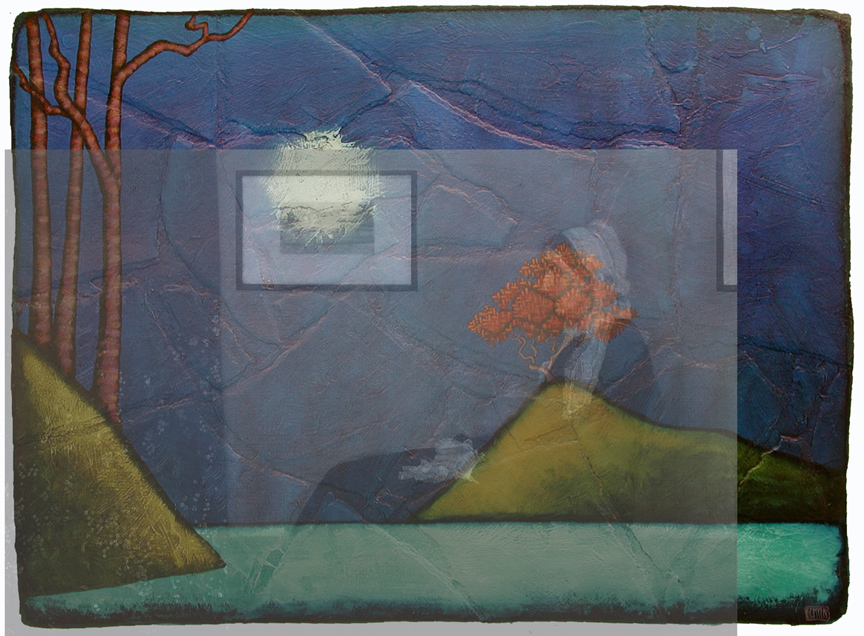
Yesterday I wrote about how I have often used in my own work the composition from the James McNeil Whistler painting popularly known as Whistler’s Mother.  I did so without illustrating the point so I thought I’d take quick moment to show how I might block in my own work with Whisyler’s composition.

Going into my archives, one of the first things I look at is a painting from a few years back, The Way of Light.  At first glimpse, this piece has nothing in common with the Whsitler piece.  First, it is not portraiture ( although I often view my trees as such) and it is a landscape.  It is obviously a different palette of color than that of Whistler and the elements are rendered in a less realistic fashion than you would see in Whistler’s work.

But if you put those differences aside and quickly take in the shape and form of each piece, you can begin to see the similarity.  The line of trees on the small mound of land in my piece take the place of Whistler’s dark curtain on the far left.  The water in mine becomes the floor of his. The body of his mother is replaced by my island and her head becomes my red tree.  The framed print is now my moon.

Here, I overlaid my piece with the Whistler piece to further illustrate the point.  Obviously, there are worlds of differences separating the two pieces, as I pointed out above.  But the composition and use of blocking and light help us each achieve a sense of mood that is the primary goal in both cases.  Like Whistler, I am often more concerned with the mood and emotion of a piece of work than the actual subject matter.  In this pursuit I have come to view much of my work as Whistler did his, as musical compositions rather than merely representative images.

In color and shape there is rhythm, tempo and tone.  The placement of the compositional elements of a piece are much like the placement of individual notes in music, each affecting and reacting with those around it.  All trying to evoke feeling, response.

Well, there’s my illustration of how Whsitler’s iconic piece fits in with what I try to do with my work.  Hope you can now see the connection…

Read Full Post »

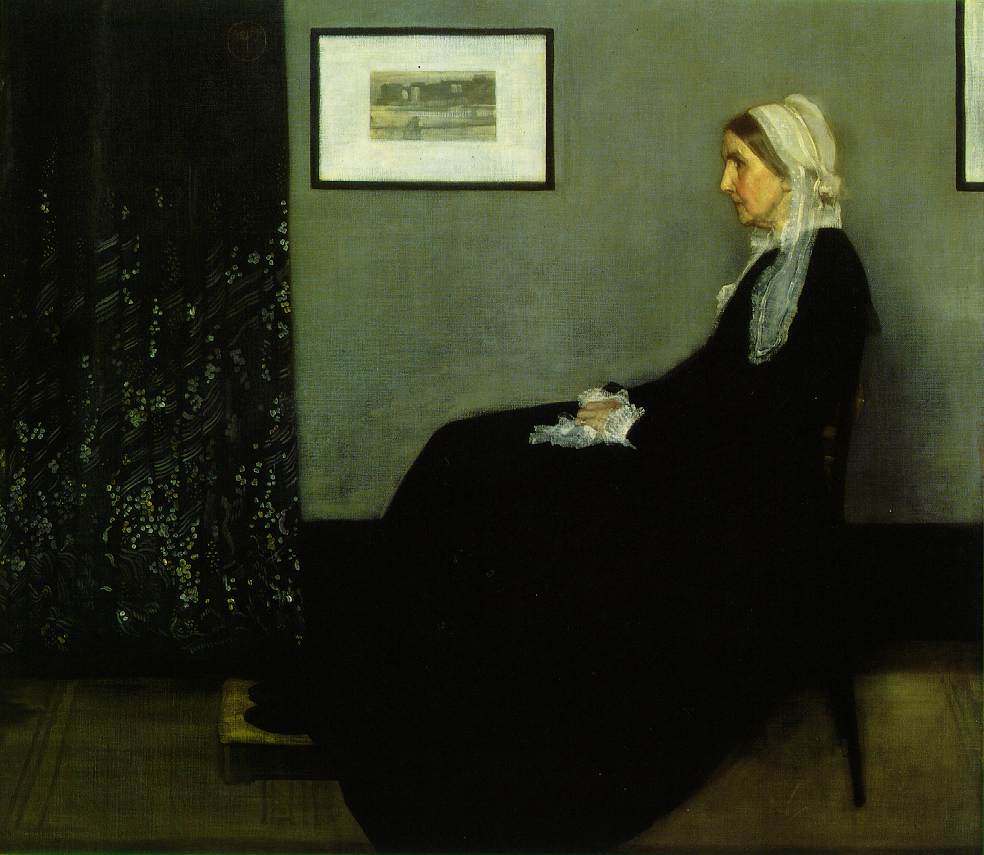
This is James McNeil Whistler’s most famous piece, Arrangement in Grey and Black, No. 1:  Portrait of the Painter’s Mother.  It is, of course, better known as Whistler’s Mother.  It was a painting that I was casually familiar with as I grew up but it wasn’t until I looked more closely at it after I had started painting that I saw the brilliance of it’s composition.

Whistler always asserted that the painting was not about his mother but was more concerned with creating mood with color and composition, which the primary focus of almost all his work. This piece achieves it’s mood with beautiful diagonal lines formed by the woman’s form and contrasting verticals and horizontals that create great visual tension and energy.  The stark whiteness of the matted print on the wall behind shines like a full moon against the pale blue-gray sky that is the wall itself.  The head of the old woman seems to be almost lit by the light from the moon/print.

This is not a portrait of an old woman.  It’s a nocturnal landscape.  That’s what I saw when I looked at it as a painter trying to glean what I could from it for my own use.  This was a composition that had a geometry that just felt so right immediately.  It had such a sense of perfection in the way color and form combine with sheer simplicity that I knew I would have to use it for myself.

And I have, quite a few times over the years since I first really looked at it, sometimes with slight variations in the placement of the elements but still basically with the same compositional base.  And inevitably, they are pieces that great immediacy in their impact, pieces that carry great mood whatever their subject matter.

And for that I thank you, Mr. Whistler…

Read Full Post »

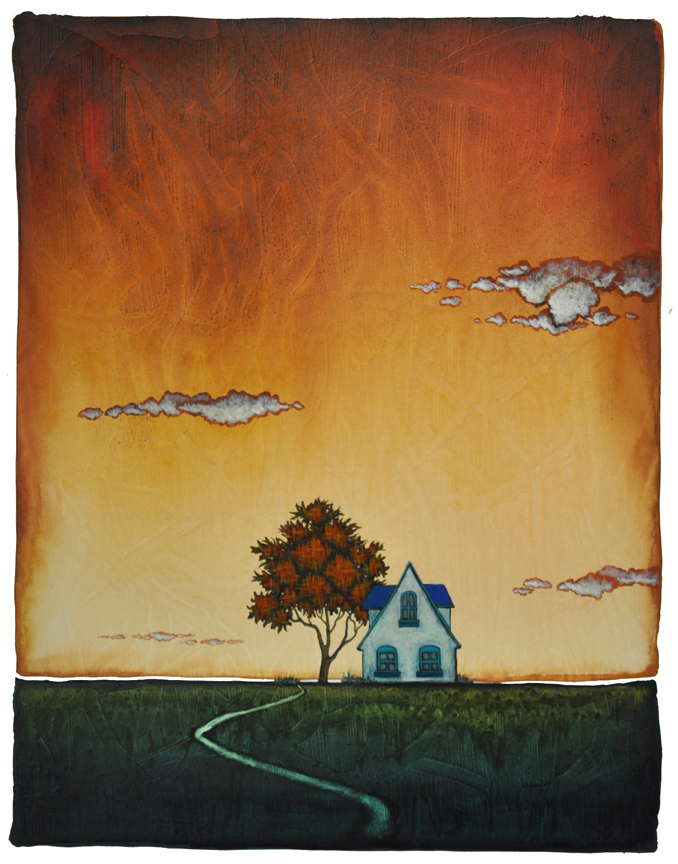
This  is a new painting that I’ve just finished, tentatively called As Clouds Roll By.  It’s a 14″ by 18″ image painted on ragboard.  It’s a composition that I have visited on a number of occasions, this time at the request of a collector in Pennsylvania, and one that I always get great pleasure from painting.

Even though this is a very simple composition with few elements, the great satisfaction I feel after finishing a piece such as this is something I can’t fully explain.  Perhaps it’s the recognition of the things in this piece that fully jibe with what I want from my own paintings.  The simplicity of design. The quietude of vast open space.  The depth into the picture, even though it is a very simple composition.  The inviting warmth of the house and tree.  The languorous fashion in which the clouds roll by, in a way representing the slow and inevitable march of time.

It clicks a lot of my own buttons.

The clouds in this piece always take me back to the first time I painted clouds in that looked like these.  I was not yet a full-time painter and had obtained a large commisiion that would prove to be very important to me.  I was on a short deadline and was still painting in the dining area of our home at the time with large sheets of paper spread over folding tables.  I was working on a large triptych and was nearly finished when our late cat, Tinker, decided to explore the tables.  Bounding up, she stepped first in a damp part of my palette and ran across the three sheets, leaving perfect little paw prints in a watery blue tint in her wake.  As the echoes of my bellow faded, my mind raced as I looked at my now very unfinished work.

Start over?  No time.  Try to blend them in to the background?  Not with this particular style of painting.  I sat and looked, concentrating.  Wait a minute.  The prints only ran across the sky portion of all the sheets.  And they ran in lovely diagonal manner.

Quickly, I was at it with paint and within several minutes I had blocked in clouds where once there were paw prints.  It worked.  Tinker’s run across the sky fit the rhythm of the piece and the clouds actually gave a fullness to the composition that it had lacked.  It was actually quite an improvement.

So when I see clouds such as these, I always flash back to my initial panic and the subsequent discovery of good fortune in this happy accident.  Since that day, when what seems to be a disatrous event happens with one of my paintings I step back with a much calmer mind and eye with the knowledge that perhaps this is just a new opportunity to see things a new way.

Read Full Post »

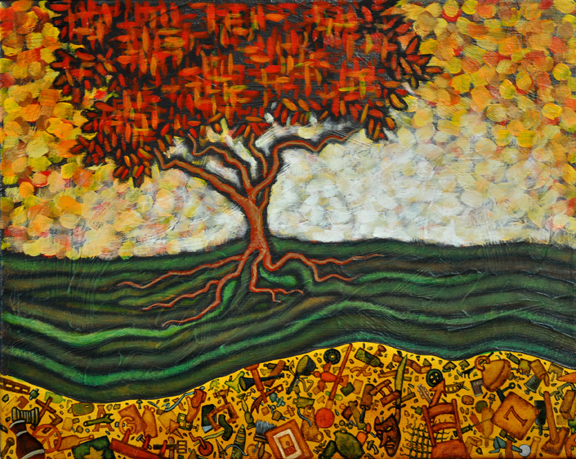
This is a new painting I’ve been working on for the last couple of days.  It’s a 14″ by 18′” piece on ragboard and fits well in my Archaeology series.  The upper and lower sections of this piece are painted in two different styles, with the upper being painted by adding layers of paint ( what I call my obsessionist style) and the lower painted in a predominately transparent fashion but with quite a bit of opaque touches.

Shown at the top, I wanted to show the lower section of this piece in a little more detail, to give a better idea of how this section is put together.  It’s  a chance for me to paint spontaneously, but in detail.  I  start at one corner and bounce all over the section, basically using my brush to draw the small items.  As I’m moving along, I’m constantlly weighing each new artifact against those around it then against the section as whole.  This weighing process has to do with color and shape, not what the item actually is.  I don’t really think about what the items will be in these pieces.  I prefer to let them take shape as the piece progresses although I do fall back on a number of recurring artifacts.  Some of these are the peace symbol, my initial, a shoe, a mask of some sort, books and a few others.  This particular piece also has a self-reference in the form of a small painting.

This is only the second piece in this series that has the upper section painted in this way,  showing the simplified  roots of the tree and having the sky painted with multiple layers of rough strokes.  So far I am liking the contrast between the top and bottom.  I may lighten the foliage of the tree and adjust a few parts of the sky but I’m not sure yet.  This is at a point where it requires a little time to sit and be taken in, almost with a peripheral view.  With paintings like this, with a lot of detail and action in the color and forms, I find that I need to see it but not focus on it completely to get the best overall feel for it.  That’s the real test.

So, with this piece, we’ll see over the next several days in the studio.

Read Full Post »

I’m in the middle of a piece at this moment so I’m going to be brief this morning.  Actually, I’m at two different points in two different paintings and am pretty eager to get to them.  Sometimes it’s difficult for me to go back and forth between pieces.  My focus sometimes gets broken in the transition from one to the other and both pieces suffer.  But this time there seems to be a seamless shift between the works and I’m actually taking energy from one piece and plugging it into the next. 

Wish I had four arms.  And eyes that worked independent of one another like some tropical fish looking for moray eels…

My selection for this winter Wednesday is from the late Warren Zevon, a wonderfully talented songwriter/performer best known for his Werewolves of London.  Actually, it sort of yoked him and overshadowed his abilities as a composer of unique and often beautiful songs.  Here’s one of my favorites, Mohammed’s Radio,  from way back in the day.  1976, I think.  Give a listen…

Read Full Post »

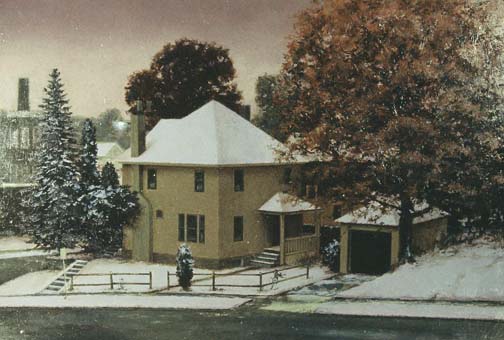
This is the view of a house that Dave Higgins, one of my favorite painters,  used to see from his bedroom as a child growing up in Binghamton.  This scene and that yellow house made quite an impression because over the years Dave has painted this particular house over a hundred times.

I mention this today to illustrate a point about how artists will often paint in series or repetitively, often using the same compositional elements again and again.  For some painters, it might become an exercise in copying each detail so that eventually the very life is squeezed out of the scene  but in the hands of a talented artist with a truly probing mind such as Dave, it becomes a study in finding nuance and dimensions that make each new version take on a new and different life.

Painting repetitively allows a painter to free their mind from trying to compose and focus on pure execution, letting them spend more of their mental effort on the surfaces they’re creating.  The less time spent on capturing the basic form of the subject  results in a scene that changes subtly with new version, revealing more depth and feeling.

Think of it as musician with a new song.  The first several times through they are focused on learning the basic construction of the composition but it’s not until it becomes ingrained in their muscle memory and they can play the composition with little thought that they are free to find and express real feeling within the piece.

This bottom piece is an early version from Dave and you can see how Dave has evolved over  the years by examining the ones above this.  He paints the scene from memory and adds and subtracts small elements to fit each new piece.  Whatever is needed to fulfill what he sees in that new version, to give the depth he’s seeking in it.  If you’ve been fortunate enough to see some of the Yellow House paintings from Dave Higgins over the years, you’ll know what I mean.

Great stuff…

Read Full Post »

It’s a Saturday morning and I feel like I’m starting slowly to reach a rhythm with my recent painting where it’s just coming easily, not feeling forced.  This rhythm, this feeling lets me know I’m going in a direction that is desirable to me.  It’s a feeling that, like many things, that is hard to put in definable or measurable terms. 

It’s just a feeling.

For me, when the everpresent knot in my stomach fades away as I’m working I know I’m in the vicinity.  It used to bother me when the knot would return and I seemed a bit out of rhythm in my work, as though it might never return.  But through the years I have come to know that by simply pushing forward, working hard to the point that all the extraneous distractions melt away, this rhythm will return.  In fact, it never leaves.  It just gets pushed aside at times.

Anyway, let’s have a little music on this fine Saturday.  Here’s Bob Dylan’s Thunder on the Mountain.  Enjoy…

Read Full Post »

This is a new painting from the studio that I finished yesterday.  It’s a 16″ by 20″ canvas that combines, for the first time, the elements of the Archaeology series with the painting style that I call obsessionist.  The difference is visible when comparing the finer, more detailed work in the detritus of the Archaeology section at the painting’s bottom with the way the tree and sky above are painted, with more expressive, visible brushstrokes.

Also for the first time, I show the roots of the tree above.  I had been thinking of doing this in the past and many people had inquired but I didn’t want to do it unless it maintained the rhythm of the piece for me.  I don’t know how to explain how I judge this rhythm.  It’s just a matter of looking at the piece and determining whether a sense of rightness exists.  Do the elements flow easily together?  Is there anything that makes the eye stop because of something, a line for instance,  feeling unnatural?  Just intuition, I guess.  So far, I like the roots showing and feel they maintain the rhythm of this painting but I’m still taking in the piece.

It’s the time of the year when I can hold a piece for a while and soak it in, let it live in the periphery of my vision for weeks.  This gives me a better sense of the piece’s cohesiveness.  Sometimes a painting will feel complete and ready but, with a little time to let it be, reveals a need for something more.  It may be a major change such as the addition of a whole new compositional element or just a tweak in a small bit of color in a small section of the painting.

It will be interesting to see what this piece reveals over the next few weeks…

Read Full Post »

This is a short film that I put together one day last week.  It was a little project that I took on at the request of my friends at Lovetts Gallery in Tulsa, OK.  They, like many galleries around the country, have taken a hard look at how they interact with their clients and are making a real effort to provide more information about the artists they represent in their gallery.  To this end they are putting together a multimedia website that will give their clients a better look at the work and thoughts of their artists.

They asked that I provide them with some film of me working in the studio with some dialogue.  It was pretty difficult deciding what I wanted to say in the film.  I wanted to give an idea of what I see in my work and to tell a little of how I came to painting but I didn’t want to say too much.  Wanted the paintings to be the focus.

As I was putting it together and I was inserting narration a theme came around.  About the idea of finding one’s home.  It’s a concept that I’ve been seeing a lot in my work as of late and one that I think can be applied to most of the work through the years.  I think it fits.

The music is from the great acoustic guitarist Martin Simpson, a longtime favorite.  I had the chance to take lessons from him many years ago when he resided in Ithaca for a while, after coming to the States from England.  Carried the little classified ad from the Ithaca Times around in my wallet for the longest time but, like so many things in life, never got around to doing it.  I’m not big on regrets but I do wish I’d taken that opportunity.

Anyway, this is the film that I came up with.  I hope it works in some way…

To see the film in higher quality please click here to go the YouTube page.

Read Full Post »

« Newer Posts - Older Posts »